Single-Signal Career FOMO: Testing the Pivot Before the Leap

Single-Signal Career FOMO at 11:40 p.m.
I knew the pattern as soon as I met Maya (name changed for privacy): one "you would be good at this" message had sent her from a LinkedIn headline edit to a course checkout before midnight. She was 29, working in customer success at a Toronto software company, and her stable role no longer felt like a convincing future.
On our video call, Maya angled her laptop toward me. Blue-white light washed over four open tabs: a user-research programme checkout, a rewritten LinkedIn headline, a resignation budget in CAD, and the message from a senior researcher who had said, "I could imagine you succeeding in this field." The radiator clicked behind her. She lifted a forgotten mug, tasted the cold tea, and put it down while her right leg kept bouncing beneath the kitchen table.
"I know one encouraging response isn't the whole market," she said. "So why am I already planning the exit? If I slow down, I might lose the momentum."
I could see the core conflict in her shoulders, which had climbed almost to her ears: she wanted to honour a promising career signal, but every pause felt like watching a train leave while she stood on the platform. That anxious urgency had become a physical current, buzzing through her knees and pushing her fingers toward one more tab. This was single-signal career FOMO: hope on the surface, with fear of professional scarcity supplying the speed.
"I don't think we need to extinguish your excitement," I told her. "We need to find out what it can genuinely carry. Let's make a map of the fog before you ask yourself to sprint through it."

Choosing the Four-Layer Insight Ladder
I asked Maya to place both feet on the floor and take one unforced breath while I shuffled. I use that small pause as a change of focus, not as a mystical performance: it gives the nervous system a moment to stop answering before the question has been fully heard.
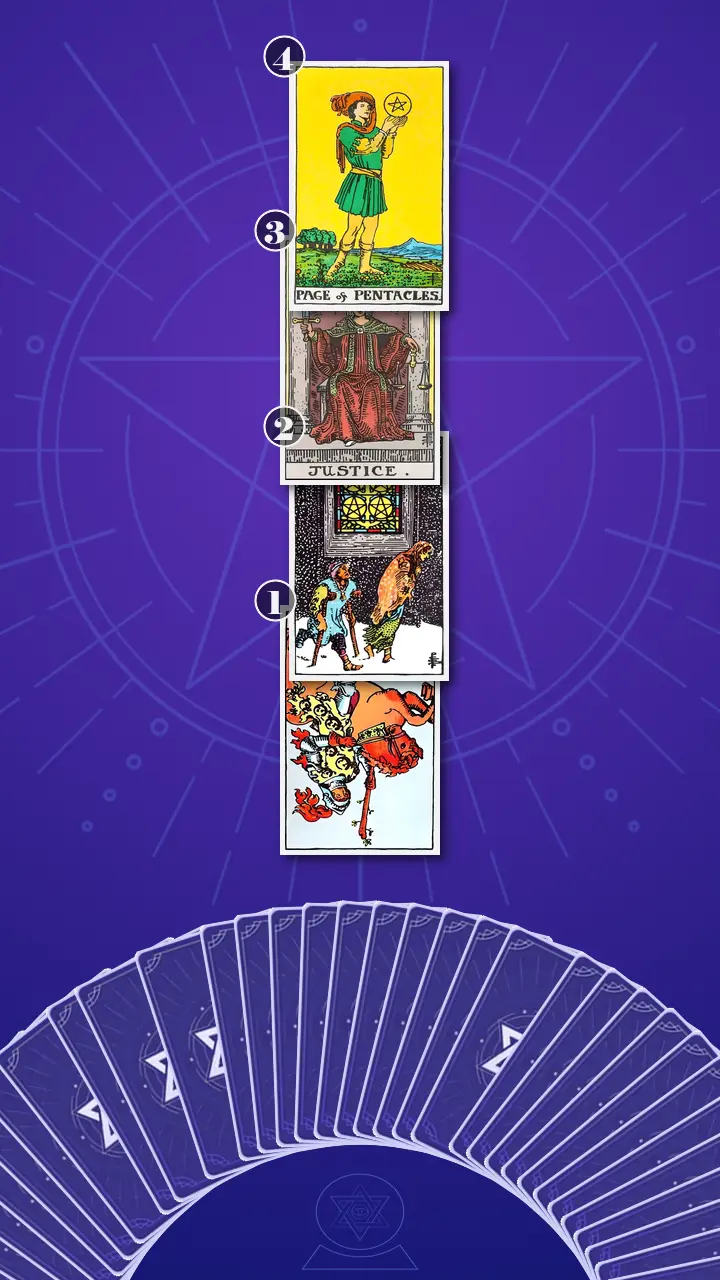
I chose the Four-Layer Insight Ladder, a four-card career-pivot reflection spread. Maya's question looked like a decision between customer success and user research, but the more useful question was why one favourable signal had triggered disproportionate acceleration. A comparison spread would have weighed two careers before examining the pressure distorting the comparison.
I arranged the cards vertically like a fire escape climbed one deliberate rung at a time. The first position would show the visible acceleration. The second would uncover the scarcity fear beneath it. The third would identify the perspective capable of restoring proportion. The fourth would turn that insight into a reversible experiment. The spread was not going to predict Maya's career; it was going to help her evaluate it.
Reading the Lower Rungs
Position 1: The Movement That Wasn't Yet Direction
I turned the first card for the observable acceleration pattern that began when Maya treated one encouraging career signal as sufficient reason to reorganise her pivot. The card was the Knight of Wands, in reversed position.
I pointed to the rearing horse beneath a rider whose wand was already aimed forward. Reversed, the Knight's fire showed excess speed alongside blocked direction. Maya had turned one enthusiastic conversation into same-night LinkedIn edits, course comparisons, job-board searches, networking plans, and a resignation budget. Her body was moving before her evidence standard existed.
"The choice here isn't action or passivity," I said. "It's whether your actions produce new evidence or create commitments that pressure future evidence to agree with you. Right now the loop sounds like: 'If I close the checkout, the opening might disappear, so I'll do one more thing to feel certain.'"
Maya gave a short, bitter laugh, then pressed her fingertips against the cold mug. "That's so accurate it feels slightly brutal."
"Accurate doesn't mean indicting," I replied. "The Knight also shows real energy. We're only giving that energy a route."
Position 2: The Only Warm Window
I turned the second card for the underlying scarcity fear that made slowing down feel equivalent to losing professional safety. It was the Five of Pentacles, upright.
I showed Maya the two figures crossing snow beneath an illuminated pentacle window. Here, earth was experienced as deficiency: not necessarily actual ruin, but the felt absence of secure ground. Maya was rereading one senior researcher's encouragement as the only warm entrance out of a stale professional identity. Toronto rent, a role she could tolerate but no longer inhabit, and polished LinkedIn career announcements made that entrance look singular.
"What if this is the only person who will ever see this in me?" I asked, offering the sentence rather than assigning it to her.
Her breath lengthened. Her thumb stopped circling the mug. "Yes," she said quietly. "The message felt less like feedback and more like rescue."
I told her that the card did not predict exclusion or loss. It revealed a narrowed field of vision: one emotionally vivid opening had become easier to see than the wider set of routes, supports, and unanswered questions around it.
When Justice Gave the Signal Its Proper Weight
Position 3: The Pause That Became an Active Choice
I turned the third card for the key shift from confirmation-driven urgency to fair evidence weighting, clear criteria, and proportionate judgement. Justice appeared upright. At that moment, the radiator stopped clicking, and the room seemed to borrow the card's symmetry.
The scales represented balance; the vertical sword represented a decision rule Maya could state clearly. This was balanced energy, not an outside authority issuing a career verdict. I asked her to picture one uncluttered Google Sheet with three fixed checks: repeated demand, fit with the actual work, and practical feasibility. Supportive, neutral, and contradictory findings would all remain visible.
I brought in my Career Cycle Phase Identification lens, which separates a personal skill or fit question from an industry-wide macro cycle. The senior researcher's response offered meaningful evidence about Maya's transferable potential. It offered no evidence, by itself, about repeated hiring demand, the daily texture of the work, or whether the current market could support her preferred timeline. One bright point in the sky can deserve attention without defining the orbit around it.
I asked Maya to look again at the four glowing tabs. Her leg was bouncing because closing any one of them felt like losing the opening. The course, headline, budget, and message had fused into one apparent instruction: move now, or remain stranded.
One bright signal is not a verdict; let repeated evidence earn its weight as Justice's scales balance what excites you against what the facts can support.
I let the sentence settle. Maya's breath stopped first; her fingers hovered above the trackpad as if an unfinished click were waiting there. Then her gaze slipped past the screen, and I could see her replaying the week: the saved success stories, the salary searches, the question about job dissatisfaction that she had deleted from a networking message. Her brow tightened and her eyes shone before her shoulders released by a fraction.
"But doesn't that mean I was wrong this whole time?" she asked, the words sharper than anything she had said before.
"No," I said. "It means you found a real possibility and asked it to provide certainty too soon. Revising the weight of evidence isn't failure. It is evidence-based self-trust."
Her jaw unclenched. She exhaled with a small tremor, then sat very still, almost disoriented by the responsibility clarity returned to her. She no longer had a deadline disguised as a sign, but she did have a choice.
"Now, with this new perspective, think back to last week. Was there a moment when this insight could have changed how you felt?" I asked.
"At the Ossington cafe," she said. "I deleted the question about what people dislike about user research. I didn't want the answer to complicate the story."
I nodded. That recognition marked the first movement from anxious, confirmation-driven acceleration toward grounded curiosity. Maya did not have to dismiss the signal. She only had to stop asking it to prove more than it had proved.
Position 4: One Piece of the Work in Her Hands
I turned the fourth card for the practical integration of that new perspective: a reversible experiment testing repeatability, work fit, and feasibility before larger commitment. The Page of Pentacles appeared upright.
The Page studied one pentacle with both hands while standing on cultivated ground. Unlike the rushing Knight, this figure stayed still long enough to learn. The card's healthy earth energy gave Maya a modest container: one beginner-sized user-research exercise, two independent practitioner conversations, and an honest look at training costs and her required financial buffer.
"I can become a beginner for one afternoon without declaring a new identity," Maya said, testing the sentence aloud.
Her palms opened on the table. The next honest step could be a field test, not a new identity. She could take the possibility seriously without making the leap irreversible.
Evidence Before Exit
I read the ladder back to Maya as one connected story. A validating conversation had lit the Knight's fire, but that speed was being fuelled by the Five's fear that no other professional shelter would appear. Justice separated potential from proof, and the Page returned opportunity to her hands as something she could test. Her blind spot had been equating visible productivity with evidence and treating a pause as lost access. The transformation was simpler and more demanding: give one signal exactly one signal's worth of weight, then let larger commitments earn support through repeated evidence.
I translated the reading into two next steps:
- Run the 30-Day Micro-Orbit Observation. Before the next job-board session, spend ten minutes creating a signal log with the source, exact wording, supportive/neutral/contradictory classification, repeated demand, actual-work fit, and practical feasibility. For 30 days, add a row after each meaningful conversation or market observation. I call repeated openings, budgeted roles, and independently confirmed fit signals "blueshifts"; I call hiring freezes, persistent fit concerns, and financial strain "redshifts." Neither is a prophecy. Both are observable movement. Start with only the original message and write what it supports and what it does not establish. Review the pattern for 15 minutes each week without moving the criteria.
- Complete a Page-Level Field Test. Within seven days, choose one low-stakes product question, spend 30 minutes drafting five interview questions, conduct one 20-minute practice interview with a consenting friend, and spend ten minutes grouping the notes into three observations. Record what felt engaging, draining, difficult, or unexpectedly satisfying. Then book two separate practitioner calls and ask the same questions about daily tasks, entry routes, difficult aspects, and current hiring demand. Keep the exercise deliberately beginner-sized and use no sensitive data. If one hour is too much, draft the five questions and review one public research case study.

A Week Later, the Quiet Proof
A week later, I received a message from Maya. She had removed her saved payment method from the course checkout, completed the practice interview, and scheduled two practitioner conversations. She enjoyed asking follow-up questions more than she expected and found note synthesis more tiring than the career-change videos had suggested. Mixed evidence had not ruined the possibility; it had made the possibility real.
She also wrote that she had slept through the night. Her first thought in the morning was still, "What if I wait too long?" This time, she smiled, added the thought to her signal log, and made coffee before opening LinkedIn.
I saw the Journey to Clarity complete its first orbit there. The Four-Layer Insight Ladder had guided us from visible rushing to scarcity fear, proportionate evaluation, and a reversible experiment. The cards had not chosen Maya's career. Maya had used them to recover the standards, pace, and agency with which she could choose for herself.
If one hopeful message makes your knees buzz and your shoulders climb toward your ears, I want you to remember that pausing can feel as though it risks more than an opportunity. It can feel as though it risks the only proof that your working life could become safer. Simply noticing that extra weight means you are no longer letting it operate unseen.
If that bright signal were allowed to rest on Justice's scales as a question instead of a deadline, what Page-sized piece of reality would you place in your own hands this week?