Therapist-Friend Burnout: Three Links, Then a Fifteen-Minute Limit

The 11:48 p.m. Cost of Being the Therapist Friend
If your phone stays beside your plate, laptop, and bed because someone might need you, the pressure may not be generosity alone. Sometimes it is the fear that being less available will make you less relevant.
Maya, a 27-year-old product marketing coordinator in Toronto, joined my video call at 11:48 on a Tuesday night. She was sitting on the edge of her bed with WhatsApp open. I could hear her radiator clicking through the microphone, and the blue-white screen light made her tired eyes look almost silver. Her phone had grown hot in her palm. Her jaw was locked.
Below a friend’s “Can I vent?” message, Maya had drafted a three-step plan, three links, and a suggested script for a difficult conversation. Above that draft sat Maya’s own unanswered update from earlier in the day.
“I know she didn’t ask for a plan,” Maya told me. “But I can see exactly what she needs to do.”
Then she looked away from the screen and added, more quietly, “If I stop being the reliable one, I’m not sure what’s left.”
I heard the core contradiction immediately. Maya wanted to be chosen for her ordinary presence, but making herself indispensable felt safer than waiting to discover whether her friends would choose her without a crisis to solve. The fear beneath her ribs seemed less like a passing thought and more like a service alarm strapped to her chest, ready to sound whenever a message went unanswered.
“I’m not going to tell you to care less,” I said. “Your care is real. I want us to understand why it has started feeling like a job you can never clock out of. Let’s make a map of the fog, then find one place where you can put your own feet back on the ground.”

Choosing the Compass: A Relationship Spread for Unequal Emotional Labor
I asked Maya to place her phone face down and take one slow breath before we began. I shuffled while she held one question in mind: “What keeps me playing therapist so my friends will still need me?” The pause was not a mystical performance. It was a deliberate transition from reacting to observing.
I chose a classic five-card Relationship Spread. For anyone wondering how tarot works in a situation like therapist-friend burnout, I use the cards as a structured diagnostic tool, not a prediction about which friendships will survive. This spread separates Maya’s behavior from her friends’ participation, then reveals the belief holding the pattern together, the principle that can rebalance it, and the next behavior she can test.
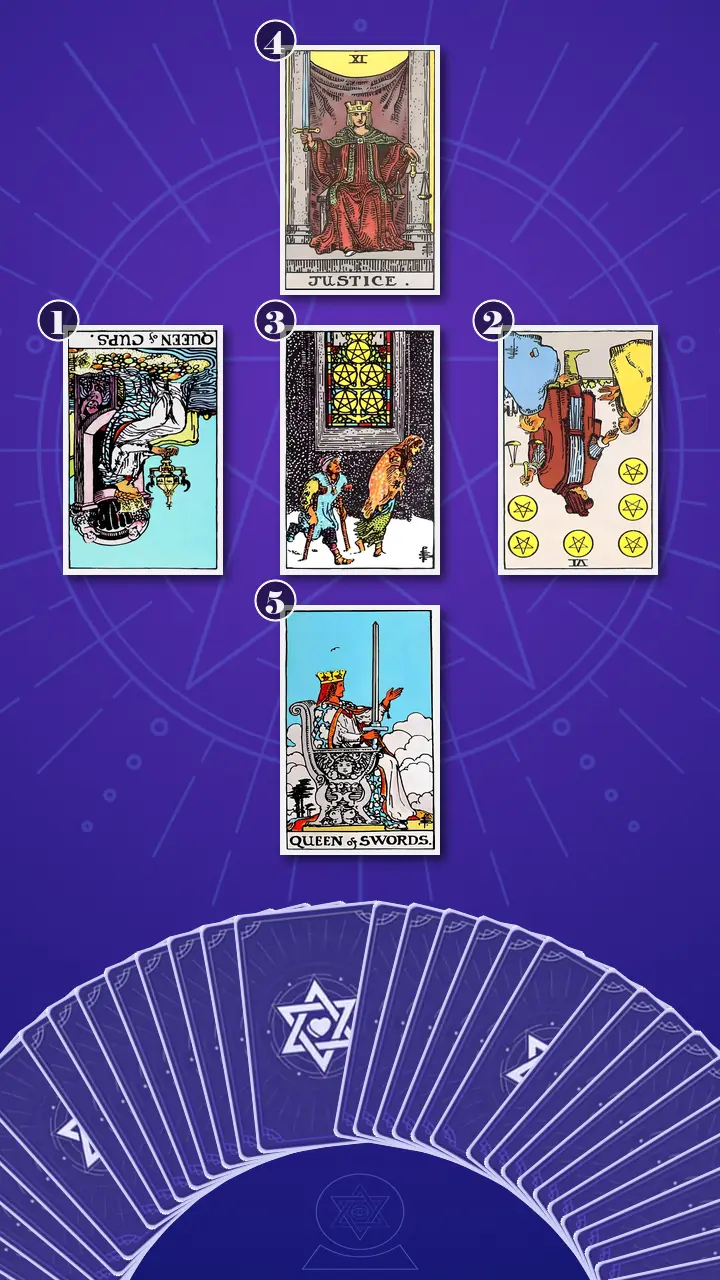
I arranged the cards in a cross. The first card, on the left, would show Maya’s observable therapist role. The second, on the right, would show how her friends and the established social pattern respond to her overfunctioning. The center would uncover the fear beneath the arrangement. Above it, the fourth card would identify the central relational lesson. Below it, the fifth would turn that lesson into language Maya could use in an actual conversation.
The layout resembled scales crossed by a plumb line. The horizontal line would show how one-sided emotional labor was maintained. The vertical line would show how to move from hidden scarcity through fair assessment and into grounded action.
“These cards are not going to decide who deserves blame,” I told her. “They are going to help us separate evidence from fear, support from ownership, and care from the need to prove your place.”
The Sealed Cup and the Unsent Truth
Position 1: Queen of Cups Reversed, the Caregiver Who Cannot Clock Out
I turned the first card. “Now the card I am turning over represents your observable role in these friendships: monitoring emotions, supplying solutions, and treating helpfulness as your main way of preserving closeness. It is the Queen of Cups, reversed.”
The Queen held an ornate, closed chalice in both hands and stared at it with absolute concentration. The open sea remained beside her, but her attention never moved beyond the sealed container.
I returned Maya to the scene that had brought her to me. At 11:48 p.m., she was studying her friend’s messages as if one perfect emotional interpretation could secure the friendship. She was checking whether her response sounded warm enough, building a plan that had not been requested, and keeping her own disappointment sealed because expressing it might interrupt her role as the composed helper.
“The Queen’s Water is blocked here,” I explained. “Your empathy is genuine, but it has become over-absorption. Instead of simply noticing your friend’s emotion, you begin monitoring whether you have responded well enough to remain valuable.”
I gave the pattern the sentence I could hear underneath it: “If I understand this perfectly, respond quickly, and stay available, then I will still matter.”
Maya let out a brief, bitter laugh. “That’s accurate enough to feel rude.”
I did not hurry past the sting. “I know. But the card is not accusing you of caring for the wrong reasons. It is showing us the moment free care turns into an attempt to prevent distance. You can be caring without becoming the case manager.”
Her fingers stopped moving over the edge of her phone. I watched her glance at the unanswered message above her draft, then press her lips together as if she had finally noticed how long her own feelings had been waiting in the queue.
“Think of the last ‘Can I vent?’ message,” I said. “At what exact point did listening become researching, planning, or taking responsibility for the outcome?”
“Probably before she had even finished the voice note,” Maya said.
That was the first honest measurement of the night.
The Friendship That Became a Group Project
Position 2: Six of Pentacles Reversed, the Exchange Nobody Negotiated
I turned the second card. “Now the card I am turning over represents how your friends and the established social pattern respond to your overfunctioning, including the unequal exchange that can develop without anyone deliberately trying to exploit you. It is the Six of Pentacles, reversed.”
The card showed an elevated giver distributing coins while two figures received them below. Scales hung in the giver’s other hand, but the existence of scales did not automatically create equality.
I asked Maya about a seven-minute voice note she had mentioned earlier. She told me she had listened to it during a Wednesday lunch break while her food cooled beside her. She had sent two thoughtful responses, looked up a job listing, and checked in again the next morning. Once the friend’s work crisis passed, the conversation stopped. Maya’s own update was never revisited.
“No one formally assigned you this job,” I said, “but you are afraid to stop performing it.”
The reversed Pentacles energy showed an excess of giving hardened into a fixed structure. Maya supplied reassurance, research, scripts, reminders, and follow-ups. Her friends accepted because that was the relationship they had repeatedly experienced. The imbalance did not require villains. It required repetition, unspoken terms, and Maya’s reluctance to make a direct request.
I compared it to a group project in which one person quietly becomes the researcher, coordinator, editor, and deadline reminder while everyone continues to call the work shared. Maya had become the unpaid operations lead of the group chat. She was highly valued whenever something needed fixing, yet rarely invited to arrive without a task.
“Resentment can be the receipt for care you offered past your capacity,” I said. “It doesn’t mean the care was fake. It means the real cost was never made visible.”
Maya’s eyebrows drew together. “But isn’t it unfair to expect them to know I need something if I keep saying I’m fine?”
“That is exactly the right question,” I said. “The pattern is unequal, but that does not make you solely responsible for it or make them automatically malicious. Your responsibility is to change what you offer automatically and to make one need visible. Their response will give you information.”
She slowly nodded, then looked away. I saw recognition arrive first, followed by a quieter grief. The one-sidedness was real, but so was the fact that she had helped hide herself inside it.
The Lit Window Beyond the Line 1 Glass
Position 3: Five of Pentacles Upright, the Fear Beneath the Fixing
I turned the center card. “Now the card I am turning over represents the psychological foundation holding the pattern together: the fear that losing usefulness will mean losing belonging. It is the Five of Pentacles, upright.”
Two figures moved through snow beneath an illuminated stained-glass window. The warmth was visible, almost close enough to touch, but the figures experienced themselves as outside it.
I asked Maya to tell me about the last time she had felt excluded. She described riding north on Line 1 at 7:06 on a rainy Friday evening. The brakes had shrieked against the rails. Damp wool coats had pressed against her arm. Then Instagram Stories showed two friends laughing over drinks without her.
Her stomach had dropped. Instead of sending, “Wish I was there,” she had searched for a useful article she could share in the group chat. A practical reason to contact them felt less exposing than admitting she wanted ordinary company.
“That is the Five of Pentacles in context,” I said. “You experience one missed invitation, one quiet chat, or one problem solved without you as if it were evidence that you no longer have a place in the relationship.”
The card carried an energy of perceived deficiency. Maya’s mind treated belonging as scarce, so the absence of a request for help became a threat. Her personal algorithm had been trained almost entirely on crisis engagement: urgent problems produced intense contact, so quiet companionship had begun to look invisible.
“Finish this sentence without correcting it,” I said. “If they are fine without me, then maybe...”
Maya inhaled, held the breath high in her chest, and stared at the card. “Then maybe they don’t actually want me. Maybe they only remember me when I can do something.”
Her hand went still. Her gaze lost focus for a few seconds, as if she were replaying a series of quiet chats, finished crises, and photos from plans she had not attended. Then she exhaled through her nose, long and unsteady.
“Being needed is not the same as being known,” I said. “But being unnecessary in one moment is also not the same as being unwanted altogether.”
I watched the distinction land. Maya did not look relieved yet. She looked sad, which made sense. Naming the fear did not erase the nights she had felt outside the lit window. It did, however, stop the fear from impersonating a fact.
When Justice Put the Friendship on the Scales
Position 4: Justice Upright, the Measure That Changes Everything
The radiator on Maya’s side of the call stopped clicking. On my table, the lamplight caught the edge of the fourth card as I turned it over, and the room became unusually quiet.
“Now the card I am turning over represents the central relational lesson: replacing dependence-based closeness with consent, fairness, accountability, and reciprocity. This is Justice, upright.”
Justice sat between two symmetrical pillars, holding balanced scales in one hand and an upright sword in the other. The scales assessed the exchange. The sword represented the sentence that must follow an honest assessment.
Before I said more, I watched Maya’s eyes return to her phone. Her own update was still unanswered, and the unsent three-step plan was waiting below it. She was caught in the demand to make the friendship secure by performing correctly, as though one flawless response could settle the whole question of belonging.
“You are not asking whether you can stop caring,” I said. “You are asking whether care can stop being your admission fee.”
I introduced the diagnostic lens I call Reciprocity ROI Analysis. I told Maya that I was not asking her to monetize affection or turn friendship into a scorecard. I was asking her to include the costs she usually left off the page: exhaustion, private resentment, hidden needs, lost sleep, and the pressure to remain permanently competent.
I had spent years on Wall Street watching positions that appeared profitable until someone accounted for carrying costs, hidden exposure, and assumptions no one had stress-tested. Looking at Justice, I remembered how clean a contract could appear before the obligations were examined line by line. Fairness was not a warm feeling. It was a structure visible in repeated behavior.
For friendship, I explained, the meaningful return was not gratitude for excellent advice. It was mutual curiosity, respect for capacity, ordinary invitations, follow-through, room for both people to speak, and care that could move in both directions. The evidence questions were concrete: Was support requested? Was Maya’s capacity stated? Did the other person ask about her? Were her limits respected? Did contact exist outside crisis?
“Justice asks, ‘What is actually happening here if I stop using my exhaustion as the only evidence?’” I said. “The scales assess the pattern. The sword names what the evidence requires.”
You do not have to earn belonging by carrying every crisis; choose reciprocal care, and let Justice's balanced scales measure friendship by mutuality rather than need.
I let the sentence remain in the silence.
Maya’s breath stopped first. Her fingers hovered above the dark phone screen without touching it. Then her eyes shifted away from me and fixed on something beyond the laptop, as if a month of conversations were replaying in sequence: the cold lunch, the late call, the forgotten work update, the drinks on Instagram. Her brow tightened before her eyes began to shine.
“But doesn’t that mean I got all of this wrong?” she asked. Anger sharpened the words before her voice cracked at the end. “I’m the one who taught everyone to come to me like this.”
“It means you developed a strategy that gave you short-term certainty,” I said. “It worked well enough to keep repeating. That is not the same as choosing it freely forever. Justice is not prosecuting the past. It is giving you better terms for the future.”
Her fist loosened against her knee. Her shoulders dropped, then lifted once more with a shaky breath. Relief appeared, but it was followed by the slight blankness that can come when an old burden is removed and the responsibility underneath it becomes visible. She no longer had to rescue everyone, but she would have to risk letting herself be seen without the role.
“Now, using this new perspective, think back to last week,” I said. “Was there a moment when this insight could have changed how you felt?”
Maya wiped beneath one eye. “When I saw the drinks photo. I could have admitted that I felt left out instead of sending them an article. I could have just said I wanted to see them.”
That answer marked the central crossing of the reading. Maya was moving from fear-driven indispensability and one-sided emotional labor toward reciprocal friendship, self-respect, and secure belonging without rescuing. It was not certainty. It was the first willingness to measure friendship by mutual participation instead of by how urgently she was needed.
The Open Hand Beside the Upright Sword
Position 5: Queen of Swords Upright, the Boundary That Keeps Connection Open
I turned the final card. “Now the card I am turning over represents the practical next step: using direct questions, time limits, and honest self-disclosure to practise being an equal friend. It is the Queen of Swords, upright.”
The Queen held her sword vertically while extending her other hand. I pointed to the contrast. The sword defined the terms; the open hand preserved the invitation.
“This is not emotional coldness,” I said. “It is balanced Air energy: clear perception, honest language, and a boundary shaped by experience. You can keep the door open without giving someone unlimited access to your time, analysis, or emotional labor.”
I gave Maya a real-life version of the card: “I can listen for fifteen minutes, but I don’t have capacity to problem-solve tonight. Do you want ten minutes on the phone?”
In that scenario, Maya would not add three apologies, offer a replacement service, or take responsibility for the friend’s decision. Before ending the call, she would share one true detail from her own week. That was how the helper role could become an equal friendship role.
“A boundary is not a friendship verdict; it is information about your capacity,” I said. “Ask for the support mode before supplying it.”
Maya picked up her phone and opened Notes. I saw her type the sentence, pause, and delete an apology she had automatically added at the end.
“That feels terrifying,” she said.
“I believe you,” I replied. “And terror is not a requirement. You can use the smallest version with a relatively safe friend: ‘Listen or brainstorm?’ You can stop the experiment if it feels too exposing. The purpose is to gather information, not to force yourself through discomfort.”
The spread contained Water, Earth, and Air, but no Wands. I explained that insight alone would not change the arrangement. Maya would have to supply the missing Fire through one manageable action: one consent question, one stated limit, or one direct request for support.
Her thumb remained above the note for a moment. Then she saved it under the title “Support Mode.” The gesture was tiny, but it was the first enacted choice of the reading.
From Emergency Kit to Equal Seat at the Table
I gathered the five cards into one coherent story. The Queen of Cups reversed showed Maya’s sensitivity becoming anxious monitoring. The Six of Pentacles reversed showed that private overfunctioning becoming a fixed giver-receiver arrangement. The Five of Pentacles revealed the hidden engine: Maya feared that if she stopped carrying the emergency kit, she would lose her seat at the table. Justice replaced that scarcity forecast with evidence, consent, and proportion. The Queen of Swords turned the new standard into language.
Maya’s cognitive blind spot was not simply that she gave too much. She often dismissed forms of care that did not make her feel essential: memes, remembered details, quiet company, ordinary invitations, or a friend trusting her enough to handle their own decision. At the same time, she treated her own exhaustion as private proof of unfairness while withholding the information that would allow the relationship to change.
The transformation was not from caring to detachment. It was from automatic fixing to chosen support, from hidden scorekeeping to visible capacity, and from waiting to be noticed to making one direct request. Tarot could show the architecture of the pattern, but the cards could not test a boundary, send an honest message, or ask for ten minutes of listening. That authority belonged to Maya.
Three Small Experiments in Reciprocal Friendship
- The Consent-Before-Care Check The next time one relatively safe friend asks to vent, Maya will pause before opening links or drafting advice and send: “Do you want listening, brainstorming, or practical help? I have about fifteen minutes tonight.” She will use the “Support Mode” text replacement she saved so the question is available before her problem-solving reflex takes over. Start with one low-stakes conversation. If the full script feels too formal, use “Listen or brainstorm?” Pausing may feel less caring at first, but discomfort is not evidence that the boundary is wrong.
- The One-for-One Ordinary Contact Experiment Before the end of the week, Maya will send one message containing no advice, favor, reminder, or crisis check: “I walked past that bakery we liked and thought of you. Want coffee this weekend?” During the next conversation, she will share one concrete update about her own life after listening to one update from her friend. Keep the disclosure small and specific. Maya does not need to justify why it matters, apologize for taking space, or help the other person first.
- The Reciprocity Evidence Log On Sunday, Maya will spend ten minutes reviewing her last five meaningful conversations using only three columns: “What I offered,” “What I asked for,” and “What happened.” She will note who initiated, whether support was requested, whether limits were respected, and whether there was room for her life. One interaction is data, not a verdict. If several bounded experiments repeatedly show no room for Maya, she can use my Friendship Downgrade Strategy: stop instant replies, stop unsolicited follow-ups, and shift the relationship toward occasional group contact. Sunk-Cost Decoupling in Loyalty means that ten years of history can be honored without giving the current friendship unlimited access. If tracking increases rumination, she should stop and use only the ordinary invitation experiment.
I reminded Maya that the Friendship Downgrade Strategy was not punishment and did not require a dramatic confrontation. It was a decent, gradual adjustment of access based on current evidence. Some friends might respond well when the terms changed. Some might resist. Others might simply become more casual connections. The goal was not to guarantee that every relationship remained unchanged. The goal was to stop purchasing temporary closeness with chronic self-erasure.
A Week Later: The Quiet Proof
Six days later, Maya sent me a screenshot. A friend had messaged, “Can I vent?” Maya had used the short version: “Listen or brainstorm? I have fifteen minutes.”
The friend chose listening.
Maya stayed present without researching, building a plan, or promising a next-morning follow-up. When the fifteen minutes ended, she said, “I also need ten minutes to tell you what happened in my meeting this week.” Her throat tightened as she waited. The friend replied, “Of course. I’m sorry I didn’t ask.” Then she listened.
The exchange did not resolve every friendship or erase Maya’s fear. That night she slept through until morning, but her first waking thought was still, “What if they stop asking me?” This time, she noticed the thought, smiled faintly, and did not reach for her phone.
Later that afternoon, she sent the bakery invitation with no useful article attached. One friend was busy. Another said yes. Maya sat alone in a café for twenty minutes before they arrived, clear about what she wanted and still slightly exposed. The lightness was real, and so was the vulnerability.
I did not see the outcome as proof that tarot had made something happen. The five-card Relationship Tarot Spread had given Maya a way to distinguish therapist-friend behavior from reciprocal care, but she created the change by asking for consent, stating capacity, revealing one need, and allowing the response to become information.
When the phone stays quiet, I know how quickly that small clamp can close around the chest and send us searching for help no one requested. Being useful can feel safer than finding out whether our ordinary presence is enough. Yet noticing that old admission fee already places us somewhere new: at the edge of a friendship shaped by choice instead of constant emergency.
If your place at the table did not depend on carrying the emergency kit, what small, ordinary part of your life might you let a friend know about this week?