Leaving "You Used to" Unsent: Meeting an Old Friend as They Are
The 11:41 p.m. Draft That Asked an Old Friend Not to Change
If you can write tactful client copy all day but spend midnight rewriting “you used to be different” to an old friend, you may be caught between friendship grief and the fear of sounding controlling. That was where I met Jordan (name changed for privacy), a 28-year-old content strategist who could finesse a campaign headline in minutes but had spent nearly an hour editing one WhatsApp message.
At 11:41 p.m. in their London flatshare, I watched Jordan sit on the edge of their bed with an archived chat open beside our video call. The radiator hissed through my laptop speakers, and a night bus dragged a stripe of red light across the rain-streaked window. Jordan told me the phone had grown hot in their palm while their thumbs kept replacing “I miss the old you” with softer phrases that still meant the same thing.
“Why do I keep pushing my old friend to stay who they were?” they asked. “I miss who we were, and I keep treating that feeling like evidence that they should go back. If they change, what exactly am I supposed to hold on to?”
The feeling moved through them like wet film caught in a projector: every new frame snagged on an image from six years earlier. Their throat tightened each time the friend sounded unfamiliar, and their hands tried to repair that uncertainty by sending the conversation backwards. I said, “Missing who they were is grief. Asking them to become that person again is pressure. We can respect the grief without turning it into a verdict about who your friend should be. Let’s give this fog a map and find the part of the story you can actually rewrite.”
Choosing a Compass for a Friendship in Motion
I invited Jordan to put both feet on the floor, take one unforced breath, and hold the question without polishing it. I shuffled slowly, using the physical rhythm as a transition from compulsive editing into focused attention, not as a performance of mystery.
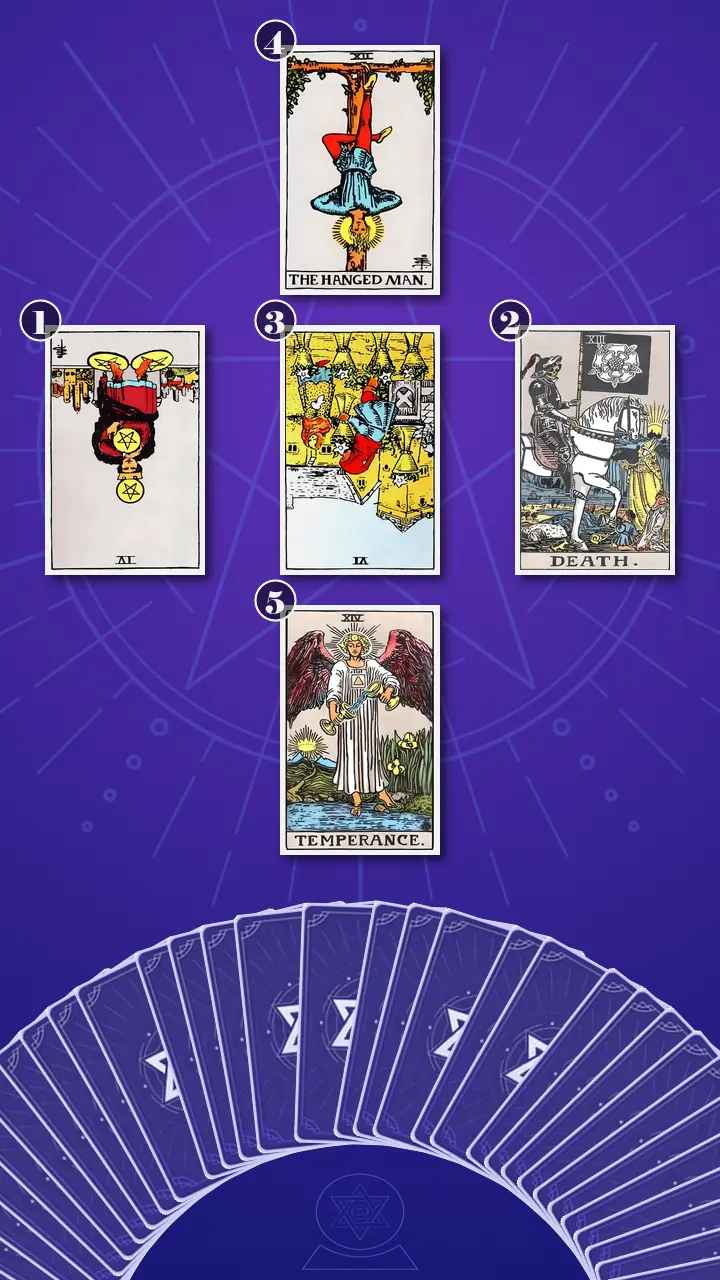
I chose the five-position Relationship Spread · Context Edition. This focused relationship tarot spread was better suited to a changing friendship than a broad future-oriented layout: Jordan did not need a prediction about whether the friendship would survive. They needed to see the loop connecting grief, nostalgia, pressure, and distance, then identify an ethical next move within their control.
This is how tarot works best in a situation like this. The cards do not grant me private access to the friend’s motives, and they do not decide what either person must do. They place different parts of Jordan’s experience where we can examine them: Jordan’s stance on the left, the change they are encountering on the right, the shared pattern at the centre, the needed perspective above, and grounded guidance below. The horizontal line would show the tension between self, friend, and history. The vertical line would turn that tension into perspective and practice.
When the Archive Became a Witness
Position One: The Hand Still Holding the Old Script
“Now I’m turning over the card that represents your own stance in this dynamic: what you do when the friendship stops feeling recognisable.” I placed down the Four of Pentacles, reversed.
In the Rider-Waite-Smith image, a figure clutches one coin against the chest while guarding the others with their body. Jordan glanced from the illustrated coin to the phone resting against their jumper. The modern card meaning was almost literal: after an unfamiliar exchange, Jordan held the phone close, reopened the archived WhatsApp thread, and built a message around who the friend used to be. The archive was not merely preserving a memory. Jordan was asking it to stabilise the present.
I read the reversed Earth energy as a Blockage beginning to loosen. The grip was no longer completely unconscious, but releasing it felt unstable. Jordan could notice the urge before pressing send, yet part of them still believed that without the old version of the friend, their place in the relationship might disappear. That fear kept converting a valid feeling into an attempt to manage someone else’s identity.
“The inner sentence sounds something like this,” I said. “I call this concern, but what I am trying to secure is a version of them that proves I still belong. Loyalty says the history matters. Control says the history gives me authority over who they are now. Those two things can feel similar in the body, but they create very different conversations.”
Jordan gave a short laugh with a bitter edge. “That is so accurate it feels a bit brutal.” Their hand moved away from the phone, then immediately returned to the corner of its case.
“Accuracy does not have to become condemnation,” I replied. “I’m separating the behaviour from the care underneath it. Your care is real. We are simply noticing that the strategy you use to protect it is giving the present friendship less room to breathe.”
Position Two: The Scene That Has Already Changed
“Now I’m turning over the card representing the change you are encountering in your friend, based only on what you can observe rather than what we might assume about their private experience.” The second card was Death, upright.
I addressed the name before Jordan could tense around it. “This is not literal death, and it is not a prediction that the friendship must end. Death is transition: the ending of one form so reality can be met as it is. The old pub table, the standing call, the shared commute, or the conversational rhythm that once happened without planning may no longer fit either person’s calendar or current life.”
Here the energy was Balance through transition, although Jordan experienced it as disruption. Death interrupted the idea that the friendship’s former shape was only experiencing a temporary glitch. I gave language to the admission beneath that hope: “I kept treating this as temporary because admitting it had changed would mean I had to mourn something that still matters.” Continuity of care was still possible; continuity of form was not guaranteed.
As an artist, I looked at the white rose on Death’s black banner and thought of a film set after a beloved scene has wrapped. Striking the set does not make the scene false. It means production has moved, and demanding endless retakes can prevent the next honest scene from being filmed. “You can honour the old friendship without making your friend audition for it,” I told Jordan.
Their gaze dropped to the card. A long breath left their chest, and they named the ritual that had actually ended: a Sunday voice call that had once been automatic but had become sporadic, then quietly disappeared. “I kept calling it a busy patch,” they said. “It’s been nearly two years.”
Position Three: When Memory Became the Admission Test
“Now I’m turning over the card representing the shared pattern at the centre: how history, comparison, and your repeated appeal to the past maintain the current tension.” I revealed the Six of Cups, reversed.
The illustrated flower-filled cup became a Google Photos memory on the Northern line. Jordan immediately recognised the scene: an old festival photo of both friends under cheap ponchos, sent with the private joke that used to guarantee an instant reply. The brakes had squealed, damp coats had filled the carriage with a metallic smell, and Jordan had watched two grey ticks sit beneath the image. When the eventual response was brief, the memory stopped being a gift and became evidence in an invisible case.
“If this memory still matters to you,” I said, voicing the pattern, “then surely you should still respond like the person in it.” The reversed Cups energy showed a Blockage: feeling had become stagnant in the past. A recommendation algorithm trained only on six-year-old data kept serving Jordan the same version of the friend even while the live inputs had changed.
I placed one finger beside the flower-filled cup. “History is context, not consent for the present. A memory can prove that closeness existed. It cannot require a current person to reproduce the same laugh, availability, priorities, or identity on command.”
Jordan’s fingers stopped worrying the phone case. Their gaze drifted beyond my image as if the Tube scene were replaying behind the screen, and then their shoulders lowered by a fraction. “I wanted the exact old laugh,” they admitted. “When I didn’t get it, I decided the memory meant less to them. I never actually asked.”
That was the main blockage in the spread. Selective nostalgia had edited out old tensions, earlier changes, and the ordinary unevenness of the friendship. The highlight reel was beautiful, but it could not answer what either person wanted now. Jordan had been using affection as a loyalty test, then reading the friend’s different response as proof that change was destroying the bond.
When the Hanged Man Stopped the Send
Position Four: The Bridge Between Longing and Choice
The rain softened outside Jordan’s window, and the radiator went quiet. In that sudden absence of background noise, I turned over the card representing the central challenge and perspective shift: the assumption Jordan needed to suspend long enough for another truth to become visible. It was The Hanged Man, upright, the Bridge card of the reading.
The calm figure hangs from a living tree by one foot, not as a defeated person but as someone who has voluntarily interrupted the usual angle. In Jordan’s life, the image became a corrective paragraph moved from WhatsApp to Notes and left unsent overnight. The Hanged Man’s upright energy was Balance through deliberate suspension: neither impulsive pursuit nor punishing withdrawal, but a pause in which observable facts, bodily feelings, and fearful interpretations could be separated.
I asked Jordan to return mentally to the late-night chat. The old thread was open, their thumbs were rewriting who the friend used to be, and the warm screen lit a tight throat. Beneath the polished message sat the quieter admission: “I miss how belonging felt then, and I do not know where I belong with you now.”
The old belief that a real friendship must preserve its past keeps Jordan pulling backward; the Hanged Man's suspended figure invites a voluntary pause and a new angle, so connection can be explored in the present rather than enforced through a fixed image.
I let the words sit between us before giving the insight its simplest form.
The pressure to restore the old friendship is not proof of how deeply you care; it is grief trying to make belonging depend on sameness.
I brought in a diagnostic lens I call Sidekick Syndrome Diagnosis. I usually use it to reveal how a clique keeps someone trapped as the clown, therapist, organiser, or permanent supporting character. Here, the same role mechanism had narrowed a two-person friendship. Jordan had cast the friend as the keeper of their shared origin and cast themselves as the continuity editor, responsible for catching every deviation from the earlier script. Any update to either character then felt like betrayal. The Hanged Man did not demand that either person leave the film. It suspended the casting call.
Jordan’s inhale stopped halfway. Their right thumb stayed suspended above the dark phone screen, and their eyes widened before losing focus, as though they were replaying every reunion where “You’re not yourself anymore” had replaced “I feel left behind.” Their mouth tightened, and a flash of anger reached their voice. “But doesn’t that mean I was wrong about all of it?”
“No,” I said. “It means the care was real, and the method you used to protect it had an impact. A memory can be true without becoming instructions for another person’s identity. Clarity does not put your whole past on trial; it gives you responsibility for the next draft.” Their eyes reddened. The hand gripping the phone slowly opened, their shoulders sank, and a trembling breath left their chest. Then came a brief, almost dizzy blankness: the old explanation had loosened, but the new perspective placed the next choice back in their hands.
I asked, “Now, with this new angle, think back to last week. Was there a moment when this insight might have changed how you felt?”
Jordan remembered Saturday drinks, when their friend had suggested meeting somewhere other than the old pub. Jordan’s first story had been, “They’re abandoning who they were.” The feeling underneath was, “I don’t know where I belong with them now.” The question they had not asked was, “What would make seeing each other easier for you these days?”
To anchor the shift, I set a seven-minute exercise. I asked Jordan to open a private note and complete two lines: “What I miss is...” and “What I want to understand now is...” The first line had to remain about Jordan’s experience. The second had to become one curious, non-corrective question. Nothing had to be sent. If the note started turning into a case against the friend, Jordan would stop, save one honest sentence, and return when they had more capacity.
“A pause is where longing stops becoming an instruction,” I said. This was the first clear movement from nostalgic control and fear that change meant losing belonging toward grief-aware, non-coercive curiosity about a reciprocal friendship in the present. It was not certainty. It was perspective-taking, acceptance without coercion, and the willingness to mourn an old role without abandoning care.
Position Five: Two Cups, Two Current People
“Now I’m turning over the card representing ethical guidance: one grounded way you can communicate and listen without deciding for your friend or predicting the outcome.” The final card was Temperance, upright.
The angel poured water between two cups, with one foot on land and one in water. I read this as Balance: emotional honesty joined to practical boundaries, continuity blended with change, and two distinct people contributing to the relationship without one experience overwriting the other.
In ordinary life, Temperance looked like a short message: “I miss how regularly we used to talk, and I realise I have sometimes made that sound like criticism of who you are now. What kind of contact feels realistic for you these days?” It looked like one forty-minute coffee near a station convenient to both people, not an attempt to recreate an entire era. It looked like asking one follow-up about the friend’s current experience before introducing another old story.
“The inner sentence here is, ‘I can bring my cup of history without pouring it over yours,’” I said. “Temperance is closer to a shared calendar than a recurring demand. Connection exists where two present schedules, boundaries, and desires genuinely overlap.”
Jordan rubbed both palms over their knees and sat more squarely in the frame. “And if they say they don’t want much contact?”
“Then you will have present-tense information,” I replied. “You may feel grief, relief, anger, or several things at once. The card does not promise that the friendship will survive in a form you prefer. It shows how you can speak without coercion and listen without treating their boundary as a puzzle you must defeat. The shape of the relationship belongs to both of you; your conduct belongs to you.”
The Two-Cup Rewrite: Actionable Next Steps
I drew the five cards into one continuous story. Jordan had tried to secure belonging by gripping a familiar identity. Death showed that an old relational form had already changed. The Six of Cups reversed revealed why admitting that felt unbearable: memory had become the authority against which every present interaction was judged. The Hanged Man interrupted the automatic journey from unfamiliarity to correction. Temperance turned that pause into measured, reciprocal communication.
The cognitive blind spot was not that Jordan cared too much. It was that they treated familiarity as proof of loyalty and change as proof of loss. The friendship had become like a shared Google Doc frozen in view-only mode: the earlier draft remained perfectly preserved, but neither person was allowed to update it. The needed shift was precise: replace the attempt to restore the old friend with one honest statement of what was missed, followed by one curious question about what could work now.
Resigning as the Continuity Editor
I adapted my Role Resignation Act for this one-to-one friendship. Jordan did not need a dramatic announcement or a final relationship summit. They needed a graceful conversational pivot that resigned from the self-appointed character of continuity editor. Their new role was smaller and more honest: one current person describing their experience to another current person, without directing the other person’s performance.
- The Unsent-Night Pause The next time an unfamiliar reply triggers a corrective WhatsApp paragraph, move it into Notes and title it “Unsent until tomorrow.” Set a seven-minute timer. Underline every sentence beginning with “you used to,” rewrite one as “I miss,” then put both feet on the floor and name three things: the observable change, the sensation in your body, and the story you are telling about what it means. Leave the note overnight before deciding whether any part should be sent. If seven minutes feels impossible, use ninety seconds. Do not spend the pause monitoring the friend’s activity or collecting more evidence; the purpose is to separate the emotional surge from a message that affects another person.
- The Present-Tense Two-Cup Check-In After the pause, and only if you still want contact, send one feeling plus one curious question: “I miss how regularly we used to talk, and I realise I have sometimes made that sound like criticism of who you are now. What kind of contact feels realistic for you these days?” If they opt in, offer one present-tense plan, such as a forty-minute coffee near a mutually convenient station. This is the Role Resignation Act in practice: no audition, no identity correction, and no demand to recreate the old ritual. Keep the exchange to one feeling and one question. Accept “not now,” a brief answer, or no answer as a boundary rather than a mystery to solve.
Neither action could guarantee closeness, reconciliation, or a particular reply. That was the point. Actionable advice should strengthen Jordan’s capacity to choose, not create a new technique for controlling the result. The cards supplied an external map; Jordan remained the person holding the pen.

The Quiet Proof in a King’s Cross Café
Six days later, Jordan wrote to me. Their friend had answered, “I care, but weekly calls don’t fit my life now. Coffee next month?” Jordan sat alone in a King’s Cross café, relieved and a little heartsore. They did not open the archive. They saved the café in Citymapper.
I did not treat that reply as proof that the friendship had been saved, and neither did Jordan. The quiet proof was the change in their own response: they could hear a boundary without immediately turning it into evidence that the history had been false. The old closeness remained precious. Its present form remained undecided.
I reminded Jordan that the five-position Relationship Spread · Context Edition had never been an authority over either person’s future. It had helped Jordan see the difference between grief and pressure, between a treasured context and a binding contract. The journey to clarity was the movement from protecting sameness to meeting the present with honest grief, clearer boundaries, and curiosity.
When someone who once made belonging feel effortless becomes unfamiliar, I know why the throat tightens and the hands reach for old messages. Asking them to stay the same can feel safer than admitting that you no longer know where you stand. Yet noticing that reach, before turning it into an instruction, means you are already outside the oldest version of the script.
If you let the archived chat remain history rather than instructions, and bring your cup of memory without pouring it over theirs, what is one present-tense thing you would become curious about between you now?