Five Family-Photo Retakes, One Delayed No, and a Timely Boundary
The Fifth Retake: When a Family-Photo Smile Becomes an Outburst
If you can facilitate a tense product-design critique all week but still snap when a relative asks for one more Sunday photo, emotional masking may be following you home. That was the contrast Maya brought into our session: polished and measured in Figma reviews, then suddenly unable to tolerate being moved two inches closer to the sofa.
She took me back to 4:18 p.m. in her parents’ North York living room. The roast-garlic smell still hung in the air, a floor lamp heated one side of her face, and the phone hidden behind her back had grown warm in her palm. Five retakes in, she kept lifting the corners of her mouth while her jaw locked, her shoulders climbed toward her ears, and each breath stopped halfway into her chest.
“I wanted the photo too,” she told me. “That’s what makes it confusing. I wanted a nice memory. I just also needed everyone to stop.”
Then came another request to move closer. The no she had delayed through every previous pose arrived all at once: “Can everyone just stop?” The room went quiet, and she left the frame with heat flooding her face. Later, when the finished photo appeared in the WhatsApp family chat, every person in it looked happy, including her.
A camera-ready smile can hide a limit that has already been reached. I could see Maya’s resentment working like a beach ball held underwater: the pressure remained invisible while she forced it down, so the eventual release looked far larger than the effort that had preceded it.
“Why does nobody notice that I’m already at my limit?” she asked. A second later, she looked down and added, “And then I hate becoming the angry one after trying so hard not to be.”
I told her I was interested in the full sequence, not just the sharpest five seconds. I was not there to excuse the tone, blame her family, or turn an ordinary photo ritual into evidence of hidden malice. I wanted to help her locate the point at which irritation was still information and had not yet taken control of her voice. Our Journey to Clarity would be a map of that interval.
A Relationship Spread Shaped Like a Camera Frame
I invited Maya to place both feet on the floor and take one unforced breath while holding the question in mind: Why do I keep smiling until my anger spills out? I shuffled slowly, using the repetition as a transition from replaying the incident to observing its structure. There was nothing supernatural she needed to perform correctly.
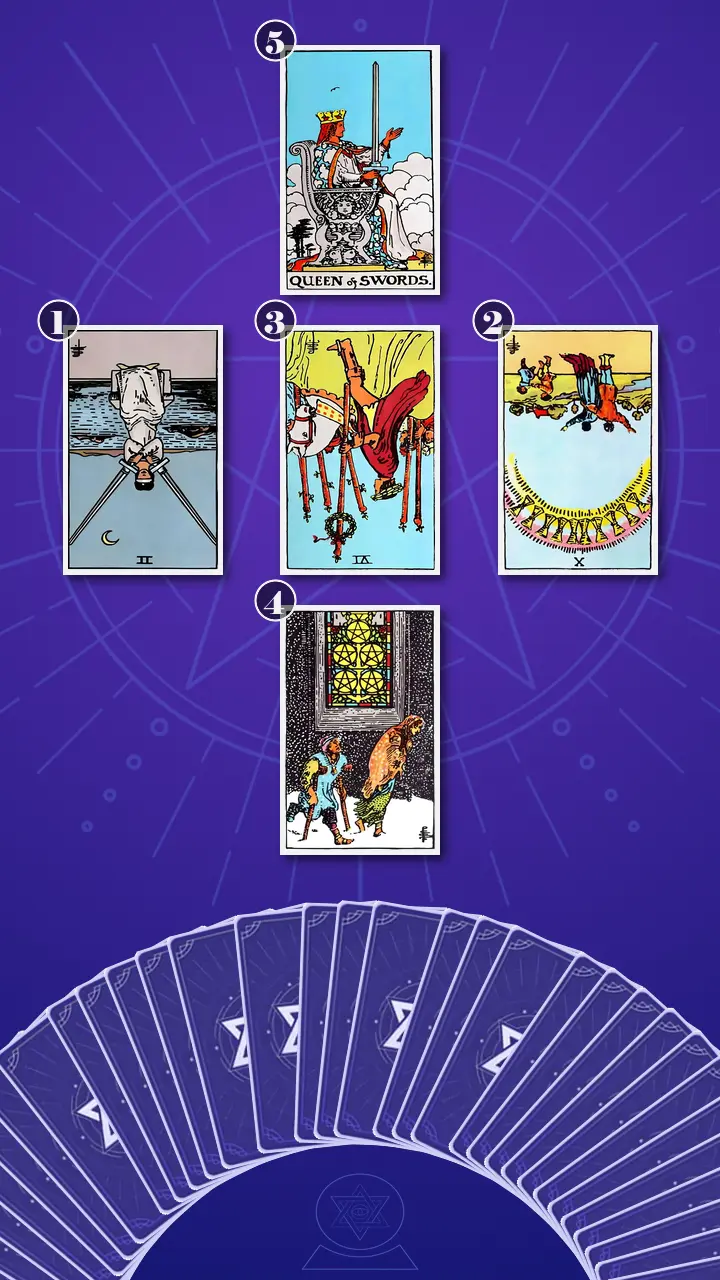
I chose a classic five-card Relationship Spread. For this question, it offered the smallest useful map: Maya’s current stance, the family atmosphere as she experiences it, the interaction pattern connecting the two, the fear underneath that pattern, and a healthier form of participation. I did not include a predictive outcome because the cards could not responsibly tell me how her relatives would respond or what they privately intended.
I placed the third card at the centre, Maya’s card to its left and the family-field card to its right. Beneath the centre sat the hidden vulnerability; above it sat conscious guidance. The layout resembled a family portrait crossed by a vertical focus line: visible performance ran across the surface, while fear and clarity occupied the unseen depth below and above it.
For anyone wondering how tarot works in a psychologically grounded consultation, this was the purpose of the spread. I was not asking the deck to pronounce a verdict. I was using card meanings in context to separate symptom, atmosphere, approval loop, belonging fear, and possible next steps. Tarot supplied a set of objective images; Maya remained the only person with authority over what fit her experience and what she chose to do with it.
Crossed Swords Behind the Fixed Smile
Position 1: The Stalemate Maya Was Holding in Her Body
I began with the position representing Maya’s current stance: the observable symptom of holding two competing reactions behind a smile until the internal stalemate collapses. The card was the Two of Swords, in reversed position.
The blindfolded figure held two blades crossed tightly over the chest. I pointed to the physical resemblance before interpreting anything abstract. On the fifth retake, Maya had said, “I’m fine,” tightened her smile, and gripped her phone behind her back while trying to keep irritation separate from her wish for a warm family memory. When another request came, the divided reactions broke through as a sharp reply.
I read the reversal as a blockage that had become unsustainable. The problem was not that Maya contained two real needs. Wanting closeness and wanting the posing to end could coexist. The blockage came from forcing those needs to remain strangers inside her, as though acknowledging one would destroy the other.
“The internal sentence sounds like this,” I said. “I want this to be nice, but I need this to stop, so I will say neither.”
Maya gave one short laugh, but there was no amusement in it. Her fingertips rose to the hinge of her jaw, pressed there for a second, and then dropped into her lap. “That’s so accurate it’s almost rude,” she said. “That is the exact moment before I snap.”
I asked her to notice something important: her first point of awareness was not the outburst. It was the earlier tight jaw, the shallow breath, the raised shoulders, and the increasing effort required to look unaffected. Those signals did not order her to confront anyone. They simply showed that her capacity had changed.
Position 2: The Rainbow That Had to Prove Everything Was Fine
I turned next to the position representing the visible family atmosphere as Maya experiences it, especially the expectation that togetherness should look cheerful and conflict-free. The card was the Ten of Cups, in reversed position.
Upright, the card’s rainbow of cups, celebrating adults, children, and distant home can form an almost complete image of shared happiness. Reversed, I read its water energy as distorted by an ideal: the finished image was being asked to carry more emotional certainty than any photograph could hold.
In Maya’s real-life version, she saw the bright group photo on the preview screen and experienced it as evidence that the gathering needed to be happy. She agreed to another shot because admitting irritation seemed incompatible with the polished record of togetherness. The photo stopped being a memory and became a test.
Having travelled across cultures, I have often seen family photographs carry genuine tenderness, history, migration, grief, pride, and the wish to preserve a moment before it changes. I thought of those layers as I looked at the reversed rainbow. The card was not telling Maya to reject the ritual. It was asking whether the ritual had become too narrow to contain an ordinary mixed emotion.
“What visible cue makes you feel everyone has to look cheerful?” I asked.
Her eyes stayed on the row of cups. “The preview,” she said. “As soon as people start checking it, I’m not in the moment anymore. I’m checking whether my face passed.”
That distinction mattered. Genuine warmth could be present, and so could fatigue, annoyance, or the need for a pause. The reversal did not cancel the family connection; it challenged the idea that connection had to be visually flawless in order to count.
When the Photo Became a Performance Review
Position 3: The Approval Loop at the Centre of the Frame
I returned to the central position, representing the recurring interaction pattern: visible harmony pursued through approval and image management while Maya’s actual limit remains unspoken. The card was the Six of Wands, in reversed position.
The elevated rider and doubled laurel wreaths usually evoke public recognition. Reversed, I saw blocked fire: energy that could have supported direct action was being redirected into monitoring, performing, and waiting for an external sign that Maya had finally done enough.
Each retake felt like another review cycle on a design file she had already thought was approved. Maya scanned the room for evidence that her smile was finally good enough, lost contact with her own capacity, and felt resentment surge when another correction implied that her effort had not yet earned approval. The family photo had acquired the emotional logic of a Figma file with one more unresolved comment.
“Maybe this next smile will finally count as cooperative enough,” I said.
Maya went still. First, her thumb stopped rubbing the edge of her sleeve. Then her gaze drifted away from the cards, as if she were replaying every small adjustment beside the sofa. Finally, she exhaled through her nose and shook her head. “It really does feel like a performance review,” she said. “And I keep waiting for somebody else to tell me I’ve passed.”
When ten quiet yeses end in one loud no, everyone notices the no. I told Maya that accountability for the loud no did not require deleting the ten earlier moments when she had overridden herself. Seeing the complete pattern was not absolution; it was the information she needed if she wanted a different response next time.
The Six of Wands reversed exposed a cognitive habit: she treated other people’s approval as the only reliable signal that she had participated enough. The longer she waited for that signal, the more her own body had to escalate its message.
The Cold Window Beneath the Bright Picture
Position 4: The Fear of Stepping Outside the Warmth
I moved down to the position representing the central vulnerability beneath the outburst: the fear that one honest limit could place Maya outside the family’s warmth or make her the identified problem. The card was the Five of Pentacles, upright.
Two strained figures crossed through falling snow beneath an illuminated stained-glass window. In Maya’s modern-life version, she imagined saying, “I’m done with photos for now,” and her mind jumped from one awkward pause to being labelled difficult, excluded from future warmth, or remembered as the person who spoiled the gathering.
I did not treat the card as proof that exclusion would occur. Upright, it showed the belonging vulnerability fully present in Maya’s experience. In energy terms, anticipated threat had become excessive relative to the immediate request: a two-minute break felt internally like surrendering her key to the whole building.
This was where I used a Jungian diagnostic lens I call Adult-Child Regression Auditing. I explained that regression in this context did not mean immaturity. It described a context-dependent shift in role. At work, Maya experienced herself as an adult collaborator who could question a brief, negotiate scope, and name a revision cap. In the old family living room, under repeated instructions about where to stand, how to angle her body, and when to smile, that adult authority narrowed. Her nervous system began acting as though compliance protected belonging and disagreement could make her the difficult teenager in the picture.
I audited the environmental triggers with her: the camera coming out, repeated physical repositioning, cheerful teasing, several people speaking at once, the first request framed as “just one more,” and the preview screen becoming a public score. None of those cues proved manipulation or bad intent. Their importance was that they activated a familiar internal rule: stay agreeable until the moment is over.
Maya’s breath caught. She folded her arms, stared at the cold figures, and then slowly loosened her grip on her sleeves. “I live by myself. I manage a team. But in that room, I feel about sixteen,” she said. “Like saying no will become the entire story of who I am.”
I asked, “If you stepped out after two photos, what does your mind predict would happen, and what present evidence do you actually have?”
She took her time. She could name awkward questions and visible disappointment as possibilities. She could not honestly claim that one pause would erase every relationship or future invitation. The distinction did not make the fear disappear, but it reduced its scale. I watched her begin to separate anticipated exclusion from known fact.
When One Upright Sword Replaced Two Crossed Blades
Position 5: The Queen of Swords and the Sentence That Arrives in Time
I turned to the final position, representing conscious guidance: naming a concise boundary before resentment becomes an outburst. The room seemed to settle as I revealed the Queen of Swords, upright.
Her sword stood in one clear vertical line at eye level, replacing the crossed swords from the first card. Her other hand remained open. I read this as air energy restored to balance: direct language without hostility, discernment without emotional closure, and self-respect that did not require Maya to attack or disappear.
In ordinary life, the Queen’s move sounded like this: before the next camera session gathered momentum, Maya could say, “I can do two photos, and then I’m taking a break.” She would not need to accuse anyone, explain her entire emotional history, or leave the gathering. She could name the limit while her voice was still steady and remain connected on terms she had consciously chosen.
I brought her back to the fifth retake: the phone warm behind her back, her jaw locked, and “I’m fine” still coming out of her mouth. She wanted the photo because she wanted closeness; she resented the pose because her limit had disappeared from it. The old move was one more silent yes. The Queen’s move was one timely sentence.
I said, “A clear limit spoken early does more to protect connection than a perfect smile held until anger speaks for you.”
Keeping quiet is not the same as keeping peace; use the Queen's upright sword as a model for one clear boundary spoken before the smile hardens into resentment.
For a moment, the dishwasher hum from Maya’s kitchen became the only sound on the call. Even the blue-white light on her face seemed less harsh once she stopped looking down at the cards.
Maya’s breath stopped first. Her fingers hovered above the table, still curved as though they were holding the warm phone from the memory. Then her eyes lost focus, and I could see the sentence moving through older scenes: birthdays, holiday gatherings, every “one more” she had answered with a rigid smile. Her mouth tightened. “But doesn’t that mean I was doing it wrong all these years?” she asked, with a brief flash of anger. I told her no. The silence had been a protective strategy, not a character defect; it had simply become too expensive. Her eyes shone, her shoulders lowered by an inch, and her hands opened flat on the table. The release was followed by a slight, unsteady look, the vulnerable blankness that can arrive when clarity returns responsibility to the person who now sees a choice. I asked, “Now, using this new perspective, can you think of a moment last week when this insight might have made the experience feel different?”
“Before the fifth photo,” she said quietly. “Actually, before the third. My jaw was already tight. I could have said, ‘I need two minutes.’ Not a whole speech. Just that.”
I linked the Queen back to the Adult-Child Regression Audit. The repeated instructions had pulled Maya toward the role of a managed subject inside somebody else’s frame. The Queen represented her adult self returning as a participant: able to choose, revise consent, remain open, and speak one limit without waiting for permission to have it.
This was the key crossing in her emotional transformation. She was not moving from anger to permanent calm, or from difficult family moments to guaranteed approval. She was moving from camera-ready people-pleasing and accumulated resentment toward timely, self-respecting boundaries that could leave room for connection. Her anger was becoming information she could translate, rather than pressure she had to hide until it translated itself.
The Smallest Boundary That Could Hold the Whole Picture
I drew the five cards together as one causal story. Maya’s professional polish had taught her to manage visible tension, but at family gatherings that skill became self-silencing. The idealized Ten of Cups image made mixed emotion feel like failure. The reversed Six of Wands turned each retake into an approval check. Beneath that performance, the Five of Pentacles made a small limit feel like a threat to belonging. The Queen of Swords did not ask her to care less about connection; it showed her how to stop purchasing connection with silence.
The core pattern was still the beach ball underwater. Maya had been analysing the force of the final release while overlooking the continuous effort used to keep the ball submerged. Her cognitive blind spot was equating visible calm with relationship care, then using other people’s satisfaction as the only measure of whether she had given enough.
I made the transformation direction explicit: notice the first physical cue, identify one specific need, and decide whether to voice it while irritation is still manageable. Tarot did not make that decision for her. It made the leverage point visible, and Maya chose which experiments felt appropriate for her relationships and sense of safety.
The One-Sentence Sword: Three Low-Pressure Experiments
Anger is easier to communicate while it is still a sentence, not an eruption. I offered Maya three small experiments, with permission to adapt, postpone, or stop any of them if they felt too exposing.
- Write the seven-minute sentenceThat evening, Maya could open Apple Notes, set a seven-minute timer, and complete: “When I notice my jaw tightening, I can say: ___.” The minimum versions were “I need two minutes” and “I’m done with photos for now.”She did not have to send or rehearse the note. The exercise could end as soon as one usable sentence appeared.
- Use the Regression Circuit BreakerAt the first tight-jaw or raised-shoulder cue during a family gathering, Maya could place both feet on the floor, exhale once, and silently orient herself: “I’m twenty-nine, I can pause, and I can choose whether I stay in this frame.” Then she could use one brief boundary while her voice was steady.The grounding was not designed to suppress anger again. Its only job was to interrupt automatic compliance long enough for her adult reasoning to re-enter the room.
- Set a two-photo energy budgetBefore the next gathering, Maya could text the likely photo organiser: “I’m up for two group shots, then I’m taking a break.” After those shots, she could put her phone away and wait twenty minutes before checking the previews.The number was an energy budget, not a judgment on her family. If two felt too difficult, the minimum experiment was declining only the first extra retake.
I also made room for an outcome the cards could not control: somebody might look disappointed, ask why, or prefer another photo. A boundary was not a method for engineering everyone else’s comfort. Its value was that Maya could respond to her own capacity before resentment decided the tone.
That was the Queen’s open hand beside the sword. Precision did not require cruelty, and connection did not require unlimited participation. A boundary could keep Maya in the room without keeping her in the frame.

A Week Later: The Quiet Proof Outside the Frame
Six days later, Maya sent me a message from another family gathering. Before the camera came out, she had said she was available for two photos. When someone called for a third, she felt the familiar pressure at the hinge of her jaw. She put both feet down, breathed out once, and said, “I’m taking a water break. Keep going without me.”
There was a short pause. Maya did not fill it with a defence brief, retract the limit, or turn the moment into a confrontation. She stepped aside, poured water in the kitchen, and then returned to the living room while the gathering continued. She was still part of the afternoon, simply absent from one frame.
That night she slept through, though her first thought the next morning was, “What if they think I’m difficult?” This time, she noticed the thought, smiled slightly, and made coffee.
I did not count the reading as successful because a card had predicted the future or because Maya had become perfectly calm. I counted the small proof she created herself: she recognised the first cue, used a clear sentence, tolerated a little awkwardness, and remained connected without forcing her face to certify that everything felt fine.
When your jaw is locked behind a family-photo smile, the hardest part is not only the anger. It is the fear that letting your face tell the truth could cost you your place in the picture. If that fear is familiar, I would invite you to remember the Queen’s open hand as well as her sword: a limit can be firm without closing every door, and even noticing the moment before the smile hardens means you are no longer seeing only the outburst.
If you let the first tightness in your jaw count as enough information, what one honest sentence might you want available before the next photo?