Scrolling Manager Titles on the TTC—Then Opening a Figma File

Finding Clarity in the Toronto Promotion Trap
I met Jordan (name changed for privacy) after a day that had been almost entirely made of other people's priorities. As a senior product designer in Toronto, they had finished a day of mentoring and stakeholder meetings, saved another management-track posting, and realized they had protected zero time for the work they actually missed.
At 8:47 PM on the TTC Line 1 train north from downtown, Jordan scrolled through LinkedIn stories about new Design Manager titles. The carriage hummed beneath their feet, their phone felt warm in their palm, and their shoulders had crept almost to their ears. They wanted to open Figma and make something, but kept reading because every new title seemed to prove that everyone else was moving forward.
When Jordan sat down opposite me, they turned their phone face down and said, Why do I keep chasing management when I miss doing the work? They told me that every promotion conversation framed people management as the natural next step. They nodded, volunteered to coordinate another workstream, and then went home wondering why the prototype they had postponed was still the only thing they wanted to think about.
I could see the contradiction in the restless movement of their hands. The feeling was not a simple lack of ambition. It was like standing on an escalator marked management while looking over one shoulder at a quiet workbench, afraid that stepping off would make the whole building assume they had stopped climbing.
I said, You are not failing because two real needs are speaking at once. Let us separate the work that gives you energy from the title that signals progress, then give your own experience a chance to answer. That was the beginning of our Journey to Clarity.

The Workbench Path: Choosing a Shadow Spread
I invited Jordan to take two slow breaths and hold the question without trying to solve it. I shuffled slowly, not to create a supernatural verdict, but to give the mind a clean transition from the noise of Slack, LinkedIn, and five-year-plan documents into focused observation.
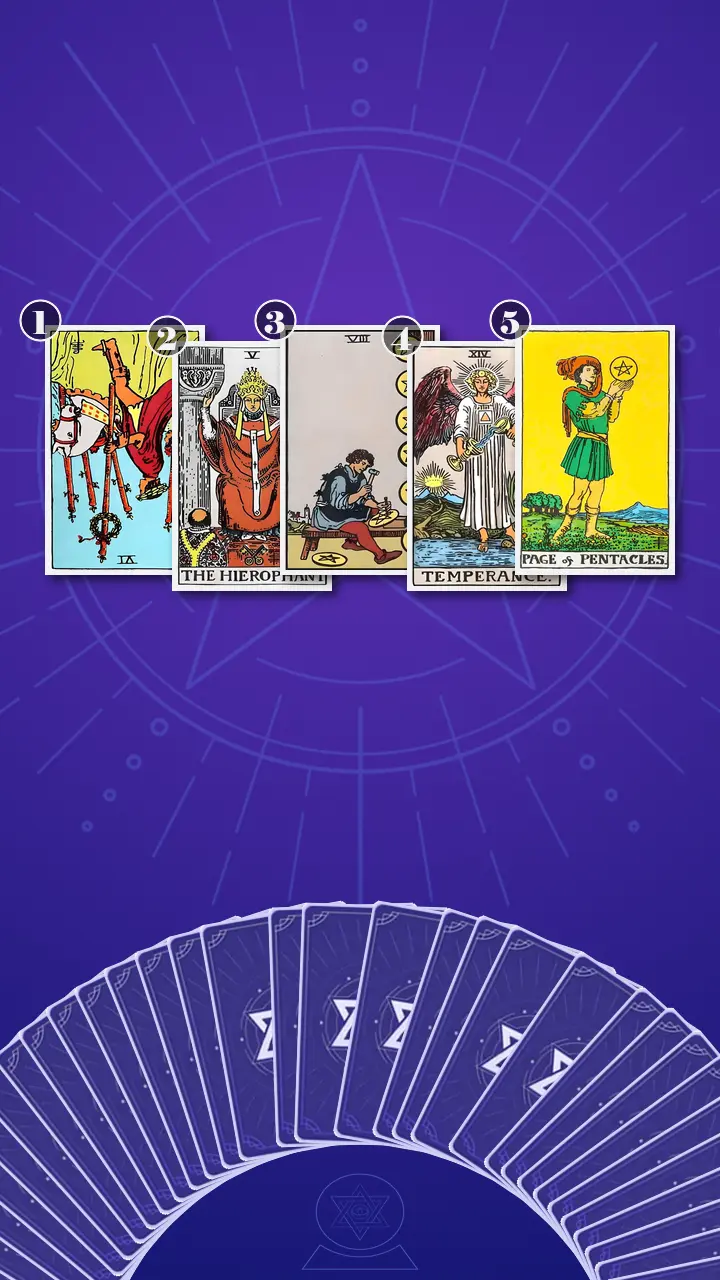
I chose a five-card spread called The Shadow Spread. For a career crossroads like this, I explained, a decision spread could push us too quickly toward manager or individual contributor. The Shadow Spread is better suited to asking why the same choice keeps returning. It traces the visible behavior, the inherited rule beneath it, the need pushed outside the professional identity, the bridge between divided capacities, and one grounded experiment.
This is also how I explain how tarot works in a psychological reading. The cards do not predict which job Jordan will take. Their images give us a structured language for card meanings in context, so an elusive pattern can meet observable evidence: the calendar, the body, the tasks, and the choices already being made.
I told Jordan that the first position would show the visible shadow pattern, the second would reveal the hidden career rule and underlying fear, and the third would name the focused craft they had disowned. The fourth card would be the integration bridge. The fifth would offer a practical landing point, small enough to test before making any permanent career decision.
The Crowd Around the Raised Wand
Position 1: The Visible Shadow Pattern
Now I turned the card for the visible shadow pattern: the observable behavior of pursuing management-track recognition while continuing to miss and postpone hands-on work. It was the Six of Wands, in reversed position.
In the RWS image, the rider carries a raised wand and a laurel wreath while a crowd watches. In Jordan's life, I saw the rider leaving a promotion conversation, opening LinkedIn on the TTC, and rewriting a profile around leadership scope before asking whether they wanted the daily work of managing people. The wand became a new title. The laurel became public approval. The crowd became peers, managers, imagined recruiters, and every phrase about expanded scope or building high-performing teams.
Reversed, the fire of recognition was blocked and turned inward. External approval was being asked to do a job it could not do: report whether Jordan enjoyed the actual work. The more they chased visible advancement, the less steady the image became. A title could describe their position; it could not measure their aliveness inside the work.
I asked, When you last said yes to mentoring or coordination, what hands-on task did you quietly postpone, and what did you hope the visible responsibility would prove?
Jordan did not nod. First, their breath paused and their thumb hovered over the edge of their phone. Then their gaze lost focus, as if the last several promotion conversations were replaying across the dark window of the train. Finally, they gave a short, bitter laugh and said, That is almost too accurate. I keep calling it growth when it keeps me away from the work I actually miss.
I let the laugh stand. I did not turn it into a warning or tell Jordan to abandon leadership. I said, The card is not judging your ambition. It is showing where recognition has become louder than contact. We can use that difference as information. Their hands settled on their knees, though their shoulders stayed lifted, as if the first layer of the pattern had become visible but had not yet become safe.
The Keys to the Approved Next Step
Position 2: The Hidden Career Rule
Now I turned the card for the hidden career rule and underlying fear that make management feel safer or more valuable than direct contribution. It was The Hierophant, in upright position.
The two gray pillars, the crossed keys, and the two kneeling acolytes gave the card a familiar Toronto workplace translation. I saw the promotion rubric, the five-year-plan question, the leadership podcast playing during a commute, and the respected colleague saying that people management was the natural next step for a successful senior designer. The crossed keys resembled the manager title or formal team scope Jordan believed would unlock professional legitimacy.
Upright, the Hierophant carried the energy of an established system. That energy was not inherently harmful. Structure, mentorship, and shared standards could help Jordan grow. The blockage appeared when an institutional teaching became an unquestioned personal rule: management is the approved form of advancement, while staying close to the craft is only a stage to outgrow.
I translated the pillars into an inner dialogue and read it back carefully. Management is the respectable next step, said the inherited voice. I feel most present when I am solving the thing myself, answered the personal voice. I asked Jordan which review comment, mentor message, podcast, or peer announcement had taught them to treat the first sentence as objective fact.
Jordan's fingers tightened around the paper cup between us. They looked toward the rain-striped window and said, Maybe I am trying to become impressive instead of trying to become integrated. A long breath left their chest. They were not rejecting the institution; they were noticing that they had been kneeling before a rule they had never consciously chosen.
I told them that questioning the management ladder did not require rejecting useful authority or pretending that financial security and ordinary rent did not matter. It only meant separating practical constraints from the inherited belief that a title could settle the question of worth.
The Quiet Workbench Inside the Career Story
Position 3: The Disowned Need
Now I turned the card for the disowned need or quality: the focused craft, direct contribution, and satisfaction Jordan had pushed aside while trying to prove professional progress through management. It was the Eight of Pentacles, in upright position.
The card showed an artisan seated at a workbench, shaping one pentacle while a row of completed pieces lined the wall. I asked Jordan to picture a contained Figma file, one prototype revision, a research synthesis, or a real interaction problem with a clear next step. I did not ask them to romanticize hands-on work or pretend it would solve their career. I asked what happened to their attention when no one was watching.
Upright, the earth energy was available and steady. The card treated practice as a source of identity, confidence, and measurable skill. It challenged the idea that craft was less ambitious because it was quieter. The workbench was not a retreat from leadership. It was direct evidence, built through repetition, that Jordan could make, test, revise, and finish something meaningful.
Jordan described a prototype they had abandoned after twenty minutes because a thought had interrupted the flow: Should I be delegating this? They had opened a management article, lost the thread, and ended the hour with both the prototype and the career question unfinished. I said, You do not need to decide what the task means yet. You can notice what happens when you do it.
Something small changed. Jordan's shoulders dropped by a fraction. Their eyes moved from the row of pentacles to the blank space beside the cards, and their restless fingers began tapping a slower rhythm, like keys on a keyboard. The satisfaction they remembered was no longer being treated as evidence against ambition. It had become career information.
When Temperance Mixed the Two Cups
Position 4: The Integration Bridge
Now I turned the card for the integration bridge: the practical balance that can hold leadership ambition and hands-on work together without making either one a verdict on worth. The room became very quiet as Temperance, in upright position, appeared between the cards. Outside, a streetcar bell sounded once through the rain, then disappeared into the traffic.
Temperance showed an angel pouring liquid between two cups, one foot on dry land and one in the water, with a path leading toward distant mountains. I read the image as proportion rather than compromise. One cup could hold mentoring, coordination, and team direction. The other could hold direct design, research, and problem-solving. The question was no longer which identity should win. The question was what mixture could function in one real working week.
I told Jordan that I was using my Authentic Desire Decoding lens here. I use it to strip away inherited societal or parental pseudo-expectations without pretending that I can announce a person's true desire for them. I asked Jordan to distinguish the daily responsibilities they wanted from the status those responsibilities seemed to promise. Then I brought in my Shadow Path Analysis: not a diagnosis, but a way to trace the fear-based logic that says choosing craft will make a career look backward, which then sends the person toward more visible leadership, which creates more distance from the craft.
At 8:47 PM on the TTC ride home, Jordan had scrolled through new manager titles, then opened a blank Figma file and felt the quiet pull of making. The same person wanted proof of progress and missed the work that gave progress a pulse. I could see the old choice trying to turn that tension into a verdict.
Stop treating management and hands-on work as mutually exclusive badges of progress; mix a small amount of leadership with a real piece of craft, as Temperance mixes the two cups, and observe which combination restores self-trust.
I added, You do not have to keep chasing management to prove that you are progressing. Let a deliberate return to hands-on work test what fits; leadership can be a capacity you use, not a verdict you must earn.
Jordan's face went still. Their eyes widened slightly, and their fingers stopped moving above the table. For a moment, the insight seemed to pass through them without finding a place to land; I watched old promotion language and the unfinished prototype occupy the same mental frame. Then their jaw tightened and they asked, But does that mean I got it wrong? Have I been making the wrong choices this whole time? I answered that the choices had made sense under the rules Jordan had been given. Their breath came out unevenly. The shoulders that had held themselves high through every title conversation began to lower, and one hand opened slowly from a fist. A faint flush touched their cheeks, followed by a steadier exhale. Relief arrived with a little dizziness, the blankness that can follow a long argument when the argument finally stops. I asked, Now, use this new perspective to remember whether there was a moment last week when it could have felt different. What might you have noticed before opening LinkedIn?
Jordan looked at the two cups again. I might have noticed that I wanted the responsibility of helping people, but not every hour of my week to be about managing them, they said. That was the crossing I wanted them to feel: from status anxiety and career ambivalence toward evidence-based self-trust about a coherent mix of hands-on contribution and leadership. It was not certainty. It was the first usable proportion.
One Pentacle Held Close
Position 5: The Grounded Practice
Now I turned the card for the grounded practice: one small action Jordan could take this week to gather direct evidence about what kind of work supports a coherent professional identity. It was the Page of Pentacles, in upright position.
The Page held one pentacle at eye level, standing in a cultivated field with mountains in the distance. I saw a small ticket moved into In Progress with a clear definition of done, not a five-year roadmap. For Jordan, it could be one user-flow revision, one prototype, one research synthesis, or one interaction detail. The mountain preserved the larger career horizon. The field made this week's evidence concrete.
Upright, the Page carried grounded curiosity and the balance of a capable person willing to become a beginner in one chosen practice. I said, A return to hands-on work is not automatically a demotion. You can approach it as an experiment, gather information, and still leave the larger path open.
Jordan gave a small, uncertain smile. Twenty-five minutes sounds almost embarrassingly small, they said. I told them that was precisely why it could be useful. A small experiment could reveal attention and energy without demanding a new job, a public announcement, or a permanent manager-versus-maker identity.
They wrote the number twenty-five in the margin of their notebook. The act was modest, but I saw their gaze become more direct. The decision was no longer a courtroom in which the cards would deliver a sentence. It was a workbench with one tool placed back in their hand.
A Calendar That Can Hold Two Truths
When I placed the five cards in a line, the story became clear. The reversed Six of Wands showed Jordan seeking a public signal of progress. The Hierophant explained why that signal felt legitimate: management had been taught as the approved route. The Eight of Pentacles restored the quiet source of satisfaction that had been pushed outside the professional identity. Temperance then refused the false binary and made room for both capacities. The Page of Pentacles gave the insight a small place to live.
The cognitive blind spot was not that Jordan had failed to recognize their own longing. They had recognized it repeatedly. The blind spot was treating a future promotion as more reliable evidence than present-tense experience. They had postponed hands-on practice until the career path felt settled, then used the resulting distance from the work as proof that management was necessary.
The transformation direction was therefore specific: separate the work that creates energy from the title that signals progress, then run a contained hands-on project before making another management-track commitment. This was career self-integration, not a command to leave management. Leadership and hands-on work were ingredients, not rival identities.
I gave Jordan three next steps. I wanted each one to be small enough to survive a full calendar, concrete enough to produce evidence, and flexible enough to respect workload, compensation, and financial reality.
The Two-Cup Career Check
- The Workbench Evidence BlockBefore the end of this week, choose one real product-design task you have been postponing and place a 25-minute block on Google Calendar. Work alone on the first concrete step in Figma, a research document, or a prototype, with Slack closed if your role allows it. When the timer ends, write three brief observations: what held your attention, what felt draining, and whether you would voluntarily return.Set the minimum at 10 minutes if 25 feels heavy. Use an existing brief and define completion as one visible output, not a polished portfolio piece or a career answer.
- The Leadership-and-Craft MixFor the next seven days, mark two calendar blocks: one for a hands-on deliverable and one for mentoring or coordination that you genuinely choose to keep. Before accepting another leadership task, ask what existing task will move and what protected craft time it will replace. On Friday, compare the two blocks by attention, satisfaction, and recovery cost rather than by title.Treat the calendar as Temperance's two cups. Adjust the ratio after observing energy and workload; do not promise a permanent hybrid role before discussing capacity, authority, and compensation.
- The Persona Detox ProtocolFor three evenings, spend five minutes in a two-column note titled What I Should Want and What I Actually Desire. After one hands-on task or one leadership task, write a single sentence beginning with I noticed rather than I should or This proves. When a management-track post triggers comparison, pause for ten minutes and name whether you want the responsibilities, the recognition, or both.Keep the journal factual, not punitive. A difficult day is not a final answer, and the exercise is designed to separate inherited expectations from lived information without forcing a decision.
I reminded Jordan that the Five-card Shadow Spread for career self-integration had done its job when it made the pattern easier to observe. The next answer would not come from asking the cards to repeat themselves. It would come from the direct evidence Jordan gathered, one finished piece of work at a time.

The Quiet Proof of a Different Kind of Progress
Four days later, Jordan sent me a message: I closed Slack, worked on the prototype for twenty-five minutes, and noticed I wanted to keep going. I also noticed I do like mentoring when I choose it instead of using it to prove I am moving up. They had written the observations in plain language and had not changed their LinkedIn headline.
A week later, Jordan slept a full night. In the morning, the first thought was still, What if I am wrong? They smiled, opened the calendar, and kept the next craft block. The doubt had not vanished; it had stopped being the only voice in the room.
I told Jordan that this was the first evidence of the emotional transformation we had been tracking: not a dramatic escape from management, but a movement from status anxiety and fear of professional regression toward grounded self-trust. The cards had not chosen a role. They had helped Jordan see the difference between a capacity they could use and a title they had been asking to certify their worth.
That is what I mean by a Journey to Clarity. Clarity is not always a final answer. Sometimes it is the moment when a crowded public career image stops drowning out the quiet sound of your own attention. The choice remains yours, and you remain the author of what leadership, craft, ambition, and a coherent professional identity will mean in your life.
When the Sunday-night job-listing spiral tightens your shoulders, you can miss the work that makes you feel like yourself and still chase the title that promises you have not fallen behind. I would not treat that contradiction as a flaw. I would treat it as a signal that deserves patient, practical attention.
If one small piece of hands-on work could be information rather than a verdict about your ambition, what would you be curious to notice in the next twenty minutes, the first pentacle you could place on your own workbench?