LinkedIn Spiral Lost Ground to Figma in the Four-Layer Insight Ladder
The 11:47 p.m. LinkedIn Spiral
I often begin a session with a sentence that makes the room feel briefly familiar: “You might be a junior creative in an expensive city who can focus on meaningful work until a former colleague’s promotion turns one slow Tuesday into a LinkedIn comparison spiral.”
Jordan sat across from me in my London studio with their phone still warm from their hand. At 11:47 p.m. the rain hissed against the window, the laptop fan hummed over the stale warmth of the shared flat, and an unfinished accessibility case study glowed in Figma beside LinkedIn. A former colleague had posted a leadership promotion; within minutes, Jordan had opened three strategy-course tabs, saved two roles, and revised a professional headline that had already been edited more often than the portfolio itself.
They told me they could explain why the new direction was strategically smarter, but could not explain why they wanted it. The meaningful path felt steady until somebody else’s visible progress made it look embarrassingly ordinary. I heard the central conflict clearly: Jordan wanted work that mattered personally, yet feared that an unimpressive-looking path would diminish their worth.
I recognized self-doubt in the physical sequence rather than as a label: a tight chest, shallow breaths, a jaw held as if waiting for a verdict, and an urgent hand reaching for another tab before the first feeling could finish forming. I said, “You do not lose interest first. You lose confidence that your interest will look important enough. We can slow that sequence down and draw a map through it.”
Choosing the Compass: The Four-Layer Insight Ladder
I invited Jordan to put the phone face down, take one unhurried breath, and name the question without improving it. I shuffled slowly, treating the movement as a practical transition from reaction to attention, not as a supernatural test. A tarot spread can work as an objective pattern-recognition tool: the images give a structured language to instincts, habits, and evidence that can be difficult to see while a comparison spiral is active.
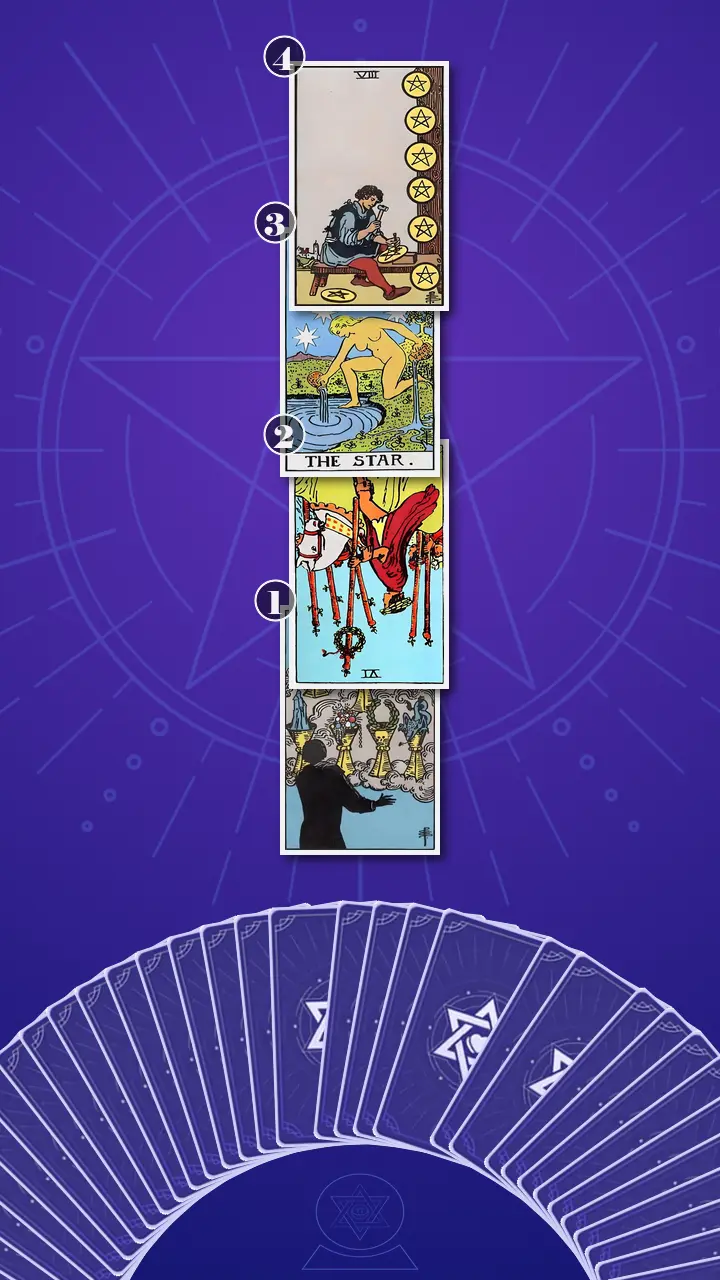
For this career crossroads, I chose the Four-Layer Insight Ladder. It is a focused spread for an inner excavation question, because Jordan was not really comparing two fully tested paths. They were reacting to a hidden prestige criterion, a fear about worth, and a protective habit of reinventing their identity. A larger spread might add context, but these four positions were enough to move from the observable symptom to its root, then from reorientation to practical action.
I explained that the bottom card would show the current-state layer: what happens when meaningful work is interrupted by an impressive possibility. The card above it would reveal the root layer, including the imagined audience and the fear beneath the switch. The third card would identify the transformation layer, the internal reference point that could loosen status-based decision-making. The top card would translate that insight into a bounded practice, so clarity could become evidence rather than another attractive idea.
Reading the Map: When Career Images Become Instructions
Position 1: The Seven of Cups and the Open Browser
Now I turned over the card representing the current-state layer: the observable pattern of interrupting meaningful work whenever a more impressive possibility appears. It was Seven of Cups, upright.
The card showed me seven emotionally charged options suspended in clouds, while the silhouetted figure stood at a distance from all of them. I connected it directly to Jordan’s 11:47 p.m. split screen: the accessibility case study, LinkedIn, a strategy-course page, two saved job listings, and a newly drafted headline. Each tab presented itself as a complete future identity, but none showed the repetitive meetings, beginner work, financial cost, admin, revisions, or dull Tuesdays required to inhabit it.
I read the upright water energy as an excess of projection. Jordan was not touching seven real paths; they were reacting to seven representations. The image of a prestigious identity became more persuasive than the direct evidence already available from the work in front of them. I asked, “If I removed the title, the audience, and the imagined announcement, which option would still matter when its ordinary working day came into view?”
I used the split screen as a visual equivalent of the seven cloud-borne cups. Jordan had been admiring identities rather than inhabiting their Tuesdays. Their inner line sounded like this: “That identity looks convincing, so maybe my current desire was naive.” I named the distinction carefully: an impressive path can still be someone else’s life, and another tab is not yet new evidence.
Jordan’s breathing paused; their thumb hovered over the laptop trackpad; their eyes moved from the Figma file to the course tabs as if replaying the previous night. Then they gave a small, bitter laugh and said, “That is too specific. I keep calling it research when I am mostly trying to feel less behind.”
I did not ask them to agree with the card. I asked them to notice the next ten minutes after a trigger: what they opened, rewrote, saved, or abandoned. Jordan slowly closed one course tab. The gesture was small, but it separated attraction to an image from knowledge of the work itself.
Position 2: The Wreath and the Imagined Crowd
Now I turned over the card representing the root layer: the fear that an ordinary-looking path will fail to prove personal worth, together with the recognition-based defence that sustains switching. It was Six of Wands, reversed.
I brought Jordan back to a Shoreditch networking event from the previous week. Warm lager had stuck to their fingers, bass had blurred the conversation, and someone had asked, “So, what do you do?” Saying “junior product designer working on accessibility” had suddenly sounded too modest, so Jordan had mentioned a strategy course they had barely started. The answer protected them from an imagined judgement, but it did not bring them closer to the daily work they wanted.
The laurel-crowned rider and the surrounding crowd became a profile update staged before a professional network. Reversed, the public procession turned into an internal ranking system. I read the fire as blocked and deficient: ambition was present, but it could not move freely unless an audience seemed ready to reward it. Jordan was evaluating a path through the reaction it might produce rather than through the work it required.
Jordan looked down at their hands. I said, “I can tolerate slow progress until I picture how it looks from outside. That is the silent audience inside this card. It is not wrong to care about money, advancement, or recognition. The problem begins when applause becomes the only measurement allowed to count.”
I remembered the old lesson from Wall Street, where every decision could be made to look rational after the fact. A strong presentation did not make a position structurally sound; it only made the risk easier to overlook. I told Jordan, “Quiet progress is not proof that you chose too small. It may simply be progress that has not become public yet.”
Their jaw tightened first, then their shoulders lowered by a fraction. Jordan exhaled and said, “This update changed my status feeling; it did not necessarily change my direction.” I suggested muting one promotion-heavy feed for seven days, not as a rejection of ambition, but as a way to make the trigger observable and interruptible before it became a new identity.
When The Star Turned Off the Audience
Position 3: The Star and the Title-Free Question
The room became quieter when I reached the card representing the transformation layer: the internal reference point that can loosen prestige-based decision-making and restore contact with personal desire. I turned it over and found The Star, upright, the key card and the antidote to the recognition loop.
Jordan was still caught in the old demand: choose the path that proves you are going somewhere, make the choice legible, and avoid the private work that might reveal uncertainty. The accessibility case study remained open, but the imagined announcement had been louder than the work. I asked Jordan to remove title, salary, audience, and profile language from the decision and listen for what remained honestly interesting.
I said, “A path becomes yours through honest contact, not through how impressive its announcement would look.” Then I placed my hand beside the card and spoke the sentence I wanted Jordan to carry out of the room.
You do not need a path that wins the crowd; choose the work that keeps you honest, and let The Star’s unguarded light guide the next small commitment.
For a moment, Jordan’s breath stopped and their fingers froze above the edge of the notebook. Their pupils widened as the sentence found an older memory: the quiet concentration they had felt while researching accessibility barriers before anyone praised the work. Their eyes lost focus, as if a polished networking answer and a half-finished case study were being placed side by side for the first time.
Then the thought moved through them. Their mouth opened slightly; the tight line of their jaw softened; one hand unclenched and rested flat on the table. Jordan whispered, “Without the announcement, I still want to know why the interface fails people.” Their shoulders dropped, followed by a shaky breath that sounded almost like relief but carried the brief dizziness of having no audience left to impress. Their eyes grew bright, and they looked frightened for one second by the responsibility of choosing from inside themselves. I let the silence stay long enough for that new space to feel real.
I asked, “Now, using this new perspective, can you remember a moment last week when this insight might have made you feel differently?” Jordan recalled opening the promotion post, then paused before the first new tab. The pause had not solved their career. It had created a point of choice.
The Sunk Cost Neutralization Check
I then used one of my Wall Street-honed diagnostic tools: Sunk Cost Neutralization. I asked Jordan to list the money spent on courses, the hours invested in abandoned portfolio drafts, and the emotional effort spent constructing impressive identities, then place that list to one side. Neutralizing a sunk cost does not erase it and does not force Jordan to continue a path merely because they have already invested in it. It prevents the past from dictating the future opportunity cost.
The clean question became: if the course fees, unfinished drafts, and imagined reactions earned no credit, what piece of actual work deserved ten more minutes? I paired that with Asymmetric Risk-Benefit Analysis. London rent and career realities mattered, so I would not romanticize uncertainty or tell Jordan to ignore a credible opportunity. A ten-minute private test carried little downside; abandoning meaningful work every time a promotion appeared carried a larger, accumulating cost in continuity, skill evidence, and trust in personal preferences.
The Star did not promise Jordan a perfect vocation. It restored a private reference point. This was the first movement from comparison-driven career switching toward grounded self-trust built through direct experience: not certainty, but honest contact without performance.
Position 4: Eight of Pentacles and One Finished Piece
Now I turned over the card representing the action layer: translating authentic direction into a bounded practice of repetition, completion, and evidence-based reflection. It was Eight of Pentacles, upright.
The craftsperson in the image attended to one pentacle while completed pieces waited nearby. I translated that into Jordan’s Figma file labelled Case Study v3 FINAL-final: one accessibility-focused portfolio case study, three short sessions each week, a defined finish line, and a visible record of what the work actually taught them. The energy here was grounded balance. The card did not demand a permanent identity; it asked for enough repetition to turn a projection into knowledge.
Jordan resisted. They said, “But if I spend thirty days on this and a more impressive role appears, I could miss my chance.” I heard the practical concern beneath the status fear. I did not answer with a command to trust the universe or ignore the labour market. Instead, I used my 3rd-Option Leverage Test, a rigorous 72-hour exercise for situations where Option A and Option B appear to be zero-sum dead ends.
Option A was to abandon the case study and chase the strategy identity. Option B was to stay with the project defensively and pretend the career question did not exist. The hidden third path was a reversible contact test: mute the comparison cues, touch the current work for ten focused minutes, write down the ordinary tasks involved in the shiny alternative, and compare lived evidence rather than announcements. After 72 hours, Jordan could review what created curiosity, friction, or useful information without declaring a lifelong allegiance.
I told Jordan, “You do not need to marry the path; you need enough contact to learn from it.” They opened their calendar and selected three 25-minute sessions. The gesture was less dramatic than a resignation or a new credential, but it placed agency back into their hands.
From Insight to Action: The 30-Day Contact Test
When I joined the four cards into one story, the sequence became precise. Seven of Cups showed water diffused across polished possibilities. Six of Wands reversed showed fire organised around an imagined audience, so a promotion post could make a meaningful path feel suddenly worthless. The Star redirected desire toward honest, unperformed contact. Eight of Pentacles gave that contact a shape: one bounded piece of work, repeated long enough to produce evidence.
The blind spot was not a lack of ambition. It was treating the imagined audience as a neutral evaluator and treating its reaction as data about fit. The transformation direction was a shift from ranking paths by prestige to testing one chosen path for thirty days through private, process-based measures: skill practised, curiosity sustained, friction encountered, and work completed.
I also made the financial and professional constraints explicit. My Asymmetric Risk-Benefit Analysis did not tell Jordan that visibility was bad or that accessibility work had to become a permanent calling. It asked which next move was reversible, which produced useful evidence, and which merely offered short-term relief from the feeling of being ordinary.
I wrote the following next steps with Jordan. Each one was deliberately small enough to begin before a new comparison story could take over.
- The Recognition Feed BoundaryI asked Jordan to mute LinkedIn notifications and the promotion-heavy university group chat for seven days, move LinkedIn off the phone’s first screen, and reserve one 15-minute career-research window on Friday afternoon. When an impressive update appeared, Jordan would write, “This changed my status feeling; it has not yet changed my direction,” before opening another page.The boundary is reversible and does not block genuine opportunities. If seven days feels too large, Jordan can begin with one work session or one evening.
- The No-Audience CheckOn Tuesday evening, I asked Jordan to put the phone on Do Not Disturb for ten minutes, open a private note with that title, and write what remains interesting about the accessibility case study when title, salary, and announcement value are removed. I also asked for a two-minute version of the question: “Would I want ten ordinary Tuesdays of this?”The check does not replace salary, rent, access, visa, or career research. It simply stops prestige from becoming the sole criterion, and “I do not know yet” counts as valid information.
- The 30-Day Contact TestI asked Jordan to schedule three 25-minute sessions each week for one accessibility-focused Figma case study. The finish line was limited to problem framing, two key design decisions, and a reflection section. After each session, Jordan would record one skill practised, one interest noticed, and one friction encountered in a Private Evidence Log.Thirty days is a review date, not a permanent commitment. During a heavy week, each session can become ten minutes. At the review, Jordan can continue, revise, or leave with better evidence instead of another untested identity.
The practical aim was not to make Jordan feel certain before acting. It was to let repeated work answer a question that more profile editing could never answer: does the daily reality of this path continue to feel worth exploring when nobody is watching?

A Week Later: The Quiet Proof
Four days later, Jordan sent me a screenshot of one completed case-study section and three entries in the Private Evidence Log. They had muted the feeds, worked for 25 minutes, and still felt the old urge to check what everyone else was doing. This time, they finished the session first.
The change was small and slightly bittersweet. Jordan slept through the night, but woke with the familiar thought, “What if I am wrong?” They smiled at it, opened Figma, and worked on the next section instead of treating the fear as an instruction.
I saw the first evidence of the journey to clarity there. Tarot had not chosen a career for Jordan, and The Star had not removed uncertainty. The cards had helped separate public recognition from personal fit, then return the decision to the person who had to live the ordinary Tuesdays. Jordan was beginning to build grounded self-trust through direct experience rather than claim it as an affirmation.
When meaningful work goes quiet and someone else’s promotion lights up the screen, I know how quickly the chest-tightening urge can turn a lack of applause into a verdict about worth. I also know that noticing the verdict is already a change in position. Quiet progress is not proof that a person chose too small.
Clarity is sometimes the first honest outline rather than a final answer. If the next 30 days did not need to impress anyone, what small piece of your path would you be curious to keep touching?