When Transfer Research Became Avoidance: Letting Current Facts In

Internal Transfer Anxiety at 8:47 PM
"You have the internal transfer bookmarked in Workday, the draft message half-written in Google Docs, and a calendar full enough to make waiting look sensible; this is what internal transfer anxiety can feel like when preparation becomes a hiding place." I said to Jordan (name changed for privacy) as they sat beside me on the northbound TTC Line 1.
It was 8:47 PM. Their phone was warm against their palm, the fluorescent lights buzzed overhead, and someone's headphones leaked a soft bass line through the carriage. Jordan opened the saved vacancy, hovered over the unfinished message to the hiring manager, then switched to a course search before the train reached the next stop. Their shoulders rose as if the phone had become a small, glowing test.
"I want the autonomy and growth in that team," Jordan told me. "But I keep calling it preparation, and I know I'm also hiding in it. What if wanting the transfer isn't the same as being capable of it?"
I could see the self-doubt physically: a tight chest, restless hands, and a heavy pause each time the possibility of being evaluated became real. It was like trying to navigate Toronto with a route app that kept recalculating because every possible route had to be delay-free, transfer-free, and guaranteed not to reveal a wrong turn.
"I believe you," I said. "You are not confused about the direction as much as you are bracing for what the direction might reveal. We do not need to force a decision tonight. We can look at the pattern, separate old feedback from current evidence, and draw a map toward clarity together."

Choosing a Map Instead of a Verdict
I asked Jordan to place the phone face down, take one slow breath, and name the question without trying to solve it. I shuffled steadily while they listened to the ordinary sounds of the carriage, using the small ritual as a transition from mental replay into focused observation rather than as a promise about the future.
I chose the Transformation Path Grid (6) · Context Edition, a six-position tarot spread for career avoidance and self-doubt. For me, how tarot works in a consultation like this is practical: the cards give us distinct images and questions, so we can examine a repeating behavior without confusing a symbolic mirror with a prediction.
This spread fits because Jordan is not weighing two equally desired options in a neutral decision. The real question is why a wanted internal career move keeps being deferred. The six linked positions trace the visible symptom, the structural blockage, the past-facing root, the conscious interruption, the grounded action, and the way Jordan can carry the lesson forward. It is the smallest structure I know for preserving the whole chain without drowning the question in extra information.
I explained the route to Jordan and to anyone reading along: we would begin with the observable avoidance, then identify the protective loop beneath it. We would examine which old workplace memory had become current evidence, find the turning point that could interrupt the loop, and finish with one bounded next step and a wider exploration plan.
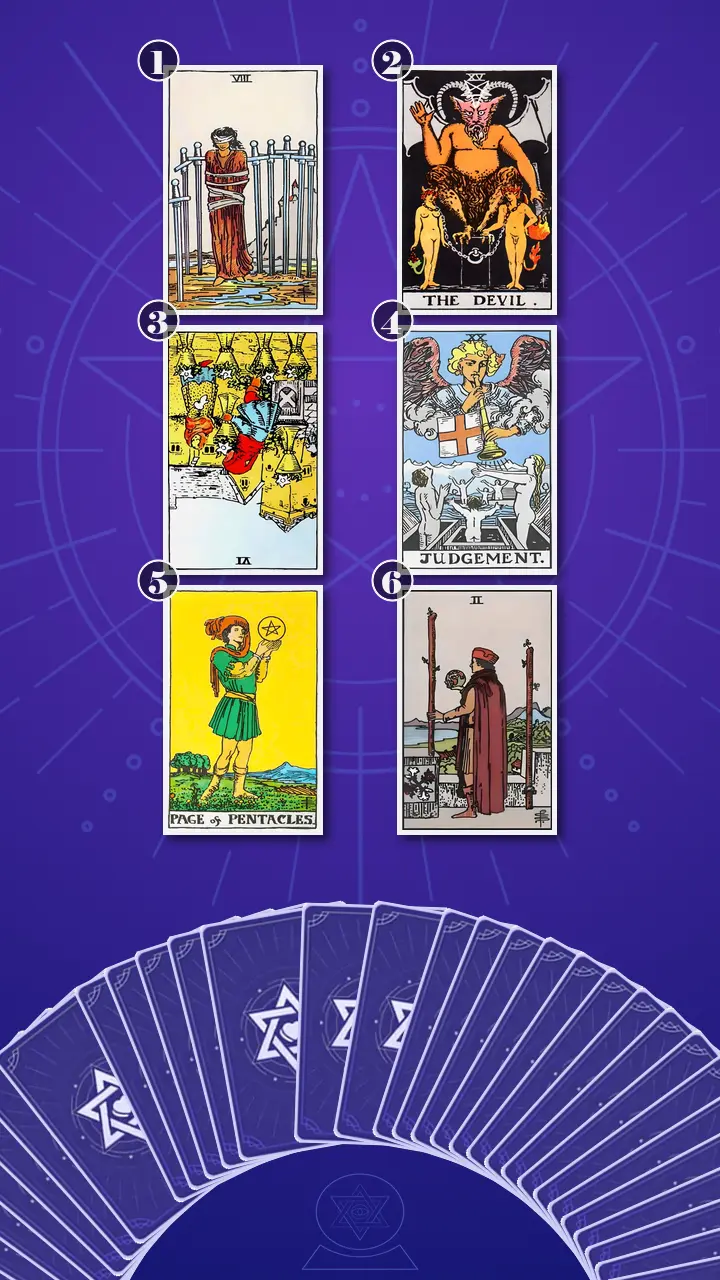
Reading the Map from Mental Enclosure to Open Horizon
I placed the cards in two columns and three rows, like a practical workbench map. I read across the top, moved diagonally toward the center, and then descended into action and integration.
Position 1: The Wall Made of Requirements
"Now I am turning the card for the Presenting cycle, the position that reveals the observable avoidance behavior and the contracted mental state described in the diagnosis."
The card was the Eight of Swords, upright.
I saw Jordan in the blindfolded figure: not permanently trapped, but interpreting an inner conclusion as an outer enclosure. Jordan opens the internal transfer posting during lunch, sees several requirements that are only partly familiar, and treats the list as a wall instead of as information that could be discussed or learned on the job. They reopen an old performance note, compare every line with it, and move the unfinished message into a private folder where no one can answer.
The upright Swords energy is over-constricted. Thought is active, precise, and busy, but it cannot become movement. The loose bindings matter to me because they show that the restriction is not an objective sentence about Jordan's future. The blindfold represents imagined judgment and the belief that complete readiness must come before visible participation.
"Which part of this is a confirmed workplace fact," I asked, "and which part is a conclusion you have repeated so often that it now sounds official?"
Jordan did not nod. They gave a small, bitter laugh and looked back at the posting. "Damn, this is exactly what I do. I save the role, research the requirements, and call the delay careful planning. It feels almost cruel to see it laid out like that."
I let the laugh stand. "The card is not calling you foolish or incapable. It is showing the moment useful preparation becomes avoidance when it keeps the question theoretical. The first opening is not a leap. It is noticing that the wall may be made partly of interpretation." Jordan's fingers loosened around the phone, though their eyes stayed fixed on the same requirement.
Position 2: The Task That Never Leaves In Progress
"The next card represents the Structural blockage, the attachment or self-reinforcing force that keeps the same response repeating."
The card was The Devil, upright.
I connected its chains to the workplace bargain Jordan described. After opening the transfer page, they switch to a low-risk operations task. Clearing a queue or formatting a spreadsheet feels productive because it cannot produce a visible rejection. The relief arrives quickly, like moving a task across a project board, but the transfer stays permanently in the research column.
The Devil's energy is not a warning that the role is wrong. It is an attachment to protection. The familiar discomfort of waiting feels safer than letting a current colleague or prospective teammate respond. In the short term, postponement lowers exposure. In the longer term, it prevents the new information that could make the role feel less intimidating.
I asked Jordan to listen for the inner bargain: "If I keep preparing, no one can judge me yet." That thought has the smooth, persuasive quality of an autopilot setting. It can even resemble the work-identity trap people recognize from Severance, except this pattern is happening in a real calendar, a real Workday tab, and a real body sitting in front of me.
Jordan went still. Their gaze moved from the card to the half-written message, then to the ordinary admin notifications on their phone. I saw the short relief and the longer uncertainty meet in their expression.
"You keep choosing familiar discomfort because it gives you control for ten minutes," I said. "That does not prove the transfer is unsafe. It shows what the loop promises to protect, and what it quietly prevents you from learning."
Position 3: The Flower Returned from the Past
"Now I am turning the card for the Underlying root, the position that exposes the limiting belief and past-facing emotional script feeding the repetition."
The card was the Six of Cups, reversed.
I saw the flower-filled cup as an old workplace memory being handed into the present. After reading the transfer description, Jordan remembers one difficult project review and silently turns it into a rule about every future team. They compare each listed requirement with that memory and wait to feel disproved before sending anything. The useful lesson and the shame-based conclusion arrive in the same package, so the past feels more authoritative than current evidence.
The reversed Cups energy is blocked in replay. Memory is not being used as context; it is being used as a forecast. The root pattern is not that earlier feedback meant nothing. It is that a specific event has been allowed to describe an entire identity.
"Past feedback is data; it is not a permanent job description," I said. "What happened in observable terms during that review? Separately, what did you decide it proved about you?"
Jordan's thumb pressed into the edge of the phone. Their face tightened, then softened by a fraction. "The feedback was that I missed context in one handoff," they said. "The verdict I added was that people would always see me as someone who needed too much help."
I watched them hold both sentences without rushing to erase either one. That was important. A fair reading does not demand that Jordan dismiss useful feedback or apply impulsively just to prove the past no longer matters. It asks them to stop carrying an old conclusion as though it were a current fact.
When Judgement Opened the Frame
The room around us seemed to quiet even though the train was still moving. I placed my hand beside the fourth card without turning it immediately, because this was the bridge between remembering the old story and answering the present desire.
Position 4: The Trumpet in the Saved Posting
"This card represents the Key transformation, the conscious awakening or reframing that can interrupt the loop without deciding your future for you."
The card was Judgement, upright.
Judgement does not ask Jordan to pretend the old review never happened. Its trumpet asks for a fair review of what that experience actually says, what it does not say about the prospective team, and what could be learned through one current question. The figures rising from the gray coffins are not being rescued by an outside force. They are responding to information in the present.
At 12:14 PM in the Toronto office kitchenette, Jordan had reopened the internal posting while the kettle clicked off. Their chest tightened, and they told themselves that one more hour of research would finally make the decision feel safe. They already knew which direction they wanted, but kept asking certainty to arrive before participation.
Jordan looked at the card and said, "But if I treat this as a question, does that mean I was wrong to wait?"
You do not need to keep repeating an old workplace story to prove you are safe or worthy; answer the present call with one honest, testable step, like the figures rising to Judgement's trumpet.
I let the sentence remain between us. Then I added, "The transfer is a question you can ask the present, not a courtroom where your worth has to be proven. A current answer can teach you more than another week of rehearsing every possible judgment."
Jordan's breath stopped first, fingers frozen above the phone. Their eyes lost focus; I could see the old review replaying, the sentence turned into a private ruling. Their jaw tightened. "But does this mean I was wrong about myself all this time?" they asked, anger carrying grief for the hours spent waiting. I answered, "A fair review does not erase useful feedback. It removes the sentence claiming one moment can describe every future room." Their shoulders lowered; their hands stopped rewriting the same message. A breath came out unevenly, then another, and their eyes shone without spilling over. They sat straighter, not certain, but available to new information. The kettle clicked, ordinary after the trumpet. I set a 10-minute timer and asked them to write one question about the prospective team's first 90 days. The question could stay private, shrink to two minutes, and did not require an application. "Now use this lens to remember last week: was there a moment when one current question could have felt different from another hour of rehearsing?"
This is where I used my signature diagnostic lens, Macro-Narrative Arc Auditing. I asked whether Jordan's current confusion was a true dead end, a false climax, or simply the messy middle of a transition montage. The answer was the messy middle. The transfer had been cast as a final scene in which an application would reveal the truth about Jordan, when it was actually an inciting incident for the next act.
As an artist, I have learned that a painful scene can become so familiar that it starts impersonating the whole film. My second lens, Turning Point Catalysis, helped me reframe the apparent dead end as the point at which the old workplace story could finally be tested. The card was not granting permission. Jordan was changing the relationship between perception and action.
I named the emotional crossing plainly: this was a movement from fear-driven perfectionistic delay and past-feedback replay toward grounded curiosity, present-day evidence, and steadier self-trust. Jordan did not need to feel fully ready to find out one real thing.
Position 5: The Pentacle You Can Actually Hold
"The next card represents the Grounded action, the practical step that translates the new perspective into information and self-trust."
The card was the Page of Pentacles, upright.
The Page held one pentacle at eye level, and I read that as one concrete piece of current workplace evidence. Jordan could send a concise message to a prospective teammate or another current colleague asking what the first 90 days in the role actually involve. The message would be a learning experiment, not an audition for worth.
The Earth energy is balanced through modest scale. It does not demand a dramatic application, a new certification, or a personality transplant. It asks Jordan to choose one bounded action that can produce information. One current answer can do more than ten rehearsed scenarios.
Jordan opened a notes app and typed a possible question: "What does someone in this role spend most of their first 90 days learning that the posting does not show?" Their hands still shook slightly, but they stopped editing after the first clear version. I told them the message could remain unsent until they had decided what they were asking for, and that retaining control over the next step was part of the experiment.
Position 6: The Horizon with Two Wands
"The final card represents Integration, the emerging direction and conscious way of carrying the lesson forward with planning, agency, and openness."
The card was the Two of Wands, upright.
I saw the globe and the two wands as a wider view held from solid ground. Jordan can value the stability of the current operations role while exploring a team with more autonomy and growth. The internal transfer does not have to become a forced leap or a secret promise. It can become a short plan with one person to contact, one skill gap to investigate, and one date to review what the evidence shows.
The Wands energy expands only after the Page has gathered something real. This is how a career crossroads becomes manageable: not through endless preparation and not through hustle-culture pressure to move faster, but through deliberate planning that leaves the decision with the person living it.
Jordan drew three lines in the notes app: what happened, what I learned, and what I want to ask next. They looked at the open posting again. This time, their shoulders remained low.
The One-Page Director's Cut
When I laid the six cards together, the story became coherent. The Eight of Swords showed the visible symptom: requirements had become a wall. The Devil showed why the wall stayed in place: postponement offered quick protection from evaluation. The reversed Six of Cups showed the root: one past workplace experience had been carried forward as an identity verdict. Judgement interrupted the loop by inviting a fair present-day review. The Page of Pentacles offered one small piece of evidence, and the Two of Wands turned that evidence into a wider, self-directed career plan.
The blind spot was not that Jordan secretly wanted the wrong transfer. It was the assumption that waiting was neutral preparation. Waiting reduced the immediate discomfort of being seen, but it did not teach Jordan anything new. In fact, the lack of current information made the role feel more intimidating and gave the old verdict more time to sound official.
The transformation direction was clear: move from trying to eliminate every possibility of judgment before acting to taking one bounded, information-gathering step this week. Jordan could explore a new direction without turning the exploration into a final decision. That is the practical heart of this six-position Transformation Path Grid for internal-transfer avoidance.
I offered three small next steps. Each one was designed to create evidence while keeping Jordan's boundaries and agency intact.
- Separate one lesson from one verdictBy Wednesday, open a note on your phone, set a 10-minute timer, and write one past workplace lesson connected to the transfer in two columns: Observable Lesson and Old Verdict. Add one current fact you know about the role and leave one unknown as a question.Use a neutral example if the memory feels too intense. The goal is not to decide whether the transfer is right; it is to stop filling unknowns with predictions.
- Run a One-Question Career ExperimentBefore Friday, draft or send a three-sentence message to a current colleague, recruiter, prospective teammate, or hiring manager. Ask one role-specific question about what the first 90 days involve or which skill is most important to learn.Read the message once for clarity, then either send it or label it an exploratory draft. If a full conversation feels too exposed, keep the first version to two minutes of work.
- Make the Director's Cut ReframeOn Sunday, create a two-week internal-transfer exploration plan with one person to contact, one requirement to investigate through current evidence, and one review date. Then write an objective six-month logline beginning with: For the next six months, I am exploring...Keep the logline a draft, not a promise to transfer. This is my Director's Cut Reframe: a way to reclaim your authorial voice over the next act without pretending the ending is already known.

A Week Later, the First Piece of Evidence
A week later, I received a Teams message from Jordan: "I asked the question. The first 90 days are more about stakeholder mapping and process design than the advanced tool I thought I had to master first. I'm setting up one conversation, not promising myself the transfer."
That was the proof I cared about. Jordan had not solved their whole career or banished self-doubt. They had allowed current information into a story previously controlled by old feedback. The doorway was still a doorway, but it was no longer a courtroom entrance.
That night, Jordan slept a full night, then woke with the familiar thought, "What if I'm wrong?" They smiled at it, opened the two-week plan, and kept going.
As I watched the reading settle, I understood the Journey to Clarity as a small change in authorship. Tarot had not chosen the team, guaranteed an outcome, or certified Jordan as ready. It had helped them see the loop clearly enough to write one present-tense line of the next scene.
If the saved Workday posting still makes your chest tighten and your hands restless, remember that wanting different work and fearing an old verdict can exist at the same time; noticing that split means you are no longer completely inside the old script.
What one small question could you place in the present-evidence column this week, allowing its answer to be information rather than a verdict about who you are?