One Tap Ends the Debate: 90 Seconds Bring the Next Choice Into View

When Five Minutes Became an Hour at 10:40 p.m.
I have learned that someone can be thoughtful, reliable in every team meeting, and still watch a five-minute scroll swallow an hour the moment a tedious task begins. The instant-gratification loop rarely waits for anyone to feel ready.
When Jordan (name changed for privacy) joined my video call from Toronto, they looked composed in the way competent people often do when discussing something they privately consider embarrassing. Then I asked for the most recent version of the problem, with timestamps instead of conclusions.
They took me to 10:40 p.m. on a Tuesday. Their portfolio file was open in the shared apartment, the laptop fan hummed, and a streetcar scraped along the rails outside. Blue light sharpened the dry feeling behind their eyes as one short-video notification appeared beside the document.
Jordan knew the better choice. They had even begun it. Then their warm phone offered relief without uncertainty, their fingers moved, and by 12:15 a.m. the unfinished file was still glowing behind a stream of clips.
"Five minutes somehow becomes an hour," they said. "I know what the sensible choice is, so why am I still bargaining with myself? If stopping takes this much effort, maybe I just don't have discipline."
I watched their jaw tighten on the last word. The feeling had the physical shape of pressing a brake pedal that had hardened into wet cement: every attempt to stop seemed to require more force, while the screen kept pulling the body forward.
"I don't hear a character defect in that story," I said. "I hear a repeatable sequence happening at a low-energy point in your day. We are not going to put your worth on trial. We are going to slow the sequence down and draw a map of where choice is getting lost, and where it can become visible again."
After a decade of reading cycles, I have stopped blaming people for every low tide. A difficult cycle can shape the conditions of a choice without becoming its author. That distinction would guide the entire reading.
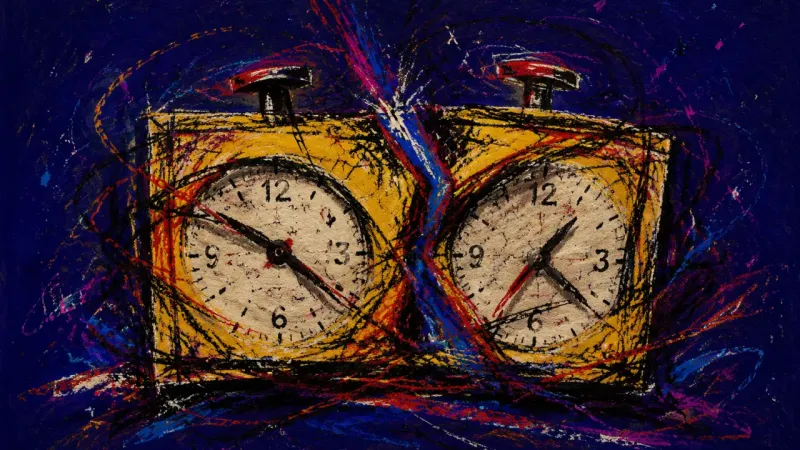
Choosing a Staircase Through the Noise
I asked Jordan to place both feet on the floor, take one unforced breath, and hold one question in mind: "Why does the tempting option keep beating my better judgment?" I shuffled slowly, using the movement as a transition from self-accusation into observation. Nothing about it required belief in a fixed future.
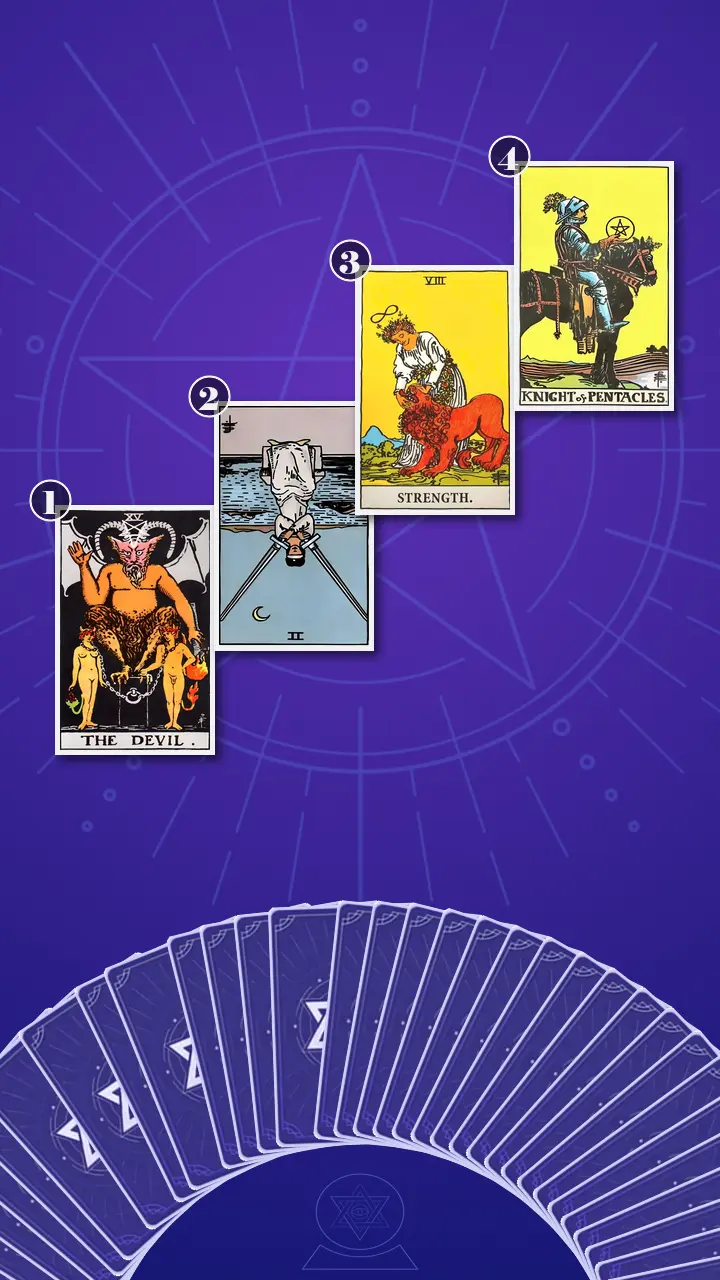
I chose the Four-Layer Insight Ladder, a four-card tarot spread arranged like an ascending staircase. I use tarot here as an external cognitive map. The images help me separate behavior, belief, capacity, and action so that a fast, shame-loaded loop can be examined without pretending the cards predict what Jordan must do. That is how tarot works in this kind of reading: the cards organize attention; the person retains authority.
The spread was the smallest structure capable of answering the whole question. The first position would show the observable five-minutes-becomes-an-hour pattern. The second would reveal the fear and internal bargaining maintaining it. The third would identify the capacity that could change Jordan's relationship with the urge. The fourth would ground that insight in one repeatable setup.
I placed the cards from lower left to upper right. The diagnostic pair sat on the first two steps; the transformation pair rose above them. I told Jordan that this was not a prediction about whether the app or the portfolio would "win." It was a way to locate the point at which agency could be practiced.
The Loose Chain Before the Tap
Position 1: The Observable Pattern
Now I turned over the card representing the observable pattern: beginning the better-judgment option, switching to immediate reward, and experiencing the urge as if it controls the decision.
It was The Devil, upright.
I addressed the name before it could create unnecessary alarm. "This is not a verdict, and it is not saying you are trapped by some permanent force," I said. "In this context, The Devil shows attachment, temptation, and the moment a rewarding pattern is granted more authority than it actually owns."
I pointed to the two figures beneath the raised hand. Their chains were visible, but the loops around their necks were loose. The card did not pretend that leaving was effortless. It showed that influence and inevitability were not the same thing.
I returned Jordan to 10:40 p.m. The portfolio document was already open when the notification appeared. Their hand reached toward the phone before they named the decision. The inner bargaining arrived almost instantly: "I am only going to check. I deserve a quick break. I can still start at eleven." One clip became a feed, and at 12:15 they described the missing time as something the app had done to them.
The Devil located the meaningful choice point much earlier. It was not at the end of the lost hour, when Jordan was tired and furious with themselves. It was in the half-second before the first automatic reach, while the chain was persuasive but still loose. Like a "Continue watching?" screen, the design strongly favored continuation while still containing a visible decision point.
The energy here was an excess of immediate reward combined with a blockage around conscious agency. The urge filled the whole field of attention, while the longer-term choice had not yet been translated into a small enough action to compete. That imbalance maintained the belief that desire was making the decision from outside Jordan.
Their thumb froze against the edge of the phone. Their eyes drifted away from me as if they were replaying the ten seconds before several different nights. Then a short, bitter laugh escaped.
"That is so accurate it is almost rude," they said. "I keep focusing on the whole hour. I don't even look at the first reach."
"Then we have found an observable point, not a new reason to blame you," I replied. "The loose chain is not asking you to prove that interruption is easy. It is asking us to notice where support could arrive earlier."
The Browser With Fifteen Arguments
Position 2: The Mechanism Beneath the Loop
Now I turned over the card representing the psychological mechanism beneath the pattern, especially the fear of lacking control and the internal bargaining that makes immediate relief attractive.
It was the Two of Swords, reversed.
In the Rider-Waite-Smith image, a blindfolded figure holds two blades crossed tightly over the chest. Reversed, the card showed judgment in excess and in blockage at the same time. Jordan did not lack reasons. They had so many competing reasons that none of them could become a usable direction.
I described the subway ride home after a hybrid office day. Jordan planned to work on the portfolio after dinner. Then the internal hearing began: responsible people follow the plan; they were legitimately exhausted; five minutes might restore enough energy; tomorrow could be more efficient; a stricter schedule would fix everything. By the time every argument had acquired an exception, Instagram was already open.
"It is like a browser with fifteen tabs," I said. "One is playing 'Be disciplined.' Another is playing 'You deserve rest.' A third is promising that tomorrow will be different. None of them contains the next physical action, and they are all making noise."
I saw Jordan's shoulders rise toward their ears. One hand closed around the other, then loosened.
"The app is not winning a moral contest; it is ending an exhausting negotiation," I said. "Immediate reward gets leverage because it closes the meeting faster than your current plan does."
That was the root beneath the visible lapse. Better judgment had become associated with an internal cross-examination, competing rules, and anticipated regret. The tempting option offered not only entertainment but immediate release from having to decide perfectly.
"That's the part I haven't wanted to admit," Jordan said quietly. "Sometimes opening the app feels like relief because the argument stops. Then afterward I start a second argument about what the first argument means about me."
Their chest expanded around a careful breath, but their jaw remained set. Recognition had reached them without yet becoming relief. There was grief in realizing that the strict Screen Time limits, pristine Notion resets, and promises about Monday had often added more courtroom voices to an already crowded room.
I told them that this card did not recommend a better closing argument. It recommended briefly uncrossing the blades. For seven days, the experiment could be as small as writing down the two actual options and waiting ninety seconds before opening either one. The purpose would not be to force the "productive" choice. It would be to make the decision visible before frictionless design made it feel inevitable.
When Strength Met the Lion Without a Fight
Position 3: The Turning Point
A streetcar bell sounded outside Jordan's window just as I reached the third step of the spread. The clean note cut through the laptop fan, and the room seemed to hold still around it. I turned over the card that represented the key shift from willpower-based self-judgment to a curious pause capable of holding the urge without automatically obeying it.
It was Strength, upright, the catalyst and central antidote of the reading.
The woman in the card did not run from the lion, pin it down, or shame it for having teeth. Her hands rested calmly around its open mouth. The energy was balanced: instinct remained alive, but patient contact replaced either obedience or attack. The infinity symbol above her suggested a repeatable relationship, not a one-time victory.
I translated the image into Jordan's real evening. Their hand begins moving toward the phone. Instead of launching another argument, they place both hands on the desk and name the promised reward: "I want fast relief from not knowing how to finish this section." The urge is allowed to remain while they replace one portfolio heading for two minutes. Afterward, they can reconsider the scroll. Nothing has to be conquered before choice returns.
"A strong urge is information, not an instruction," I said. "Strength is a volume control, not a delete button. The urge may remain audible without controlling the whole room."
Calibrating the Moment, Not Judging the Person
At that point, an old professional instinct surfaced in me. When I look at planetary motion, I do not ask whether a planet has enough character to resist gravity. I look at timing, momentum, and the point where a modest course correction can matter. Human choices are not planets, but the comparison gives me a useful diagnostic lens.
I call that lens Decision Timing Calibration. I asked whether 10:40 p.m., after a demanding workday, with a warm phone in reach and an undefined creative task on screen, was structurally optimal for making a high-friction choice. It was not. That did not remove Jordan's agency. It showed why asking that moment to produce heroic willpower was a poorly timed demand.
Then I used Cyclical Variable Filtering. I stripped away the temporary friction that changed from night to night and isolated the variables that repeatedly shaped Jordan's longer orbit: the phone was within automatic reach, the portfolio step was vague, the relief beneath the urge went unnamed, and no pause had been selected in advance. Those were workable variables. "Undisciplined" was not one of them.
I brought Jordan back to the familiar scene. At 10:40 p.m., the portfolio file is open and the phone is already warm in their hand. A five-minute scroll quietly becomes midnight. Their jaw tightens because they knew the sensible choice before clicking, yet knowing did not make its first step easier.
You do not need to defeat the lion to regain choice; meet it with a steady hand, then guide its energy toward the next small action.
I let the sentence remain between us. An urge did not have to disappear before Jordan could choose. Curiosity could replace the courtroom, and one prepared step could replace the willpower contest.
Jordan's breath stopped for a beat. Their fingers remained suspended above the desk, neither clenched nor relaxed, while their eyes lost focus as if an old reel were running behind them. Their brows drew together first, not with relief but with resistance.
"But doesn't that mean I've been doing it wrong this whole time?" they asked. The words came out sharper than anything they had said before. "I have wasted so much time building rules and then breaking them."
I watched the anger reach its edge. Their lower lip pressed inward; their shoulders dropped by a fraction; then both hands opened flat on the desk. A long breath left their chest with a slight tremor. Their eyes had reddened, but the expression was not simple sadness. Relief had arrived beside the unsettling responsibility of seeing a real choice point. For a moment, clarity left them almost blank, as if putting down a heavy bag had changed their balance faster than their body could adjust.
"It means your earlier systems gave us data," I said. "They showed that harsher rules do not reliably support the tired version of you. That is different from saying you were wrong. We are not rewriting your history as failure. We are using it to design the next experiment."
I leaned a little closer to the camera. "Now, with this new perspective, think back to last week. Was there a moment when this insight could have made the experience feel different?"
Jordan recalled Saturday morning in a crowded Queen West cafe. They had opened Figma, stalled over a case-study caption, and reached for the phone when a limited-time sale appeared. The urge had promised two forms of relief at once: the certainty of buying something and escape from not knowing how to phrase the caption.
"If I had named that, I might still have bought it or still have taken a break," they said. "But it would have felt like I was choosing, not getting dragged."
That qualification mattered. Strength was not secretly productivity advice, and tarot was not there to decide that the portfolio must always outrank rest or pleasure. The shift was from automatic relief to a choice that could include the need underneath it.
This was the first crossing from shame-driven willpower battles and perceived helplessness to compassionate self-regulation, practical agency, and steadier self-trust. It was not a cure or a promise that every urge would become easy. It was a workable change in relationship: the lion could stay in the room without holding the phone.
The Knight Who Prepared Before Moving
Position 4: The Action That Can Survive a Tired Day
Now I turned over the card representing the practical next step: one repeatable setup or small action that could make the better-judgment choice easier to begin.
It was the Knight of Pentacles, upright.
The horse stood still. The Knight held one pentacle at eye level while cultivated fields stretched behind him. I read that stillness as purposeful inspection, not hesitation. The card carried balanced earth energy: preparation, modest effort, and repetition sturdy enough to work on an unremarkable evening.
I mapped the image onto Jordan's Thursday portfolio block. Before the tired part of the night, the phone charges across the room. Unrelated tabs are closed. The case-study file is already open, with "replace one heading" written at the top. A two-minute timer begins. The same setup returns the next ordinary evening, so better judgment no longer depends on exceptional motivation.
"This is a saved template for a tired day," I said. "You do not need to prove you can resist all night. You need to support the next two minutes."
Jordan reached for their phone, but this time they opened Notes. I watched them type "replace one heading" and place the phone on the far edge of the table.
"That feels almost suspiciously small," they said.
"Small is the feature," I replied. "After two minutes, you are allowed to stop deliberately. Self-trust grows from kept two-minute promises, not dramatic resets. Do not ask tomorrow to supply willpower that tonight's setup could provide."
The Knight completed the progression I saw in the cards' hands: The Devil's raised hand appeared to control; the reversed Two of Swords crossed both arms in defense; Strength's hands guided living energy; the Knight held one chosen commitment steadily in view. Agency had not arrived from outside the spread. It had changed form.
Building a Better Orbit Around the Next Two Minutes
I gathered the four cards into one explanation. Jordan's past attempts at app bans and perfect weekly resets had increased pressure without making the first portfolio step clearer. At the visible level, The Devil showed the automatic reach for fast relief. Underneath it, the reversed Two of Swords showed an overloaded internal hearing in which distraction ended the debate. Strength recovered choice by treating the urge as information. The Knight of Pentacles moved that recovery into the physical environment.
The central blind spot was Jordan's belief that knowing the sensible choice should make a system unnecessary. When it did not, they treated the lapse as evidence about their character. But judgment is not the same thing as a first action. The transformation was to stop trying to win a willpower argument in the most depleted moment and instead use a preselected pause, an honest translation of the urge, and one prepared two-minute step.
I also placed a guardrail around Jordan's habit of designing a harsher life immediately after a lapse. I call it The Orbital Pause Strategy: any dramatic system-level response, such as deleting every app, imposing a total ban, or rebuilding the entire week, waits seventy-two hours. The delay is not applied to urgent safety, essential support, or the tiny choice in front of them. It is reserved for high-stakes resets made while shame and fatigue are temporarily distorting the environment.
After seventy-two hours, Jordan could review what actually happened: the trigger, the relief promised, the first automatic action, and the setup that was missing. A course correction based on those variables would have a better chance of serving their long-term orbit than a punishment designed at midnight.
The Choice Gap and the Better-Choice Ramp
- Use the 90-Second Choice Gap.At the next familiar decision point, open Notes before tapping either option. Write one sentence beginning with "The two actual choices are..." and another beginning with "This urge is promising immediate relief from..." Set a ninety-second timer. When it ends, choose one action on the better-judgment path that takes no more than two minutes, or deliberately choose a bounded form of rest and reconsider afterward.The pause does not have to remove the urge or force productivity. Start with thirty seconds if ninety feels like extra pressure. If the exercise increases distress or feels unhelpful, stop and use whatever rest or support feels appropriate.
- Prepare the Two-Minute Better-Choice Ramp.Before one portfolio session this week, charge the phone outside the immediate work area, leave only the required file visible, and write one physical first step at the top, such as "replace the case-study title" or "draft three caption options." Set a two-minute timer, then decide whether to continue. A preselected ten-minute scroll can remain available afterward if Jordan genuinely wants it.Prepare the surface before the low-energy part of the evening. The minimum version is moving the phone one arm's length away and opening the correct document. The boundary belongs to Jordan; it is support, not punishment.
I asked Jordan which experiment felt small enough to try without turning it into another referendum on discipline.
"The note first," they said. "And one heading. Not a full case study, not a perfect evening, just one heading."
That answer contained more agency than any promise to resist forever. The cards had clarified the pattern, but Jordan had chosen the scale, the boundary, and the next move.
A Week Later, One Heading Before Coffee
Six days later, I received a message from Jordan. They had used the ninety-second note at 10:43 p.m. and written that the urge was promising relief from uncertainty, not merely entertainment. They moved the phone, replaced one heading, and then intentionally watched clips for ten minutes with a timer they had selected before opening the app.
They also had one night when the five-minute scroll became forty minutes. This time, they did not draft a total ban. They put the proposed reset into the seventy-two-hour Orbital Pause, recorded the choice point the next morning, and kept the one useful part of the setup.
On Friday, Jordan slept through the night. Their first thought on waking was, "What if this stops working?" They smiled anyway, set the phone across the room, and changed one portfolio heading before coffee. Clearer, not cured; vulnerable, but choosing.
I saw the reading's value in that modest evidence. Tarot had not supplied Jordan with supernatural discipline or removed temptation from their life. It had made the loop visible early enough for them to meet it differently. The cards offered the map; Jordan remained the person steering.
For me, this Journey to Clarity was not about achieving a perfect orbit. It was about distinguishing a temporary pull from a permanent verdict, then building steadier self-trust through choices small enough to keep.
I know the moment when the phone is already warm in the hand, the jaw tightens, and one small click starts to feel like evidence that personal judgment cannot be trusted. If that moment belongs to you too, noticing the lion before fighting with it already means you are no longer at the beginning.
If your lion did not have to vanish before you could choose, what tiny part of your next setup could carry the first two minutes for you: a phone across the room, two honest options in Notes, or one line already waiting at the top of the file?