From Deleted Draft to Family Boundary: The Workshop Stayed Booked
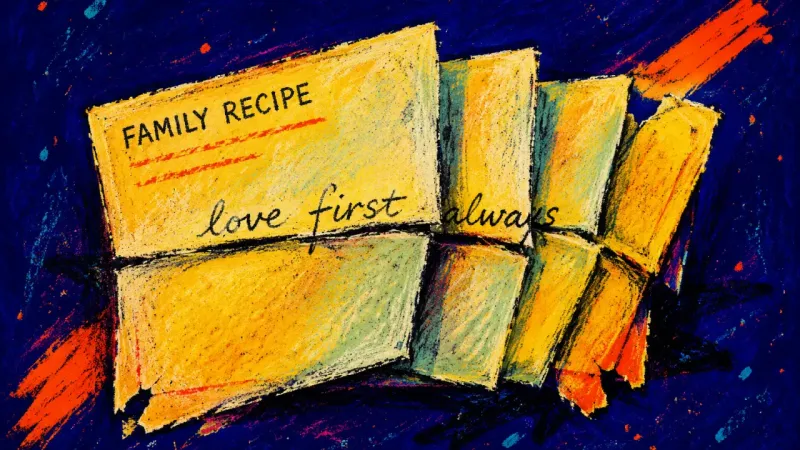
The Happy-Family Script That Left a Life in Drafts
I have learned to pay attention when a twenty-something Toronto professional can write a polished stakeholder update but deletes one honest sentence to the family group chat. That kind of decision paralysis is often doing more than keeping the peace.
At 8:56 p.m. on a Sunday, Jordan joined my video room just as their family Zoom ended. I could hear the laptop fan whirring through their microphone. A screenshot of five smiling faces still glowed behind our call, their phone vibrated against the table, and they lifted a mug before pulling a face at the cold-coffee smell. Their shoulders stayed raised as if the conversation had not actually released them.
I watched Jordan open a note titled What I Actually Want. They typed, I want to try editorial strategy. A family-chat notification sounded. Hearts began appearing beneath the group screenshot. Then I watched them delete the sentence.
"I know exactly how to look fine in a family photo," Jordan said. "I keep telling them the communications job is still a good fit. It is stable, and with Toronto rent, I know that matters. But I do not know whether I want this life or just know how to explain it. Why do I keep faking family harmony instead of choosing my path?"
I heard the contradiction immediately. Jordan was not simply choosing between a career path and a family. They were trying to prevent visible difference from being interpreted as lost belonging. The guilt had the physical logic of a conference lanyard pulled one notch too tight: every cheerful answer made the room easier for everyone else while leaving pressure at the base of Jordan's throat.
"I am not going to tell you that your family is secretly bad, or that honesty guarantees an easy response," I said. "I also will not ask you to make a dramatic decision tonight. Let us map the pattern carefully. We are looking for the point where care turns into self-erasure, and for one next step that gives your own path a chance to produce evidence."
Choosing the Bridge-and-Compass Spread
I invited Jordan to put both feet on the floor and take one unforced breath. I shuffled slowly, not to create mystique, but to mark a transition from replaying the family call to examining it.
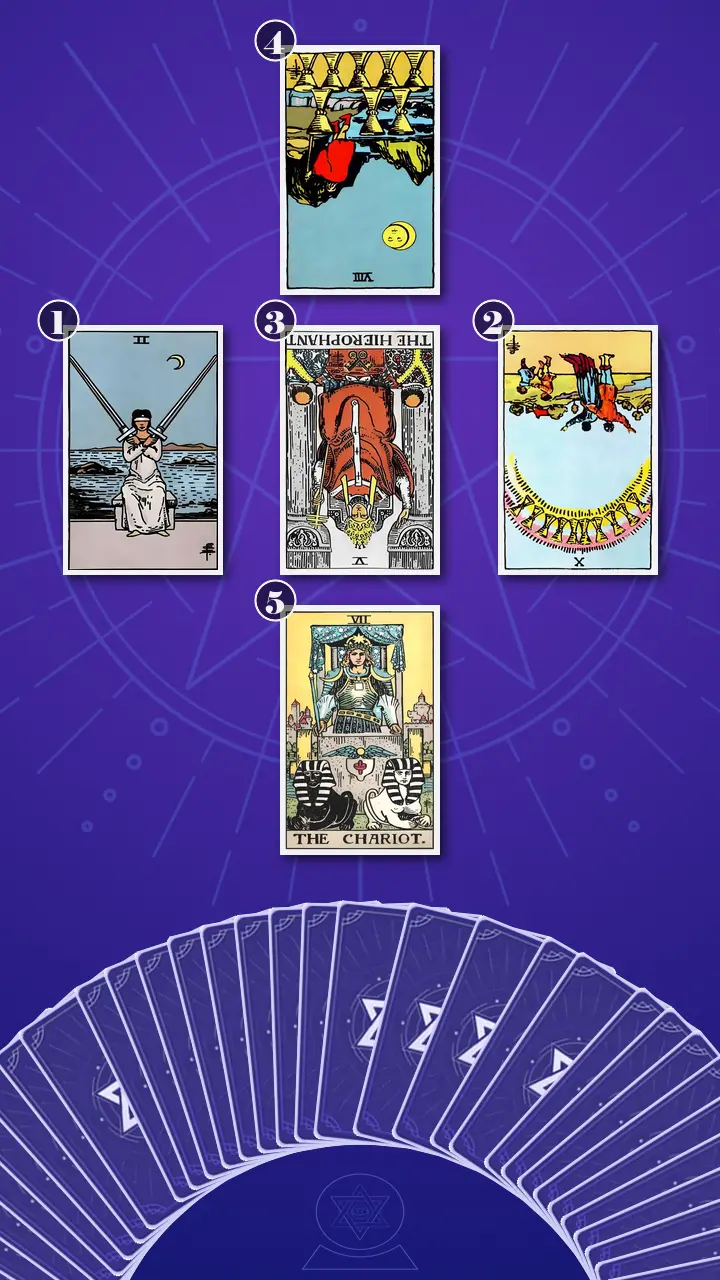
I chose the Relationship Spread · Context Edition, a five-card relationship tarot spread for family boundaries and personal direction. For anyone wondering how tarot works in my practice, I use a spread as a structured set of questions. The cards do not expose relatives' private motives or issue a verdict about the future. They help me separate observable behaviour, interpretation, inherited rules, blockage, and available agency.
I arranged the cards like a bridge crossed by a vertical compass. The first position would show Jordan's contribution to the stalemate. The second would reflect Jordan's perception of the happy-family image, without pretending I could know what each relative privately intended. The central card would reveal the rule holding the relationship pattern together. Above it, I would place the deeper blockage. Below it, the final card would point toward a constructive direction Jordan could choose regardless of whether anyone else changed.
I selected this spread because the problem was relational before it was predictive. A larger Celtic Cross could have added impressive-looking detail without improving the answer. A shadow-focused reading could have placed too much responsibility inside Jordan and ignored the family context. These five positions were enough to trace a clean line from self-silencing to self-directed movement.
Reading the Map Between Belonging and Choice
Position 1: The Two Windows of the Two of Swords
"The card I am turning now represents the behaviour through which you help keep the decision suspended," I told Jordan. "It shows the automatic agreement, deleted preference, and private over-analysis at the entrance to the pattern."
I turned over the Two of Swords, upright. The blindfolded figure held two swords crossed over their chest while water rippled at a distance. I saw thought being used as a protective barricade. Jordan was not short of intelligence, language, or options. Mental control was running in excess, while visible choice was blocked.
I matched the crossed swords to the two windows still open on Jordan's screen. One held the honest private note: I want to try a different direction. The other held the family-safe reply: Yes, the stable job is still good. Jordan could name both loyalties perfectly. They wanted to test editorial strategy, and they did not want the family to experience that choice as rejection. So they rehearsed every consequence and allowed neither truth to change the calendar.
"The inner sentence sounds like, I know what I want, but if I say it, then everyone will have to admit we are not as uncomplicated as we look," I said. "Silence prevents tonight's awkward pause, but it also prevents this week's experiment. You are not out of options; you are protecting every option from becoming visible."
Jordan gave a short laugh that carried no amusement. Their hand covered their mouth, then dropped to the table. "That is so accurate it feels a little brutal."
"Then let us keep the accuracy and remove the brutality," I replied. "This stalemate began as protection. I am not asking you to shame the part that learned it. I am asking whether the protection still deserves control of every decision."
I invited Jordan to recall the last time they said, "Whatever works." I asked, "What preference had you already formed before you edited it out?" Their eyes moved toward the unsent note. "Saturday morning," they said. "I wanted to keep it for a portfolio workshop."
Position 2: The Photograph Beneath the Reversed Rainbow
"The card I am turning now represents your perception of the family system's investment in looking happy and uncomplicated," I said. "It describes your experience of that image. It does not give me objective access to anyone else's motives."
I revealed the Ten of Cups, reversed. Upright, its rainbow of cups frames a scene of visible emotional fulfilment. Reversed, the Water energy was not a declaration that affection was false. It showed shared feeling being edited so carefully that tension, difference, and disappointment had nowhere legitimate to appear.
I asked about the most recent family visit. Jordan described standing in a North York condo lobby, the lemon-cleaner smell still sharp in the air and wet traffic hissing beyond the glass doors. The visit had included a question about their career that everyone redirected into jokes. Jordan chose the brightest group photo, added three hearts, and replied, "Such a perfect day," when someone praised how close the family looked.
At almost that exact moment in our reading, Jordan's phone lit up beside the card with another heart reaction. I did not treat the timing as an omen. I treated it as a useful mirror.
"The photo can be real without being the whole truth," I said. "The affection can be genuine, and the pressure to crop out difference can still leave you invisible. Reversed Ten of Cups energy becomes excessive image maintenance and deficient room for complexity. The problem is not that you love the picture. It is that the picture has become a job description."
Jordan's chest lifted with a shallow breath. Their thumb hovered over the new notification, but they turned the phone face down. "We do this after every tense visit," they said quietly. "We prove it was good before anyone can say it was complicated."
I let that distinction settle. Closeness and performance were not identical, even when they occupied the same photograph.
Position 3: The Approval Gate of the Reversed Hierophant
"The card I am turning now represents the relationship dynamic itself," I said. "It shows the shared or internalised rule that connects your private conflict to the performance of harmony."
I turned the Hierophant, reversed. The crossed keys at the figure's feet looked like an approval gate, while the two acolytes suggested the transmission of a code for acceptable belonging. The reversed energy made that code available for review. Tradition was no longer functioning as an unquestioned structure, but Jordan had not yet replaced it with consciously chosen values.
I asked Jordan to notice how every career idea was rewritten before it could pass that imaginary gate. Editorial strategy had to become stable, practical, immediately profitable, easy to explain, and incapable of worrying anyone before it was allowed onto the calendar. No relative had explicitly banned a workshop, yet Jordan was still seeking an imagined stamp of approval.
"No one explicitly banned this, so why am I still asking permission?" Jordan said, testing the sentence aloud.
"Because an inherited rule can feel objective long after you become capable of questioning it," I said. "Care is not the same as compliance. You can consciously value connection while questioning automatic availability. Review is not rebellion, and self-authorship does not require turning your family into an enemy."
I thought of the apparent backward motion I had watched in planetary cycles throughout my years of working with the stars. A retrograde does not mean a planet has been condemned to reverse forever. It reveals what changes when perspective shifts. I saw the same invitation here: the reversed card was not punishment. It was a chance to inspect the terms and conditions of belonging that Jordan had accepted before realising individual clauses could be reviewed.
I compared the moment to The Truman Show, not at the dramatic exit, but at the quieter instant when the set's rules become visible. Once Jordan could see the production, the polished version of normal stopped being the only available reality.
I asked for two private lines. Jordan wrote, I value connection, then beneath it, I am allowed to question automatic availability. Their fingers tightened around the pen, their gaze drifted as if replaying years of easy answers, and then their grip loosened. The exhale that followed sounded as though it had travelled up from somewhere below the ribs.
Position 4: The 11:42 p.m. Return Loop
"The card I am turning now represents the primary blockage," I said. "It exposes the fear that visible difference will threaten belonging, and the behaviour that pulls you back before your path can produce evidence."
I revealed the Eight of Cups, reversed. In the upright image, a red-cloaked figure walks away from an established row of cups toward difficult mountains. Reversed, that motion becomes hesitation, circling, or repeated return. Water was blocked in a familiar emotional arrangement: Jordan could approach a personal direction, feel the first spark of meaning, and then retreat before learning anything from it.
I returned to a Thursday night Jordan had described. At 11:42 p.m., they sat at the narrow kitchen table with an editorial course open beside a half-built Notion board. The fridge hummed. The tea had gone cold and tannic. Blue screen light sharpened the shadows under their eyes. Then a cheerful family notification arrived.
The inner sentence was immediate: I was almost ready, but first I need to know how everyone will take it. Jordan closed the course page and opened LinkedIn instead. Someone else's completed career pivot appeared on-screen, while Jordan's own experiment remained untested.
"This is not evidence that the path failed," I said. "It is evidence that anticipated relational discomfort interrupted the test. Possible disagreement feels urgent tonight. The slower loss of direction takes weeks to become visible, so your nervous system keeps prioritising the immediate relief. No conflict appeared, but neither did your life."
Jordan's breathing paused. Their index finger froze against the mug handle. Their eyes lost focus for several seconds, as if the late-night kitchen scene were replaying behind them. Then their jaw released and they said, on a long breath, "I keep preparing the explanation instead of trying the thing."
"That does not make you weak or disloyal," I said. "It tells us exactly where intervention is possible. The Eight of Cups is not demanding a dramatic departure. It is asking for one reversible action that can survive thirty minutes without a family presentation."
When the Chariot Took the Reins
The laptop fan clicked off, and the sudden quiet changed the texture of the room. Through Jordan's open window, I heard the distant bell of a Toronto streetcar. A route was continuing somewhere outside while we turned the reading's key card.
Position 5: Two Loyalties, One Chosen Direction
"The card I am turning now represents the constructive direction available to you," I said. "It shows how care can remain possible while automatic agreement is replaced by one boundary and one reversible action."
I revealed The Chariot, upright. The black and white sphinxes faced slightly different directions. The charioteer did not force them to merge, erase their difference, or wait for perfect agreement. Self-command appeared as balanced, deliberate energy: the capacity to establish a route while competing loyalties remained present.
I showed Jordan the symbolic dialogue across the spread. The Two of Swords had placed two opposing forces against a seated, guarded body. The Chariot kept two opposing forces in view, but the body was now upright, open-eyed, and directional. The breakthrough was not choosing family or self as enemies. It was changing who governed the tension.
In modern terms, the Chariot sounded like this: I care about seeing everyone, and I am keeping Saturday morning for a portfolio workshop. No apology would cancel the preference. Jordan could then place one thirty-minute experiment on the calendar with a clear cost and stopping point. Affection, guilt, and uncertainty could travel alongside the choice without any one of them receiving sole control of the route.
I returned us to 8:56 p.m.: five smiling faces gone, the Notes file open, one honest line erased, Jordan's throat still tight. They were treating the need for a perfect, harmless decision as proof that no movement was yet responsible.
This was where I used what I call Decision Timing Calibration. I asked whether Sunday-night guilt was a structural reason not to test editorial strategy, or temporary friction created by the emotional low tide after a family call. A major announcement made in that contracted state might be badly timed. A private, reversible thirty-minute experiment was not.
I then applied Cyclical Variable Filtering. I stripped away the temporary variables: the glowing group photo, the immediate heart reactions, comparison fatigue, and the imagined need to explain a whole new identity. I kept the variables that could affect Jordan's longer orbit: interest, energy after doing the work, cost, safety, skill fit, and whether a small test generated enough curiosity for another one.
You do not have to keep the peace by staying motionless; choose one honest next step and take the reins between the Chariot's opposing sphinxes.
Jordan's breath stopped for one beat. Their eyebrows lifted, their pupils widened, and the hand gripping the mug went completely still. Then the insight reached somewhere less defended. Their gaze moved from the crossed swords to the two sphinxes; their fingers opened one by one; their shoulders dropped with a movement so sudden it looked almost unfamiliar.
"But does that mean I have been wrong this whole time?" Jordan asked. The words came out sharper than anything they had said before. Their eyes had begun to redden, but the anger arrived ahead of the tears.
"No," I said. "It means stillness once reduced a real relational risk, and now it is being applied to choices small enough to test safely. You do not have to prosecute your past self to change the strategy. You only have to stop treating yesterday's protection as today's command."
Jordan looked briefly weightless, almost dizzy in the space where the old rule had been. Relief had lowered their shoulders, but clarity had also handed responsibility back to them. "So I actually have to put something on the calendar," they said, half laughing and half exhaling.
"Now, using this new perspective, think back to last week," I invited. "Was there a moment when this insight could have made you feel different?"
Jordan remembered the Tuesday message about missing part of a family weekend for the portfolio workshop. "I could have booked it before turning their imagined reaction into a verdict," they said. "I could care how they feel without giving that anticipated feeling control of my calendar."
I named the transition plainly. This was a move from guilt-driven self-silencing and approval-seeking paralysis toward self-directed choice that allowed family connection and visible difference to coexist. It was not full certainty. It was the first step from contraction into curiosity, where one bounded preference and one reversible test could create information that overthinking could not.
"Let the choice produce evidence before the fear produces a verdict," I said.
Evidence Before Permission: The Seven-Day Route
I gathered the five cards into one coherent story. The earlier influence was not one hidden event I could claim to uncover. It was the repeated experience of being useful as the easy one, combined with an inherited rule that belonging worked best when difference stayed offstage. In the present, the Two of Swords used thought to preserve a ceasefire. The reversed Ten of Cups showed how genuine affection could become entangled with a curated image. The reversed Hierophant made the approval rule visible. The reversed Eight of Cups exposed the research-and-retreat loop. The Chariot supplied the unused resource: self-governance while both love and discomfort remained on board.
I also pointed out the spread's elemental imbalance. Jordan already had plenty of Air for analysis and plenty of Water for relational awareness. No Wands or Pentacles had appeared. Insight, desire, and practical follow-through were not yet working together as habits. Another night of thinking would not supply the missing evidence. Jordan needed one spark of preference and one concrete appointment.
The cognitive blind spot was treating an anticipated family response as if it were observed data. Jordan had been requiring each personal option to survive an imaginary stakeholder review before it could reach the calendar. The transformation direction was therefore specific: replace one automatic agreement with one bounded truthful preference, then complete one reversible seven-day experiment without demanding that it become a permanent identity decision.
I gave Jordan three pieces of actionable advice. I kept them small because finding clarity at a family and career crossroads rarely requires a dramatic launch. It usually requires better evidence.
- The Eight-Minute Evidence Note Before the next scheduled family call, open a phone note and set an eight-minute timer. Complete three lines: "This week I want to test ___." "The smallest reversible version is ___ for 30 minutes by ___." "I am willing to share ___, but I am keeping ___ private." Put the test on the calendar before the timer ends. Keep the review private if writing it already feels loaded. The minimum version can concern one neutral hour this weekend. Do not disclose anything that could affect housing, finances, privacy, or physical safety.
- The Unpolished Preference Practice During one low-stakes conversation this week, replace "whatever works" with a concrete preference about timing, food, travel, or call length. Use: "I care about staying connected, and this week I am choosing ___. I am not looking for a group decision about it." Leave the sentence unpolished. Do not add "but it is totally fine if not" after the boundary. If sending it is unsafe or materially risky, practise it in Notes or with a trusted person instead.
- The Chariot Beta and Orbital Pause Within seven days, run one 30-minute, CAD 0-15 test: draft a 200-word editorial brief, take one free course lesson, or ask a trusted colleague three questions in a 15-minute call. Create a visible artefact or appointment. Schedule the test immediately, but use my Orbital Pause Strategy before any irreversible commitment or dramatic family announcement: wait 72 hours, then review interest, energy, cost, safety, and skill fit. The 72-hour pause is for high-stakes decisions, not for postponing the experiment. Record only: "I felt more curious when ___." "My energy dropped when ___." "The next smallest test could be ___." A result of "not this" still counts as useful evidence.
I asked Jordan to look at the plan as a route, not a verdict. The Chariot was not promising that the workshop would become a career or that every relative would respond well. Tarot had clarified the variables, but Jordan retained authority over timing, disclosure, cost, and direction. The cards could hold the map steady. They could not, and should not, take the reins from the person living the life.

A Week Later, the Calendar Changed First
Six days later, I received a message from Jordan. It included a screenshot of a calendar block labelled Editorial Test 1: 30 minutes and a rough 214-word brief saved with that day's date. Jordan had also sent one family message: "I care about being there this weekend, and I am keeping Saturday morning for a portfolio workshop. I will join everyone at one."
A relative had replied, "Is everything okay?" Jordan had felt their throat tighten, waited without deleting the original preference, and answered, "Yes. This is something I am testing." The exchange contained an awkward pause and no cinematic resolution. The plan remained on the calendar anyway.
Jordan told me they slept through the night, then woke with the thought, What if I am selfish? They laughed softly, opened Test 1, and added another sentence. Clear, but still vulnerable. Moving, but not magically finished.
I did not read that week as proof that every boundary would be easy or that one workshop had solved Jordan's direction. I read it as a micro-proof of authorship. The family picture could remain meaningful without containing the whole truth. Difference had become survivable for one conversation, and curiosity had acquired thirty real minutes in the world.
That was the heart of this Journey to Clarity. Jordan did not need tarot to choose a destiny for them. They needed a structured mirror that could separate temporary relational weather from the variables shaping their longer orbit. Once the pattern was visible, they became the person who decided what to test, what to share, what to keep private, and when to move.
When a family call ends without conflict but your throat is still tight, I hope you will consider whether keeping everyone close required you to disappear from the decision again. Noticing that disappearance does not make you disloyal, and it does not obligate you to stage a confrontation. It simply means the honest draft still deserves a place in your field of view.
So I will leave you with the question I now associate with Jordan's two sphinxes: if visible difference did not have to mean lost belonging, what small, reversible choice would you be curious to place on your calendar and let exist for thirty minutes this week?