Missing 'Senior' Closed the Tab; Four Days Later, Duties Came First

The 11:47 p.m. Career Crossroads
I am Hilary Cromwell, and I recognised Maya as an experienced London professional whose title landed easily at networking drinks, yet whose clearest sign of career pivot anxiety was how quickly she closed a genuinely interesting role when its title sounded one rung lower. At 11:47 p.m. in her rented flat, an appealing job description sat beside her LinkedIn profile. The laptop fan whirred, abandoned tea had gone cold, and blue screen light caught the edge of the room.
She reread the responsibilities involving writing, research, and direct creative problem-solving. She leaned toward the screen, already imagining the work, then noticed that the title did not contain the word Senior. Her chest tightened. Her shoulders rose. She opened two former colleagues' promotion posts, watched an invisible career ladder assemble itself on the screen, and closed the application tab.
'The work sounds right,' she said, 'but the title looks like I am going backward.' She hated how much she cared about the label. She could explain her current role as a Senior Product Marketing Manager in one clean sentence, but she could not explain why she stayed in work that left her calendar heavy with coordination and her attention flat.
Her ambivalence had the texture of a hand clamped around a name badge: the grip promised identity and safety, but left no free fingers to test another kind of work. I told her that rent, credibility, authority, and stability were legitimate concerns, and that we did not need to turn meaningful work into a reckless leap. We could simply sit with the fracture, dust off what was durable, and draw a map toward clarity together.

Choosing a Compass for the Crossroads
I asked Maya to put both feet on the floor, take one slow breath, and hold the question without trying to solve it. I shuffled slowly. The purpose was not to summon a verdict; it was to move from the noisy reflex of comparison into a more focused conversation with the evidence already present in her experience.
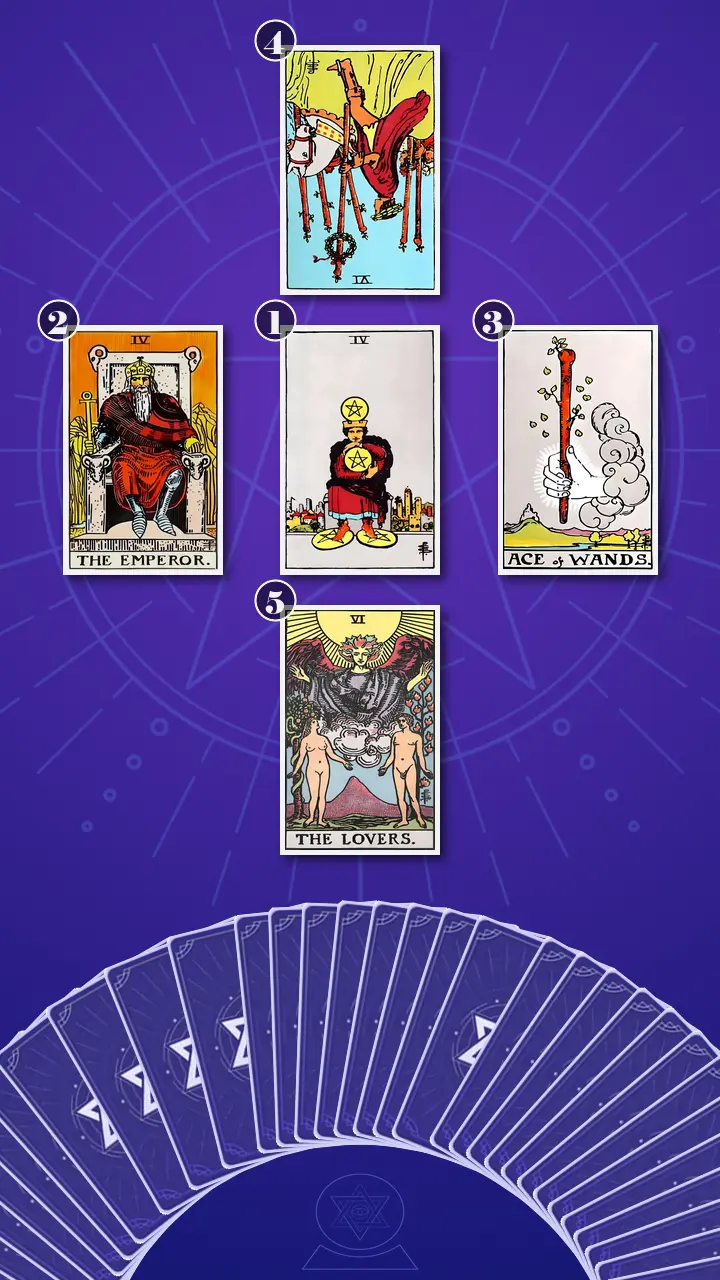
I used a five-card Decision Cross. This is the smallest structure that can hold the present pattern, the comfortable-title path, the path toward work she loves, the hidden influence shaping both options, and a principle for integration. It is a useful way to understand how tarot works as a reflective tool: the cards do not decide a career, but they can make card meanings in context visible enough for a person to question the order in which they are evaluating a choice.
The centre would reveal the present behaviour of preserving a comfortable title even when the work felt less engaging. The left card would examine what that established path genuinely provided. The right card would look at the energy and uncertainty awakened by more engaging work. The card above would expose the recognition pressure operating over both paths. The card below would offer guidance for a values-based choice that could include pay, stability, authority, boundaries, and progression without allowing a title to carry all of Maya's identity.
What the Cards Could See in the Working Day
The Grip Behind the Open Tab
Now turning over is the card that reveals the present behaviour of preserving a comfortable title even when the work itself feels less engaging, along with the contracted energy maintaining that pattern.
It is the Four of Pentacles, upright.
The image showed me the pentacle pressed against the figure's chest and two more pinned beneath both feet. I connected it directly to Maya's 11:47 p.m. routine: one hand near the trackpad, her LinkedIn headline visible beside a role full of writing and research, and the moment the missing word Senior made her press back toward the credential she already owned. She had not checked the salary, scope, manager, pension, flexibility, or working boundaries. The title provided real reassurance, but protecting it had stopped her from gathering evidence.
The energy here was earth in excess: security had hardened into a restrictive grip. The card did not say that Maya was foolish for wanting stability. It showed that a useful professional asset had become so tightly defended that it prevented movement, curiosity, and even a fair comparison. The practical question became, 'What does the title concretely provide, and what identity claim has she asked it to defend?'
I repeated the sentence I had heard in her voice: 'The work sounds right, but if I let go of this label, what proves I am still progressing?' I placed the need for rent, credibility, and structure beside the need for mobility. Security was not the opposite of recklessness. Security and immobility were different things.
Maya gave a short, bitter laugh rather than nodding. 'That is uncomfortably accurate,' she said. Her fingers stopped above the trackpad, then curled around the edge of her phone. I did not rush to reassure her. I asked what evidence the title had actually supplied, and what relief she received when she closed the tab. Her breath left her slowly, as if the distinction had made the familiar routine visible for the first time.
The Stone Throne of Legibility
Now turning over is the card that examines what the comfortable-title path genuinely provides, including structure, legibility, and control, without assuming that those benefits should determine the choice.
It is The Emperor, upright.
The Emperor's stone throne became an org chart box: a visible place where authority sits, a defined remit that colleagues and recruiters can understand quickly, and a professional identity that makes introductions easier. Maya's senior title could represent genuine scope, decision rights, salary continuity, and boundaries. I would not shame any of that. The problem was not ambition. The problem was asking the throne to manufacture proof that her career was valid even on days when her calendar contained little of the hands-on thinking she valued.
I invited her to hold the line, 'At least everyone, including me, knows where I stand here.' Then I placed it beside the reality of a Tuesday dominated by alignment meetings. A title can name your level. It cannot tell you whether Tuesday feels worth repeating. The Emperor's energy was balanced when it supported meaningful responsibility, but it became rigid when maintaining the visible structure became the project itself.
I told Maya about a pattern I had noticed on archaeological digs: a surviving wall can tell us where a settlement once needed protection, but it cannot tell us whether the rooms behind it were still being lived in. That was not an instruction to abandon the wall. It was a reason to inspect the life inside it.
Maya nodded, this time without the bitter edge. Her eyes moved from the Emperor's throne to her own notes. She said, 'I do want authority. I do want to be taken seriously. I just do not know when the title stopped describing the work and started defending me from having to define progress myself.' The structure had not been dismissed. It had been returned to its proper size.
The Hand That Offered a Spark
Now turning over is the card that examines what the path toward work Maya loves activates, what kind of energy it restores, and what uncertainty she would need to investigate rather than resolve in advance.
It is the Ace of Wands, upright.
The card showed an open hand offering a sprouting wand. I returned to the moment before Maya noticed the title. She had been reading about direct customer research, narrative development, and hands-on writing, and she was already imagining questions, arguments, and ideas. Before comparison entered the tab, her attention had already moved toward the work she wanted to do. That movement mattered, not as proof that the role was perfect, but as a spark worth testing.
The fire here was available but unproven. It was not a promise of a flawless job or a command to apply immediately. It was the energy of a beta test rather than a product launch: enough curiosity to run one bounded experiment, without demanding market certainty. The Four of Pentacles closed around a fixed object; the Ace offered one through an open hand. Maya did not need to possess a whole new career before learning whether one task restored her attention.
I asked her which responsibility reliably made her sit forward. She named the work of turning messy customer insight into a clear argument. Then she smiled with surprise, as though she had expected the answer to be more complicated. 'Before I look at the title, I can already see what I would try,' she said.
I watched her shoulders lower by a small but noticeable amount. She did not look triumphant. She looked curious, which was more useful. The Ace of Wands was not asking for certainty. It was asking for direct evidence gathered at a scale small enough that apprehension could come along without taking over.
The Audience in the Screen
Now turning over is the card that reveals the underlying fear that a less impressive title would weaken Maya's visible progress or self-worth, clarifying why the established path feels disproportionately safe.
It is the Six of Wands, reversed.
The laurel-crowned rider and surrounding crowd became Maya's imagined LinkedIn audience: former colleagues, recruiters, and people from networking events silently reviewing a decision she had not made. While the role was still private, she was already drafting the public announcement and the explanation that would follow it. The energy of recognition was blocked and redirected. A reasonable wish to be respected had become an invisible approval test.
I let the inner sequence come out plainly: 'They will think I stalled. They will assume I could not keep moving up. I will have to explain myself.' Then I separated the private working day from the public career announcement, and actual feedback from anticipated judgment. I did not tell Maya that recruiters or colleagues would never care. That would have been another unsupported certainty. I asked which person had actually criticised the possible move, and which reactions existed only in rehearsal.
The imagined audience is making a private decision louder than the work itself. Comparison fatigue had turned other people's promotion posts into a performance dashboard, especially after Maya's own workday felt least convincing. The reversed fire did not mean recognition was bad. It showed that recognition had become the only signal in the system, while engagement, boundaries, and sustainable daily work had been left without a vote.
Maya went quiet. First, her jaw tightened and her thumb stopped scrolling. Then her eyes lost focus as if she were replaying several promotion posts and networking conversations at once. Finally, she set the phone face down and exhaled through her nose. 'No one has actually said I failed,' she said. 'I have been preparing for the verdict before there was a trial.'
I told her that naming the imagined audience did not make her shallow or vain. It made the hidden influence available for inspection. Respect could remain a value. The question was why respect had been narrowed to uninterrupted title progression.
When The Lovers Asked What Tuesday Was For
The Choice Without a Badge
The room became quieter as I moved to the grounding card. Now turning over is the card that provides a values-based decision criterion and a low-risk method for integrating practical security with direct evidence about meaningful work.
It is The Lovers, upright, in the Bridge position of the Decision Cross.
I described two unlabelled working days standing side by side beneath the open figures of The Lovers. One day offered familiar authority, clear structure, and a recognisable professional story. The other offered more writing, research, and direct problem-solving, along with questions about title, salary, scope, and progression. The figures carried no rank badges between themselves and the choice. They were exposed to the consequences of choosing, but not condemned by them.
This was the point at which I used my Historical Crossroad Matching lens. At Cambridge and on archaeological digs, I had learned to look at a turning point from above before mistaking one broken wall for the whole civilisation. Maya was not standing at the end of her career. She was at a smaller historical crossroads: one established professional identity had reached a point where its protective function no longer explained the whole landscape. The question was not which road looked most impressive from a distance, but which road could support a working life she would still recognise as worth repeating.
Then I applied my Enduring Value Assessment. I asked what would survive the test of time and what was merely a short-term impulse. A title might remain a useful practical factor. A skill developed through direct work, a sustainable boundary, a clearer understanding of her values, and evidence about what actually restored her attention could also endure. Neither prestige nor enjoyment was allowed to win by default. Each had to answer for the life it would help create.
At 11:47 p.m., the role was still open beside her LinkedIn profile. The responsibilities made her sit forward; then she noticed the word Senior was missing, checked two promotion posts, felt her chest tighten, and closed the tab before gathering any real evidence. I could see the whole loop waiting to repeat.
Maya was still caught in the demand for a perfect choice: one that preserved visible progress, removed uncertainty, guaranteed respect, and made the working day feel alive. Her hand hovered over the notes. For a moment, the room held only the radiator's soft click and the rain tapping the window.
A title can organise your career, but it cannot decide whether the life inside that career is worth repeating.
You do not need a more impressive label to prove your worth; choose through honest evidence about the work, as the open figures in The Lovers stand before the choice without hiding behind status symbols.
Maya's breath stopped first, and her index finger remained suspended above the page. Then her gaze went slightly unfocused, as if she were replaying the exact instant when the word Senior had changed the temperature of the room. Her eyes brightened. Her shoulders lowered. The fists she had made without noticing opened against her knees. A quiet, uneven breath left her chest, followed by a small laugh that held relief and grief together. 'But this means I cannot make the title carry the whole decision,' she said. There was a brief blankness after the insight, the light dizziness of seeing a clear path and realising that she still had to choose. I let the silence remain. 'Now, use this new perspective to revisit last week: was there a moment when this insight might have made you feel differently?'
She remembered the Tube ride after a day of back-to-back coordination meetings, the warm phone in her palm, and the Head of announcement that had made the current role look suddenly safer. 'I treated someone else's announcement as evidence about my own Tuesday,' she said. 'I could have asked what I actually needed to know instead.' Her voice was steadier, though not certain.
The Lovers was the Bridge because it did not erase the trade-off. It changed who was allowed to set the weights. This was the first step from contracted, status-driven ambivalence toward grounded, values-based self-trust about daily work: not a final answer, but a willingness to let direct evidence, chosen values, and practical facts stand beside the title.
The One-Page Map Toward Clarity
When I joined the cards into one story, the pattern became straightforward. The Four of Pentacles showed Maya gripping a professional label for reassurance. The Emperor showed why that grip was not irrational: the title offered structure, authority, continuity, and an easy explanation of where she stood. The Ace of Wands showed the living spark that appeared when she read the actual responsibilities. The Six of Wands reversed showed recognition pressure diverting that spark into LinkedIn comparison and anticipated judgment. The Lovers showed the missing bridge: a conscious way to weigh structure and aliveness without treating either path as a verdict on her worth.
The cognitive blind spot was not that Maya valued status. It was that she had allowed an imagined audience to decide what counted as evidence before she gathered facts about the role. She filtered by seniority, felt immediate relief, learned nothing about the work, and then interpreted the remaining uncertainty as proof that the familiar title was the only responsible choice. I described the transformation direction simply: change the order of evaluation. Let the working day speak before the label settles the decision.
I also made clear that a values-based career choice could include salary, pension, commute, flexibility, authority, manager, meeting load, boundaries, and future progression. The title-blind comparison was temporary, not an ideology that titles never matter. It was a way to correct the first impression long enough to see whether the actual responsibilities deserved a vote.
- Run the Title-Blind Workday TestBefore Friday evening, I asked Maya to paste the responsibilities from three saved roles into a blank Google Doc or Notion page and remove the titles and company names. She would write three criteria for a sustainable working week, such as hands-on writing, direct customer insight, and manageable coordination, weight each from 1 to 3, and score the unlabelled roles before restoring the titles.Keep the first pass to ten minutes. If three roles feel too large, use one role and one criterion, then stop. Reveal the titles only after recording the scores and the body's response.
- Try the Spark-Before-Seniority ExperimentI asked her to choose the most energising responsibility from one appealing description and turn it into a twenty-minute task at home: drafting a positioning argument, analysing three customer comments, or outlining a short research memo. The timer would create evidence about the task, not a commitment to apply, resign, or accept anything.Use an existing personal topic, public brief, or fictional prompt so the experiment does not become unpaid labour. Record energy before, energy after, and whether another ten minutes felt interesting. The smallest version can last ten minutes.
- Separate Facts from the Fear of the LabelOn Wednesday, I asked Maya to create two phone-note headings: What I concretely need and What I fear the title would mean. Under the first, she could list measurable requirements such as minimum compensation, pension, flexibility, decision scope, and meeting load. Under the second, she could record what peers, recruiters, or friends might assume. Then I guided her through my Time Stratigraphy Exercise by asking her 10-year future self to read the page and distinguish an observed fact, an askable fact, and an imagined reaction.Set a fifteen-minute limit so the exercise does not become another immaculate decision matrix. No result obliges a career move. The purpose is to preserve practical structure while loosening the identity burden placed on the title.
Maya asked what she should do if the title still mattered after the comparison. I told her that would be useful information, not a failure of the method. The cards were not selecting the lower title. They were returning ownership of the decision to her. She could remain, explore, apply, ask questions, or change nothing until the practical facts were clearer. The next steps were evidence-gathering, not obedience.

A Week Later, the First Small Proof
Four days later, Maya sent me a message. She had hidden the titles, scored one saved role against writing, direct problem-solving, and meeting load, then restored the label. The score had stayed high. The title had changed her first reaction, but it had not erased the work's fit. That evening, she used twenty minutes to draft a customer-insight argument and discovered that she wanted another ten.
She slept through the night, but her first thought the next morning was still, 'What if I am wrong?' This time, she smiled, wrote down the question, and checked the role's actual scope instead of opening LinkedIn. The uncertainty remained, but it no longer held the steering wheel.
I saw that as the first quiet proof of the Journey to Clarity. Maya had not solved her entire career or reached a consequence-free answer. She had moved from gripping a name badge as identity proof toward treating the title as one practical factor among engagement, values, boundaries, stability, and sustainable daily work. That was grounded self-trust in its earliest form: small, observable, and still allowed to be imperfect.
When a role makes you sit forward until a smaller title appears, that sudden grip in your chest may be the strain of wanting a more alive working day while fearing that other people will read the choice as proof that you were never valuable without the label. You do not have to shame that fear or obey it. A visible trade-off is not a verdict on your worth.
If nobody could see the label for ten minutes, which part of the working day would you be curious to test first?