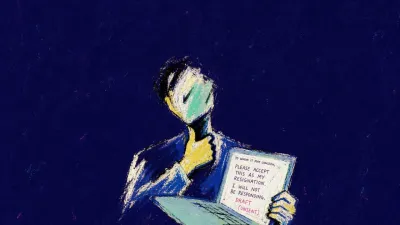
Career Email in Drafts Became an Honest Request for Information

When Every Career Option Feels Wrong at 4:18 PM
If you can organise everyone else's deadlines but keep your own career email in Drafts, analysis paralysis may be hiding inside a very polished career plan.
Alex, a 28-year-old nonprofit project coordinator in Toronto, came to me after another Sunday spent reopening the same choice: remain on the stable management track or test a more creative professional direction. She could build a project timeline for twenty people, but one exploratory email about her own future had survived five revisions without being sent.
At 4:18 that Sunday afternoon, she had sat in her Parkdale apartment moving between a Google Sheet, management postings, and a creative certificate page. The kettle hissed, the radiator clicked, and the laptop felt warm beneath her restless palms as she added a column titled “possible future regret.” Her jaw tightened with every new comparison.
“I keep waiting for the option that doesn't cost me anything,” she told me. “If I choose wrong, I'll have to admit I never knew myself. Maybe being careful is the only reason I haven't disappointed myself yet.”
I heard ambivalence in her voice, but I saw it more clearly in her body: it was as if two hands were pulling the same steering wheel while her foot stayed pressed on the brake. She wanted a more vivid working life, yet she also wanted to protect the financially stable, visibly competent self she had already built.
“I don't think you're failing to decide,” I said. “I think the delay is doing a job for you. Indecision can be protection, even when it calls itself discernment. Let's find out what it is protecting, then draw a map through the fog without asking tarot to choose your life for you.”

Choosing the Compass: The Decision Cross
I invited Alex to take one ordinary breath and notice her jaw, chest, hands, and shoulders without trying to change them. I shuffled slowly while she held the question in mind: “What am I protecting when every option feels like the wrong one?” The pause was a way to focus attention, not a performance of mystery.
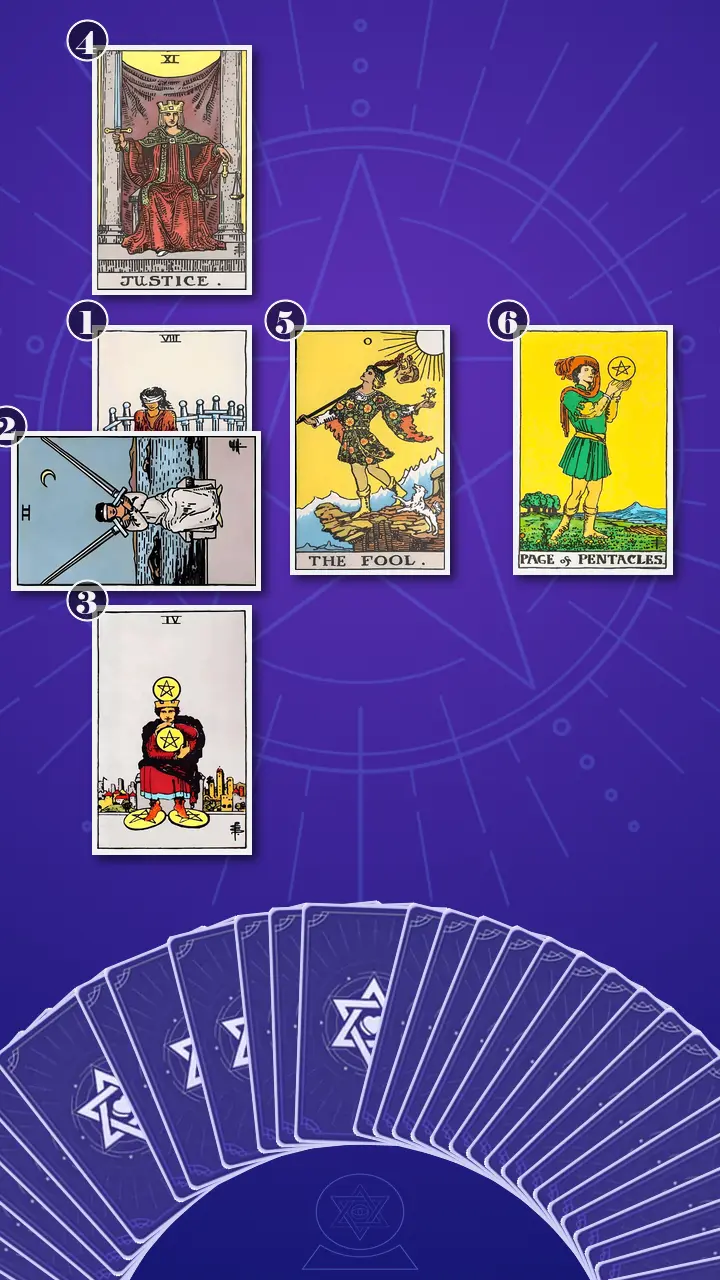
I chose the Decision Cross · Context Edition, a six-position Decision Cross tarot spread for career choice paralysis. This is how tarot works in my practice: it does not predict which employer, course, or career will succeed. It gives us a structured set of images and questions through which we can examine facts, assumptions, emotional defenses, values, and available actions.
The spread suited Alex's situation because her problem was not a shortage of plausible options. It was a compressed decision knot. The centre would show the visible pattern of researching and postponing. The crossing card would expose the inner conflict maintaining it. The root would reveal what her stasis preserved, while the upper card would establish a fairer criterion for clarity. Two cards extending to the right would then turn insight into a reversible opening and a grounded next step.
I laid the cards as a locked intersection opening into a short path. “We're going to read the card meanings in context,” I told her. “Nothing here gets to issue a verdict about your worth. The cards can challenge the structure of the problem, but you retain the authority to choose, revise, pause, or walk away.”
The Blindfolded Intersection
The Surface Bind: Eight of Swords
The card I turned over first represented the surface decision bind: the repeated research, reopened options, and postponed commitments that made every available route feel wrong. It was the Eight of Swords, upright.
I pointed to the blindfolded figure, the surrounding swords, and the bindings that were looser than they first appeared. “Some of your constraints are real,” I said. “Rent, income, time, and workplace consequences deserve serious attention. But this card asks us to separate those limits from conclusions that have never been tested.”
In Alex's daily life, the card was almost literal. A management posting, a creative course, and an unfinished networking email sat in separate browser tabs. She read every unanswered question as a barrier, added those barriers to her spreadsheet, and closed the laptop without trying the small action that could answer one of them. The Eight of Swords showed blocked mental energy: her attention had been trained so thoroughly on imagined consequences that visible options began to resemble walls.
“It's like an algorithm trained only on worst-case outcomes,” I said. “Every search teaches it to recommend another reason not to click. The internal message becomes: ‘I can see the options, but I cannot see a version of myself who survives choosing imperfectly.’”
Alex gave a short laugh, but there was no amusement in it. She rubbed her thumb over the edge of her mug and looked away. “That's painfully accurate. Almost rude, honestly.”
“Then let's let it be accurate without letting it be cruel,” I replied. “The blindfold is not proof that you're incapable. It describes where your attention has been placed. Which sword is an external limit, and which one is a prediction you have not yet tested?”
The Exhausted Stalemate: Two of Swords Reversed
The card now turning over represented the inner conflict crossing the decision: the part of Alex that used indecision to protect against regret, disappointment, and self-judgment. It was the Two of Swords, reversed.
Its modern-life scene had played out on the Line 1 train. Alex had once sent the same job posting to two friends. One recommended stability; the other preferred the creative direction. Instead of gaining clarity, Alex copied both arguments into her phone and decided she needed another opinion.
Reversed, the Two of Swords showed a stalemate becoming too strained to maintain. The energy was not an absence of intelligence but a blockage around preference. Alex wanted support, which was reasonable, yet she was also asking borrowed certainty to carry a risk only she could meaningfully consent to. More votes could not tell her which value mattered most.
“This has a little of Chidi's decision process in The Good Place,” I said. “Every choice becomes a referendum on whether you're a defensible person. The more perfectly you try to justify it, the further you move from the quieter information of preference.”
Her fingers tightened around the mug, then loosened. Her eyes lost focus for a moment as if she were replaying the train ride, and a slow breath finally moved through her chest. “If someone else can make the stronger case,” she said, “I don't have to own the risk.”
“Exactly. Support can help you think, but no group chat can remove ownership. What value was beginning to matter before you introduced the next objection?”
The Identity Kept in Reserve: Four of Pentacles
The next card represented what the fulfillment stasis preserved: security, control, familiar identity, and the competent self-image Alex protected by withholding commitment. I turned over the Four of Pentacles, upright.
I described the figure clasping one pentacle to the chest, pinning two beneath the feet, with a secure city behind him. In Alex's life, the card appeared at 9:37 on a Thursday evening: two budgets at the kitchen table, cold tea leaving a bitter taste, the refrigerator humming, one palm pressed against her sternum while contingency rows multiplied.
The card's upright energy had moved into excess. Holding resources carefully could be wise, but holding every possible identity in reserve had begun to restrict movement. Alex kept the stable role, her savings assumptions, her competent reputation, and the fantasy of succeeding at either path simultaneously protected by investing fully in neither.
“Keeping every path open can become its own closed room,” I said. “If you never become a visible beginner, you never have to learn that the creative direction might be difficult, disappointing, or simply not yours. But you also never receive evidence that it could fit.”
I watched her breathing stop for a beat. Her gaze settled on the pentacle held against the figure's chest; then her shoulders dropped by a fraction, and she exhaled through pursed lips. “As long as I don't choose,” she said quietly, “I can still be the person who would have succeeded at both.”
“That is what you're protecting,” I told her. “Not only money. You're protecting control, competence, and untested potential. That protection is understandable. We just need to ask whether the emotional holding fee is still worth paying.”
When Justice Cleared the Risk Register
The Clarity Criterion: Justice
The card I placed above the knot represented the clarity criterion: the value-based and reality-based standard that could replace the impossible demand for a guaranteed right option. It was Justice, upright.
Justice brought balanced energy into a spread compressed by overthinking. I translated the scales into a comparison that included both the cost of trying and the cost of delay. I translated the upright sword into a clean distinction between observable facts and stories about identity.
Years earlier, on a Wall Street trading floor, I had learned how quickly a vivid fear could be mistaken for a measurable risk. Looking at Justice, I remembered risk registers where an imagined catastrophe had been marked as if it were already a verified condition. A fair process does not erase uncertainty; it stops uncertainty from impersonating evidence.
I asked Alex to imagine two short lists. The first held facts: salary, hours, mentorship, trial cost, schedule flexibility, and an income floor. The second held fear stories: “Changing direction would prove I wasted my twenties,” or, “Finding the work difficult would prove I never understood myself.”
“A fair decision is not the same as a risk-free decision,” I said. “Would you use these standards to evaluate a friend's three-month experiment, or are you using them only because this decision has been recruited to grade your worth?”
I also brought in a method I call Sunk Cost Neutralization. Alex's years of competence in project coordination were real assets, but they did not create an obligation to remain on one track forever. Past time and effort could inform her next move without being allowed to dictate it. Equally, leaving the stable track was not automatically brave if it ignored her actual financial boundaries. Justice asked for proportion, not a dramatic gesture.
Alex drew her chair closer to the table. Her shoulders loosened, and she wrote one phrase on the edge of her notebook: schedule autonomy for the next three months.
“That feels almost suspiciously ordinary,” she said.
“Good,” I replied. “Clarity often becomes useful when it stops trying to sound profound. A choice can be information without becoming your identity.”
When The Fool Opened a Road Instead of a Verdict
The Transformative Opening: The Fool
The room became noticeably still as I reached for the card representing the transformative opening: the smallest shift from demanding certainty to treating a choice as a reversible experiment in self-trust and fulfillment. I turned over The Fool, upright.
I did not read The Fool as reckless escape. I showed Alex the white rose, the small bundle, and the open road near the cliff. In her actual life, this was not a resignation letter or a public reinvention. It was one workshop, one twenty-minute conversation, or one forty-five-minute creative task with the time, cost, privacy, and exit conditions defined in advance.
The card carried balanced openness: enough curiosity to move, enough awareness to look where she was stepping. The small bundle meant she did not have to carry her whole future into the test. The threshold asked for attention, not catastrophe thinking.
I named the familiar loop before going further: “You know the Sunday sequence: the kettle finishes boiling, the spreadsheet gains another regret column, two friends receive another text, and your shoulders feel heavier even though you have technically spent hours working on the decision.”
You do not have to protect yourself by keeping every path unopened; let The Fool's open road turn uncertainty into one small experiment that teaches you what comparison cannot.
I left the sentence in the quiet for a moment, then gave its sharper edge:
You do not need a choice that proves you know yourself perfectly; you need a small enough choice to let experience introduce you to yourself.
I explained the strategic logic through my Asymmetric Risk-Benefit Analysis. A bounded workshop had a capped downside: one hour, a known fee, no public career announcement, and a clear exit. Its potential upside was larger than the commitment itself because it could produce firsthand information about energy, interest, environment, and fit. The choice was structurally favourable not because success was guaranteed, but because the possible loss was limited while the learning could compound.
Alex did not relax immediately. Her breath stopped; her right hand froze halfway between her notebook and the card. Her pupils widened as she stared at The Fool's small bundle, and then her brow drew tight. “But doesn't that mean I've been doing this wrong for years?” she asked, the words arriving faster and louder than anything she had said before. Her shoulders remained high even as her fist began to open. A thin flush reached her cheeks; her eyes brightened, not quite with tears and not quite with relief. Then the anger gave way to a hollow, unsteady pause, as if putting down the demand for certainty had left her briefly unsure what to hold instead. She released a trembling breath. “If I can't blame the options,” she said more softly, “then I have to decide what to test.”
“You weren't wrong for protecting yourself,” I said. “That strategy helped you preserve stability and competence. We are only noticing that it now costs more than it protects. Clarity brings responsibility, but responsibility is not punishment. It is the return of your agency.”
I leaned forward. “Now, with this new perspective, think back to last week. Was there a moment when this insight could have made you feel different?”
Alex remembered hovering over the registration button for a one-hour creative workshop at a Toronto Public Library branch. Printer toner had hung in the cool air while pages rustled nearby. She had treated clicking “register” as a declaration of who she must become.
“I wasn't promising to become that person,” she said, looking directly at the card now. “I was allowing myself to meet the experience.”
I slid a blank card toward her and set a ten-minute timer. I asked her to write one option, one value it could honour, and one reversible test that would take under an hour. She added a time limit, a spending cap, and a private exit point. I reminded her she could stop after the first line, change the test, or leave it entirely if it felt too exposing.
This was the decisive emotional shift: not from uncertainty to perfect confidence, but from hyper-analytical self-protection and imagined regret toward curious experimentation and grounded self-trust. The open road did not remove vulnerability. It made vulnerability proportionate and chosen.
The Page's One Ordinary Afternoon
The Grounded Next Step: Page of Pentacles
The final card represented the grounded next step: a practical action that could create lived information without turning one experiment into a permanent identity verdict. It was the Page of Pentacles, upright.
I drew Alex's attention to the Page studying a single pentacle while cultivated fields stretched behind him and distant mountains remained unsolved. In ordinary life, this looked like completing one focused sample task and recording what gave her energy, what drained her, and what she wanted to test next while the full career spreadsheet stayed closed.
The Page brought earth into balance after the spread's mental compression. Its energy was steady, modest, and teachable. Alex did not need to decide which path would define her. She needed one concrete object of attention and permission to become an apprentice long enough to observe reality.
“Do not choose your whole future; test one honest question,” I said. “The evidence might be ‘I liked the writing but disliked the pace,’ or ‘I lost track of time during the concept work.’ Neither observation has to become a prophecy. It is simply something you know now that you did not know before.”
Alex looked from The Fool's open road to the Page's single pentacle. She nodded once, slowly. “I don't have the answer,” she said, “but I can find out what this task feels like on an ordinary afternoon.”
I could see the whole spread's visual argument: two blindfolded figures had opened into Justice's direct gaze, then narrowed into the Page's focused attention. Tarot had not selected a career for Alex. It had helped her move from trying to see the entire future to observing one real thing clearly.
The Reversible Chapter
I gathered the reading into one concise story. The Eight of Swords showed Alex treating uncertainty as a closed system. The reversed Two of Swords revealed how reassurance and defensive neutrality kept preference suspended. Beneath both, the Four of Pentacles showed the protected assets: financial security, control, professional competence, and the fantasy of remaining equally capable of every unchosen future. Justice separated facts from fear stories. The Fool opened a bounded threshold, and the Page of Pentacles turned that opening into practical learning.
The hallway of doors had been the core metaphor all along. Alex kept inspecting every handle for proof that it was the right one, but refusing to enter any room prevented her from learning what the rooms were actually like. Her cognitive blind spot was treating delay as neutral and judging decision quality by whether the eventual outcome could embarrass her. The direction of change was clear: replace the demand for a permanently right answer with a reversible, values-based experiment that produces lived evidence.
“But I can already feel myself turning the experiment into another dashboard,” she said. “And honestly, seventy-two hours sounds like time I don't have.”
“Then we keep the structure narrow,” I replied. “Seventy-two hours is the window for completing one small test, not seventy-two hours of work. The minimum version takes eight minutes today and forty-five minutes later. No new dashboard.”
Three Next Steps for Actionable Clarity
- Run the Eight-Minute Justice Check. On Tuesday evening at home, open a phone note with two headings: “Verified facts” and “What I fear this would mean about me.” Set a timer for eight minutes and place no more than three statements under each heading. Use only one criterion for the next three months, such as schedule autonomy, mentorship, creative practice, or an income floor. Minimum version: write one verified fact and one fear story, then close the note when the timer ends.
- Use the 3rd-Option Leverage Test. For the next 72 hours, refuse the false binary of “stay forever” versus “quit now.” Create the hidden third path: schedule one forty-five-minute sample task at the kitchen table, book one twenty-minute informational call, or register for one workshop. Label it “research experiment.” Set a time cap, cost cap, privacy boundary, and exit point before starting. Choose only one test. Its job is to produce contact, not commitment, and Alex remains free to continue, revise, or stop.
- Record Lived Evidence. Immediately after the experiment, keep the comparison spreadsheet closed and write three lines in a phone note: “What gave me energy,” “What drained me,” and “What I want to test next.” Add no more than two observations per line, then schedule one follow-up of under an hour. Do not grade the trial as success or failure. If three lines feel like homework, record a voice memo beginning, “One thing I know now that I did not know before is...”
“The third option is not necessarily a third career,” I told Alex. “It is a different relationship to choosing. You are no longer buying a lifetime subscription to an identity. You are running a small, ethical beta with boundaries you control.”

A Week Later: The Quiet Proof
Seven days later, I received a message from Alex. She had registered for the library workshop and completed a forty-five-minute campaign concept for an imaginary nonprofit project. Her spreadsheet remained closed. Her Lived Evidence note said: “Writing gave me energy. Working alone for the whole task drained me. I want to ask how creative teams actually collaborate.”
She had not solved her career. She had learned enough to send one factual message to someone on the communications team: “What does a normal Tuesday in your role actually involve?” It was the same exploratory email she had kept in Drafts, reduced from an identity announcement to an honest request for information.
That night she slept through until morning. Her first thought was still, “What if I'm wrong?” But this time she smiled, made coffee, and left the question unanswered while the email stayed sent.
I think of that as the real Journey to Clarity. The cards did not move Alex's hand or certify a correct future. She did. Tarot gave form to a pattern she could examine; her boundaries, values, and actions turned the insight into evidence. She was no longer waiting to trust herself before acting. She had begun building self-trust through proportionate action.
When every option feels capable of exposing that you chose badly, you can spend hours with a locked jaw and heavy shoulders, protecting the competent self you already know while quietly longing for a life you can discover only by entering it. If that is where you are tonight, noticing what the closed doors protect already means you are no longer standing at the beginning.
If one option could become a short, reversible chapter rather than a verdict on who you are, what tiny piece of its open road would you feel curious enough to experience first?