Writing the Hidden Sentence: From Final-Button Dread to Ownership

Point-of-No-Return Decision Anxiety at 11:40 p.m.
If you are a late-twenties product designer who can defend every trade-off at work but cannot close one private decision at home, I may already know the shape of your point-of-no-return decision anxiety. Jordan, a 29-year-old product designer in London, came to me with one question: What am I afraid to admit before I make this choice irreversible?
At 11:40 p.m. on a Tuesday, Jordan shared their screen from a small London flat. A final confirmation page waited on the left. On the right sat a document titled Reasons to Proceed, its bullet points polished enough for a stakeholder meeting. Behind both windows, a minimized Notes app draft held one unsaved sentence. The laptop fan hummed through my headphones. Jordan took a sip of tea, winced at its cold bitterness, and placed the mug down with a small, sharp click.
Their jaw was locked. Their shoulders had risen toward their ears. What Jordan called dread looked to me like a Tube-door alarm wired beneath the ribs: every passing second demanded movement, while the body braced against being carried somewhere it had not fully agreed to go.
"I keep calling this due diligence," Jordan said. "But I have already checked everything twice. I know how to explain the choice. I just do not know if I believe my explanation."
I asked what happened when a friend said, "Are you sure?"
"I pitch the decision," they said immediately. "Salary, timing, long-term upside. I sound brilliant. Then I go home and reopen the document."
A LinkedIn tab sat among the open windows, showing another former colleague who was "thrilled to announce" a promotion. I watched Jordan glance at it and press their lips together. Comparison fatigue had turned hesitation into evidence of personal failure. Every public milestone made the private pause feel more embarrassing.
"You keep checking the facts because checking is easier than naming the sentence that could disturb them," I said. "That does not mean the sentence is right, and it does not mean your choice is wrong. It means part of the decision is still outside the room. I am not here to push you toward confirm or cancel. Let us make a map of the fog and find out what deserves to be included."

Choosing the Doorway: A Five-Card Shadow Spread
I asked Jordan to stop sharing their desktop, leave the confirmation page untouched, and place both feet on the floor. I invited one long exhale before I began shuffling. The pause was not mystical theatre. It was a deliberate transition from reacting to observing.
I chose The Shadow Spread, a classic five-card tarot spread for hidden motives. When people ask me how tarot works in a situation like this, I explain that the cards do not make the decision or predict which option will succeed. They give us a structured set of images and questions through which we can examine information that polished reasoning may have excluded.
A Decision Cross would have compared Jordan's external options. That was not where the reading needed to begin. Jordan already had the costs, timelines, and exit terms. The missing material was internal: the motive they feared admitting, the behaviour keeping it hidden, and the perspective that could allow it into the decision without handing it control.
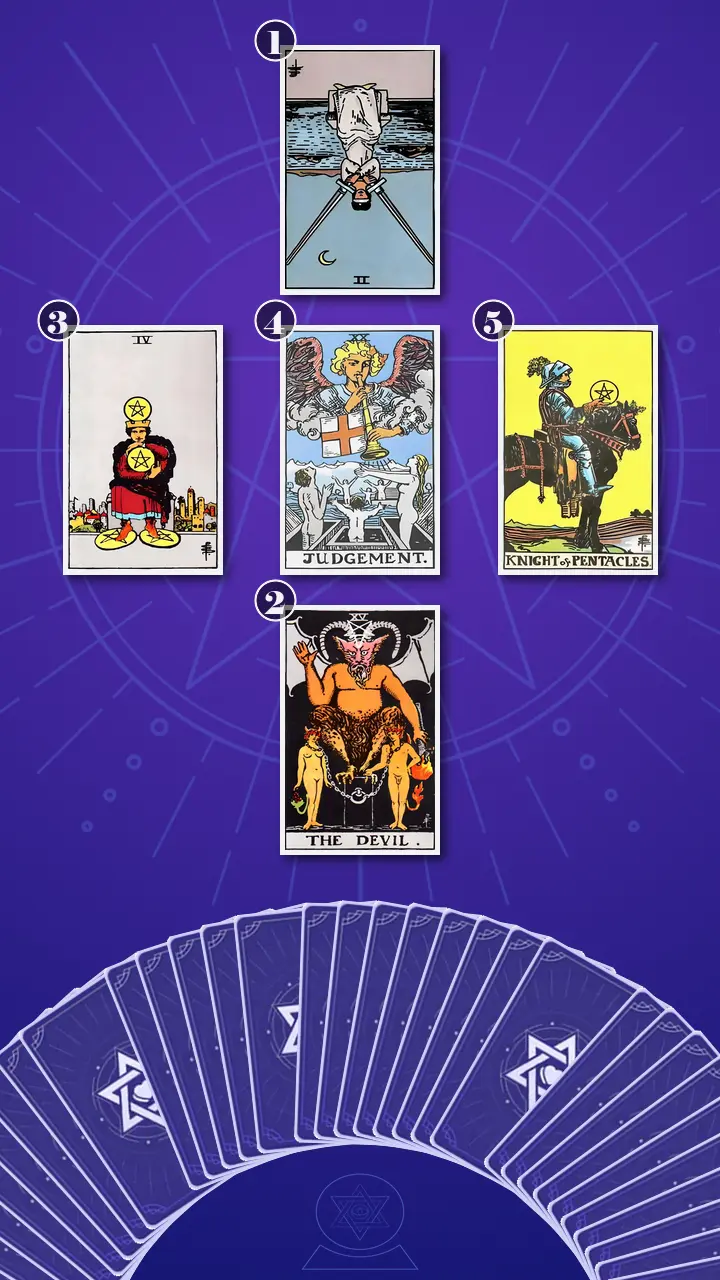
I arranged the cards like a cross-section of a doorway. Position one, above the centre, would show the visible symptom: Jordan's repeated revisions and defensive certainty. Position two, below, would reveal the desire, fear, or attachment treated as too dangerous to admit. Position three, to the left, would identify what was bracing the door shut. Position four, at the centre, would show how to integrate the hidden material. Position five, to the right, would offer a practical route forward without prescribing the final choice.
I told Jordan that the sequence would move from what they displayed, down into what had been buried, across the defence, through integration, and finally into action. Card meanings in context matter more to me than isolated definitions. The question was not, "What does this card generally mean?" It was, "What does this image help Jordan notice about the exact choice waiting on their screen?"
What Was Bracing the Door Shut
Position One: The Two Tabs That Were Never Equal
Now I turned the card representing the diagnosis-level symptom: Jordan's repeated revisions, defensive certainty, and inability to complete the choice while the conflict remained unnamed. It was the Two of Swords, reversed.
The blindfolded figure held two swords across the chest while restless water moved behind them. Upright, the card can hold a temporary mental balance. Reversed, that balance was collapsing. I described this as blocked Air: thought was active, but it could no longer circulate freely because one piece of self-knowledge had been deliberately kept outside the debate.
At 11:40 p.m., Jordan had been alternating between the final confirmation page and two equally polished explanations. They were rechecking facts that had already been verified while the minimized note held the sentence neither argument included. The review looked careful, but the tight chest and urgent wish to finish showed that apparent neutrality was no longer neutral.
"Try completing this privately," I said. "I say I need one more fact, but the fact I am avoiding is..."
Jordan gave a short laugh. It carried no amusement.
"That is uncomfortably accurate," they said. "Almost cruel."
I did not rush to soften the card into something vague. I also did not let accuracy become accusation.
"Then we slow down," I said. "This card is not calling you dishonest. It is showing that a strategy which once protected you is no longer producing clarity. You may not be missing information. You may be protecting the explanation you already chose."
Their fingers stopped circling the rim of the mug. Their eyes moved toward the minimized note and then back to the card. I asked which detail they had checked again that evening. Jordan named a cost they had already confirmed the previous day. When I asked what sentence they had avoided while checking it, they did not answer yet. The silence itself became part of the reading.
Position Two: The Loose Chain Beneath the Polished Pitch
Now I turned the card representing the underlying fear: the desire, attachment, need, or motive Jordan believed would be dangerous or shameful to admit. It was The Devil, upright.
I was careful with this card. The Devil did not declare Jordan's choice corrupt, and it did not tell them to reverse course. I directed their attention to the loose chains around the figures' necks. The restraint was real, but it was not locked. The card asked what had gained disproportionate influence because shame had prevented it from being examined consciously.
Jordan had already told me about a Thursday evening in a crowded Old Street pub. A friend had asked, "Are you sure this is what you want?" Glasses clinked around them. Rain-soaked coats steamed in the warm room. Jordan's jaw had tightened before they launched into salary, timing, and long-term advantages. They had given their friend the LinkedIn version of the choice while keeping the Notes app version out of view.
"If I admit that I want approval, escape, control, or just immediate relief," Jordan said slowly, "then maybe the whole decision means something worse about me."
"That is the chain," I said. "Not the motive itself. The belief that an imperfect motive proves a bad identity."
The Devil's energy appeared here as a blockage of honest instinct. Because the motive could not be named, it operated with excess influence from underground. Jordan's situation had acquired the emotional logic of Severance: the competent professional self could access the metrics, while the private self with inconvenient wants, resentments, and fears was expected never to enter the meeting.
"A mixed motive is not a moral failure; it is part of the decision data," I said. "Approval can be present without becoming your boss. Relief can matter without becoming proof that you should proceed. Influence is not total authority."
Jordan inhaled, held the breath near the top, and then released it through their nose. Their shoulders did not fully drop, but their jaw softened.
"Part of me wants people to be impressed," they said. "And part of me wants the uncertainty to stop. I hate how small that sounds."
"I hear how exposed it feels," I replied. "But saying it plainly has already changed your relationship to it. A hidden preference behaves like an algorithm no one is allowed to inspect. Once the input is visible, you can evaluate its influence instead of letting it quietly shape every recommendation."
Position Three: The Story Held with Both Hands
Now I turned the card representing Jordan's protection strategy: the control, selective disclosure, and over-analysis that kept the hidden motive outside conscious integration. It was the Four of Pentacles, upright.
The figure clutched one pentacle to the chest, balanced another over the head, and pinned two beneath the feet. Every limb was occupied with securing the structure. There was no part of the body free to move. I read this as an excess of control paired with a deficiency of flexibility. Earth, the element of useful structure, had hardened into a fortress.
In Jordan's daily life, that grip looked like controlling which facts friends heard, locking down every practical variable, and treating each new feeling as a threat to the plan. They asked for reassurance, but they supplied an edited brief. The resulting advice sounded supportive because the one fact most likely to complicate it had never entered the conversation.
"If I control what enters the conversation," I said, "I can control what the conversation asks me to face. That is understandable protection. It is also exhausting."
This was where I used what I call Safe-Choice Sabotage Recognition. A safe choice is not always the cautious external option. Sometimes it is the cleanest internal story. Clicking confirm immediately and postponing forever can serve the same defence if both allow a person to avoid the necessary inciting incident: saying the difficult sentence and discovering that they can survive hearing it.
As an artist, I thought of a film rough cut with one crucial scene removed. No amount of colour grading, sound mixing, or clever editing can repair the continuity gap if the missing scene explains why the protagonist acts. Jordan had been polishing the film while protecting the deleted scene.
"So the sabotage is not necessarily the choice I am making," Jordan said. Their voice had become quieter. "It is trying to make it from a version of me that does not have mixed motives."
"Exactly," I said. "The blind spot is the belief that control requires exclusion. Real ownership asks for enough structure to hear the disruptive information without letting it seize the whole process."
Jordan's hand tightened around the mug, then released. Their gaze went unfocused for a moment, as if replaying every conversation in which they had offered impeccable context and withheld the sentence that might have changed the response. When they looked back at me, there was recognition in their expression, but also grief for the amount of effort the protection had required.
When Judgement Opened the Sealed Room
Position Four: The Voice That Was Allowed Back In
The laptop fan clicked off. In the sudden quiet, I could hear rain tapping Jordan's window in separate, precise beats. I turned the central card, the one representing the transformation required to let an uncomfortable admission become information rather than a command, verdict, or reason for self-rejection.
It was Judgement, upright.
The card showed an angel sounding a trumpet above figures rising from open coffins. Their arms were lifted. Their faces turned upward. After the crossed swords, loose chains, and tightly clutched pentacles, the change in body language was unmistakable: closed containers had opened, and what had been sealed away was being invited into conscious response.
Jordan had checked the costs, rewritten the explanation, and watched the final button glow at 11:40 p.m. Yet their chest still tightened around the sentence in the minimized note. They had been treating the existence of that sentence as proof that they could not trust themselves.
I used my Narrative Fork Analysis, but I did not frame the competing plotlines as "proceed" versus "walk away." That would have made tarot an external decision-maker. Instead, I showed Jordan two ways the protagonist could enter either outcome.
In the first plotline, Jordan deleted the difficult scene, performed certainty, and acted mainly to end the tension. In the second, Jordan paused, restored the missing scene, and allowed the whole cast of motives into the review. That second plotline could still end with confirm. It could also end with delay, renegotiation, or refusal. Its value was not a predetermined ending. Its value was that Jordan would no longer have to abandon part of themselves to reach it.
You do not need to silence the disowned truth to stay in control; let Judgement's rising figures model an honest response from the whole self, then decide with the hidden voice included rather than obeyed.
I let the sentence rest between us. Rain touched the glass. Somewhere outside Jordan's flat, a car passed over wet pavement and faded into the distance.
Then I gave them the same insight in its simplest form.
The truth you are afraid to admit does not get to decide for you; naming it simply lets the whole decision belong to you.
Jordan went completely still. Their breath stopped first. Their right hand, halfway to the mug, remained suspended above the table. Then their eyes shifted away from the screen and lost focus, as if they were watching the Old Street conversation, the LinkedIn posts, and every late-night revision replay in a private montage. Their eyebrows pulled together. Colour rose along their cheekbones.
"But does that not mean I have been doing all of this wrong?" they asked. The words came out sharper than anything they had said before. "If I knew there was another motive and kept editing it out, maybe none of my reasoning counts."
The anger held for a second. Then their mouth trembled. Their fist loosened against the table, finger by finger, and their shoulders dropped with a long breath that seemed to leave from somewhere below the chest. Their eyes shone, but the relief was not simple. I could also see the slight disorientation that comes when a heavy defence is removed and responsibility remains. The path was clearer, and that meant Jordan could no longer blame the fog for whichever step came next.
"Your reasoning still counts," I said. "The facts do not disappear because your motives are mixed. You are not putting your past self on trial. You are updating the decision record. Accountability means including what you know now, not condemning yourself for needing protection before you could say it."
I invited them to look back through the new lens.
"Think about last week. Was there a moment when this insight could have changed how the choice felt, even if it would not have changed the choice itself?"
Jordan thought for a while.
"When my friend asked if I was sure," they said. "I could have said, 'I think part of me wants the status, and I am still checking whether the actual life fits.' I would not have needed them to approve or disapprove. I could have heard myself say the whole thing."
I asked Jordan to set a ten-minute timer and begin with: If nobody judged me, I would admit that part of me... I told them not to edit it, improve it, or share it. Once they had one sentence, they would ask only: Does this change a fact, a boundary, the timing, or the story I wanted this choice to tell about me? If the exercise felt too exposing, they could stop after one unfinished phrase. Privacy and choice still belonged to them.
This was the central crossing in the reading: from defensive urgency and hidden-motive dread toward sober evaluation and grounded self-ownership. Jordan did not suddenly possess perfect certainty. They gained something more usable: the possibility of being honest without treating honesty as an order.
Position Five: The Horse That Did Not Charge
Now I turned the card representing the grounded response: a deliberate next step Jordan could take before the choice became difficult to reverse. It was the Knight of Pentacles, upright.
The Knight sat on a stationary horse and held one pentacle level at eye height. Nothing in the image rushed. The fields behind the figure were cultivated rather than wild. I read this as balanced Earth: structure was still present, but it now supported integrity instead of suppressing inner conflict.
In Jordan's life, this meant setting a twenty-four-hour pause, writing a short checklist that included the admitted motive, material costs, non-negotiables, and reversal limits, and conducting one scheduled review. It meant taking the next verifiable step without treating urgency as proof, hesitation as failure, or discomfort as a command to abandon the choice.
"The Knight is not asking you to solve your identity tonight," I said. "It is asking you to check what this admission actually changes. The horse is still because deliberate pacing is not the same as avoidance. You review once, at a scheduled time, and then you decide what the next real-world step is."
Jordan nodded slowly. This time the movement did not look like agreement performed for my benefit. They picked up their phone, opened the calendar, and created a hold for Saturday at 10:00 a.m.
"No new arguments," they said as they typed the title.
"Exactly. Ownership does not require perfect certainty or perfectly pure motives."
The Whole-Self Decision Check
I drew the five cards together as one story. Jordan's professional life had trained them to defend trade-offs through clean evidence, a skill that genuinely served them at work. At this personal threshold, however, the reversed Two of Swords showed that useful analysis had become repetitive checking. The Devil revealed the hidden attachment, including approval and relief, that gained power through shame. The Four of Pentacles showed how tightly controlling the explanation kept that motive active but unexamined. Judgement reopened the sealed compartment without turning it into a courtroom. The Knight of Pentacles converted that honesty into a bounded process.
The cognitive blind spot was not merely overthinking. It was the belief that self-control meant excluding destabilising information and that a trustworthy choice required morally pure motives. The transformation direction was the opposite: admit the mixed motive, test what it changes, and make the decision with more of the self present.
The spread's doorway shape now made sense. Jordan had been holding the door shut with one hand while reaching for its lock with the other. The answer was not to kick the door open or seal it forever. It was to release the brace, look through the opening, and decide from there.
"Pause long enough to hear the truth, not long enough to build another maze around it," I said.
The Protagonist Pivot: The Next 24 Hours
I framed the actions through my Protagonist Pivot Action: a twenty-four-hour creative mandate to perform one small act belonging to the more honest plotline. Jordan did not need a dramatic reveal or a complete life plan. They needed observable evidence that the protagonist could stop deleting their own dialogue.
- Run the five-minute Hidden-Motive Pause.Within the next twenty-four hours, open a private note at home and write: "If nobody judged me, I would admit that part of me wants this because..." Write without editing for five minutes. Underline the sentence that creates the strongest reaction in your chest, jaw, stomach, or shoulders, and label that reaction with one or two ordinary words, such as shame, relief, anger, wanting, or fear. Then create a twenty-four-hour calendar hold titled "No New Arguments" and add no new searches, pros, cons, or reassurance requests during that window.Keep the language rough and private. If five minutes feels too exposing, write only "The part I keep editing out is..." followed by one phrase. Admission does not remove your right to stop, keep it private, or choose freely.
- Complete one Whole-Self Decision Check.At one scheduled time, ideally at the kitchen table with the confirmation page closed, set a twenty-minute limit and make four headings: "What I know," "What I want," "What I fear," and "What becomes costly to reverse." Write no more than three bullets under each. Add the hidden motive, then mark whether it changes a fact, a boundary, the timing, or only your self-story. Finish by recording one next verifiable step.Cap the page at twelve bullets and review it once. Do not turn the checklist into another Notion system. Hesitation is not an automatic no, and urgency is not an automatic yes. The page supports the decision; it does not make it for you.
I reminded Jordan that the most daunting authentic plotline was not necessarily the one with the most dramatic external ending. It was the one in which they allowed the difficult sentence to exist without hiding from it or surrendering to it. That was the pivot available now.
Five Days Later: Ownership, Not Certainty
Five days later, a message from Jordan appeared on my phone.
"I wrote the sentence," they told me. "For about thirty seconds it felt like evidence against me. Then it just felt true. I realised it changes the timing and one boundary, but it does not erase every practical reason. I made the four-heading page, reviewed it once, and made my choice at the scheduled time."
Jordan did not tell me which button they had pressed. I did not ask. The outcome was theirs, and the privacy of it felt like part of the progress.
They added one more line: "I needed to know the choice was mine before I told anyone what it was."
That night, Jordan slept all the way through. Their first thought in the morning was still, "What if I am wrong?" They smiled because uncertainty no longer sounded like a fire alarm.
That was the quiet proof of this Journey to Clarity. Tarot had not handed Jordan a verdict. The classic five-card Shadow Spread had helped them uncover the hidden motive before an irreversible decision, but the change came from Jordan's willingness to look, name, test, and choose. The hidden truth did not decide for them. It let more of them participate in the decision.
When your chest tightens over the final button and your mind produces one more perfect explanation, the hardest part may be knowing that the truth you keep deleting could change the choice you are trying so hard to control. Noticing that hidden sentence does not make you weak, dishonest, or incapable of commitment. It means some part of your inner wisdom is still asking to be included.
If you could unmute that hidden sentence without letting it chair the meeting, what small piece of your choice might you look at differently for the next ten minutes?