A Fast Slack Yes, Then a Two-Week Test of Values and Boundaries

The Fast Yes Before the Values Note
I met Alex (name changed for privacy), a 29-year-old junior product designer in Toronto, after she had spent an hour trying to explain a decision that had taken less than a minute. She showed me a carefully formatted values list in Notion and said, “I always open it after I commit, never before.”
I asked her to take me back to the Tuesday morning when the pattern began again. At 9:14 a.m. in a King West tech office, a Slack notification cut through the HVAC hum: “Rare chance to own the launch flow. Great visibility. Need an answer this morning.” Her coffee had gone lukewarm beside the keyboard. I could see her fingers moving before Google Calendar or the pinned values note had finished loading. The message “I'm in!” appeared first; the questions came later.
By 6:22 p.m., Alex was on Line 1 between Union and St. George, rereading the public reply while LinkedIn served her a former classmate's promotion announcement. The brakes squealed, the carriage lights flickered against the dark window, and the phone felt warm in her palm. She told me her shoulders had climbed towards her ears. The first yes had brought ten minutes of relief; by the train ride home, it had become a promise she was trying to defend.
“I want the excitement and momentum,” she said, “but I keep discovering that the commitment doesn't match the values I meant to live by. Why do my values sound loud before the offer and quiet once it arrives?” I heard the central conflict clearly: what she wanted right now was pulling against the autonomy, rest, honesty, and sustainable work she wanted her choices to honour over time.
To me, the feeling looked less like ordinary indecision than force-quitting a decision screen because the loading state felt intolerable, then discovering that the unsaved conflict was still running in the background. Her chest tightened, her hands kept searching for another practical reason, and the urge to reply seemed to say that uncertainty would become dangerous if she gave it another minute.
I told her that wanting the opportunity was not the problem, and that I would not turn the reading into a verdict about whether she should take it. “Let's make the pattern visible without shaming it,” I said. “Our Journey to Clarity is about seeing what the fast yes is trying to do for you, then giving the choice back to you with better terms.”

Choosing the Shadow Spread for an Inner Crossroads
Before I shuffled, I asked Alex to put both feet on the floor, take one slow breath, and name the question exactly as she had brought it: “Why do I keep committing early when my wants clash with my values?” I invited her to notice the question rather than solve it. Then I shuffled slowly, using the movement as a practical transition from the notification-filled day into a more deliberate kind of attention.
Today, I used a four-card spread called the Shadow Spread. I explained to Alex, and to anyone reading this, that tarot can work here as a structured reflective tool: the images give a sequence of prompts for examining behaviour, reinforcement, principle, and practice. The cards do not decide whether an opportunity will remain available, and they do not replace facts, consent, contracts, or personal judgment.
The Shadow Spread suited this question because Alex was not asking me to predict an external outcome or choose between two named options. She was trying to understand a repeated self-protective loop. Four positions were enough to move from the visible behaviour to the hidden reward beneath it, then to an integrating truth and one grounded experiment. A larger spread would have added past, future, and outside influences without necessarily clarifying the precise loop between wanting, valuing, committing, and regretting.
The first card would show the visible pattern, the moment when Alex said yes before checking the conflict. The second would expose the hidden reinforcement, the fear or reward that made speed feel safer than uncertainty. The third, placed at the conceptual centre, would reveal the integrating truth. The final card would offer the grounded practice: a small way to test alignment without hard-launching an entire future.
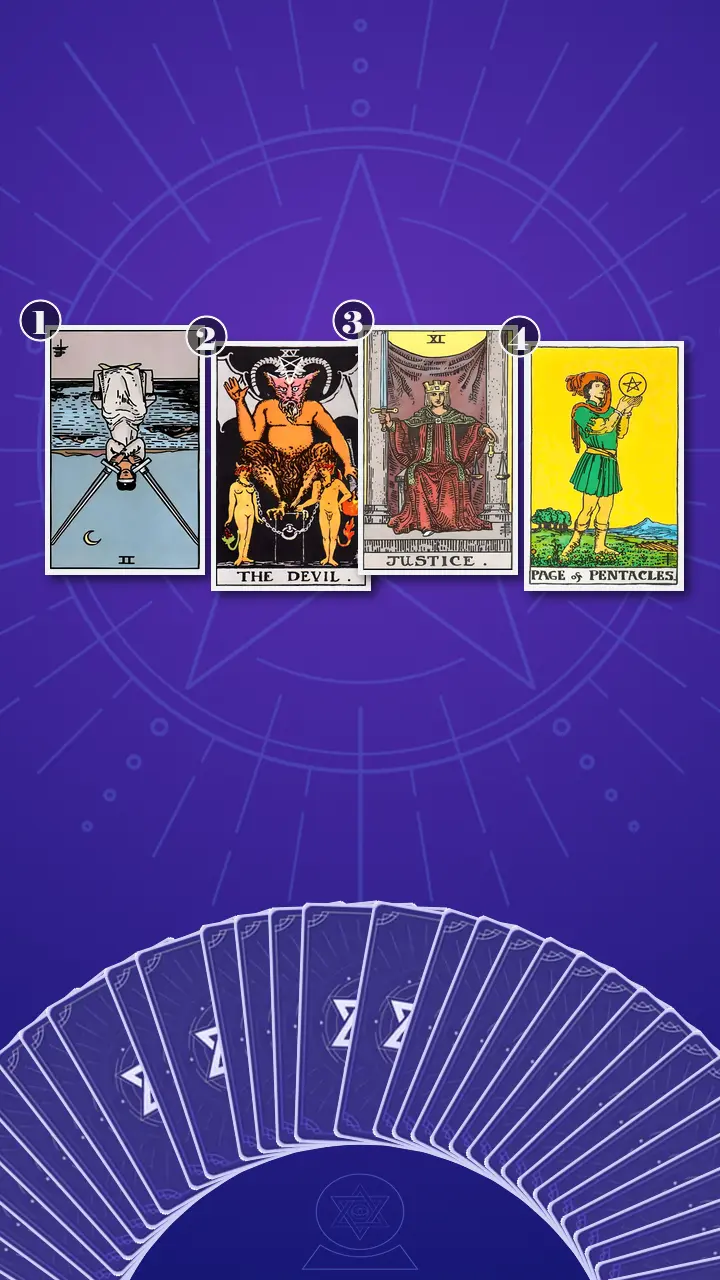
Position 1: The Reply That Ends the Debate
I turned over the first card and said, “This card represents the visible pattern: the observable behaviour of committing early, including the moment you say yes before checking the conflict between what you want and what you value.”
The card was the Two of Swords, in reversed position.
I brought the blindfold and crossed swords back to the 9:14 a.m. Slack scene. The blindfold was not proof that Alex had no values. It was the unopened calendar and the closed Notion note. The crossed swords were the tight feeling across her chest as she tried to keep desire and principle in separate rooms until one decisive tap could end the discomfort.
“If I answer now, I can stop feeling split; if I look first, I might lose it,” I said. “That is the precise conversion this reversal describes: blocked discernment becoming premature closure. The decision is made to manufacture certainty, not because the terms have been seen clearly.”
The energy here was blocked Air. It was not a deficiency of intelligence; it was an obstruction in seeing. The quick yes briefly relieved the internal pressure, but it also delayed contact with the fact, value, or limit that might complicate the answer. I asked, “What feeling, fact, or value are you refusing to face before you commit?”
Alex did not nod. First, her thumb stopped above the edge of her phone. Then her eyes went slightly unfocused, as if the Slack thread were replaying itself. Finally, she let out a short, bitter laugh and said, “That's uncomfortably specific. I do this and then call it a scheduling problem.” I told her that recognition did not require self-accusation. It was simply the first clear look at the crossed swords.
I added, “Urgency can end the debate without answering the question.” I watched her shoulders remain tense, but the tension had changed. It was no longer only pushing her towards another explanation; it was beginning to point at the moment before the reply.
Position 2: The Bargain Beneath the Spark
I placed my hand beside the second card and said, “This card represents the hidden reinforcement: the attachment, belief, or fear that makes premature commitment feel safer than staying with uncertainty.”
The card was The Devil, upright.
I told Alex that I was not reading this as a moral label, punishment, or sign that wanting recognition made her selfish. In this position, The Devil showed the bargain beneath the speed. I pictured a free trial with auto-renew already switched on: the first click offered access, excitement, and relief, while the recurring cost remained below the fold.
“The project did not only promise work,” I said. “It promised visibility, momentum, and a temporary escape from having to keep choosing. Saying yes made the future feel under your control. The hidden price was that the commitment quietly claimed evenings, rest, and room to revise.”
The energy was excessive attachment to the immediate reward and a blockage around the longer bargain. The chains in the card were visible, but they were not welded shut. That mattered. Alex had participated in the pattern, yet participation was not the same as permanent captivity. A public yes could still be examined, limited, renegotiated, or honestly revised within the real consequences of the situation.
I asked, “What does the commitment promise you immediately, and what does it ask you to surrender?” Alex looked down at the scales printed on the card beneath my fingers. “It promises that I belong in the room,” she said. “It asks me to act as if rest is the least important thing on my calendar.”
Her reaction came in three small movements. Her breath dropped low and briefly caught in her stomach; her eyes travelled from the card to the calendar on her phone; then her jaw released enough for her voice to soften. I said, “A want is real; it is not automatic consent to the terms.” The sentence allowed the desire to remain alive without giving it the only vote.
When Justice Held the Decision Still
Position 3: The Terms Become Visible
The room seemed to narrow around the third card. I turned it over and said, “This card represents the integrating truth: the principle that can reconnect desire with your chosen values before you consent to the terms.”
The card was Justice, upright. The balanced scales and upright sword made the answer direct: name what you want, name what it costs, name the value involved, and name the boundary that would make your participation conscious rather than automatic.
I remembered a lesson from archaeological digs. At a historical crossroads, the most dramatic option is not always the one that deserves the foundation. A temporary rush can make a structure look impressive while the underlying materials quietly fail. My Historical Crossroad Matching is the practice of widening the frame until the choice can be seen beside a larger turning point: not “Which option makes me look decisive today?” but “Which terms can support the life I am actually trying to build?”
Then I used my Enduring Value Assessment. I asked Alex to compare the short-term impulse with what would still matter after the Slack praise faded: sustainable workload, autonomy, honest capacity, and room to recover. This was not a test of purity. It was a way to identify which part of the opportunity might survive the test of time and which part was merely the bright first flash of being chosen.
I could see the old bargain trying to return: the offer glowing, her hand ready to close the discomfort, and the fear that a pause would expose unreliable judgment. The question beneath the question was whether she could trust herself without producing an instant answer. She was standing at an exciting doorway, one hand on her values rulebook.
You do not need to decide quickly to prove that you have control; use Justice's balanced scales and upright sword to weigh what you want against what you value, then make a bounded choice you can consciously own.
Your wants do not need to be punished or obeyed on contact. They need to sit beside your values long enough for you to see the terms of the yes.
For a moment, Alex's face went still. Her breath paused, her fingers hovered above the phone, and the room's small sounds seemed to separate: the radiator ticking, a car moving through wet Toronto streets, the faint hum of my lamp. Her eyes lost focus as she replayed the Slack thread and the public reply. Then her jaw loosened, her shoulders fell a fraction, and a shaky breath left her chest. She did not look triumphant. She looked briefly unburdened and newly responsible for the space that had opened. “But does this mean I was wrong every time before?” she asked. I said, “It means you can learn from what the quick yes was protecting. New information is not a punishment, and revising a term is not proof that you failed.” I invited her to ask herself: “Now, use this new perspective to remember last week. Was there a moment when seeing the terms this way could have made you feel different?”
This was the first real crossing from scarcity-driven urgency and performed certainty towards values-based discernment. The relief was genuine, but so was the brief blankness that followed it. When a person stops using speed as proof of control, they have to feel the responsibility of choosing with open eyes.
The Pause Is an Owned Choice
I asked Alex to picture the exact message again. She deleted “I'm in!” and replaced it with “This sounds interesting. Can I confirm by tomorrow at noon after I check the scope and my capacity?” In the imagined scene, the typing bubble disappeared. The opportunity did not instantly vanish.
“I have not lost control,” she said slowly. “I have made room to check the terms.” I answered, “A pause does not surrender control. It returns the choice to you.” Justice was not asking her to suppress desire or demand impossible certainty. It was asking her to let desire, values, consequences, and consent occupy the same frame.
Position 4: The Page's Small Field
I turned to the final card and said, “This card represents the grounded practice: a small action that lets you test alignment without making an oversized promise about your identity or future.”
The card was the Page of Pentacles, upright.
The Page held one pentacle at eye level while standing in a cultivated field. I saw the image as a beta release rather than a hard launch: one defined user group, one manageable task, one review date, and no promise to hand an entire season of life to an idea before knowing how it behaves in reality.
“You do not have to promise the whole quarter,” I said. “You can propose a two-week pilot with one deliverable, a maximum time budget, and a review conversation already on the calendar. The point is not to make the option harmless. The point is to make the terms observable.”
The Page brought the spread from Air to Earth. The reversed Two of Swords had shown thought trapped behind a blindfold; The Devil had shown the reward that made the trap attractive; Justice had made the bargain visible; now the Page offered learning through contact with an ordinary calendar, a real body, a real budget, and a limited commitment.
Alex opened Google Calendar. Her fingers moved more slowly this time. She made a small entry instead of a full-season rearrangement and said, “I can try one deliverable. I don't have to hard-launch a new version of myself.” I heard the first practical form of self-trust in that sentence: not certainty, but a willingness to gather evidence.
The One-Page Terms Review
From my side of the table, the four cards formed one coherent story. The reversed Two of Swords showed Alex closing the decision before looking directly at the conflict. The Devil revealed why that speed felt so rewarding: access, recognition, belonging, momentum, and relief from the discomfort of not knowing. Justice supplied the antidote by putting desire and values on the same scales. The Page of Pentacles turned that clarity into a small experiment.
The deeper blind spot was not that Alex wanted too much. It was that she treated pausing as evidence of lost control and then tried to solve a values mismatch with calendar Tetris. Once the commitment was public, practical explanations helped her avoid reopening the more honest question: “Did I consciously agree to what this would ask from my life?”
The transformation direction was therefore specific: move from scarcity-driven urgency to a deliberate, bounded choice. Let a want remain a want while examining its terms. Let a value speak without turning it into a rigid command. Let a boundary make an attractive option testable rather than forcing an immediate all-or-nothing yes or no.
I gave Alex three small next steps. They were not a ritual for guaranteeing that every opportunity would wait. They were practical ways to create better information before a non-urgent commitment becomes expensive, public, scheduled, or difficult to revise.
- The 24-Hour Scales CheckFor the next non-urgent opportunity arriving by Slack, email, text, or DM, send: “I'm interested. Can I check the scope and confirm by tomorrow at noon?” Ask for the actual deadline instead of assuming that urgency language means immediate consent. During the pause, write four lines: what I want, which value is involved, what this may cost, and what boundary would make it workable.If a full day is unavailable, use the minimum version: step away for ten minutes, check your calendar, and write one value. This pause is for non-urgent commitments, not immediate safety decisions or fixed contractual deadlines.
- The Time Stratigraphy ExerciseDuring the pause, I asked Alex to time-travel strictly from the perspective of her ten-year-future self. She did not ask that future self to predict the outcome. She asked which parts of the decision would still matter after the visibility, comparison, and first rush had faded, then returned to the present to compare want, value, cost, and boundary.Set an eight-minute timer and draft the message without sending it. The future perspective is a lens, not an authority; Alex still owns the present decision and can revise it when new information appears.
- The Bounded Yes ExperimentWhen an appealing project, side venture, trip, or social plan arrives, ask whether the commitment can become a two-week pilot, one defined deliverable, a maximum weekly time budget, and a review date. For a social plan, that might mean joining Saturday afternoon while keeping Sunday unscheduled instead of promising the whole weekend.Present the smaller scope as clear terms, not an apology. If the other person accepts only an open-ended commitment, you are allowed to decide that the terms do not deserve your yes.
These steps also leave room for accountable revision. If Alex has already answered too quickly, she can write, “I replied before checking my capacity. I can commit to X, but not Y. Does that still work for you?” She does not need to over-explain, and she does need to respect any real contract or material consequence. The aim is not to pretend that every promise can disappear; it is to stop treating an earlier rushed reply as unlimited access to her time and autonomy.
Tarot did not make the decision for Alex. The cards gave her a visual language for seeing, weighing, and testing. The choice remained hers, and the evidence would come from how the smaller agreement met her actual energy, values, responsibilities, and consent.

The Quiet Proof of Self-Trust
Six days later, I received a message from Alex while I was cataloguing a small fragment from an excavation photograph. She had asked her design lead for the actual scope, proposed a two-week pilot with one launch-flow deliverable and a three-hour weekly limit, and put the review date on both calendars. Her lead agreed to remove one existing task before the pilot began.
Alex wrote, “I still want it. I also know what I'm agreeing to now.” The project had not become a perfect fit, and the response had not solved her relationship with uncertainty. It had given her something more durable than a confident performance: observable information and a choice she could consciously own.
That night, she slept a full night. In the morning, her first thought was still, “What if I'm wrong?” She smiled, opened the four-line note, and answered the question with evidence instead of another instant promise.
That was the small proof I wanted her to have. Clarity was not a dramatic revelation or a guarantee that every desired opportunity would remain open. It was the first moment when a want could stay alive beside a value, and a pause could become part of choosing rather than a failure to choose.
I have spent years studying civilizations at their fractures, and I have learned not to confuse a break in the old structure with a permanent fate. In Alex's case, the fracture was the moment when speed stopped being the only available form of control. The rebuilding began with one question, one boundary, and one deliberately smaller yes.
When the offer lands and your thumbs rush towards yes while your chest tightens, the hardest part may not be wanting it. It may be fearing that one honest pause could cost both the opportunity and your trust in your own direction. If a pause could count as part of choosing, what tiny piece of your next yes might you leave open, like one evening, one deliverable, or one line in the terms, until you know what it is really asking of you?