Fear of Texting First: Choosing Data Over a Verdict After Flirting

The 11:40 p.m. Send Button: Finding Clarity After a Flirt
When Jordan settled into the chair across from me, I recognized the pattern before they had finished taking off their coat. "You are a twenty-something junior creative in Toronto who can defend a design decision in a stakeholder meeting, yet one quiet chat the morning after a mutual flirt sends you straight into texting anxiety," I said. "And now a two-line follow-up feels like an exam."
Jordan had described the scene to me on the phone: 11:40 p.m. on a Tuesday, stretched across the sofa with the chat open, changing "I had fun talking with you" into a joke and then deleting the joke. The radiator clicked in the background, blue screen light caught the rim of a cold water glass, and their warm phone sat beneath a hovering thumb.
"I want to text them," Jordan said, "but I do not want to be the one who cared more. It was probably mutual, unless I imagined the whole thing." They wanted to honour the spark and explore the connection, yet feared that reaching out would expose rejection or make the flirt seem more significant than it had been. I could feel the ambivalence in the details: a tight chest, restless hands, and a stomach drop whenever a notification appeared. It was like standing between two subway platforms and checking both arrival boards until both trains left.
"It is only one text, but it is carrying a question much bigger than itself," I told them. "This is not silly, and you do not have to shame yourself for caring. We are here to find out what the choice is actually carrying, then give the pen back to you. We are not asking the cards to decide whether you are wanted."

Choosing a Compass for the Quiet Chat
I asked Jordan to put both feet on the floor, take one slow breath, and name the question without improving it. I shuffled at an even pace. The preparation was a way to move attention out of the message thread and into the room, a practical transition from spiralling to observing.
"Today, I am using a five-card Decision Cross spread," I explained. "This is a tarot spread for comparing two paths when the real problem is not a lack of options, but the meaning we attach to each option. The cards will not tell you whether to text. They will help us see what texting represents, what letting it fade represents, and what fear is making both choices feel unsafe."
I explained the structure for anyone who has wondered how tarot works in a relationship decision. The centre card would show the present symptom: the drafting, deleting, checking, and waiting. The two cards beside it would compare Path A, texting, with Path B, letting the interaction fade. The lower card would reveal the hidden root, and the upper card would offer an integrating principle for making a deliberate choice. The purpose was not prediction. It was card meanings in context, used as an objective cognitive tool for separating observable information from a feared verdict.
"We will begin with what is happening," I said to Jordan, "then look beneath it before we decide what either path is asking of you. The final card will not choose for you. It will show you how to choose without handing your self-worth to the reply box."
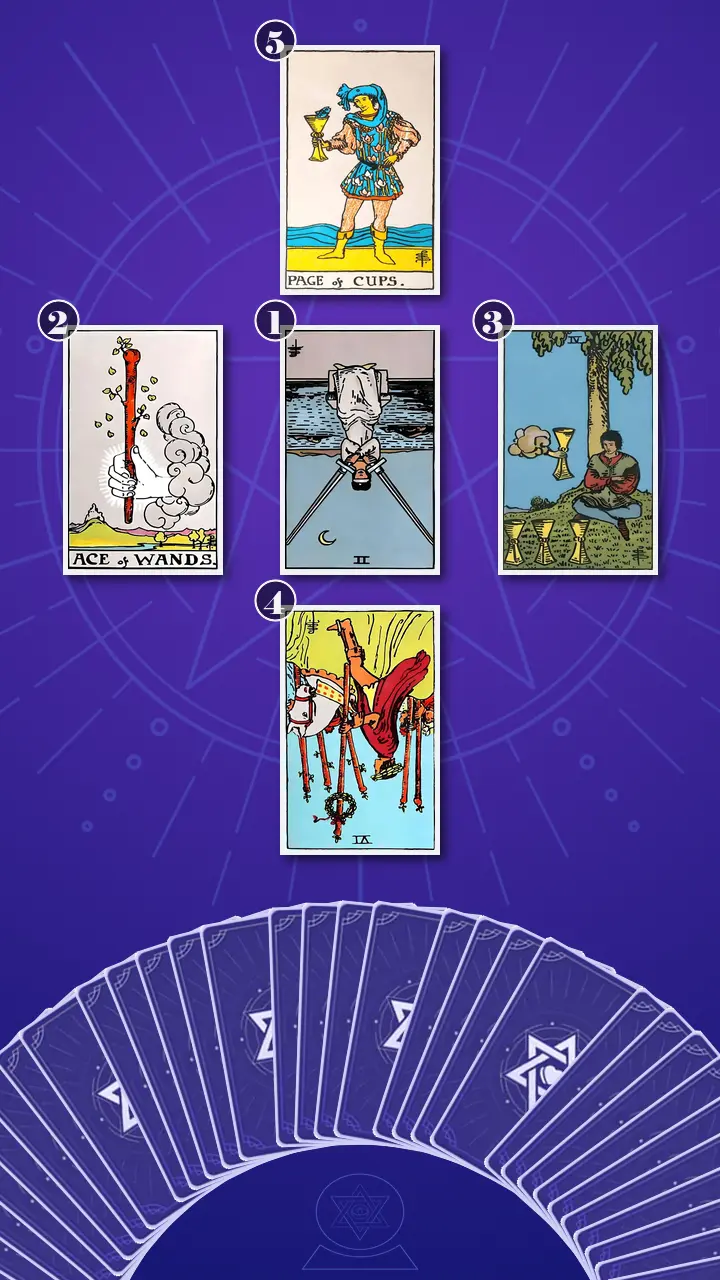
The Map Beneath the Message Thread
Position 1: The Reversed Two of Swords and the Draft That Stays in Review
"Now I am turning over the card for the present symptom: your repeated drafting, deleting, checking, and inability to choose between reaching out and allowing the exchange to fade." I placed the centre card face up: The Two of Swords, in reversed position.
The card showed me a blockage in Air rather than an absence of intelligence. Upright, the Two of Swords can hold competing considerations in a temporary balance. Reversed, that balance has become overloaded and agitating. At 11:40 p.m., Jordan cycles through five versions of the same follow-up, rejecting each one for looking too eager, too detached, too serious, or too casual. They close the app, reopen it minutes later, and check the other person's Story instead. The blindfold becomes a refusal to treat either imagined outcome as uncertain, while the crossed swords become two defended stories: "They liked me" and "I imagined it."
"This is like leaving a decision card permanently in the In Review column of Notion," I said. "You keep adding comments, but no new information enters the file. Maybe this sounds too eager. Maybe the joke sounds cold. Maybe tomorrow will make it obvious. The thinking is real work, but it is being used to postpone the only thing that could create new data: a proportionate choice."
Jordan's thumb stopped above their phone. Their breath paused, their eyes slid briefly toward the floor as if replaying the sofa, and then a short, bitter laugh left their chest. "That is too accurate," they said. "Almost rude." I did not ask them to turn the recognition into agreement. I let the laugh show that the defence had loosened without making Jordan wrong for needing it.
Position 2: The Ace of Wands and the Spark Worth Acknowledging
"Now I am turning to Path A: what texting represents internally, including the desire to honour the spark through a proportionate act of initiative." I turned over the card on Jordan's left: The Ace of Wands, in upright position.
Here Fire is available as a beginning, not as a guarantee. The Ace of Wands frames texting as one concrete chance for mutual interest to reveal itself. It does not ask Jordan to confess feelings, define the connection, or secure a particular response. It asks whether they want to place one living possibility into the conversation rather than keep rehearsing it privately.
I showed Jordan the hand extending a sprouting wand from a cloud. "The hand is offering potential, not a destination," I said. "A message such as, "Still laughing about your take on that terrible bar playlist. I had fun talking with you," can refer naturally to what already happened and leave both people room to respond freely. The leaves are already moving. You do not need to write the whole relationship roadmap before taking the first step."
As an artist, I have learned that a prototype becomes useful only when it leaves the sketchbook. That does not make the first mark a promise about the finished piece. I felt that old reflex in myself as I looked at the card: initiative can be light, curious, and reversible. Jordan's shoulders lowered by a fraction, and they imagined the message without immediately attaching a speech, a disclaimer, or a prediction to it.
Position 3: The Four of Cups and the Difference Between Silence and Release
"Now I am turning to Path B: what letting the interaction fade represents internally, distinguishing intentional non-engagement from passive emotional suspension." I placed the right-hand card beside the Ace: The Four of Cups, in upright position.
This card brings still Water and a useful question. The Four of Cups does not declare silence right or wrong. It shows withdrawal, reflection, and the possibility of overlooking an emotional offer. Jordan can decide not to text because the connection does not fit their life or because they genuinely do not want to pursue it. But if they say, "I am letting it go," and continue checking activity status every night, the interaction has faded externally while remaining active internally.
I brought up the Queen West coffee-shop scene Jordan had described: they told a friend they were over it, then turned the phone face-up every time it lit while the espresso machine hissed and rain tapped the window. "Closed in public, waiting in private," I said. "Silence is a choice only when you are no longer using it to keep the possibility safely untested. Deliberate release would include changing the digital behaviour that keeps reopening the door."
Jordan folded their arms, then noticed the movement and let them fall into their lap. Their gaze stayed on the fourth cup in the card instead of darting toward the phone. "So I am allowed to let it fade," they said, "but I cannot call constant monitoring peace." I nodded. "Exactly. You can choose space without performing indifference."
Position 4: The Reversed Six of Wands and the Hidden Scoreboard
"Now I am turning over the deeper root: the fear that the other person's response will confirm or deny your desirability and personal worth." I placed the lower card beneath the centre: The Six of Wands, in reversed position.
The Six of Wands traditionally carries recognition, visible success, and affirmation from an audience. Reversed, its Fire has become distorted into dependence on recognition. Jordan is not only deciding whether to text. They are trying to avoid a response that might feel like evidence that they were not impressive, attractive, memorable, or socially perceptive enough.
I returned to the lunch-hour Story viewer scene: trays clattering in a downtown Toronto food court, the smell of fried food hanging in the air, Jordan checking the viewer list because the other person had seen the Story but had not restarted the conversation. "They viewed it but did not reply, so I was not memorable enough," Jordan had thought. I looked at them and said, "You want private clarity, but you are measuring the connection with a public scoreboard."
This is where I use one of my signature lenses, Safe-Choice Sabotage Recognition. I look for the option that sounds most logical because it protects the old story. "Do not text first" can sound like dignity while quietly preserving the untested possibility. It can create the appearance of control without giving Jordan any direct relational information.
First, Jordan's hand froze against the phone. Then their eyes went unfocused, as if the story views, response times, and group-chat screenshots had gathered into one impossible ledger. Finally, their stomach released a small breath and their jaw softened. "I have been treating texting first like losing leverage," they said. "That is a lot of pressure to put on a person I barely know." The scoreboard had not disappeared, but Jordan could now see who had built it.
When the Page of Cups Looked at the Fish
Position 5: The Page of Cups and the Curious Beginning
"Now I am turning over the integrating guidance: a way to replace certainty-seeking with a small, emotionally honest experiment while retaining self-respect regardless of the response." I reached for the upper card.
The room seemed to quiet around the final turn. I revealed The Page of Cups, in upright position. In the Page's cup, a fish rises unexpectedly from the water. The Page does not panic, perform indifference, or demand to know what the fish means forever. They look directly at what is present. For Jordan, that means sending a light, sincere message, then allowing an engaged reply, a flat reply, or silence to provide limited information about mutual momentum.
At this point, I use my signature Narrative Fork Analysis. I laid out the two options as competing plotlines, not competing verdicts. One plotline says Jordan sends a brief message and receives data about whether the conversation has another beat. The other says Jordan chooses not to text and genuinely releases the attention. The growth arc is not "be chosen." It is becoming someone who can act from curiosity and self-respect without making another person's response the narrator of their worth.
I asked Jordan to picture the familiar scene: 11:40 p.m., the chat glowing on the sofa, one harmless sentence edited until it no longer sounds like them, while a new Story is easier to open than the conversation. They were trying to make one tiny choice carry a guarantee.
You do not need certainty before reaching out; make one light, honest bid and let the Page's cup hold curiosity instead of a verdict on your worth.
I let the sentence settle, then added, "A message can be a small expression of curiosity; it does not have to prove the flirt was real or submit your desirability for grading."
Jordan went still. Their breath stopped halfway in, and the fingers that had been rubbing the phone edge hovered above the table. For a moment, their eyes lost focus, as if the deleted drafts had begun playing back: the joke, the softer version, the imagined flat reply. Then their jaw tightened. "But if I send it and they do not care, does that not still say something about me?" The resistance came before the relief, and I let it be there. Outside, a streetcar bell sounded and faded. Jordan looked at the Page again; their pupils widened, their shoulders lowered by a fraction, and their grip on the phone loosened. A shaky half-laugh left their chest. "Maybe I have been asking a text to tell me who I am." I placed paper beside the card. "Set a ten-minute timer. Draft no more than two sentences, label the feared outcome information or verdict, and choose once whether to send or delete. Sending is optional, and one unanswered message never asks for another. Now, with this new view, where might one honest bid or one deliberate release have felt different last week?"
I told Jordan that this was the first movement from contracted uncertainty toward steadier self-trust. The Page of Cups was not promising a reply, a relationship, or closure. It was offering a different relationship with uncertainty: a response could be relational information rather than a verdict on desirability. Curiosity and caution could exist in the same body, and that was already a change in the plot.
Two Plotlines, One Hidden Scoreboard
Once the five cards were face up, I could see why the post-flirt decision paralysis had lasted. The reversed Two of Swords showed thought circling without new information. The Ace of Wands showed a healthy spark that could be acknowledged with initiative. The Four of Cups showed that fading could be valid only if it created real space. Beneath both paths, the reversed Six of Wands revealed the hidden scoreboard: Jordan had made a small message responsible for proving their worth. The Page of Cups offered the resource already present in them, an ability to feel something honestly without forcing it to become a complete story.
"Your life is a film still in production," I said. "You have stayed in a painful scene a little too long, trying to edit the next line until no one can misunderstand it. The blind spot is believing you must feel safe before you choose. In reality, you have been asking safety to arrive as a guaranteed response. The shift is smaller and more powerful: make one proportionate choice, then read what happens as data rather than a verdict."
The spread also showed why more analysis would not solve this alone. Air had become trapped, Fire was divided between genuine initiative and recognition-seeking, and Water was split between withdrawal and emotional openness. Earth was missing. The insight needed a concrete boundary, not another interpretation of the flirt. So I gave Jordan my 24-hour creative mandate, the Protagonist Pivot Action: one micro-action aligned with the most daunting but authentic plotline, small enough to complete before fear can turn it into a full screenplay.
The Protagonist Pivot Action: One Honest Bid Is Information
- Build the two-sentence prototypeWithin the next 24 hours, sit somewhere neutral rather than in bed, open the Notes app, and set a ten-minute timer. Draft one light follow-up that naturally refers to the shared flirt or conversation. Read it once and ask whether it sounds like you and leaves both people room to respond. Make no more than one edit, then choose once: send during normal waking hours, or delete and close the interaction for that evening. If the other person has already declined, shown discomfort, or set a boundary, do not send.Treat ten minutes as an energy budget, not a discipline test. The minimum version is one sentence drafted for two minutes. No screenshot review or group-chat vote is required. If you send, place the phone out of reach for thirty minutes while showering, walking around the block, or finishing dinner.
- Make a deliberate fadeIf you choose not to text, delete the draft, mute the person's Stories and activity indicators for 24 hours or seven days, and tell one trusted friend, "I am choosing not to pursue this, so please do not help me decode their posts this week." Schedule one absorbing activity within the next day, such as a cinema ticket, a fitness class, a design meetup, or dinner with your phone in your bag.Silence is reversible and does not need to be punishment or strategic scarcity. Start with 24 hours if seven days feels too loaded. At the end of the week, check whether monitoring reduced. If it did not, name that honestly as ongoing suspension rather than evidence that the choice was wrong.
- Separate data from verdictCreate a note titled "Data / Verdict." Under Data, write only observable facts such as "we flirted," "neither of us followed up," or "they replied briefly." Under Verdict, place interpretations such as "I was not desirable enough." Exclude Story views, likes, and activity status from the Data column. Decide in advance to match an engaged reply, match a flat reply, and send no reassurance-seeking follow-up after silence.You do not have to argue a feared meaning away. Label it an interpretation and stop there. The smallest version is one fact and one feared meaning. Pause the exercise if it fuels more checking, and return only when it supports clarity rather than another round of analysis.

A Week Later, the Quiet Proof
Four days later, I received a message from Jordan: "I used the timer. I sent the terrible-bar-playlist text. They replied briefly, and I did not go looking for extra meaning in their Stories." That was not a cinematic resolution, and I was glad. It was a real piece of evidence about what Jordan could do.
That evening, Jordan received a brief, friendly reply and still stared at the chat for three minutes. Then they put the phone down, finished their pasta, and let disappointment remain disappointment instead of turning it into a verdict.
I thought of the Page of Cups looking at the unexpected fish. The card had not made the decision, softened the other person's response, or guaranteed that the spark would grow. It had helped Jordan stop maintaining limbo long enough to make a deliberate choice. That is the beginning of finding clarity: not certainty, but the return of authorship.
When your thumb hovers over Send and your chest pulls tight, the frightening part is rarely the two-line message itself; it is the possibility that one person's response could seem to decide whether you were ever desirable enough to reach for. I want you to know that the cards can help you see that old equation, but only you can decide whether it still gets to direct the scene.
If this message only had to express one small piece of honest curiosity, rather than prove anything about you, what might you want it to sound like - perhaps in the voice of the Page of Cups, with no scoreboard attached?