The 11:40 p.m. Slow-Fade Spiral
“You can defend every pixel in Figma,” I said to Maya, “yet at 11:40 p.m. you keep rewriting a two-sentence dating reply because sending it feels like becoming the villain in your own story.”
Across my table, Maya wrapped both hands around a cappuccino she had barely touched. She told me about the previous Tuesday in her Toronto apartment: blue phone light pooling across the duvet, the radiator clicking, her thumb changing I do not think this is the right fit to I am just really busy, then deleting both. The phone had grown warm in her palm while the rest of the room stayed cold.
“I know silence is an answer, but it is not the answer I want to give,” she said. “I want closure without having to become the person who closes it.”
I watched her throat tighten and her shoulders rise. The pressure seemed to move through her like a seat belt ratcheting one click tighter every time the unread thread returned to the top of her screen. She already knew she did not want another date, but conflict-avoidant slow fading offered a temporary escape: draft, delete, delay, send a heart reaction, and keep the connection technically alive.
“I am not here to decide whether you are kind or unkind,” I told her. “I want us to understand why a simple boundary keeps turning into a moral crisis. Let us give this fog a practical map.”

Choosing the Four-Rung Map
I asked Maya to put both feet on the floor, take one unforced breath, and hold the question in mind: Why do I slow-fade when I actually want honest closure? I shuffled slowly. The pause was not a mystical performance; it was a way to move her attention from ten imagined reactions back to the decision in front of her.
I chose the Four-Layer Insight Ladder, a four-card surface-root-transformation-action spread. I use it when the question is not “What is the other person thinking?” but “What mechanism in me keeps repeating this pattern?” A larger predictive spread would have added noise. This one could show the visible behavior, the protection underneath it, the perspective capable of interrupting it, and the action that would embody the change.
For anyone wondering how tarot works in a reading like this, I treat the cards as an objective cognitive tool. I do not use them to predict a recipient’s response. I use card meanings in context to make an existing pattern visible enough that the person in front of me can choose what to do with it.
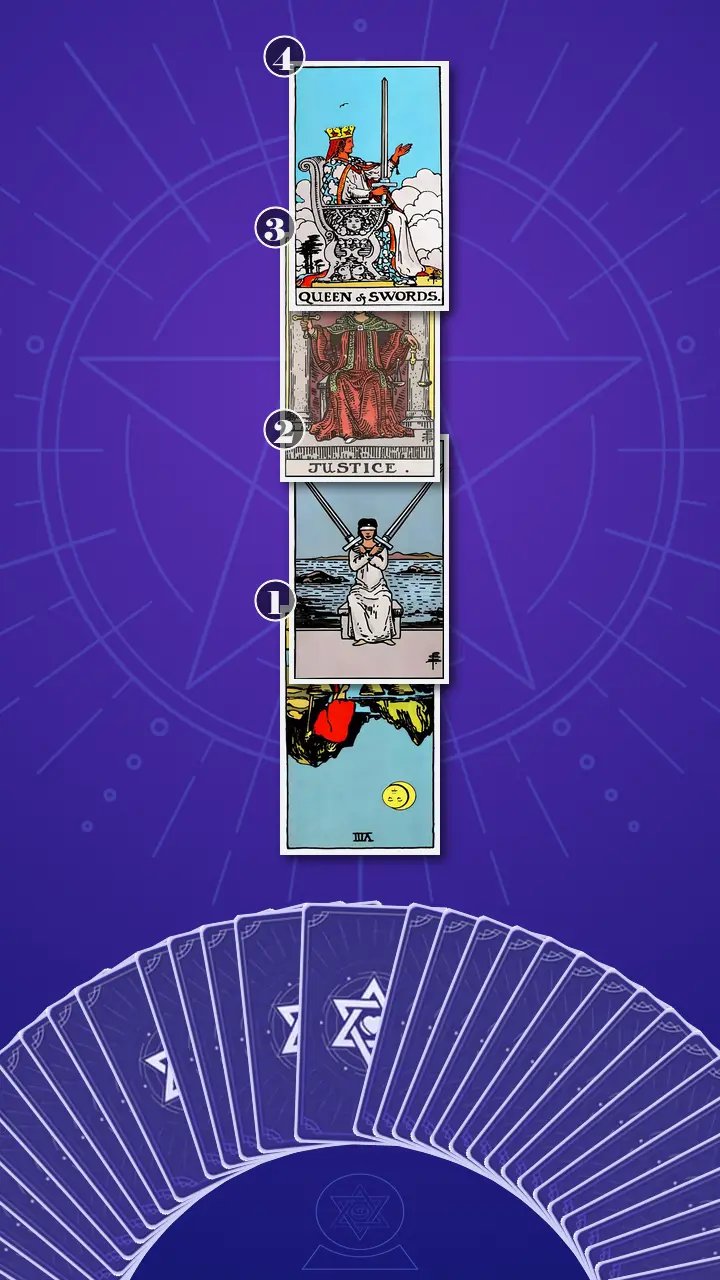
Reading the Unfinished Exit
Position 1: The Door Maya Had Not Closed
Now I turned over the card representing the surface layer: the observable drafting, delaying, and reduction of contact after the desire to leave had already formed. It was the Eight of Cups, reversed.
In Maya’s real life, this reversed Eight of Cups looked like emotionally leaving after two Hinge dates while keeping the chat technically alive. She spaced replies farther apart, sent a heart reaction, or said she was busy. The conspicuous gap among the cups mirrored the gap between her internal decision and the still-open message thread.
I described its reversed energy as a Blockage. The feeling had already moved away, but the action had not followed. To avoid appearing abrupt, she kept reopening the door with small friendly signals. That reduced discomfort for an evening, but it also renewed ambiguity.
“Think of the last message you opened after you knew you did not want another date,” I said. “What did you send instead of naming the decision?”
Maya gave one short, bitter laugh. “That is so accurate it feels a little brutal. I sent, ‘Hope your week is going well,’ and then panicked when he asked whether I was free Friday.”
“I am not reading the card as an accusation,” I replied. “It shows that you have been trying to leave without experiencing the moment of leaving. That strategy deserves understanding, but it does not have to remain in charge.”
Position 2: Two Drafts Arguing in the Same Text Box
Now I turned over the card representing the root layer: the inner conflict that equated directness with causing harm and kept honesty and self-protection locked in stalemate. It was the Two of Swords, upright.
The modern scene was almost exact. Maya compared ten versions of the same closure message while treating every imagined reaction as another reason to pause. The blindfold did not mean she lacked words. The crossed swords represented two demands held over her braced chest: I want to be honest and I need them not to feel hurt.
Here, Air was in Excess and Blockage at once. Thought had stopped gathering useful information and begun protecting her from choice. Like a Notion board with every possible reaction added as a dependency, the task could never move to “done.”
“When you picture pressing send,” I asked, “which reaction are you trying hardest to prevent, and what would it seem to prove about you?”
Her fingers stopped against the cup. Her gaze drifted past me as if she were replaying several old threads, and then her shoulders loosened by a fraction. “If he is hurt or angry, I think it proves I handled it badly. Maybe that I am not as considerate as I think I am.”
I nodded. “So the delay is not only searching for better wording. It is trying to secure your identity as a good person before you act. That is an impossible standard for any message to meet.”
When Justice Separated Clarity from Control
Position 3: The Responsibility Split
The cafe grinder fell silent as I reached for the next card, and even the rain against the window seemed to sharpen. Now I turned over the card representing the transformative layer: distinguishing responsibility for clear closure from responsibility for controlling the other person’s emotional response. It was Justice, upright.
I brought Maya back to 11:40 p.m.: the phone warm, the radiator clicking, and I do not think this is the right fit repeatedly becoming I am just really busy. She already knew the truth. The unsent draft was postponing the moment when the truth became hers to state.
Justice showed Balance: one upright sword instead of two crossed blades, and level scales instead of competing predictions. In practical terms, it was a Figma responsibility matrix. Maya owned the copy she sent. She did not own every emotional dependency attached to the person reading it.
I used the lens I call Analysis Paralysis Deconstruction. I stripped away every abstract what-if and kept only the grounded realities: Maya did not want another date; the other person was waiting for an answer; the interaction felt safe; and continued delay was creating ambiguity. Then I used Complexity Reduction to turn the clutter into one clean test: did her message truthfully close the door, or did it keep the door open?
In that moment, I thought of twenty years of conversations held over coffee. People rarely needed one more grand theory. They needed two clear places to set down what belonged to them and what did not.
You do not need a painless ending to be a kind person; offer the truth you own, release the reaction you cannot control, and let Justice's balanced scales separate responsibility from over-responsibility.
For one beat, Maya’s breathing stopped. Her fingers hovered above the cup, and her pupils widened as if the sentence had pulled an old memory into focus. Then her mouth tightened. A flush rose along her cheeks, and she said, more sharply than before, “But does that not mean I handled all those other endings wrong?”
I kept my voice level. “It means your old method protected you from immediate disapproval. It also had a cost. Understanding that cost is not the same as putting you on trial.”
Her fist slowly opened against her knee. The breath that followed trembled on the way out; her shoulders dropped, but her eyes became wet. Relief arrived with a brief, exposed look, the kind that comes when a familiar excuse disappears and choice returns. “So I can be clear that I do not want another date,” she said quietly, “without controlling whether he feels rejected.”
“Now, from this new perspective, can you recall a moment last week when this insight might have made you feel different?” I asked.
She remembered Wednesday at 5:48 p.m., after a hybrid workday, when she had opened the message between a Slack notification and a Figma comment. “I could have admitted that I already knew,” she said. “I was not waiting for clarity. I was waiting for immunity.”
I invited her to set a ten-minute timer and create two Notes app columns: What I owe them and What I cannot control. She would write one sentence under each, then draft a two-sentence closure message only if she genuinely wanted to send it and the interaction felt safe. I made the boundary explicit: she did not owe access, debate, or an explanation to anyone who was coercive, harassing, or unsafe, and she could stop if the exercise became too activating.
This was the first real movement from braced apprehension, guilt, and over-responsibility toward accountable clarity, tolerable discomfort, and steadier self-respect. The card did not remove the discomfort. It put the discomfort in proportion.
The Queen’s Sword and Open Hand
Position 4: What Honest Closure Sounds Like
Now I turned over the card representing the action layer: one concise, respectful boundary that closed ambiguity without over-explaining or creating false hope. It was the Queen of Swords, upright.
Her upright sword and extended hand offered the exact combination Maya needed: a closed path forward with direct acknowledgment of the person on the other side. In everyday language, the card sounded like this: I have enjoyed getting to know you, but I do not feel this is the right fit for me, so I am going to leave it here. I wish you well.
The Queen’s energy was Balance, firmness without punishment and empathy without ambiguity. Maya did not need a perfect explanation. Closure did not require a courtroom brief. She could read the message once for clarity and kindness, remove any “maybe later” she did not mean, and make a deliberate choice about sending it.
“That sounds almost too simple,” Maya said.
“Simple is not the same as easy,” I replied. “A week of polite mixed signals is not automatically gentler than one respectful goodbye. You still retain the right not to engage when contact feels unsafe.”
Turning Four Cards into Two Next Steps
I gathered the reading into one coherent story. Maya’s product-design skill had taught her that more revision could make language more defensible. In dating, that useful skill had become a shield. The Eight of Cups reversed showed one foot already outside while her hand kept holding the door open. The Two of Swords revealed why: she had confused honest communication with the impossible task of preventing another person’s discomfort. Justice restored proportionate responsibility, and the Queen of Swords showed how that responsibility could sound in human language.
Her cognitive blind spot was clear: she had been measuring kindness by whether the other person stayed comfortable, rather than by whether she communicated truthfully and respectfully. The shift was not from “soft” to “harsh.” It was from waiting for a reaction-proof ending to offering brief, humane closure when doing so felt safe.
The Coffee Bean Filter Protocol
I placed two empty saucers beside our cups and gave Maya the practical exercise I use when emotional variables have crowded out decision-relevant facts. I call it the Coffee Bean Filter Protocol: only the truth, safety, and respect needed for the decision pass through; imagined verdicts and demands for universal approval stay in the filter.
- Run the 24-Hour Responsibility Sort.Within the next 24 hours, take ten minutes at a table and label two slips of paper or Notes columns: “Absolute Must-Haves: What I Owe Them” and “Emotional Noise: What I Cannot Control.” Put timely clarity and respectful language in the first. Put imagined reactions, approval, and the demand for a painless response in the second. “Noise” refers to predictive pressure, not to the other person’s humanity.Tip: Write one sentence in each category and stop. This is a clarity check, not a case against the other person.
- Try the Two-Sentence Closure Practice.Choose one low-stakes dating thread this week where your decision is already clear. During a ten-minute daytime block, draft one sentence of acknowledgment and one sentence that plainly ends the connection. Read it once for clarity and kindness. Send it only if that is what you choose and the interaction feels safe; otherwise, set a specific time to revisit the decision instead of leaving it indefinite.Tip: Remove explanations and “maybe later” language that are not true. After sending, mute the thread long enough to let your body settle before deciding whether any reply requires a response.

A Week Later: The Quiet Proof
Four days later, I received a message from Maya. She had used the two-column filter during lunch, drafted the closure text, read it once, and sent it to a person whose contact had always felt safe. Then she muted the thread and walked to Grange Park with a coffee instead of watching the typing indicator.
“I felt awful for ten minutes,” she wrote. “Then I realized I felt sad, not trapped. Those are not the same thing.”
She slept through the night. Her first thought in the morning was, What if I got it wrong? She told me she smiled, not because doubt had vanished, but because it no longer got the final edit.
I did not credit the cards with sending that message. The Four-Layer Insight Ladder gave Maya a clean map of her slow-fade dating pattern, but she supplied the judgment, courage, timing, and boundary. Her journey to clarity did not end with certainty. It began when she stopped requiring certainty before acting in alignment with what she already knew.
If tonight you are emotionally halfway out and already bracing for the reply, I want you to remember that keeping a chat alive can feel safer because a clear goodbye seems to risk proving you were not kind enough. Simply noticing that hidden requirement means you are no longer standing at the beginning of the pattern.
If Justice’s scales held only the clarity that belongs to you, while the Coffee Bean Filter caught every imagined reaction you cannot author, what small honest sentence would you finally let yourself imagine?
This story is adapted from psychological research, written so that those in a similar struggle can see their own pattern in it — and find their next step clearly.These insights are not a substitute for professional psychological, medical, legal, or financial advice.
Learn more about our Journey to Clarity.
How did this insight land for you?
🫂 This Resonates Deeply
🌀 Living This Story
✨ Now I See Clearly
🌱 Seeing New Possibilities
🧰 Useful Framework
🔮 The Confirmation I Needed
💪 Feeling Empowered
🚀 Ready for My Next Step
Author Profile
 AI
AI“For twenty years, I’ve listened to stories unfold over the warm aroma of coffee. I don’t believe life’s complexities always require grand theories to be solved; often, we just need a safe place to tidy up our reality. I don’t offer high-minded preaching—just grounded, heartfelt insights to help you regain your sense of control amidst the clutter of daily life.”
In this Choice Tarot Reading :
Core Expertise
- Analysis Paralysis Deconstruction: Stripping away abstract 'what-ifs' to focus strictly on the grounded realities and immediate constraints of your options.
- Complexity Reduction: Tidy up cluttered decision parameters into a clean, practical binary choice.
Service Features
- The Coffee Bean Filter Protocol: A 24-hour pragmatic sorting exercise to physically categorize decision variables into 'Absolute Must-Haves' and 'Emotional Noise', instantly restoring decisiveness.
Also specializes in :
Explore Related Patterns:
Approval-Driven Decision ParalysisMaya compared ten versions of the same message and treated every imagined reaction as another dependency before she could press send. When you keep refining a decision that is already clear, the editing can quietly change jobs from finding honest wording to trying to guarantee that nobody will judge you for using it. That guarantee cannot be secured through another draft. The delay is then driven by approval forecasting, not by missing facts. You can still consider the other person's humanity while accepting that a decision does not become valid only after every possible reaction has been made safe.
Closure AvoidanceAt 11:40 p.m., Maya had already decided she did not want another date, yet she changed a direct sentence into 'I am just really busy,' deleted both drafts, and kept the chat technically alive. When you send a heart reaction or stretch out replies after your decision is already clear, the behavior creates a partial exit that protects you from the immediate moment of closing while preserving the ambiguity you wanted to end. The short-term relief is the defensive payoff, but the open thread returns with a new question and renews the pressure. You are not necessarily waiting for more information; you may be postponing the moment when the truth becomes yours to state. Seeing that sequence makes the slow-fade less mysterious and shows where a clear, respectful choice can interrupt it.
Conflict AvoidanceAfter two Hinge dates, Maya knew she did not want another one, but the thought of a direct ending felt like becoming the villain in her own story. You can use vague availability, delayed replies, or a friendly reaction as a safety behavior when anticipated friction feels more threatening than continued ambiguity. That strategy lowers discomfort for one evening but transfers it into a longer, less clear exchange. The key mechanism is not a lack of words; it is the attempt to avoid the interpersonal collision altogether. A respectful boundary may still disappoint someone, but disappointment is different from evidence that you acted carelessly.
Emotional Hyper-ResponsibilityWhen Maya imagined him feeling hurt or angry, she treated that reaction as proof that she had handled the ending badly. You can end up carrying two jobs at once, stating your own decision and trying to regulate the emotional experience of the person receiving it. That expanded responsibility makes a two-sentence boundary feel morally dangerous. The responsibility split in the reading is more precise: you owe truthful and respectful communication when the interaction is safe, but you do not own every feeling that follows. Releasing the second job can make directness uncomfortable without making it cruel.
Boundary DiscernmentJustice separates the sentence Maya owns from the reaction she cannot author, and the two-column exercise gives that distinction a concrete shape. You can use the same boundary check by asking whether your message is clear, respectful, and safe rather than whether it can prevent every uncomfortable response. This is not permission to ignore context or force contact. The story keeps safety as a condition and preserves your right not to engage with coercive or unsafe communication. When the interaction is safe, discernment lets you stay connected to your own decision without confusing another person's emotional autonomy with your obligation.
IntellectualizationMaya could defend every pixel in Figma, and that same precision entered a two-sentence dating reply. You may turn an emotional choice into a technical wording problem because technical problems invite enough revision to postpone the exposed moment of saying what you mean. The Notion-board image shows how analysis became a shield rather than a source of useful information. One clarity check can protect the message from being careless; endless contingencies make it defensible instead of honest. The practical distinction is whether each edit improves truth and respect or merely delays contact with discomfort.
Moral PerfectionismMaya wanted closure without becoming the person who closes it, so an ordinary dating boundary became a test of whether she was kind enough. You may be holding yourself to a standard in which a good ending must be both completely honest and entirely painless for the other person. That standard turns another person's discomfort into a verdict on your character and makes no wording feel good enough. Kindness can be measured by truthfulness, respect, and proportionate responsibility rather than by the impossible promise of universal comfort. Once the moral trial is removed, the decision has room to be simple.
Values-Based Decision MakingMaya's final message is built around three decision-relevant facts, what is true for her, what is safe, and what is respectful. You can make the same shift when you let those values guide the wording instead of letting imagined verdicts decide whether you are allowed to act. The later choice to send the message to a person whose contact felt safe, mute the thread, and walk away from the typing indicator shows that alignment does not require the discomfort to disappear first. Values-based action gives discomfort a proportionate place while keeping the decision connected to what you already know.
Explore Related Struggles:
Clarity-Exposure SplitAt 11:40 p.m., Maya changes "I do not think this is the right fit" to "I am just really busy," then deletes both versions. The decision is already present, but making it visible would expose her to a response she cannot predict or control. The friction is not a shortage of clarity. Knowing and saying stop moving together because disclosure carries the possibility of rejection, anger, or being read as unkind. You can therefore feel internally certain while remaining behaviorally suspended at the point where certainty becomes visible to someone else. Recognizing that exposure is part of communicating a boundary restores a usable distinction. Clarity belongs to what you know and state; it does not require advance protection from every interpretation that may follow.
False Responsibility LoopMaya compares ten versions of the same message and treats every imagined reaction as another dependency the wording must resolve. She is not only asking the draft to communicate her decision; she is asking it to prevent hurt, anger, and disapproval before any of them occur. No two-sentence message can complete that assignment. You remain responsible for the clarity, timing, and respect of what you communicate, but taking ownership of another person's entire emotional response makes completion impossible and sends the process back into revision. The loop loosens when responsibility returns to proportion. You can offer a humane ending without requiring the message to provide immunity from discomfort or universal approval.
Identity Verdict LockWhen Maya is asked what a hurt or angry reply would prove, she says it might show that she handled the ending badly or is not as considerate as she believes. A dating response is therefore carrying more than feedback about one interaction; it is being granted the power to judge her character. That standard turns a simple boundary into a moral trial. You can know that a connection is not right for you and still become stuck if another person's disappointment appears capable of rewriting who you are. The lock becomes visible when conduct and verdict are separated. You retain authority over whether your message is honest and respectful, while the recipient's reaction remains information about their experience rather than a final definition of your identity.
Partial Exit LockAfter two Hinge dates, Maya already knows she does not want to continue, yet she spaces out replies, sends a heart reaction, and keeps the chat technically alive. When she writes "Hope your week is going well," the open thread produces exactly what an open thread can produce: another invitation for Friday. Each small signal postpones the exposed moment of leaving, but it also cancels part of the exit. You can become caught with your decision on one side of the door and your visible behavior on the other, repeatedly maintaining access to a connection you have already left internally. The lock is easier to locate once the half-exit is treated as a real structure rather than a failure of wording. Your choice can remain compassionate while your behavior stops advertising a future you no longer intend to offer.
Explore Related Emotions:
Approval AnxietyMaya compares ten versions of the same closure message while rehearsing how the recipient might feel about each one. When she imagines hurt or anger, she treats that reaction as possible proof that she communicated badly or is less considerate than she believes. The search for perfect wording is therefore also a search for advance approval. Approval Anxiety arises when you feel unable to trust your own respectful boundary unless the other person receives it comfortably, leaving your self-image dependent on a response you cannot author.
Closure DreadAt 11:40 p.m., Maya changes “I do not think this is the right fit” to “I am just really busy,” deletes both versions, and keeps holding the warming phone while her shoulders rise. The decision itself is already clear, but sending would make the ending concrete and place her inside the moment she has been postponing. When you experience finality as evidence that you might be the villain, a simple goodbye can feel morally dangerous even when it is respectful. Closure Dread names that braced inner weather, where keeping the thread technically alive feels temporarily safer than tolerating the exposed moment of ending it.
Messenger GuiltMaya says she wants closure without having to become the person who closes the connection. She can tolerate privately knowing that she does not want another date, but delivering that knowledge to someone else makes her feel responsible for the disappointment it may create. When you confuse carrying an unwanted message with causing every reaction to it, silence can seem kinder than speech for a few more hours. Messenger Guilt is the burden of feeling morally at fault for communicating a truth that was already present, even when you communicate it with restraint and respect.
Bittersweet ReleaseFour days later, Maya sends a concise goodbye to someone whose contact has felt safe, mutes the thread, and walks away with her coffee. She feels awful for ten minutes, then notices that the sensation is sadness rather than entrapment. The ending still matters, and another person's disappointment has not become meaningless. Bittersweet Release allows you to feel the real tenderness of closing a possibility while also experiencing the space created when false hope and indefinite waiting no longer have to be maintained.
Cognitive OverwhelmAt 5:48 p.m., Maya opens the thread between a Slack notification and a Figma comment, carrying the same unresolved decision from her cold bedroom into the workday. Her design habit of defending every detail becomes an expanding list of imagined reactions, dependencies, revisions, and reasons not to press send. More thought is no longer producing more information; it is filling every available space around a decision whose core facts are settled. Cognitive Overwhelm describes how you can become mentally crowded by possibilities until a two-sentence boundary feels too large to hold in working memory, let alone complete.
Agency ReliefMaya's fist slowly opens and her shoulders drop when she separates the clarity she owes from the reaction she cannot control. Four days later, she sends the message, mutes the thread, and walks to Grange Park instead of waiting over the typing indicator. The easing comes from recovering authorship over her side of the exchange, not from guaranteeing a painless response. Agency Relief is what you feel when a boundary stops being a referendum on your goodness and becomes a choice you can make with care, proportion, and room to step away.
Self-Betrayal AcheMaya knows she does not want another date, yet she sends “Hope your week is going well,” spaces replies farther apart, and uses a heart reaction to keep the connection technically alive. Those signals reduce the immediate pressure while contradicting the decision she has already made privately. Each contradiction asks you to place another person's imagined comfort above the truth of your own boundary. Self-Betrayal Ache is the quiet internal soreness that accumulates when your outward communication repeatedly abandons what you already know, even though the abandonment began as an attempt to be kind.
Cautious Self-TrustThe morning after sending, Maya's first thought is still “What if I got it wrong?” She smiles because the doubt remains present without receiving another week of revisions or the authority to reopen a decision she made deliberately. You do not need absolute certainty to build trust in your own judgment. Cautious Self-Trust grows when you can check for truth, respect, and safety, make a choice, and let residual uncertainty travel beside you without allowing it to take the final edit.
Explore Related Contexts:
Slow FadeAfter two Hinge dates, Maya already knows she does not want another date, yet she spaces out replies, sends a heart reaction, and substitutes "Hope your week is going well" for the decision she has made. When that friendly signal produces an invitation for Friday, the practical consequence becomes visible: her private decision and the relationship status communicated through the chat no longer match. The asynchronous thread makes it possible to postpone the ending through small gestures that require less commitment than a direct answer. Each gesture keeps access technically open, gives the other person a reasonable basis for continuing, and returns the unfinished decision to Maya's screen later. For you, identifying this stage as a Slow Fade turns an apparently minor texting habit into a defined relationship situation. Low-intensity contact is still organizing what both people can reasonably expect, so recognizing where the connection remains externally open restores a concrete point of choice.