Why Decluttering Feels Like an Identity Test: Ask What Fits Now

The 7:30 p.m. Loop: When Decluttering Becomes an Identity Crisis
I met Alex (name changed for privacy), a 29-year-old hybrid UX designer working from a compact Toronto one-bedroom, just as their Sunday reset had tipped into identity-transition decluttering paralysis. Their desk, chair, and wardrobe all seemed to be demanding decisions at once.
Through my screen, I could see Alex sitting on the living-room floor between a half-filled donation bag and three sorting piles. Their phone was warm in one hand from comparing storage bins; the radiator clicked against the quiet; stale fabric dust floated through the yellow lamplight. I watched their shoulders sink as they lifted an old jacket, hesitated, and put it back in the wardrobe.
“I keep waiting for a free weekend that never feels free enough,” Alex said. “Rearranging things makes me feel productive until I notice nothing has left. I don’t know whether I’m clearing clutter or deleting evidence of who I used to be.”
I heard the conflict clearly: Alex wanted a home that supported who they were now, but every keep-or-release decision felt like a permanent ruling on who they were allowed to become. What looked like an ordinary Sunday reset had turned into something closer to editing an entire life while staring at every sentence at once. The moment Alex looked across the whole room, their limbs seemed to fill with wet concrete and the muscles around their neck drew tight.
“So the question is, ‘Why do I keep avoiding decluttering when my space no longer fits me?’” I said. “And I want to be clear before we touch the cards: this isn’t laziness. You are not failing to tidy; you are trying to make every object explain who you are.”
I told Alex that I would not use tarot to issue a verdict about what had to stay or go. I would use it as an objective reflection tool, a way to separate the visible behavior from the pressure underneath it. “Let’s make a map of the fog,” I said, “then find one place where your own judgment can breathe.”

Choosing a Ladder Instead of Another System
I invited Alex to place both feet on the floor, take one unforced breath, and hold the question in mind while I shuffled. I use this brief transition to narrow attention; it is not a mystical test, and there is no wrong way to breathe or concentrate.
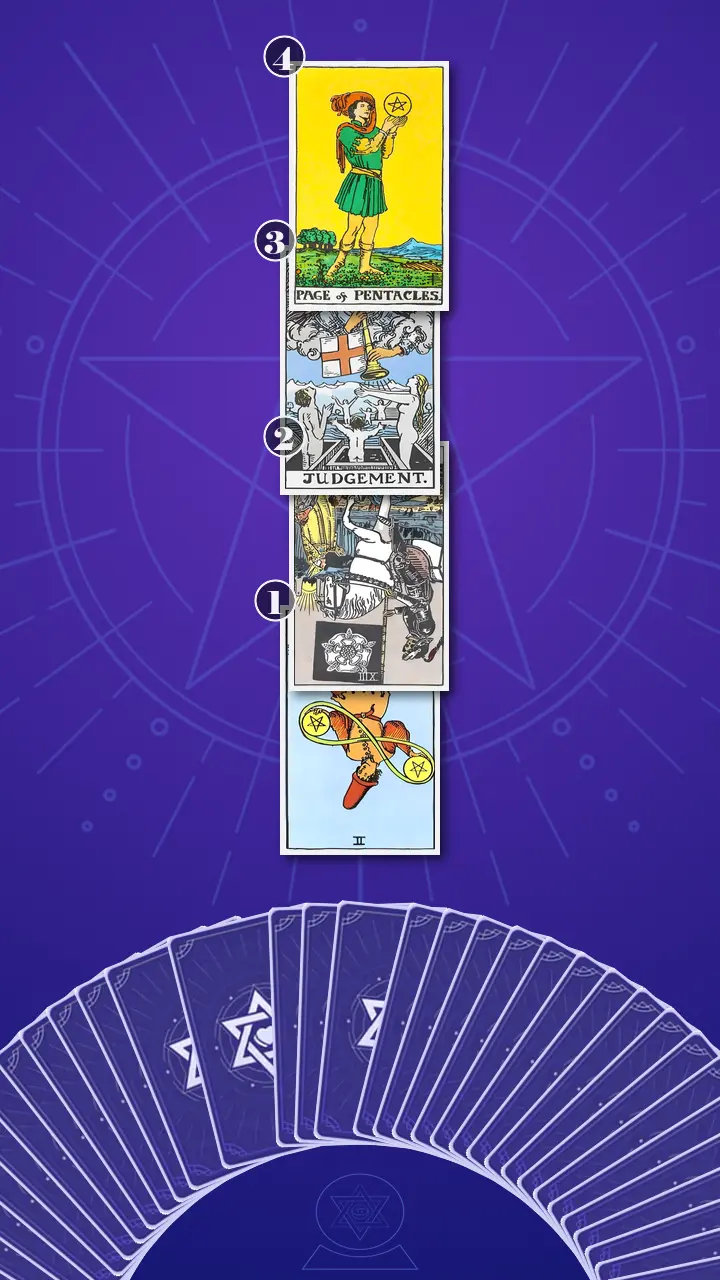
I chose the Four-Layer Insight Ladder, a four-position decluttering tarot spread arranged like ascending rungs. For anyone wondering how tarot works in a practical consultation, I chose this spread because Alex’s problem was a repeating system: whole-room scanning led to decision fatigue, decision fatigue led to research and postponement, postponement preserved the clutter, and the increased clutter made the next attempt feel even heavier.
A ten-card spread would have introduced more context than this focused question needed. These four positions would let me examine the complete chain without turning the reading into another elaborate organization system. The first card would show the observable paralysis. The second would uncover the identity-level fear sustaining it. The third would reveal the criterion capable of interrupting the loop. The fourth would turn that insight into one bounded action.
I also explained that card meanings in context matter more than dramatic predictions. The cards could help us see the pattern, but they could not choose for Alex. Authority over the apartment, the memories, and every next step would remain with them.
Reading the Loop That Looked Like Progress
Position One: Two Pentacles, Three Piles, No Exit
“Now I’m turning over the card that represents the surface layer,” I said, “the observable decluttering paralysis: scanning the whole room, juggling several sorting piles, and stopping before anything leaves.”
I revealed the Two of Pentacles, in reversed position.
I pointed to the green infinity loop around the pentacles and the ships rising and falling behind the figure. “This is the route between your desk, chair, and wardrobe,” I said. “You begin a Sunday reset by making three categories. Then the jacket creates a clothing question, the cables create an electronics question, and the notebooks create an archive question. Every object opens another tab. Your apartment looks more disturbed, your shoulders get heavier, and nothing reaches the closed donation bag.”
The reversed energy showed practical adaptability pushed into excess and then blockage. Alex was using real effort, but that effort was divided across too many simultaneous decisions. Like a Notion board where every task remains marked in progress, the system looked active while nothing reached done.
“I am doing things,” I said, voicing the loop, “so why does nothing feel done?” Then I added, “Rearranging can look like progress while keeping the decision loop perfectly intact.”
Alex gave one short laugh, but there was no amusement in it. Their fingers stopped over the open edge of the donation bag, their eyes moved from the card to the chair behind them, and their mouth tightened before they said, “That’s painfully accurate. Kind of brutal.”
“Accurate doesn’t have to mean condemning,” I replied. “This card is showing us where your energy goes. It isn’t accusing you of lacking energy. The first useful question is smaller: the last time you meant to clear one surface, did any object actually leave the apartment?”
Alex shook their head. “No. Everything just got a new temporary address.”
Position Two: The Jacket That Kept a Former Life on Retainer
“Now I’m turning over the card that represents the root layer,” I said, “the fear that releasing possessions will make an earlier identity, plan, or direction feel officially over.”
I revealed Death, in reversed position.
I immediately clarified that Death was not predicting literal death or an ominous event. In this position, its transformational energy was blocked. Daily life had already moved forward, but the physical environment had not been allowed to register the change.
I asked Alex to look at the old jacket. It belonged to a job with more office days, client dinners, and a version of adulthood they had once expected to keep building. The jacket no longer supported an ordinary Toronto workweek, yet returning it to the wardrobe preserved the possibility that the chapter was not fully finished.
“The question under the storage question is, ‘If this leaves, am I admitting that version of my life is over?’” I said. “That is why a better shelf won’t solve this particular decision. Some clutter is not mess. It is a chapter waiting for permission to be complete.”
Alex’s breathing paused. Their hand tightened around the jacket sleeve, their gaze slipped out of focus as if an old commute were replaying behind their eyes, and then their grip loosened with a long breath. “I thought keeping it meant I hadn’t given up on that version of me,” they said. “I didn’t realize it was also making current me work around it every day.”
I let the silence hold for a moment. “Keeping an item can be a valid choice,” I said. “Current meaning counts. Sentiment counts. Resting interests count. But guilt is not the same as meaning, and storage is not the only way to honor a past self. We are not preparing for a dramatic purge. We are learning to tell the difference between a chapter that is resting and one you feel required to keep reenacting.”
When Judgement Broke the Circular Route
Position Three: The Week That Is Already Happening
“Now I’m turning over the card that represents the transformation layer,” I said, “the present-day criterion capable of interrupting procrastination without requiring you to define a permanent identity.”
I revealed Judgement, upright.
The radiator stopped clicking. Through Alex’s microphone, I heard a streetcar bell cut cleanly through the wet Toronto evening, an ordinary city sound that briefly echoed the trumpet on the card. I pointed to the figures rising with open arms. They had heard the call, but the important part was their response.
At 7:30 on Sunday, Alex had been beside a half-filled donation bag, their phone warm from storage-bin reviews, while the jacket they meant to release hung behind them again. The room needed to change, but every object felt like a vote on who they were. Judgement challenged the belief that every vote had to settle the rest of their life.
“You do not need a final answer about who you are becoming,” I said. “You only need to ask whether this object supports the life that is already happening.”
I offered the orbital lens I call Rest Phase Legitimacy. After a decade of reading human lives through cycles, I no longer treat low output as proof that a role, interest, or identity has failed. A planet does not become invalid at the quiet side of its orbit. In the same way, an unused sketchbook may represent a living interest in a low tide, while another object may be occupying space only because guilt keeps paying its rent.
“Judgement is not asking you to discard everything inactive,” I said. “It is asking for honest self-appraisal. Is this a meaningful part of your current orbit, even in rest, or is it an archived obligation you no longer want to circle?”
You are not erasing your past by letting objects go; you are answering Judgement's trumpet by choosing what deserves to rise with your present life.
Alex froze with their lips slightly parted. Their pupils widened, then their eyes dropped to the jacket as though the last several Sundays were replaying across its fabric. Their shoulders remained high for two breaths. Then one shoulder lowered, followed by the other, and the fist they had made inside the sleeve slowly opened.
Relief did not arrive alone. Their eyes reddened, their jaw tightened again, and they said, more sharply than before, “But doesn’t that mean I got it wrong? I kept all this stuff for years. What if I’ve just been bad at knowing myself?” The anger in their voice softened on the last word, exposing the more fragile question underneath it.
I did not rush to turn that reaction into a positive lesson. “No,” I said. “A choice that once made sense does not become a mistake because your life changed. Updating your environment is not evidence that your earlier judgment failed. It is evidence that you are still allowed to receive new information.”
I asked Alex to picture one eight-minute test with one low-stakes object from one surface. The only question would be, “Does this support an ordinary week in my life now?” If the answer was no, they could place it in the donation bag and move the bag beside the exit. If the decision felt too loaded, they could stop, choose an easier object, or use a 24-hour holding spot. The aim was one bounded test, never a forced purge.
“Now, with this new perspective, can you think of a moment last week when this insight might have made you feel different?” I asked.
Alex looked toward a box of sketching supplies. “Tuesday,” they said. “I kept asking whether donating them meant I wasn’t creative anymore. I could have asked whether I actually want to use them now, or whether I just want proof that I once did.”
I heard the key shift in their wording. This was not instant certainty. It was the first movement from shame-tinged stagnation around identity-loaded possessions toward grounded ownership based on present-day needs. Alex had moved from asking an object for a verdict about the self to treating it as information about the life already underway.
One Pentacle, One Surface, One Finished Decision
Position Four: The Practical Apprentice Reset
“Now I’m turning over the card that represents the action layer,” I said, “one bounded decluttering experiment that can be completed without redesigning your entire home or self.”
I revealed the Page of Pentacles, upright.
I drew Alex’s attention to the Page holding one pentacle at eye level. The spread had opened with two pentacles trapped in circular motion; it closed with one object receiving steady attention. Here the earth energy had found balance. It was no longer overloaded maintenance. It had become practical learning.
I translated the image into Alex’s apartment: mark a laptop-sized rectangle on the desk, set an eight-minute timer, and assess exactly three objects before touching anything else. Each object must reach keep, donate, recycle, or relocate. When those three movements are complete, the session ends, even if motivation suddenly surges.
“This is a small usability test,” I said, speaking in language familiar from Alex’s UX work. “You’re not redesigning the entire product from assumptions. You’re testing whether one surface supports the person using it on Tuesday morning.”
Alex looked at the crowded desk rather than the whole room. I saw their brow smooth as their field of attention narrowed to the space beside the laptop. “That actually feels possible,” they said. “It’s a test of what helps, not proof that I finally have my life together.”
“Exactly,” I said. “One finished decision teaches you more than another perfect system.”
Turning the Apartment Into a Working Draft
I gathered the four cards into one coherent story. The Two of Pentacles reversed showed why Alex could spend an hour moving objects and still feel no arrival: their attention was divided across the whole apartment. Death reversed revealed why narrowing the task had been difficult: certain objects held former jobs, abandoned hobbies, and possible futures in suspended animation. Judgement restored Alex’s authority to review those belongings through present life, while the Page of Pentacles turned that authority into one observable experiment.
I also noted what the spread did not contain. There was no Swords card asking for more analysis. Alex already knew how to research systems, compare IKEA configurations, build a Notion inventory, and watch polished Sunday-reset videos. More information was not the missing resource. Research had become a familiar app running in the background, consuming energy while protecting Alex from the final click.
The cognitive blind spot was the belief that every object required a perfect, identity-defining decision. That belief made uncertainty look dangerous and storage research look responsible. The transformation direction was simpler: move from permanent identity verdicts to present-day evidence, from whole-room scanning to one bounded zone, and from circular sorting to one completed keep-donate-relocate cycle.
“Your home does not need to prove who you will become,” I told Alex. “It needs to support the week you are living. It can be a working draft, not a museum of every identity you might need to defend.”
The Lunar Routine Sync: Two Small Next Steps
I built the actionable advice around my Lunar Routine Sync, a one-week experiment that respects natural energy tides instead of treating every Sunday afternoon as a compulsory peak-performance window. I paired it with Micro-Cycle Energy Mapping so Alex could work with the rhythm they actually had, not the rhythm a thirty-second apartment-reset video implied they should have.
- Run the Eight-Minute Rising-Tide Test For one week, mark your energy once each day as rising, steady, or low. On the next hybrid workday when you notice a natural rise, set an eight-minute timer at the living-room desk. Clear only the laptop-and-mug rectangle. Ask exactly three objects, “Does this support an ordinary week in my life now?” Complete each keep, donate, recycle, or relocate movement before touching a fourth item. A low-energy day is legitimate, not overdue work. Use the one-object version or skip the session without scheduling a make-up marathon. Do not rearrange the rest of the desk before one item reaches its final destination.
- Try the 24-Hour Chapter Test Choose one low-stakes item connected to an inactive role or hobby and finish the sentence, “This belonged to a chapter when I...” Photograph it if the memory matters more than the object. Place it in a closed donation bag or a clearly marked 24-hour holding spot, then make a fresh yes, no, or not-yet choice the following day. Leave sentimental, legal, shared, expensive, irreplaceable, or safety-relevant belongings outside this first pass. If the choice tightens your chest or makes your breathing shallow, select an easier duplicate. The exercise measures what the decision feels like; it does not force release.
I asked Alex to define success before we ended. Success was not a minimalist apartment, an empty wardrobe, or a perfect new identity. It was one cleared work surface, one completed decision, and one piece of evidence that uncertainty could be tolerated without surrendering control.

A Week Later: The Quiet Proof on the Desk
Six days later, I received a message from Alex. They had noticed that their energy tended to rise for a short window after lunch on hybrid Wednesdays, not during the Sunday evening reset they kept trying to force. They used eight minutes of that window to clear the rectangle beside their laptop.
Three objects received completed destinations: one cable stayed because it supported their current setup, a duplicate adapter went into the donation bag, and an old conference notebook moved to paper recycling after Alex photographed one page they still valued. The rest of the apartment remained exactly as it was.
I read the next line twice: “The bag is beside the exit. I still stared at it for three minutes this morning and thought, what if I regret this? Then I made coffee at the clear desk anyway.” The doubt had not vanished; it no longer held the work surface hostage.
I did not see tarot as the force that changed Alex’s apartment. The cards had made the loop visible and supplied a clearer question, but Alex had chosen the boundary, tolerated the discomfort, and completed the movements. That was the real journey to clarity: not from uncertainty to perfect certainty, but from fearing erasure to trusting one present-tense decision.
I want to leave the same permission with anyone whose shoulders lock when every possession starts presenting evidence in a case about who they are. Not every object needs a verdict tonight. Not every quiet interest has ended. Not every completed chapter has been erased. Noticing the difference means the old loop is already beginning to open.
If your home could be a working draft instead of a final statement about you, which laptop-sized corner would you test against the ordinary week you are living now?