Three Deleted Holiday Replies Lead to One Bounded, Caring Answer

The 8:47 p.m. Holiday Verdict
If you are a Toronto project coordinator who drafts a simple holiday reply, deletes it, and checks the group chat again after seeing the rent payment notification, you may recognize this as holiday decision anxiety rather than a scheduling problem.
I met Alex (name changed for privacy), a 28-year-old non-binary project coordinator at a creative agency, on a Sunday evening when the city outside their apartment had gone dark and glossy with winter. At 8:47 p.m., they sat on the couch, typed I would prefer Saturday into the holiday group chat, deleted it, and opened Notes instead. The radiator clicked in the quiet. Blue phone light spilled across the coffee table, and the device felt warm against their palm.
Two overlapping invitations had become two imagined verdicts. Alex wanted to choose the plan that genuinely fit, but every possible answer seemed to carry a loyalty consequence. They told me, If I choose the wrong plan, everyone will remember what it says about me. I keep looking for the option that proves I care about everyone.
I could see the apprehension before Alex named it: a tight chest pulling each breath shallow, a jaw held shut, fingers itching to check the messages once more. It was like a metronome trapped between two beats, clicking faster each time the mind tried to find a reply that nobody could misunderstand.
I said, You are not choosing between people; you are choosing one plan while caring about more than one person. I wanted the distinction to land without making the fear sound silly. We were not going to predict who would be disappointed or force one perfect answer into existence. We were going to make a map of the pattern, separate the practical choice from the loyalty story, and begin a Journey to Clarity that left the decision in Alex's hands.

Choosing the Compass: A Five-Card Relationship Spread
I asked Alex to place both feet on the floor, take one unhurried breath, and hold the question in its plainest form: What is happening when a holiday choice starts to feel like a test of loyalty? I shuffled slowly. The pause was a way to move from the noisy group chat into focused attention, not a supernatural performance or a promise about the future.
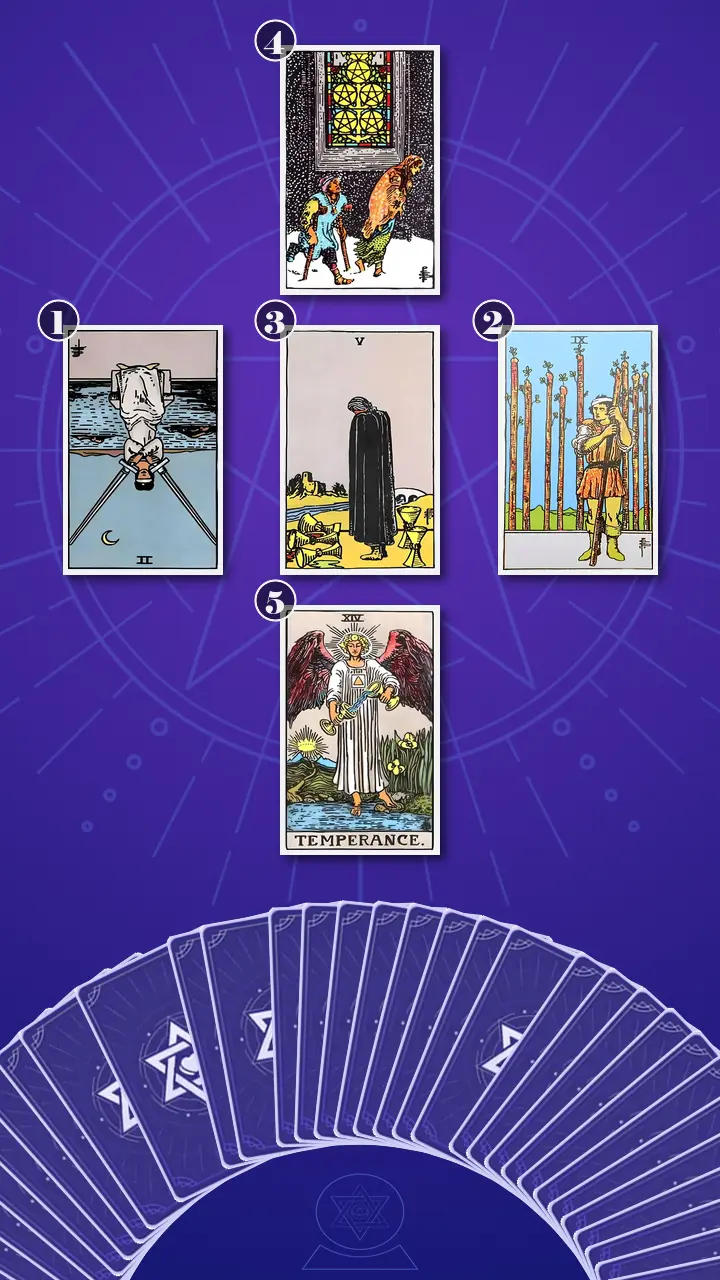
For this consultation, I chose the Relationship Spread · Context Edition, a five-card relationship tarot spread using Rider-Waite-Smith imagery. This is one way I explain how tarot works: I use the cards as a structured cognitive tool, allowing symbols to make a familiar pattern visible enough to examine. The card meanings matter, but their context matters more than a fixed verdict.
The spread suited Alex because the question was relational rather than purely intrapsychic. It could separate Alex's present stance from the loyalty demand they perceived, show the interaction pattern that narrowed their attention, name the belonging fear beneath it, and end with a self-directed communication experiment. Position 2 would describe what Alex imagined the invitation was asking them to prove, not claim access to another person's private intention. Position 5 would offer grounded guidance rather than predict how anyone else would respond.
I laid the cards in a cross: the present stance to the left, the perceived demand to the right, the interaction pattern at the centre, the underlying fear above, and practical guidance below. I told Alex that we would read across the crossroads, then move upward into the hidden fear and back down toward the stabilizing cup at its base.
Reading the Map Beneath the Group Chat
Position 1: The Reply That Stays in Notes
Now turning over is the card representing the present relational stance: the observable habit of converting a holiday choice into a loyalty test and rehearsing every possible consequence before answering.
The card was the Two of Swords, in reversed position.
In the Rider-Waite-Smith image, the blindfolded figure holds two crossed swords over the chest, with dark water behind them. For Alex, the blindfold became the unanswered holiday group chat. The crossed swords became two deleted replies held in place: If I say Saturday, they may hear I chose against Sunday. If I say Sunday, they may hear I care less about the people on Saturday. The dark water was the uncertainty Alex was trying to remove through more comparison.
Reversed, this card showed a blockage in the air element. Thinking had stopped serving choice and started serving defensive rehearsal. The mind was treating incomplete information as an emergency, refusing to let uncertainty remain ordinary. Opportunity Blindness then narrowed the view further: the practical questions of travel, energy, cost, and existing commitments disappeared beneath the question of what the answer would prove.
I asked, What has anyone actually requested? Not what might they infer, not what could the silence mean, but what words have been sent? No one had asked Alex to attend both gatherings. No one had said that choosing one date would define the whole relationship.
Alex gave a short, bitter laugh instead of nodding. That is too accurate. I am not even choosing yet; I am preparing a case. Their thumb stopped above the message field, but their shoulders stayed lifted. I did not push them to agree with the card. I said, Good. We have found the loop, not a character flaw. For one message, we can test the story against what actually happens.
Position 2: The Objections Lined Up in the Dark
Now turning over is the card representing the perceived loyalty demand: what Alex imagines each person or invitation is asking them to prove, while keeping that imagined pressure distinct from confirmed intent.
The card was the Nine of Wands, in upright position.
The bandaged figure in the image stands before a fence-like row of eight wands while gripping a ninth and looking back. I connected it to the moment a friend sends a neutral message such as no pressure or sounds mildly disappointed. Alex prepares a backup explanation, an alternate date, and a reason the original plan was unavoidable before anyone has asked a difficult question. The eight wands become a mental FAQ of possible objections. The ninth wand becomes the one boundary Alex is trying to protect.
Upright, the Nine of Wands carries real resilience and the wisdom to protect hard-won limits. In this position, though, that energy was excessive. Vigilance had become a forecast of rejection. Alex was keeping one hand on the holiday calendar like a security system, ready to change the plan whenever a notification felt slightly off. I asked, What boundary has actually been crossed, and what boundary are you defending against a conversation that has not happened?
Alex looked from the row of wands to their colour-coded Google Calendar. One tentative block had already become three. Their fingers loosened around the phone, then reached for it again. I can make a schedule, but I cannot schedule away the guilt, they said. I answered, That guilt may be asking for reassurance, but it is not automatically giving you an instruction.
Position 3: The Empty Chair and the Two Cups Still Standing
Now turning over is the card representing the interaction pattern: the way Opportunity Blindness makes Alex focus on who might be disappointed while hiding other forms of connection.
The card was the Five of Cups, in upright position.
I brought up the image of Boxing Day at 10:32 p.m., when Alex had scrolled through Instagram Stories from a warm apartment in Leslieville. Glasses clinked through the phone speaker. A person who could not attend the selected gathering had become the whole emotional landscape. Alex kept staring at the empty chair and the cancelled calendar block, while the people still attending, the care already expressed, and the possibility of a later coffee remained outside the frame.
The three spilled cups showed the disappointment that was real. I did not ask Alex to call it positive or pretend that a changed plan did not matter. But two cups were still standing behind the cloaked figure, and a bridge led toward a distant building. I said, I keep staring at what this plan cannot include, so I cannot see what it still makes possible sounded like the card's modern translation. The bridge could be a twenty-minute coffee, a voice note, a later visit, or a call on another day. It did not need to become unlimited availability.
This was the first visible shift in the reading. Alex's eyes moved from the phone to the card, then back again. So the loss is not imaginary, but it is not the whole relationship either, they said. Their voice was still cautious, yet they began naming two people who would be present and one friend they could call later. The water had not been denied; attention had simply begun to move.
Position 4: Outside the Warm Window
Now turning over is the card representing the underlying fear and unmet need: the belonging threat beneath the loyalty test and the protective pessimism that keeps it active.
The card was the Five of Pentacles, in upright position.
I saw the snow-covered street, the two figures moving outside together, and the illuminated stained-glass window. I connected the scene to 7:04 p.m. outside a convenience store near Bloor-Yonge, when Alex heard a friend say, I am a little disappointed, and immediately began rearranging the entire weekend in Google Calendar. Snow gathered along the curb. Warm air escaped whenever the door opened. Alex's hands went cold around the phone while they offered more time than they actually had.
The card did not predict exclusion. It showed the fear of it. Defensive Pessimism kept scanning for evidence that choosing one gathering would place someone outside the circle, while Opportunity Blindness made total availability look like the safest possible boundary. The hidden bargain was, If I stay available to everyone, perhaps nobody can place me outside the circle. I said, You cannot schedule away the fear of being left out by staying available to everyone.
I asked, If someone is disappointed, what are you afraid that disappointment will prove about your belonging? Is there a direct reassurance or limit that could be spoken instead of silently paid for with your whole weekend? Alex rubbed their cold hands together. I keep every date open so I will not be outside anyone's circle, but then I end up outside my own plans. The sentence stayed between us. The fear had become specific enough to meet.
When Temperance Blended the Calendar
Position 5: The Two Cups and the Choice That Stopped Performing
The final card represents integrative guidance: a self-directed way to communicate a holiday preference, hold a boundary, and notice more than one viable form of connection.
The card was Temperance, in upright position, the bridge card of the spread. The angel blends liquid between two cups, one foot on land and one in water, with a path rising toward distant light. Nothing in the image demands that either cup disappear. I translated it into two legitimate needs: a holiday plan that fits Alex's actual capacity and a relationship that deserves direct care.
I had a brief professional flashback to my ten years of sound-energy research. When a rhythm falls out of sync, adding force rarely creates movement; it creates friction. I used my Tempo Misalignment Audit at this point, the diagnostic lens I use for the feeling of pushing against a wall. Alex's psychological BPM was racing ahead of their executive BPM: their mind demanded a perfect guarantee about every reaction before their body could send two ordinary sentences. That was why more analysis kept producing less movement.
I then applied my Execution Rhythm Calibration to the calendar itself. The friction point was not a lack of care. It was the demand to communicate care, predict every response, repair every disappointment, and preserve unlimited flexibility in one message. Temperance offered a different rhythm: preference first, care stated directly, limits kept visible, and one additional connection chosen only if it genuinely fit.
The room grew quiet as I turned the card toward Alex. The radiator clicked once and stopped. Outside, a streetcar bell sounded through the snow, clear and brief, as though the city had made one small decision and continued moving.
Alex was still looking at the open group chat as if it were a public hearing. Three replies had vanished, yet the demand for a perfect answer remained. The choice felt dangerous because Alex had made one date carry every relationship, every possible disappointment, and proof of belonging.
You do not need to turn every holiday choice into a loyalty test; you can name what works, communicate care directly, and let Temperance's two cups show that connection can be blended rather than proven by one plan.
For a moment, Alex's body answered before their reasoning did. Their breath stopped; their thumb hovered above the screen, and their fingers tightened around the phone. Then their eyes went unfocused, replaying the last group-chat exchange: the phrase no pressure, the deleted Saturday reply, and the imagined pause after it. Their jaw loosened by a fraction, then tightened again. But does this mean I got it wrong before? they asked, irritation flashing through the fear. I answered before shame could take over: No. You built a protection around belonging with the information and capacity you had. The protection is simply costing more than it returns. Their eyes grew wet, not with catastrophe but with the effort of putting down a job they had never been hired to do. Their shoulders lowered, and the fist around the phone opened. A long breath left their chest, followed by a small, dizzy blankness: if the date did not have to prove love, Alex had to choose. I gave the silence room, then asked, Now, using this new perspective, was there a moment last week when this insight might have changed how you felt?
Alex remembered a friend writing either plan is fine on the TTC. They had read those three words as a hidden test, prepared three explanations, and never asked what the friend actually preferred. The breakthrough was not that every response would be comfortable. It was that discomfort could be met with a direct question instead of a second hour of rehearsal.
I named the emotional shift clearly: this was movement from defensive rehearsal, preemptive guilt, and fear-driven indecision toward self-trust, proportionate communication, and calmer connection. A holiday choice is a calendar decision, not a loyalty verdict. The plan can be limited; the care can be direct. Temperance was not promising a perfect response from anyone else. It was returning authorship of the next sentence to Alex.
The Two-Sentence Route to Clearer Connection
When I read the five cards together, I saw a precise sequence rather than a mysterious warning. The reversed Two of Swords showed air tangled in repeated comparison. The Nine of Wands turned that thought into a guarded readiness. The Five of Cups revealed the cost: attention fixed on the person or plan missing from the picture. The Five of Pentacles gave the loss its deeper shape, a fear of being outside the warmth of belonging. Temperance did not erase any feeling; it blended feeling with a practical limit so that a single holiday date no longer had to carry the whole relationship.
The cognitive blind spot was Opportunity Blindness. Alex had been recording the spilled cup in vivid detail while failing to log the two that remained upright: the people still available, the care already communicated, and the connection that could happen in another form. Defensive Pessimism made the omission feel responsible because it offered temporary relief from committing. The transformation direction was simpler and more demanding: separate the practical facts from the loyalty story, name the preference, state the care, and ask directly about what is actually needed.
I did not give Alex a command to follow. I offered a small experiment that could be paused, edited, or stopped. I called it The Syncopation Reset: a three-day tempo adjustment experiment that breaks a forced routine into smaller, harmonious beats. Through Execution Rhythm Calibration, we located the points where ambition, emotional responsibility, and daily capacity had fallen out of sync. Then we gave each point one manageable beat.
The Syncopation Reset: Three Smaller Beats
- The Two Standing Cups CheckOn day one, before choosing between two overlapping holiday invitations, set a 10-minute timer and write only the practical facts in Notes: date, travel time, cost, energy, and existing commitments. Then name two relationships, options, or forms of care that remain available even if one plan is declined, and choose the plan that fits actual capacity.If the list becomes another comparison spiral, stop after three practical facts and one remaining connection. Keep the alternate connection specific and limited, such as a 20-minute coffee, a voice note, or a call on another day.
- The Preference-First Holiday ReplyOn day two, choose one pending invitation and write two lines in Notes: What I prefer is __. The loyalty story I am afraid this will trigger is __. Then send the relevant group chat or person a two-sentence reply that names the preference and adds one caring sentence, such as I would love to see you, and Saturday works best for me.Use a two-sentence limit and call the preference provisional rather than perfect. Read the message once, then decide whether to send it. Wait 24 hours before treating the response as evidence about the relationship.
- The Bounded Connection PlanOn day three, or whenever someone responds with disappointment, pause long enough to identify the exact body signal: tight chest, clenched jaw, heat in the face, or restless message-checking. Ask one direct question, Would another time help, or would you prefer to leave this one for now? Then state one limit alongside the care: I cannot attend both events, but I can call Sunday afternoon.Acknowledging a feeling does not require removing the boundary. Leave a short pause before offering repair, use a message template if speaking live feels too intense, and do not promise time or emotional availability that you do not genuinely have.
This is actionable advice because it keeps the experiment close to the real friction: the group chat, the body response, the unfinished reply, and the urge to add five explanations. It also keeps the relationship larger than the date without asking Alex to pretend that disappointment is irrelevant.
Ownership, Not Certainty: A Week Later
Six days later, Alex messaged me from a streetcar with a sentence they had actually sent: I would love to see you, and Saturday works best for me. They had not added the three explanations or promised to split the day. The friend was disappointed, then suggested coffee the following week. It was a small reply, not a solved life.
That night Alex slept a full night, but the first thought the next morning was still, What if I got it wrong? This time they smiled, checked the actual message, and let the question remain a question. The calendar was still crowded. Their own preference was simply no longer outside the window.
I do not believe the cards made the choice for Alex. They gave us a sequence of images through which Alex could see the choice, the defensive rhythm, the overlooked connections, and the fear of exclusion without turning any of them into destiny. The clarity came when Alex named what worked, communicated care, and allowed the relationship to be bigger than the date.
When a holiday group chat makes your chest tighten and your jaw lock, choosing one plan can feel like choosing against someone, because belonging has been made to depend on never letting anyone feel left out. Noticing that mechanism is already a quiet form of relief: the old rhythm is no longer invisible.
If one holiday choice were allowed to be only a preference, what small, honest sentence could let your two cups of care exist without promising more than you have?