The TTC Ride Home from the Idealized-Ex Benchmark Trap
“You are a 28-year-old Toronto UX designer who leaves a promising date, opens your ex's message thread on the TTC, and starts measuring jokes and chemistry before the new person has even said they got home, classic comparison fatigue in app dating.” I said it slowly, so Maya could hear the shape of the pattern without having to defend herself against it.
She had come to ask me, “Why do I compare every date to my ex even when the date goes well?” The new people were often kind, consistent, and compatible with the life she said she wanted. Still, a calm evening could end with the thought that something essential had been missing because nobody had used her ex's exact phrase, timing, humour, or emotional rhythm.
Maya described the most recent trip home from a date at 11:40 p.m. on the streetcar heading east through Toronto. The fluorescent ceiling light buzzed above her, wet wool warmed the crowded air, and her phone felt hot in her palm as she reopened the old message thread. Her stomach made a hollow drop, then tightness gathered behind her sternum while the rails clicked beneath her.
“Nothing was wrong with the date,” she told me. “Which somehow makes it more confusing. They were compatible with me, but they did not feel like my ex.” I heard the central tension clearly: she wanted to stay open to a compatible new connection while keeping an idealized memory as the required benchmark for belonging. It was like asking a live musician to match a polished studio recording before the first song had finished.
I did not ask her to lower her standards, force a second date, or pretend the past had not mattered. I told her, “We can look at the comparison as information rather than a verdict. Our Journey to Clarity today is simply to understand what is happening in the first ten minutes after a good date, then give you a way to choose from present evidence.”

Choosing the Shadow Spread: A Map for Present Evidence
I invited Maya to put both feet on the floor, take one unhurried breath, and hold the question without trying to answer it immediately. I shuffled slowly while she focused on the difference between a genuine relationship need and the familiar form in which her ex had once delivered it. The pause was a psychological transition from swiping and scoring into observation, not a supernatural test.
For this relationship question, I chose a five-card layout called The Shadow Spread. I explained to Maya, and to anyone reading along, that this is how tarot can work as an objective cognitive tool: the images give a structured language to patterns that are difficult to see while they are happening. The cards do not predict whether a date will become a relationship. They help us examine the behaviour, belief, wound, resource, and practice surrounding the question.
I chose this spread because Maya was not deciding between two equivalent live options. She was investigating a recurring comparison process maintained by selective memory, projection, grief, and a fear about belonging. Five cards were enough to trace the visible pattern, the hidden mechanism, the protected feeling, the reclaimed capacity, and the next grounded practice. A decision spread would have made her ex and every new date look like competing choices, while a larger spread would have added layers that the question did not need.
The first position would show the shadow pattern operating in conscious life. The second would reveal the projection that made the pattern feel self-evident. The third would touch the grief or fear the scorecard was protecting. The fourth, placed at the centre, would identify the antidote: the capacity that could turn memory into discernment. The fifth would translate that insight into one small, present-tense experiment.
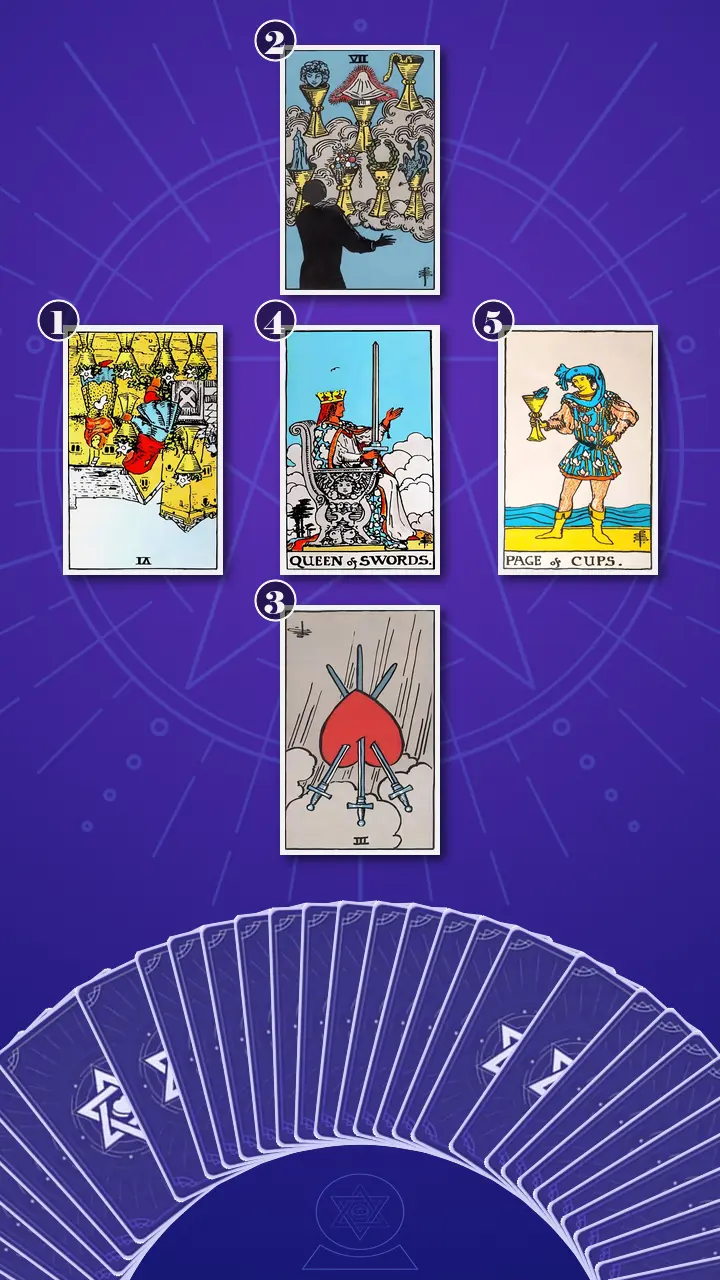
Reading the Map: From Preserved Memory to One Living Cup
Position 1: The Flowers Kept Perfect
Now I turned over the card representing the diagnosis-level behaviour of comparing compatible dates with an idealized ex, the stagnant longing visible immediately after a date. The card was the Six of Cups, in reversed position.
In the Rider-Waite-Smith image, six flower-filled cups sit in an enclosed courtyard, protected by stone walls and a manor in the distance. Upright, the scene can hold tender memory and familiar affection. Reversed, the emotional water is blocked and pulled backward. The courtyard becomes the private digital archive Maya reopens whenever unfamiliarity feels risky, and the preserved flowers become the warmest messages she treats as the complete record of the relationship.
I connected the image directly to her streetcar ritual. After a good date, she was comparing a live, unfinished conversation with a memory kept in perfect condition. The new person had not yet had time to become fully knowable, but the old exchanges never had to answer a difficult follow-up question or arrive tired after work. Their best moments remained polished by distance.
I asked her to listen for the thought underneath the scrolling: “Nothing was wrong with the date, so why am I searching for proof that it was not enough?” That question brought the card's meaning into real life. The blockage was not that Maya remembered. It was that nostalgia had become a ranking system instead of a memory held in full context.
Maya did not nod. She gave a short, bitter laugh and rubbed her thumb along the edge of her phone. “That is too accurate,” she said. “It is almost rude.” I let the reaction stand. Her discomfort was not evidence that the reading had condemned her; it was the recognition that she had been comparing a live person with the most edited part of an archive.
Position 2: The Seven Open Tabs in the Cloud
Now I moved to the card representing the disowned belief, projection, and incomplete evidence feeding the visible pattern. The card was the Seven of Cups, in upright position.
Seven cups float inside a grey cloud while a silhouetted figure faces them from below. Each vessel holds a different image: status, danger, desire, mystery, and imagined reward. I read the upright energy as excess and dispersal. Instead of letting the facts of a new date accumulate gradually, Maya's mind filled every gap with possible deficiencies. A quiet texter might never understand her humour. A different style might mean less emotional depth. A calm evening might signal absent chemistry.
The modern version looked like an algorithm filling in missing profile information with the most dramatic recommendation. She knew a few concrete details about a compatible date, then opened seven browser tabs for the person she barely knew and treated each imagined future as evidence. At the same time, her ex became a flawless composite made from several real moments, remembered intensity, and all the ordinary disappointments left outside the frame.
I used my Attachment Loop Diagnosis here as a logic map, not as a label. This tool can help me examine whether relationship friction is being driven by an anxious-avoidant trap or a deeper insecurity, but I did not need to assign Maya an attachment style to understand the loop. A compatible date felt good but unfamiliar; the belief that real connection should feel familiar activated; the old thread offered a quick comparison; the comparison created brief certainty; curiosity about the new person narrowed; the absence of a developing bond then seemed to prove that the ex had been uniquely right.
“I cannot tell whether I have standards or just a very specific memory,” Maya said. She turned her phone face down, then looked back at the seven cups. Her shoulders lifted as though she had braced for an answer, but her eyes stayed on the card long enough to notice that none of the floating images had been tested in the present.
I said, “Different is not automatically less, and familiar is not automatically true. We can keep the first sentence open until there is enough behaviour to support it.”
Position 3: The Heart Beneath the Scorecard
Now I descended to the card representing the wound, grief, and vulnerable feeling the comparison was trying to protect. The card was the Three of Swords, in reversed position.
The red heart beneath the rain showed me the emotional truth hidden under Maya's clean-looking compatibility analysis. Reversed, the swords pointed to pain held inward, delayed processing, or the beginning of release. Maya could list that a new person communicated clearly, respected her pace, and shared her values. What became harder to say was what she missed, what had hurt, and what she no longer wanted to repeat.
I brought up the cafe near Queen Street West where she had recently told a friend that a date was good on paper. When her friend asked what she was still grieving, Maya changed the subject and opened her ex's profile. The scorecard felt more organized than saying, “I miss what that relationship meant to me.” The three swords became three private sentences: “What I miss is... What hurt was... What I no longer want is...”
I told her I was not asking for a dramatic confession or a complete healing timeline. The point was to give grief its own language so a new person would not have to carry the whole weight of the loss by failing an invisible exam. Under the longing was a fear that releasing the ex as the benchmark might expose an unreliable sense of belonging, or prove that the old connection had been the only dependable one.
Maya's breath paused. Her fingers tightened around the edge of the chair, then slowly released. She looked down at the red heart and swallowed before saying, “I think comparing is easier than admitting I am scared I will not feel at home with anyone else.” Her chest remained tight, but the feeling had moved from an unnamed drop in her stomach into something she could recognise without turning it into a judgment about the date.
When the Queen of Swords Separates Need from Familiarity
When I brought my hand back to the centre of the spread, the room seemed to narrow around the next card. Outside my window, a streetcar bell gave one clean note, and rain divided itself into bright lines on the glass. I felt the atmosphere change from looking backward to asking what could be used now.
Position 4: The Upright Blade That Leaves the Door Open
Now I turned over the card representing the transferable resource, truth, and lesson concealed inside the shadow. The card was the Queen of Swords, in upright position. This was the key card and the antidote.
The Queen's sword rises directly into the open air, while her other hand remains extended rather than closed. Her energy is balanced Air: clear enough to distinguish evidence from projection, compassionate enough not to confuse boundaries with a wall. She does not erase feeling, and she does not let feeling make every conclusion on its own.
Because Maya works in UX, I used the language of research and design critique. A researcher separates observed behaviour from the story attached to it. The observation might be, “They answered directly and made a clear plan.” The story might be, “They did not text in my ex's exact rhythm, so they cannot create dependable intimacy.” One is present evidence. The other is a conclusion supplied by the old archive.
This is where I brought in my Shadow Projection Analysis. I use it to identify the fear or unmet need that may be projected onto a partner, without pretending I can prove its origin in one sitting. In Maya's case, the unacknowledged fear was that unfamiliar belonging would be unreliable. The new person was then asked to prove their worth by reproducing the ex's form, even when their actual behaviour was respectful and consistent.
We opened a simple note with two headings: observable relationship need and past-specific feature. Consistent communication belonged in the first column. Texting in her ex's exact rhythm belonged in the second. Emotional honesty belonged in the first. A particular teasing phrase, style of humour, or immediate intensity belonged in the second.
I said, “That is a need. That is a familiar detail.” Then I added, “The need deserves your attention. The familiar detail can be noticed without being promoted to a requirement.”
The Moment the Benchmark Lost Its Authority
At 11:40 p.m. on the streetcar, the date is over, the phone is warm in your hand, and the rails keep clicking beneath you. You open the old thread, not because the new person did something wrong, but because a good, unfamiliar feeling leaves you asking whether different means less.
You do not need to erase the past or obey it; let the Queen of Swords' upright blade separate what you genuinely need from what only feels familiar.
For a few seconds, Maya froze with her thumb suspended above the note and her breath caught halfway into her chest. Then her gaze lost focus, as if the streetcar ride, the warm phone, and the untouched message from the new person were replaying behind her eyes. Her jaw worked once. Finally, her expression softened; her eyes grew bright, her shoulders dropped, and the fist she had made beside her knee opened finger by finger. She released a long breath that trembled at the end. “So consistent communication is mine,” she said quietly, “but the exact timing is not.” Her voice still carried a thin thread of fear, because a clear path meant she would have to make her own choices rather than wait for the old feeling to decide. The rain continued on the glass, but it no longer looked like a wall.
Now, with this new perspective, think back to last week: was there a moment when this insight might have helped you feel differently?
I watched Maya take the first real step from nostalgic contraction and fear that different means less toward grounded discernment and cautious curiosity about a present connection. The insight did not tell her to continue with anyone. It gave her a fairer way to know what she was actually deciding.
The Page's One-Cup Curiosity
Position 5: One Living Detail Before the Verdict
Now I placed the final card representing the conscious practice that could integrate the shadow insight into daily life. The card was the Page of Cups, in upright position.
The Page looks directly at a fish rising unexpectedly from one cup. Unlike the Seven of Cups, where distant images multiply inside a cloud, this is a single living surprise held in the present. The Page's energy is receptive and curious, not indiscriminate. After the Queen's discernment, emotional openness can return without demanding immediate certainty.
I translated the card into Maya's next date. She could ask one unscripted question, notice one unexpected kind of humour or care, and write down what actually happened before asking whether the moment resembled her ex. She could let a different person remain a person for one evening instead of turning them into a verdict before they had finished introducing themselves.
The spread also showed why a small practice mattered. Water had begun as a backward current in the Six of Cups, dispersed into imagined possibilities in the Seven, and been held under pressure in the Three of Swords. The Page returned it to one cup. There was no need to force chemistry or secure a relationship immediately. A little practical structure could make room for a living response.
Maya smiled, though uncertainty did not disappear from her face. “I could try being curious without deciding that I am convinced,” she said. I told her that was exactly the point. Curiosity was not a promise to stay. It was permission to gather one more piece of real information.
The One-Page Present-Evidence Practice
When I stepped back from the cards, their story was coherent. Maya had been using preserved highlights from the past to judge an unfinished present. The Six of Cups kept the memory beautiful but incomplete; the Seven of Cups expanded that memory into an impossible composite; the reversed Three of Swords let grief hide inside a compatibility review. The Queen of Swords reclaimed the ability to separate need from familiarity, and the Page of Cups offered one bounded way to stay open.
The cognitive blind spot was not that Maya had standards. It was that she had mistaken the costume in which a need once arrived for the need itself. She treated the absence of her ex's exact intensity as evidence of incompatibility, and treated the discomfort of unfamiliarity as a red flag before enough present behaviour existed to support that conclusion.
The key shift was simple: after each date, replace the question of whether the person matched the ex with three present-tense observations about how they behaved, how the interaction felt in Maya's body during the date, and what remained worth discovering. This means replacing ex-based chemistry scoring with present-tense observations and separating observable relationship needs from ex-specific familiarity. The past can clarify her standards without deciding the precise voice, timing, or emotional style in which those standards must appear.
I gave Maya these actionable next steps. They were deliberately small, private, and reversible. None of them required her to accept a second date, override a boundary, forgive her ex, or prove that a new connection would work.
- Run the Projection Detachment ExerciseAfter the next date, before replying to the new person, open a phone note and set a ten-minute timer. Write one full-context fact about the ex, then three present-tense observations: how the new person behaved, how Maya's body felt during the interaction, and what she would genuinely like to discover. Read the note once, close it, and make any dating decision only after the note is closed and actual present behaviour has been checked. This separates what happened from the triggered story attached to it.Keep it to three observations and one question, not a score. If the person was disrespectful, unsafe, or inconsistent, that present information remains valid. Stop the exercise whenever you choose.
- Make the Need-vs-Familiarity SplitWithin five minutes after a date, or on a quiet Sunday afternoon, create two headings in a simple Notes app table: observable relationship need and past-specific familiarity. Under the first, write facts such as answers directly, keeps plans clear, or listens when I speak. Under the second, write details such as uses the same teasing phrase, texts at the same rhythm, or creates the same immediate intensity. Use only the first column when deciding what deserves further attention.Start with one example from the last date and limit each column to three entries. An unfinished column is allowed; you do not have to share the note with friends or use it to justify continuing contact.
- Give the Grief Its Own Fifteen MinutesOnce this week, mute the old message thread and set a private fifteen-minute timer. Complete three headings: What I miss, What hurt, and What I no longer want. Put one concrete scene or fact under each heading instead of a general label such as chemistry or the good times. When the timer ends, put the phone down without using the inventory to rank a current date or reopen contact with the ex.You may write in fragments, skip a prompt, or stop if the memories feel too intense. This is not a demand for closure, forgiveness, or a decision about anyone.
I reminded Maya that discernment included the right to decline. The Queen of Swords was not asking her to be endlessly available, and the Page of Cups was not asking her to call every green flag a future. The practice was only meant to help her tell real incompatibility from the pressure to recognise an old pattern on sight.

A Few Days Later: The Quiet Proof
Four days later, Maya texted me from a cafe: “I did the ten-minute note. He listened, my shoulders dropped, and now I am curious about his terrible karaoke story.” She slept a full night, woke with the thought, “What if I am wrong?” and smiled before making coffee.
That was the proof I wanted, not a perfect new relationship and not a dramatic erasure of the old one. Maya had noticed a present fact before consulting the archive. She had let her body register ease without demanding that ease arrive as remembered intensity. The next decision still belonged to her.
I told her that the Shadow Spread had not chosen a person for her. It had helped her move from retrospective scoring to cautious curiosity, from a memory acting as a judging panel to a past that could offer useful information. Finding clarity did not mean certainty. It meant having enough honest evidence to make the next choice without abandoning herself.
When a good date ends and your stomach drops as you reopen the old thread, it can feel safer to call the new person “less” than to risk discovering that belonging might arrive in a form your ex never taught you to recognize.
If the past could name what matters without approving the next person, what is one present-tense detail you might let yourself stay curious about?
This story is adapted from psychological research, written so that those in a similar struggle can see their own pattern in it — and find their next step clearly.These insights are not a substitute for professional psychological, medical, legal, or financial advice.
Learn more about our Journey to Clarity.
How did this insight land for you?
🫂 This Resonates Deeply
🌀 Living This Story
✨ Now I See Clearly
🌱 Seeing New Possibilities
🧰 Useful Framework
🔮 The Confirmation I Needed
💪 Feeling Empowered
🚀 Ready for My Next Step
Author Profile
 AI
AI“Having traveled across cultures... I've learned that what we often lack isn't a simple answer, but a moment of being truly understood. I use a Jungian psychological lens to help you deconstruct your subconscious patterns—not to prove anything, but to be the gentle companion who helps you unravel your knots, free of judgment, so you can reconnect with your inner wisdom.”
In this Love Tarot Reading :
Core Expertise
- Attachment Loop Diagnosis: Logically decoding whether your relationship friction is driven by an anxious-avoidant trap or deep-seated insecurity.
- Shadow Projection Analysis: Identifying the unacknowledged fears or unmet childhood needs you are unconsciously projecting onto your partner.
Service Features
- The Projection Detachment Exercise: A structured psychological journaling prompt to separate your partner's actual behavior from your triggered internal narrative.
Also specializes in :
Explore Related Patterns:
Certainty SeekingA good but unfamiliar date leaves Maya with no obvious problem to solve, yet she immediately opens the old thread and searches for a decisive difference. The comparison supplies a quick answer at the exact moment when present evidence remains incomplete: the date did not feel like the ex, so something essential must have been missing. When you seek certainty through an old benchmark, ambiguity is converted into a verdict before curiosity can gather more information. The ritual reduces discomfort in the short term, but it also keeps unfamiliar forms of belonging from becoming familiar through actual experience.
Comparison TrapAfter promising dates, Maya reopens her ex's message thread before the new person has even said they got home, then measures jokes, chemistry, timing, humor, and emotional rhythm against the archive. The comparison places an unfinished person with limited shared history beside a selectively preserved relationship that already carries familiarity and meaning. When you repeatedly use that unequal benchmark, difference is easily translated into deficiency even when present behavior shows kindness, consistency, and compatibility. The comparison trap persists because it produces a fast ranking, but the ranking is built from mismatched evidence: a live first impression is being asked to outperform the most polished fragments of an established past.
Emotional BypassingWhen a friend asks what she is still grieving, Maya changes the subject and opens her ex's profile. Comparing chemistry is easier to organize than naming what she misses, what hurt, and the fear that she may never feel at home with anyone else. When you convert grief into a compatibility scorecard, analysis creates distance from the vulnerable feeling while making new dates carry its weight. Emotional bypassing does not mean your standards are unreal; it means the score may be performing two jobs at once, evaluating the present while protecting you from directly contacting the loss underneath it.
Familiarity BiasCompatible dates begin to feel insufficient when nobody reproduces Maya's ex's exact phrase, timing, humor, or emotional rhythm. The missing feature is not necessarily kindness, consistency, or shared values; it is the recognizable form in which connection previously arrived. When you use familiarity as a proxy for truth, a different style can register as reduced depth before its actual meaning is known. Familiarity bias explains why the ex-shaped signal feels immediately convincing: recognition lowers uncertainty, while unfamiliar care still requires observation, interpretation, and time.
IdealizationThe old message thread preserves Maya's warmest exchanges while ordinary disappointments, difficult follow-up conversations, and tired everyday moments remain outside the active frame. Her ex therefore appears as a coherent composite assembled from peak moments, while each current date is evaluated with every uncertainty still visible. When you compare someone new with an idealized composite, the past has an advantage no living person can match: it no longer has to produce fresh behavior or contradict the memory. Idealization does not make the meaningful moments false, but it removes the full context required to use those moments as a fair relational benchmark.
Confirmation BiasWhen Maya knows only a few facts about a new date, her mind fills the open space with possible deficiencies: a quiet texter may never understand her humor, a different style may indicate less depth, and a calm evening may signal absent chemistry. Those predictions direct attention toward mismatch while compatible present behavior receives less weight. When comparison narrows your curiosity, the connection has fewer opportunities to generate evidence that challenges the original belief. The absence of a developing bond can then appear to confirm that the ex was uniquely right, even though the belief helped restrict the very process that could have produced a different conclusion.
Boundary DiscernmentThe two-column note places consistent communication and emotional honesty under genuine relationship needs, while her ex's exact timing, teasing phrases, humor, and immediate intensity remain past-specific features. Maya captures the distinction when she says that consistent communication is hers, but the exact timing is not. When you maintain that boundary, the past can clarify what matters without dictating the only acceptable form in which it may appear. Boundary discernment keeps your standards intact, preserves your right to decline, and allows a new person to remain separate from the role previously occupied by your ex.
Reality TestingThe Queen of Swords exercise has Maya place direct answers, clear plans, and attentive listening in the observation column while treating the prediction that a different texting rhythm cannot support intimacy as an attached story. Four days later, she applies the same distinction and records that her date listened, her shoulders relaxed, and his karaoke story remained worth discovering. When you separate observable behavior from an ex-shaped prediction, your decision can respond to the person who was actually present. Reality testing does not require you to continue dating someone or dismiss your feelings; it prevents a familiar interpretation from claiming more certainty than the current evidence supports.
Uncertainty ToleranceThe Page of Cups practice asks Maya to notice one unexpected detail, ask one unscripted question, and postpone the verdict long enough for a new person to provide more information. She later describes curiosity about her date's terrible karaoke story without claiming that the connection is already right. When you allow curiosity without demanding conviction, uncertainty becomes a temporary information gap rather than proof of incompatibility. This form of tolerance does not ask you to force chemistry or surrender a boundary; it gives a different connection enough room to become knowable before familiarity makes the decision for you.
Explore Related Struggles:
Attraction-Compatibility SplitMaya leaves dates with people who communicate clearly, respect her pace, and fit the life she says she wants. On the ride home, however, a calm and compatible evening is placed beside her ex's remembered intensity, and the absence of the same humour or emotional rhythm begins to feel like missing chemistry. You can therefore hold two credible signals that point in different directions. Observable compatibility says the connection may deserve more time, while remembered attraction says that anything quieter is less real. The struggle is not about forcing yourself to like someone; it is about deciding which qualities should carry authority when intensity and workability no longer arrive together.
Nostalgic Belonging LockMaya says the compatible dates do not feel like her ex, then names the deeper fear that she may never feel at home with anyone else. Her ex's exact humour, timing, and emotional rhythm have become more than remembered details; they function as the recognizable shape that belonging is expected to take. You may still want a dependable connection while finding unfamiliar forms of dependability difficult to recognize. When one past relationship controls the reference point for feeling at home, difference can register as exclusion before a new person has had time to establish trust in their own way. The lock is not the existence of the memory, but the authority given to its specific form over every possible future form of connection.
Comparison EntrapmentAfter a promising date, Maya follows the same route from the streetcar to the old message thread, then from the old thread to a ranking of jokes, timing, and chemistry. The ranking offers an answer quickly, but it also narrows her curiosity before the new connection has had time to develop. You can become trapped when the comparison produces the very outcome that seems to validate it. A new bond remains thin because attention has returned to the archive, and that thinness is then treated as proof that the ex was uniquely right. The core struggle is the closed circuit between seeking certainty through comparison and losing access to the present evidence that could revise the benchmark.
Evidence DisconnectionBefore the new person has even said they arrived home, Maya reopens the old thread and begins evaluating timing, jokes, and emotional rhythm. Facts from the date are available, including clear communication, respect, and consistency, but imagined deficiencies enter the decision before the new person has supplied enough behaviour to confirm them. You are left with evidence that can be seen but cannot reliably steer the verdict. The archive and the projections built around it receive more authority than the unfinished present, so gathering more information can feel less convincing than consulting what is already familiar. The struggle lies in restoring a workable connection between what is actually happening and what gets to determine your next choice.
Idealization-Reality SplitThe old message thread keeps its warmest exchanges ready for inspection, while the ordinary disappointments and difficult context of the relationship remain outside the active frame. A new date arrives as a live person who has not yet been polished by distance and still has to respond in real time. You are asked to judge two records that cannot meet on equal terms. The remembered relationship appears complete and concentrated, while the present connection looks partial simply because it is still unfolding. The struggle forms when an edited past becomes the standard by which unedited reality must prove its worth.
Wound-Compass FusionWhen a friend asks what she is still grieving, Maya changes the subject and opens her ex's profile. Later, she acknowledges that comparison is easier than saying what she misses, what hurt, and why the possibility of never feeling at home again frightens her. You can then use a clean-looking compatibility review to carry material that has never received its own place in the decision. The new person appears to fail because the old loss is quietly setting the terms of evaluation, not because the current date supplied matching evidence. The struggle is the fusion of past hurt with present discernment, where protecting what still feels vulnerable gives the wound authority to point the compass.
Explore Related Emotions:
Conditional Belonging FearMaya eventually says that she is scared she will not feel at home with anyone else. Her new dates may communicate clearly and respect her pace, yet those qualities struggle to feel sufficient when belonging is still associated with the ex's exact timing, humor, intensity, and emotional rhythm. When you bind a basic need for dependable closeness to one person's specific delivery, every unfamiliar form can register as a possible loss of home. Conditional Belonging Fear names the deeper apprehension that connection is available only under narrowly familiar conditions, even when current behavior offers other credible forms of care.
Good Partner PanicMaya's strongest bodily reaction arrives after dates that were kind, calm, and compatible rather than obviously disappointing. Her stomach drops on the ride home because the absence of a clear problem leaves her confronting a more difficult question: why does a good interaction not feel immediately recognizable? Good Partner Panic describes the alarm that appears when present compatibility does not recreate remembered intensity. When you cannot point to disrespect or inconsistency, unfamiliarity itself can begin to look suspicious, pushing you to search the past for a reason to reject what has not yet become familiar.
Nostalgia Loop AnxietyAt 11:40 p.m. on the eastbound streetcar, Maya reopens her ex's thread while her stomach drops and tightness gathers behind her sternum. The archive contains familiar phrases and carefully preserved highlights, so it offers immediate recognition at the exact moment a good but unfinished date feels difficult to interpret. The relief of returning to something known is brief because the same archive restarts doubt about the present. Nostalgia Loop Anxiety captures this cycle of reaching backward for reassurance, encountering an idealized record, and becoming newly unsettled that a real person does not reproduce it.
Unspoken GriefAt the Queen Street West cafe, Maya changes the subject and opens her ex's profile when a friend asks what she is still grieving. Later, she can list a new person's compatible qualities more easily than she can complete the sentences about what she misses, what hurt, and what she no longer wants. A scorecard gives shape and order to material that has not yet been spoken directly. Unspoken Grief names the loss that resurfaces as judgments about chemistry, allowing the old relationship's meaning to remain active while new people are asked to fail an exam built from feelings they never caused.
Certainty HungerNothing was wrong with the date, yet Maya searches the old thread for proof that the evening was not enough. Because the new person is still largely unknown, the archive can supply a faster conclusion than waiting to see how their behavior develops across time. Certainty Hunger is the urge to escape the suspended state between promising evidence and a settled answer. When you let familiar intensity issue the verdict, you gain a moment of decisiveness, but that decisiveness comes before the present relationship has produced enough information to support it.
Liberating UncertaintyMaya says she can be curious without deciding that she is convinced. Days later, the thought that she might be wrong still appears, but she can smile, make coffee, and leave the next decision open rather than reopening the archive for an immediate ruling. Liberating Uncertainty is the realization that not knowing does not remove your agency. You can gather another piece of evidence, remain alert to your boundaries, and postpone a conclusion without treating the unfinished state of a new connection as proof that something essential is absent.
Bittersweet ReleaseMaya's eyes brighten and her shoulders drop when the old benchmark loses its authority, but her voice still carries apprehension about having to make her own choices. The past has not become meaningless; it has simply stopped receiving the final vote on every new person. Bittersweet Release holds both parts of that moment. You can loosen the comparison system while still missing what the relationship represented, allowing memory to inform your standards without requiring future belonging to arrive in the same voice, timing, or style.
Clarity ReliefMaya looks at the two note headings and says that consistent communication belongs to her, while the exact timing belonged to the ex. Her shoulders drop, the fist beside her knee opens, and a long breath leaves her body as the distinction becomes usable rather than merely intellectual. Clarity Relief comes from realizing that you do not have to lower your standards or reproduce their former packaging. By separating the need from the familiar detail, you can preserve what genuinely matters while releasing the impossible task of making every new person sound and move like the past.
Comparison FatigueA promising date has barely ended when Maya opens the old message thread and begins measuring jokes, chemistry, timing, and emotional rhythm. The new person may have been kind and consistent, but the evening is immediately converted into another round of evaluation before its details have had time to settle. When you repeatedly compare a live interaction with a polished archive, attention is spent on detecting resemblance rather than receiving new information. Comparison Fatigue names the drained, crowded inner weather produced by having to score every promising connection against a standard that remains permanently edited and complete.
Embodied EaseMaya later writes that the new person listened and that her shoulders dropped during the date. She also sleeps through the night, giving the present interaction a bodily record that is separate from the remembered intensity she previously used as her main measure of chemistry. Embodied Ease names the quiet softening that becomes visible when your body is allowed to register current care on its own terms. It does not prove compatibility, but it restores a valid source of evidence that comparison had been drowning out: how you actually felt while the interaction was happening.
Grounded CuriosityFour days later, Maya records that the new person listened, her shoulders dropped, and she remains curious about his terrible karaoke story. She does not turn that detail into a prediction or a promise; she simply lets it count as information belonging to this person rather than to the archive. Grounded Curiosity is openness with a boundary around it. You can ask one more question, notice one unexpected form of care, and remain free to decline later, allowing a connection to become knowable without demanding that curiosity immediately become certainty.
Cautious Self-TrustMaya closes the note before making a dating decision and keeps disrespect, inconsistency, and her own limits fully available as valid reasons to step away. Present evidence becomes something she can examine without asking the ex's emotional rhythm to approve her conclusion. Cautious Self-Trust develops when you can choose without pretending to possess perfect certainty. The remaining fear does not cancel your judgment; it simply means that your confidence is being rebuilt through observable behavior, clear boundaries, and decisions that remain genuinely yours.
Explore Related Contexts:
Ex Comparison LoopThe story places Maya on the TTC at 11:40 p.m. after a date that was kind, consistent, and compatible with the life she described. Before the new person has even said they got home, she reopens the old message thread and measures jokes, chemistry, timing, and emotional rhythm against it. The end of the date is therefore organized around an ex-based benchmark rather than the unfinished exchange in front of her. The benchmark is sustained by a digital archive whose best moments remain polished while tiredness, difficult follow-up questions, and ordinary disappointments stay outside the frame. A new person is given the external task of reproducing a former partner's exact form before enough current behavior has accumulated. You are looking at a dating decision environment where belonging is screened through an inherited comparison standard. The concrete present evidence is already there in the clear communication, respect for pace, and shared values Maya describes. Treating those actions as evidence lets you keep the right to decline without allowing the old thread to deliver the verdict before the current person has become knowable.
Past Relationship IdealizationMaya's ex remains present through a warm message thread, exact phrases, familiar timing, humor, and emotional rhythm. On the streetcar, those selected exchanges are placed beside a live conversation that has not had time to include tiredness, follow-up questions, or ordinary disappointments. The past relationship is functioning as an edited social reference point for new dating. The new people are described as kind, consistent, and compatible with the life she said she wanted, so the gap is located in the preserved record's authority rather than in a demonstrated failure by the new person. You can let a past connection identify what mattered without making its delivery style the entry requirement for every future connection. The useful distinction is concrete. Consistent communication and emotional honesty can remain observable needs, while an ex's exact teasing phrase, texting rhythm, or immediate intensity can remain historical features. That separation keeps memory informative without letting a polished archive define the only acceptable shape of intimacy.