One Sneaker On, One Calendar Ping: Choosing a Measured Sunday Reset

The Cold Tea and the Sunday Scaries
When Maya (name changed for privacy) joined me for a tarot consultation, I recognized the scene before she finished describing it: an early-career coordinator in Toronto, rebuilding Monday's calendar after dinner, skipping the walk she wanted because one loose end still looked dangerous. I have scented versions of this pressure for years. It has a particular atmosphere: cold tea, warm electronics, a room that has stopped being home and started behaving like an unpaid office.
At 6:40 p.m. on Sunday, she told me, she sat beneath the range-hood light in her condo kitchen with Google Calendar open beside Notion and a paper planner. The dishwasher hummed behind her. Her screen felt hot under her fingertips. She dragged “send status update” from Monday to Tuesday, then back again, while a dinner reservation with a friend stayed unopened on her phone.
“If I can just get ahead tonight,” she said, “Monday won’t feel so hard.”
I could see the cost in the way her shoulders stayed lifted even while she sat still. Her Sunday pressure was like trying to carry a tray of full glasses through a moving streetcar: every tiny shift made her grip harder, until the effort of preventing a spill became more exhausting than the journey itself. She wanted a better week, but each attempt to secure it took another piece of Sunday away.
“You are trying to buy a calmer Monday with the last unclaimed hours of Sunday,” I told her. “That makes sense when your weekdays are full of Slack pings, shared calendars, and priorities that change mid-sentence. But we can look at whether the planning is serving you, or whether it has become another source of pressure. Let’s make a map for finding clarity.”

A Route Map for Sunday Night Overplanning
I asked Maya to take one slow breath and hold her question in mind: why did she keep sacrificing Sunday in pursuit of a better week? Then I shuffled the deck slowly. I do not use this pause as a performance of mystery. I use it to help a busy mind cross a small threshold, from reacting to noticing.
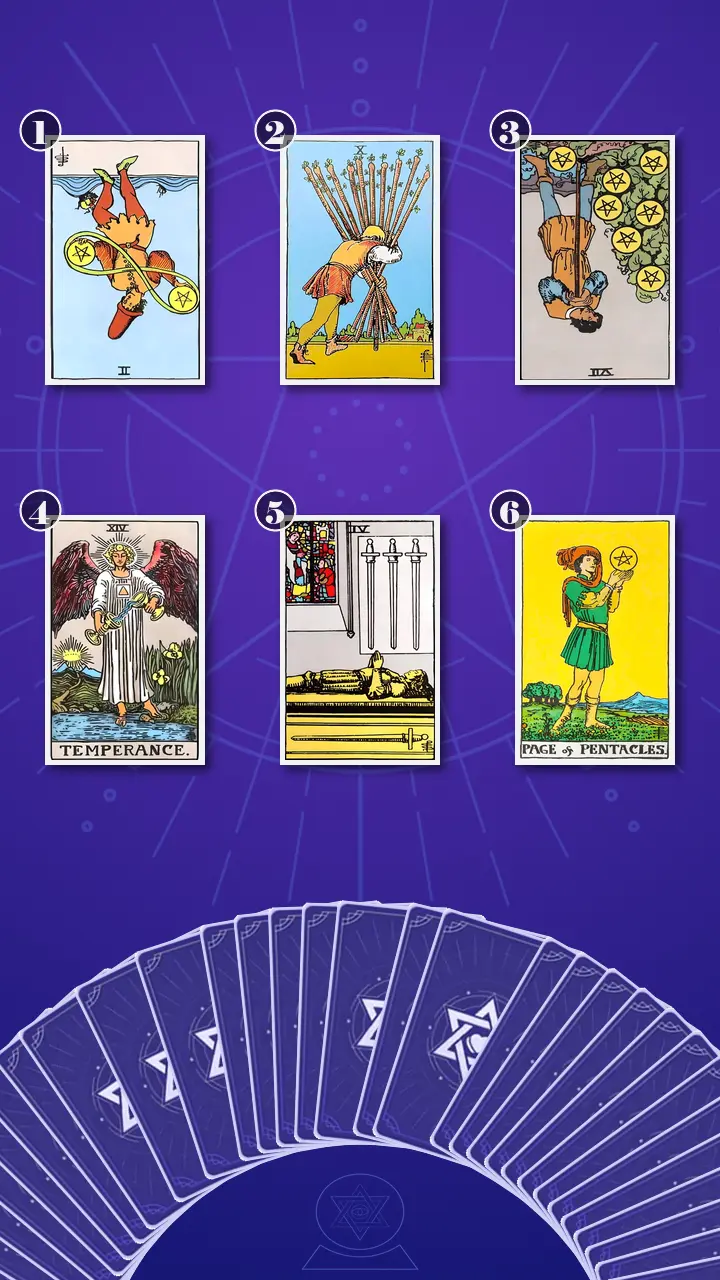
I chose my Transformation Path Grid (6) · Context Edition, a tarot spread for Sunday reset anxiety and workweek overwhelm. Its top row traces the loop: the visible behavior, the immediate burden, and the belief that keeps supplying it. Its lower row offers a return path: the leverage point, a bounded practice, and the quality of life that can grow from repeating it.
This was more useful than a broad predictive spread because Maya did not need a forecast of Monday. She needed to see the system that made Monday feel like a verdict before it had even begun. I explained that the first card would show her calendar-juggling pattern, the middle cards would name what turned preparation into exhaustion, and the final cards would identify practical next steps for a more workable weekly rhythm.
In my years as a perfumer, I learned that a room can hold two atmospheres at once: citrus from an open window, coffee from the counter, rain caught in a coat by the door. Boundaries matter because without space, every note muddies the next. I suspected that work had been diffusing through Maya’s home in exactly that way.
When the Calendar Would Not Stop Moving
The First Card: Juggling That Looks Like Planning
Now I turned over the card representing Maya’s surface Sunday pattern: Two of Pentacles, reversed.
I showed her the figure balancing while two coins loop through an infinity ribbon. Reversed, the card’s flexible energy had tipped into excess and instability. This was not a lack of effort. It was too much motion without a stopping point.
“This is your kitchen table at 6:40,” I said. “Google Calendar, Notion, and the paper planner all open. You move a status update, laundry, groceries, and a walk across the week. Each rearrangement gives you a brief hit of relief, because it makes Monday look less threatening. But the same tasks keep circling.”
I named the loop as I heard it in her story: “If I move this to Tuesday, then Monday opens up. If Monday opens up, I can relax. If I can relax, maybe I have earned dinner or a walk.” The calendar became more orderly; her body did not. Her shoulders rose, dinner waited, and the evening disappeared.
Maya gave a small laugh that caught at the end. “That is so accurate it’s kind of rude.”
“I do not mean it as a judgment,” I said. “The reversed Two of Pentacles is showing a calendar juggling loop. It is information. The question is: when you opened your planner last Sunday, what were you moving around instead of deciding?”
She looked down at the card. “Time for myself, mostly. I keep acting as if it can go anywhere.”
“You are not bad at resting,” I told her. “You have been making rest wait for a finish line that moves.”
The Second Card: Every Tab Marked Urgent
I turned over the card for Maya’s immediate blockage: Ten of Wands, upright.
The card showed a figure bent forward under ten bundled staffs, unable to see clearly past what they carried. Its fire energy was not absent or blocked; it was overloaded. Effort had become strain.
“This is like a browser with thirty tabs open,” I said, “except every tab has been marked urgent. A Friday follow-up, a meeting agenda, a grocery list, an unread message, a possible process improvement, a course you might take someday. On Sunday, they all get assigned the same consequence.”
I could almost see the Line 1 train she had described: fogged window, wet coats, the blue light from her phone on her face while she reread the list. The Ten of Wands explained why even a normal task could feel too heavy. When every unfinished item is carried as equally urgent, urgency stops helping someone choose.
“This is not responsibility itself,” I said. “It is responsibility mixed with the belief that you must carry every part alone. Work has followed you home in a way that feels a little like Severance, where the office keeps claiming square footage in ordinary life.”
She pressed her thumb into the edge of her sleeve. “If I put something down, it feels like I don’t care enough.”
“That is the blockage,” I said. “The list is obscuring your view of the two things that might genuinely help Monday. A plan is supposed to hold your week, not consume your Sunday.”
The Third Card: Digging Up the Plant
For the reinforcing root beneath the burden, I turned over Seven of Pentacles, reversed.
I pointed to the gardener pausing beside a living vine. Upright, this card understands assessment, patience, and allowing results to appear over time. Reversed, that steady evaluation becomes impatient measurement. Maya had not merely been seeking a routine. She had been asking each Sunday night to prove immediately that it could create a perfect Monday.
“This is the moment you watch a spotless Sunday-reset reel, look at your half-finished planner, and start a new Notion template,” I said. “You are judging the template after one chaotic Monday and deciding it failed because a meeting moved or a new request appeared.”
I used the image that came naturally to me: “It is like digging up a windowsill plant each evening to check whether it has grown. You cannot gather evidence because you keep disturbing the conditions that would let you see it.”
Her breath paused. Her eyes shifted from the card to the rain-blurred window behind me, as if replaying a sequence of abandoned trackers and colour-coded dashboards. Then the tension at one side of her mouth eased.
“If it worked,” she said quietly, “I thought I would already feel different.”
“That is the belief feeding the loop,” I said. “Not that you lack discipline, but that you require immediate proof. A normal Monday can still be messy even when a small Sunday practice helped. The useful question is not, ‘Did this make the week perfect?’ It is, ‘What made it five percent easier?’”
When Temperance Changed the Tap
The Fourth Card: A Measured Pour
The room quieted before I turned over the card for Maya’s key transformation. Outside, rain tapped the glass in a patient, even rhythm. I placed Temperance, upright at the lower left of the grid.
The angel on the card poured steadily between two cups, one foot on land and one in water. Its energy was balance: neither all planning nor all recovery, but an intentional exchange between practical preparation and restoration. I had seen this kind of balance in perfume composition. One bright note can lift a blend; too much makes it sharp. The answer is rarely to remove the note. It is to give it proportion and room to breathe.
This was my Spatial Boundary Scenting at work. Maya’s work-output atmosphere had been leaking across her kitchen, hallway, dinner plan, and saved walking route. She was not failing because she wanted structure. She was exhausted because the workplace had no clear edge inside her Sunday. Opening a fourth planning tool was increasing the pressure, not reducing it.
At 9:18 p.m., she had stood in her apartment hallway with one sneaker on, rain tapping the stairwell window, ready for the walk she had promised herself. Then a calendar notification vibrated. She had turned back inside, telling herself the walk could happen after the plan was finished, even though part of her knew the plan had no natural end.
Stop treating an exhausted Sunday as proof of commitment; blend planning with rest in Temperance's measured pour, and let a better week grow from a sustainable rhythm.
I let the words sit without filling the silence.
Maya’s fingers froze around the cuff of her sleeve. For a moment, her breathing seemed to stop halfway in. Her gaze went unfocused, not away from me exactly, but toward all those Sundays in which she had believed that stopping would expose her as careless. Then her pupils widened slightly. The tight line across her forehead softened. Her shoulders, which had been held almost level with her ears since we began, dropped one careful inch.
“But does that mean I was doing it wrong this whole time?” she asked. There was anger in the question, but it was not directed at me. It sounded like grief for evenings she had spent trying to become a person who could finally relax.
“No,” I said. “It means you used the best control strategy you had available in a changing environment. It gave you a little short-term relief, then charged you recovery as the price. We are not putting you on trial. We are testing a more sustainable form of control.”
Her mouth opened, then closed. She exhaled with a faint tremor, the kind that follows a long-held posture rather than a dramatic revelation. There was relief in it, and also a small blankness, as though the absence of the old burden required her to decide what came next. I asked her, “With this new perspective, can you think of a moment last week when it might have felt different to say, ‘I can prepare enough and still have an evening’?”
“The walk,” she said after a pause. “I could have left the notification alone. I would not have fixed Monday, but I might have arrived with more of myself.”
That was the crossing point: from pressure-driven control and depleted weekends toward proportionate planning, protected rest, and grounded trust in a rhythm she could repeat. A better week does not need an exhausted Sunday to prove it was earned.
The Fifth Card: Thoughts Without Instructions
I turned to the card for the bounded practice: Four of Swords, upright.
The resting figure beneath suspended swords gave us a practical image. The thoughts were still there. The work was not magically complete. But the swords did not require immediate handling. This was an Air-based pause after the earlier weight of Earth and Fire: space to think without converting each thought into an action.
“After a short planning window, this card asks you to put the planner away for a defined period,” I said. “A Monday thought can go in one note. It does not reopen the entire system. You can eat dinner at the table, take the block-long walk, shower, stretch, or read ten pages.”
I watched Maya’s hands flatten on her knees. “I always think I am only checking one thing.”
“That is why I would make the boundary physical, not just aspirational,” I said. “An unfinished thought is not automatically an instruction.”
The Sixth Card: One Small Thing to Tend
For integration, I turned over Page of Pentacles, upright.
The Page held one pentacle with full attention, standing in a green field with mountains in the distance. This was grounded Earth restored: fewer actions, clearer value, and a beginner’s willingness to learn from reality. The card did not promise Maya an optimized identity. It offered a practical experiment.
“For two weeks, you can keep one simple template,” I said. “Meetings will still move. Slack will still ping. The point is to collect lived evidence rather than audition a new system every Sunday.”
Its energy was balanced focus, the counterweight to the reversed Two of Pentacles. Maya nodded slowly, with a little more room in her face now.
“I do not need to solve next week tonight,” she said. “I only need to leave it one useful place to start.”
“Exactly,” I replied. “Keep one small promise to next week, then let the week teach you what it needed.”
The Two-Priority Sunday
I drew the full route together for Maya. The reversed Two of Pentacles showed task movement replacing real decisions. The Ten of Wands showed how every loose end had become a burden of equal weight. The reversed Seven of Pentacles revealed the hidden demand for instant proof: if a routine did not create a flawless Monday, she discarded it and rebuilt the system.
Temperance gave us the correction. The blind spot was not that Maya needed a more sophisticated planning system. It was that she had been using planning to earn permission for rest. Her transformation direction was from a perfect reset to a repeatable rhythm: one useful plan, one protected recovery period, and enough trust to observe what happened before changing everything.
I offered a short Physical Boundary Protocol, designed to make the shift tangible within 72 hours. In scent work, I do not ask one atmosphere to disappear by force; I create a clear transition so the next one can arrive. Maya’s Sunday needed the same kind of threshold.
- Choose two Monday supports. At 5:30 p.m. next Sunday, open only one planning surface and choose exactly two tasks that would make Monday easier: for example, write the first work priority on a sticky note and pack lunch or set out clothes. Set a 30-minute timer. Treat it as an experiment, not a verdict on competence. If 30 minutes feels activating, use 15 minutes and one priority.
- Create the “Later, not tonight” boundary. When the timer ends, write every remaining task or Monday thought in one note, close the planner, put the laptop in a drawer or across the room, and switch on Focus mode for 45 minutes. Keep one genuine emergency contact channel available if needed. The boundary is not forced silence; it is ending unpaid Sunday work.
- Run a two-week evidence loop. Use the same three-line note for two weeks: “Monday must move,” “Can wait,” and “One thing that restores me.” On Friday, spend two minutes noting one ease and one friction point before adjusting anything. Change only one part after two weeks. No new productivity app is required; an index card or Notes app is enough.
“The goal is not to prove you can ignore responsibility,” I told her. “The goal is to let planning and rest support each other. A contained reset gives you a better chance of meeting a moving Monday with usable energy.”

A Week Later, the Quiet Proof
Six days later, I received a message from Maya. She had chosen two priorities, set a 20-minute timer, and placed her laptop in a drawer afterward. She took the walk she had postponed the previous week. Monday still came with an unexpected meeting move and three Slack messages, but she opened her sticky note first.
She wrote, “I still had the thought that I should plan more. I just did not obey it.”
Her change was small, which made it credible. She had not solved every pressure in her job or erased the Sunday Scaries. She had created the first proof that a boundary could hold. She was learning that control did not have to mean squeezing every drop from Sunday.
When Sunday night finds you staring at a cold cup of tea with tense shoulders and a calendar still open, I want you to remember this: stopping can feel as though it will leave you exposed to Monday, even when the trying is what has already taken your rest.
So I will leave you with the question I would ask at my own kitchen table: if next Sunday did not have to prove that you are in control, what small measured pour between one useful plan and one real hour of rest would feel genuinely workable in your actual life?