Must Goodness Always Cost You?

Explore why goodness can feel tied to hardship, the tarot cards that mirror it, and reading insights from others facing the same bind.

Punishment-goodness Fusion
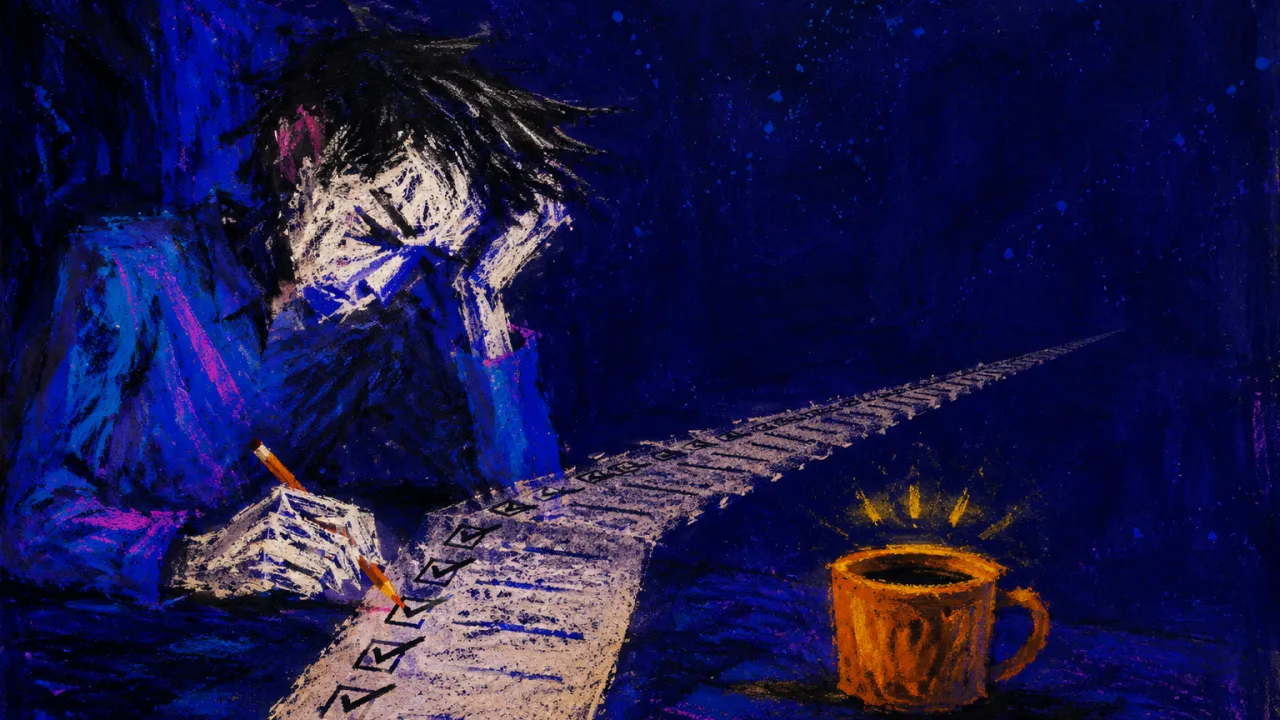
A figure at a late-night desk, hands beside an extending checklist and an untouched amber mug in cold indigo shadow.

What does this feel like?

Punishment-Goodness Fusion is when a quiet evening finally opens up and, instead of settling into it, you start looking for something difficult to do. You finish the assignment, send the last email, wash the dishes, then stand in the kitchen with your shoulders still lifted, scanning for the next thing that would make rest feel earned. When someone offers to help, your mouth says "I've got it" before you have checked whether you do; when something goes well, a small voice begins listing what you owe, what you missed, or how quickly you could become careless. Ease feels suspicious. Pleasure arrives with a bill attached. You can be generous with other people's limits and still treat your own as evidence that you are failing some private test. So you choose the longer route, take the least comfortable seat, volunteer for the extra task, downplay the compliment, or reopen the laptop after everyone else has logged off. Your chest tightens when you receive without giving back immediately, and your hands stay busy because stopping leaves you face-to-face with the thought: if this does not hurt, does it still count as good? Nothing dramatic has to happen for this bind to shape a life. It can live in cold coffee, cancelled plans, unopened gifts, and the strange relief of being burdened again because burden gives you a role you know how to perform. The cost is that kindness becomes measurable only by what it takes from you, while rest, delight, and being cared for remain permanently on probation. Eventually, goodness feels less like a value you choose than a load you must keep proving you can carry, much like the figure on the Ten of Wands, bent beneath an armful of staffs even with the town already in sight.

What's pulling at you?

You are trying to be kind, dependable, and fair, but comfort starts to look like selfishness while hardship starts to look like proof that you are doing life correctly. That leaves you caught between living by your values and believing those values only count when they cost you something.

How It Shows Up?

  • On a free Saturday, you finish the laundry, clear the kitchen, answer the message you had been postponing, and finally sit down with nothing urgent left. Within seconds your knee starts bouncing, your shoulders stay raised, and your eyes begin searching the room for one more useful thing, because the quiet feels less like rest than a test you have not passed. You can let five unproductive minutes remain exactly that.
  • A partner or friend reaches for the heavy grocery bag or offers to handle the booking, and your grip tightens before you say, "No, I've got it." Your chest draws inward as the weight begins to leave your hands, as though accepting help places an invisible mark in a ledger you must clear later. You can let the bag change hands without settling the account immediately.
  • You tick off the final task late in the evening, glance at the cold coffee beside your laptop, then add another line to the list so stopping will not feel like taking the easy way out. Your eyes feel gritty, your shoulders press forward, and your fingers reopen a document you had already closed. The completed line can remain completed for tonight.
  • At dinner, someone compliments your work or raises a glass to something you achieved, and you laugh, wave it away, or redirect the attention before the sentence can land. Heat gathers around your face, your fingertips fold the edge of a napkin, and receiving the moment feels more exposing than criticism would. The words can stay on the table without being repaid.
  • After a day that went unexpectedly smoothly, you lie awake replaying small mistakes and building a stricter plan for tomorrow, mentally adding weight to the other side of an invisible scale. Your breathing stays shallow, your hands remain folded over your chest, and relief starts to feel like something that needs correcting. You can let an easy day end without converting it into debt.

Punishment-goodness Fusion in Tarot Cards

Punishment-Goodness Fusion shows up when rest, help, or pleasure begins to feel morally suspect, while strain feels like proof that you are still a good person. You may notice it in shoulders that rise when help is offered, or in fingers reopening the laptop after the final task is done. From an existential view, its structural framework holds goodness and self-denial in the same equation. The Tarot Cards below mirror the visible shape of that bind.

Justice
Reversed
A figure holds a scale for evaluation and a sword for decisive judgment, seated within a formal structure of principles. Reversed, the growth metric is not absent but miscalibrated; you may judge a sustainable practice as weak while trusting a punishing one because its cost feels like evidence. The card exposes the difference between values and the instrument used to measure them. You can genuinely value discipline and responsibility while a distorted internal scale keeps translating those values into self-denial, preventing growth from becoming durable, flexible, or freely chosen.
The Hanged Man
Reversed
A halo surrounds the head of a figure suspended by one foot, joining the possibility of insight to a physically costly position. Reversed, the cost continues after its capacity to produce perspective has stalled; you may maintain a severe practice because ending the sacrifice would make the growth feel less real. The card names a developmental false positive. You can endure substantial discomfort without revising the rule that goodness requires punishment, allowing self-denial to appear transformative while preserving the exact cognitive system that needs to change.
The Devil
Upright
Two figures remain connected to a pedestal by chains that are restrictive yet visibly loose enough to suggest more possibility than they recognise. The image mirrors an identity bound to hardship: you may know intellectually that goodness need not hurt while still returning to burden because the chain supplies a familiar role. The upright card holds desire, fear, repetition, and attachment in one structure. Your growth is obstructed not by a lack of values, but by a contract that makes suffering the admission price for seeing yourself as ethical, useful, and worthy of belonging.
Judgement
Reversed
An angel's trumpet calls figures upward from open coffins, presenting judgment as a threshold into renewed life rather than endless condemnation. Reversed, you can hear the call only as another demand to account for yourself, so development remains tied to repeated self-prosecution. The card identifies the missing cognitive transition between responsibility and release. You may fear that outgrowing punishment would erase your values, when the actual lock is a verdict system that cannot recognise goodness unless guilt remains active.
Four of Cups
Upright
A hand extends a cup from a cloud while a seated figure keeps his arms and legs crossed, looking toward three cups already on the ground. The offer is close and visible, yet the body remains organised around non-reception; you may respond to a friend's help with an automatic insistence that you can manage alone. The upright card holds the offer and the refusal in the same frame without reducing either to ingratitude. You can value the friendship and still reject care because relief would remove the hardship through which you have learned to recognise yourself as dependable and good.
Six of Pentacles
Reversed
A standing figure controls a scale and distributes coins to people positioned below him, placing care, hierarchy, and accounting in one scene. Reversed, the family exchange carries a debt that may be internal even when it is never spoken; you can interpret help as proof that you now owe greater sacrifice. The card reveals why receiving does not settle the family system for you. You may restore emotional safety by overfunctioning, because hardship returns you to the recognised role of the good relative who contributes, complies, and does not cost anyone too much.
Four of Swords
Reversed
A motionless figure lies within a quiet chamber while swords remain suspended in the surrounding space. Reversed, the body and the mental environment no longer enter stillness together; you may be physically safe to stop while your inner attention continues searching for a duty that will justify your existence. The card identifies a failed handoff from action to restoration. You keep the mind busy because quiet would expose the fused proposition beneath the activity: if nothing is hurting, perhaps nothing good is being proven.
Nine of Swords
Upright
A figure sits upright in bed with both hands covering the face while nine swords line the dark wall overhead. The body is no longer performing external labour, yet the mind supplies a punishing substitute; you may replay small failures after an easy day so that comfort does not remain morally unanswered. The upright card makes the cost of the private audit visible. You are not discovering new responsibilities in the night; you are restoring the hardship that your internal system uses to confirm vigilance, humility, and goodness.
Six of Wands
Reversed
A mounted figure receives public recognition beneath a laurel wreath while others accompany the procession. Reversed, the elevation becomes difficult to inhabit; you may wave away praise or accept a promotion as a demand to prove yourself through even greater strain. The card captures a career pattern in which achievement cannot close the account. You treat recognition as credit that must be repaid with suffering, so success raises the workload instead of expanding your permission to trust your existing competence.
Ten of Wands
Upright
A single figure carries ten staffs toward a settled town, his body bearing a load associated with the life ahead of him. The bundle can mirror a family system in which you collect practical tasks, emotional containment, and other people's unfinished responsibilities because carrying them confirms your goodness. The upright card shows real loyalty and effort, but it also makes the concentration of weight visible. You may fear that sharing the load would expose selfishness, so the family continues to recognise your care mainly through what it takes from you.

Punishment-goodness Fusion in Tarot Card Reading Insights

Punishment-Goodness Fusion also appears in readings where people ask why accepting ease feels more uncomfortable than carrying another burden. The Tarot Reading Insights below follow what surfaced as they brought that bind to the cards.
Psychological Struggles Related to Punishment-goodness Fusion