Why Reject Yourself First?

A clear look at why you opt out before judgment arrives, plus the tarot cards and reading insights that mirror this pattern.

Preemptive Self-rejection
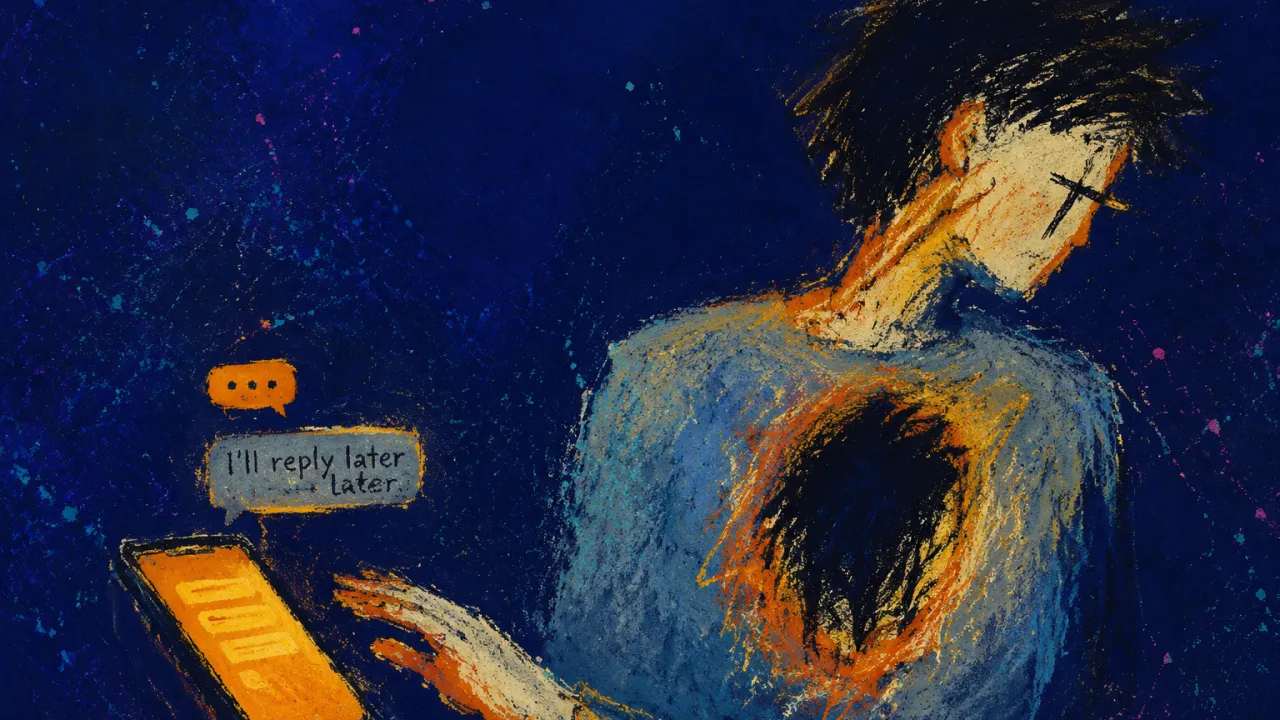
A figure angles away from a phone, one hand hovering over a group message, with a hollow chest in amber against blue-grey.

What is this really?

You reject yourself before anyone else gets the chance: you soften your opinions, leave messages unsent, and explain away invitations or opportunities before they can become a verdict. Choosing yourself out first gives you control over exposure and spares you the uncertainty of waiting to learn how someone else sees you. Yet that relief narrows your world: you are left with an unanswered question and no chance to be met as you are, like the Eight of Cups, whose cloaked figure turns from the cups already stacked behind them and walks toward an unanswered horizon.

Why did it happen?

At a time when a cool reply, a closed door, or someone's changing tone felt difficult to recover from, your body learned to scan for possible rejection and step away first; that gave you a brief sense of control. Now the subconscious loop can read an unanswered text, a neutral expression, or an open opportunity as the same warning, leaving you relieved for a moment and quietly aware that you never gave yourself a chance.

How does it feel?

  • At a group-planning text, you type, 'No worries if you're busy,' before anyone has replied, then erase your suggestion and send a thumbs-up instead. In the pause afterward, your chest feels hollow and your eyes keep returning to the screen; you can allow that reaction to be there without deciding anything from it.
  • When a job, class, or creative opportunity opens, you hover over the application button, close the tab, and type a list of reasons you would not fit in a notes app. Afterward, your shoulders stay lifted and your hands feel cold against the desk; the unfinished choice can remain there for now.
  • On a date or in a new connection, you make a joke at your own expense, glance toward the window as the other person responds, and change the subject before the compliment lands. A warm face and a quick drop in your stomach may arrive together; you may notice them without forcing yourself past them.
  • Before posting a photo, idea, or message, you zoom in on one detail, add a disclaimer such as 'probably dumb,' and save it to drafts. Your jaw tightens and your breathing becomes shallow while the screen stays open; the draft can exist without needing a verdict right now.
  • While choosing what to try alone, you open several tabs, read reviews until the options blur, and close them without booking or choosing. Your hands rest motionless and a flat tiredness settles through your body; uncertainty can stay beside you for a moment.

Preemptive Self-rejection in Tarot Cards

Preemptive Self-Rejection lives in the reflex to erase a message before anyone can answer, while your breathing becomes shallow. Jungian archetypal theory offers a way to read this inner pattern through symbolic images. The Tarot Cards below mirror the unconscious movement of stepping out of view before another person's response arrives.

The Fool
Reversed
The traveller stands at the cliff's edge with a small bundle, a white rose, and a dog calling attention to the next step, while the bright sky leaves the outcome radically open. In the reversed orientation, attention contracts around the edge itself, so possibility is processed primarily as danger before the landscape can reveal whether the step is supported. That narrowing maps the moment when preemptive self-rejection disguises itself as perfect timing. You may decide that it is too soon, too late, or irresponsible to become visible just as a real opening appears; the hesitation reduces immediate exposure, but repeated postponement allows imagined rejection to determine the calendar.
Justice
Reversed
The seated figure holds an upright sword in one hand and balanced scales in the other, framed by pillars and a veil that suggest a formal process of evaluation. Reversed, this inner courtroom becomes weighted before evidence is heard, and the sword delivers a conclusion that the scales have not actually established. That premature verdict is the cognitive core of rejecting yourself before anyone else can. You may treat discomfort as proof, infer another person's judgement, and sentence your own message or desire to silence; the image offers a precise audit point by distinguishing the evidence available now from the ruling your protective system has already issued.
The Moon
Upright
A winding path passes between two towers while a dog and a wolf react beneath the moon and a crayfish emerges from dark water. The landscape contains real sensory signals, but the uncertain light makes distance, intention, and danger difficult to judge accurately. That ambiguous field resembles the inner interval after a delayed reply, unreadable face, or altered tone. You may fill missing information with a rejection narrative and retreat before daylight arrives in the form of clarification; the Moon does not invalidate your felt alarm, but it shows why the alarm cannot serve as a complete social verdict.
Judgement
Reversed
The trumpet reaches figures who rise from confined spaces with open arms, while the mountains suggest a threshold larger than any single performance. In the reversed orientation, the response is held beneath a demand to become fully acceptable before emerging, turning self-assessment into a gate that no unfinished self can pass. That gate mirrors a growth system in which you must guarantee approval before practicing a more visible identity. You may understand the pattern intellectually yet keep refusing the experiments that could revise it; the image locates the gap between insight and change in the internal verdict that arrives before participation.
Four of Cups
Upright
The figure under the tree keeps a closed posture toward the cup being extended, while the three cups already on the ground receive the same disengaged gaze. The image holds both an actual social offer and an internal decision that the offer cannot provide belonging. That split captures how you may explain away a group invitation, replace a real suggestion with a neutral reaction, or assume a welcome is only performative. By declining before the group can respond to your fuller participation, you avoid a possible public refusal but also remove the data that could challenge your expectation of exclusion.
Eight of Cups
Upright
The cloaked figure walks away alone from eight upright cups, using a staff to cross uneven ground while the moon partly obscures the light. Nothing in the cups visibly announces rejection, so the departure occurs in an atmosphere where absence and meaning remain unresolved. That unresolved departure mirrors leaving a close friendship when a delayed reply, changed tone, or shifting routine begins to feel dangerous. You may become distant before asking what changed, preserving control over who leaves first; the withdrawal prevents a direct refusal but also denies the friendship a chance to clarify, repair, or make room for your needs.
Four of Pentacles
Upright
The seated figure uses the whole body to secure four pentacles while the wider community remains behind, physically separated from the guarded position. The feet cannot move, the hands cannot open, and the object above the head suggests that control has also become a governing idea. That full-body containment maps a family role in which speaking plainly once felt too costly. You may soften an opinion, pre-emptively agree, or hide a decision before relatives can reject it; the strategy reduces immediate conflict, but it also allows inherited expectations to answer for the family before any present-day conversation occurs.
Two of Swords
Upright
The blindfolded figure keeps both swords raised in perfect opposition while the crescent moon and changing water imply that time continues around the frozen posture. The body expends sustained effort to prevent movement, turning a temporary pause into a defended position against whatever response action might invite. That tension reflects timing governed by anticipated rejection rather than by the actual readiness of the situation. You may wait for a completely safe moment to send, apply, ask, or join, even as the relevant window narrows; delay then appears to validate the belief that there was never a place for you, although the opportunity was never tested.
Eight of Swords
Upright
The bound and blindfolded figure stands among eight swords, but the enclosure is incomplete, the knots are not visibly locked, and an open landscape extends beyond the immediate position. The scene shows a restriction that is subjectively convincing without being identical to the full range of available movement. That distinction matters when growth requires experimentation, visibility, and imperfect feedback. You may call a desired practice unrealistic or decide you are not the kind of person who can attempt it, thereby enforcing the anticipated rejection yourself; seeing the enclosure as a protective construction makes room to examine its function without shaming the part that built it.
Six of Wands
Reversed
The rider is elevated above a crowd, carrying a staff crowned with laurel while another wreath marks the head as publicly visible. In the reversed orientation, elevation is experienced less as recognition than as exposure to a collective gaze, so the crowd becomes an anticipated panel of judges before it has expressed any verdict. That shift reflects the urge to delete a post, dilute an opinion, or refuse a visible social role before public response arrives. You can regain immediate control by stepping down internally, but the withdrawal lets imagined disapproval determine your place in the group and prevents ordinary feedback from revising the fear.

Preemptive Self-rejection in Tarot Card Reading Insights

Preemptive Self-Rejection can surface as deleting a message before a reply arrives, then watching the screen anyway. Others have brought this reflex into readings; below are the Tarot Reading Insights connected to this pattern.

Psychological Patterns Related to Preemptive Self-rejection