A Researched Range Was Deleted—Then a 24-Hour Pause Changed the Reply

The 10:47 p.m. Discount Before Anyone Asked
I knew the pattern before Jordan gave it a name: a junior UX designer on short-term Toronto contracts is asked for salary expectations before the approved range is shared, so they name the lowest figure that feels survivable and add "flexible" before anyone can question it. It is classic salary negotiation anxiety, and in Jordan's case it had become preemptive self-lowballing.
Jordan joined my consultation from the small kitchen table in their shared apartment. The contract email had gone out at 10:47 p.m. the night before. They described deleting a carefully researched range, typing a lower figure followed by "flexible," and pressing send while the laptop fan hummed and their phone sat warm against their palm. Their shoulders had risen toward their ears. Relief had lasted several minutes. Then they had reopened the salary-comparison tabs, and their stomach had dropped.
"I want fair pay," Jordan said, rubbing the heel of one hand against the other. "But I lower the number before anyone else can. I keep calling it realistic, and then I resent the work."
I heard the central conflict clearly: Jordan wanted compensation that reflected the work, yet feared that asking for more would invite someone to examine their personal worth and find it inflated. The feeling moved through their body like an auction gavel lodged in the throat, ready to fall before they had presented a single piece of evidence.
"I am not going to use these cards to decide your market value," I told them. "They cannot do that. I want to help us slow down the sequence between being asked for a number and giving away the answer. Let us draw a map of the fog, then see where you still have room to move."

Choosing the Four-Frame Map
I invited Jordan to take one unforced breath and hold the consultation question in mind: Why do I accept low offers before anyone can question my worth? I shuffled slowly, using the motion as a transition from reaction into observation rather than as a piece of theatre.
I chose a four-card Shadow Spread. I use this spread when one visible habit is being sustained by a quieter belief beneath it. Its compact structure suited Jordan's question better than a larger spread: we did not need ten competing themes when one belief-behaviour loop was already producing such consistent results.
The first position would reveal the visible shadow behaviour: lowering the number, stressing flexibility, and accepting before gathering information. The second would expose the belief and fear maintaining that behaviour. The third would show the corrective perspective, while the fourth would turn that perspective into a repeatable professional practice.
This is how tarot works in my consultations. I treat the images as an external cognitive map. Card meanings in context help me separate behaviour, prediction, evidence, and choice; they do not predict an employer's response or determine what anyone should be paid.
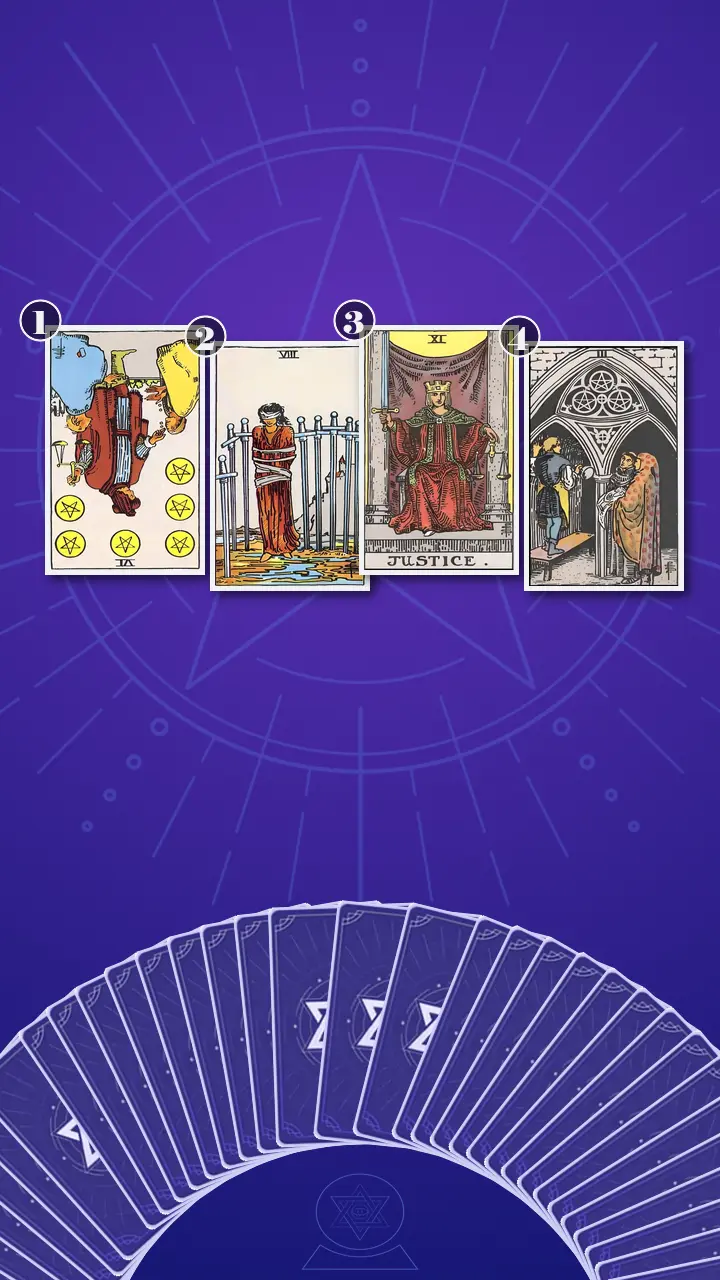
Where the Scales First Tilted
Position One: The Discount Disguised as Flexibility
The card I turned over for the visible shadow behaviour was the Six of Pentacles, reversed. In this position, it revealed Jordan naming a low figure, emphasising flexibility, and accepting before asking for the approved range or the criteria used to place someone within it.
I pointed to the scales held by the standing figure and the coins being distributed downward. In Jordan's modern compensation scene, the recruiter held the budget, the evaluation criteria, and the fuller picture of the role. Jordan, meanwhile, supplied a discounted number before requesting any of that information. The recruiter had not challenged the researched range. Jordan had already placed the work below it, trading leverage and information for a brief release from scrutiny.
The reversed Pentacles energy showed an imbalance rather than a fixed fate. Flexibility itself was not the problem. Its energy had become excessive and distorted, turning a legitimate negotiation option into a pre-emptive apology. Generosity and self-erasure had begun to look identical from the inside.
Jordan gave one short laugh, but there was no amusement in it. Their fingers tightened around the mug. "That is so accurate it feels a bit brutal. I really do think, 'I will make this easy for them, and then they cannot reject me.'"
"The accuracy is not an accusation," I said. "The quick concession gave you real short-term relief. That is why the pattern survived. But relief and fairness are not measuring the same thing."
I asked Jordan to picture their most recent compensation email and identify what had been observable. A number had been requested. A budget had not been disclosed. No one had called their researched figure unreasonable. Everything after that had been supplied by the fear of being examined.
Position Two: When Ten Seconds Becomes a Rejection Notice
The card I turned over for the shadow's origin was the Eight of Swords, upright. Its role was to expose the limiting belief that a fair request would invite scrutiny and prove Jordan had overestimated their contribution.
Jordan told me about a recruiter call in a glass-walled coworking booth near a Toronto subway stop. After Jordan gave a rate, the recruiter paused to check their notes. The air vent clicked on. Jordan's throat tightened, their shoulders rose, and the silence seemed to shrink the booth around them. Their mind inserted dialogue the recruiter had never spoken: "They think I am delusional."
The air energy of the Swords had become both excessive and blocked. Thought was moving quickly, but only in a circle. Like the blindfolded figure standing inside an incomplete enclosure, Jordan could not see the budget or decision criteria, yet treated the narrowest and most threatening interpretation as the only available reality.
I drew two columns on a sheet of paper. Under Confirmed Evidence, I wrote: "The recruiter said, 'Let me check the range.'" Under Forecast, I wrote: "They paused, so I asked for too much, and now they doubt my ability."
"The pause is not proof; it is a pause," I said. "What happens in your body when we put those sentences in separate columns?"
Jordan's breath caught first. Their eyes moved between the columns as though replaying the call; then their jaw loosened by a fraction. "I still hate the pause," they said. "But I can see that I turned it into a verdict before they finished checking anything."
I nodded. "That distinction matters. You do not need to enjoy uncertainty. You only need to stop promoting a forecast into evidence before the conversation has supplied the facts."
When Justice Put the Scales Back in Jordan's Hands
Before I revealed the third card, the refrigerator on Jordan's side of the call stopped humming. The sudden quiet gave the space between the second and third cards an almost architectural weight.
Position Three: Pricing the Work Without Putting a Person on Trial
The card I turned over for the hidden truth and transformative resource was Justice, upright. Its role was to separate personal worth from compensation and replace anticipated judgment with balanced evidence.
Justice showed its energy in balance: scales for comparing the role's scope, responsibilities, market context, and workable terms; an upright sword for separating ideas Jordan had fused together. When the next offer arrived, Jordan could ask for the approved range, compare two credible market benchmarks, check the actual responsibilities, and answer from a prepared compensation floor after a review period. They might still feel exposed, but the discomfort would no longer have to choose the number.
At that point, I used the diagnostic method I call Core Competency Excavation. Years spent on archaeological digs taught me that the most revealing layer is not always the most recent label attached to a site. I asked Jordan to set aside the title "junior" and excavate the strata of their actual work: synthesising user research, making interaction decisions, defending findings, navigating stakeholder constraints, and revising designs without losing the user's need.
Those were not inflated claims waiting to be disproved. They were transferable competencies supported by project evidence. Justice did not ask Jordan to declare themselves priceless. It asked them to evaluate a commercial exchange proportionately. A contract title was one layer in a career epoch, not the whole settlement and certainly not a definition of the person standing above it.
I brought us back to 10:47 p.m.: the deleted researched range, the lower figure, "flexible," send. Relief had arrived before evidence; then the benchmark tabs reopened and Jordan's stomach dropped. Their mind had treated speed as safety and silence as prosecution.
You do not have to discount yourself to avoid judgment; use evidence to name a fair range and let Justice's balanced scales separate your compensation from your worth.
I left the sentence alone for a moment. Then I added, "A low offer is information, not a verdict. You can price the work without putting your worth on trial."
Jordan's breath stopped so completely that the video seemed to freeze, except their thumb pressed hard into the mug handle. Their pupils widened; then their gaze slipped past me toward the sent-email tab, as if the previous contract were replaying there. Their eyebrows drew together, and a flash of anger crossed their face. "But doesn't that mean I got all of this wrong before?" they asked, their voice low and sharper than it had been. I did not rush to turn the anger into gratitude. I told them the earlier concession had been a protective response, not a moral failure and not evidence of permanent weakness. Their grip loosened one finger at a time. Their shoulders lowered, their eyes reddened, and a shaky breath became a quiet, "Oh." The relief was real, but so was the brief blankness that followed: if the number was no longer choosing itself, Jordan would have to choose a process. I could see that new responsibility land with a little vertigo.
I asked, "Now, with this new perspective, think back to last week. Was there a moment when this insight could have made you feel different?"
Jordan looked toward the kitchen window. "When the recruiter paused, I could have asked what they were checking instead of lowering the rate again. I review a Figma brief before estimating the work. I do not know why I thought I had to estimate my whole value with less information than that."
"That is the hinge," I said. "The discomfort is still here, but it is no longer choosing the number. This is one real step from anticipatory shame and pre-emptive concession toward evidence-based self-respect during compensation discussions. It is not fearlessness. It is participation."
Position Four: The Work Becomes Discussable
The card I turned over for integration into daily professional life was the Three of Pentacles, upright. Its role was to translate Justice's reframe into documented contribution, market calibration, scope questions, and a prepared response process.
I showed Jordan the craftsperson standing with collaborators beneath the carved pentacles, all of them consulting plans inside a real structure. In Jordan's life, this became a one-page evidence file kept beside the job description: project decisions, constraints, outcomes, and useful feedback. A trusted peer could help check the proposed scope and rehearse the wording before a negotiation.
The Pentacles energy had returned to balance. The reading had begun with material exchange arranged as a hierarchy; it ended with craft being examined collaboratively. Jordan no longer had to defend their character in private. They could make the work visible enough to discuss, calibrate, and price.
Jordan reached for a pen before I suggested it. They wrote three headings across a page: "Decision," "Constraint," and "Outcome." The movement was small, but it was the first one in the reading that did not look like retreat.
The Evidence-Before-Relief Plan
I read the four-card Shadow Spread as one continuous story. Short contracts and the habit of describing substantial UX decisions as "support" had accumulated like misleading labels over Jordan's professional record. In the present, the Six of Pentacles reversed showed them discounting the work before an exchange of information. The Eight of Swords revealed why: predicted scrutiny felt more dangerous than an objectively weak offer. Justice restored a transparent standard, and the Three of Pentacles grounded that standard in visible craft and informed dialogue.
The cognitive blind spot was not simply a lack of confidence or salary data. Jordan was handing the other party the sole authority to measure fairness before asking what rules, range, or scope that party was using. The transformation direction was therefore practical: move from quoting the smallest defensible number immediately to requesting the budgeted range, checking evidence, and responding from a prepared floor after time to review.
I told Jordan that this might mark the close of one career epoch: the period in which being inexpensive had functioned as their main proof of being employable. The next epoch did not require a dramatic top-of-market demand. It began with a pause, a question, and evidence entering the room before relief made the decision.
I offered two next steps as experiments, not commandments or guarantees:
- Use the 24-Hour Offer PauseBefore the next recruiter call or client quote, save this response in the Notes app on the phone Jordan already brings to those conversations: "Could you share the approved salary or rate range and the main factors that determine placement? I would like 24 hours to review the full offer before responding." Ask before naming or accepting a number, then allow the silence to remain unfilled.Start with the five-minute version: save and rehearse only the first sentence once. Asking for information is not a commitment to negotiate, disclose current pay, or accept unclear terms.
- Run the Resume Stratigraphy ReviewUse two separate 15-minute sessions in a private Google Doc or Notion page. In the first, excavate one recent UX project under three headings: decision I influenced, constraint I navigated, and outcome or learning. In the second, record two credible Toronto role-specific compensation benchmarks with source, date, currency, employment type, and scope. Then write a private compensation floor and one sentence connecting the target range to the responsibilities.Use process evidence when perfect metrics are unavailable, omit confidential information, and treat differing benchmarks as reference points rather than verdicts. The floor defines a workable exchange; it does not define personal worth.
These actions supplied what the spread lacked symbolically. The research and comparison gave Jordan clearer air; the saved script created the small spark needed to initiate a boundary; naming the body reaction allowed the shame to be noticed before it became a pricing instruction. Tarot had organised the problem, but Jordan would decide what to ask, what to disclose, and which terms were workable.

A Week Later, the Quiet Proof
Six days later, Jordan messaged me: they had asked for the approved range and requested until the next afternoon. They slept through the night. Their first morning thought was, "What if I blew it?" They told me they smiled anyway and opened the evidence note before checking email.
The message did not announce that salary negotiation anxiety had vanished or that every future offer would improve. It showed something more credible. Jordan had tolerated discomfort long enough to gather information, and they had used a repeatable process instead of buying immediate relief with a lower number.
I thought again of archaeological strata. A fracture does not erase the structure beneath it; sometimes it reveals where the rebuilding must begin. Jordan's Journey to Clarity was not a prediction delivered by Justice. The cards made the hidden sequence visible. Jordan reclaimed the scales, chose a pause, and supplied the evidence.
When a salary question makes the throat tighten and the shoulders rise, I know how much safer it can feel to discount the work before anyone has the chance to reject it. But that discount quietly turns a fear about personal worth into a price that must be lived with. Simply noticing the hand moving toward "flexible" is already a moment in which another choice can become visible.
If the next offer could be information rather than a verdict, what would you be curious to notice in the first few minutes before deciding what it means about you, and which fact would you place on Justice's scales before fear reaches for the keyboard?