When the Examples Stop Matching

See how unfamiliar assessments reshape familiar lessons, then explore related Tarot Cards and reading insights drawn from similar sessions.

Learning Transfer Trial
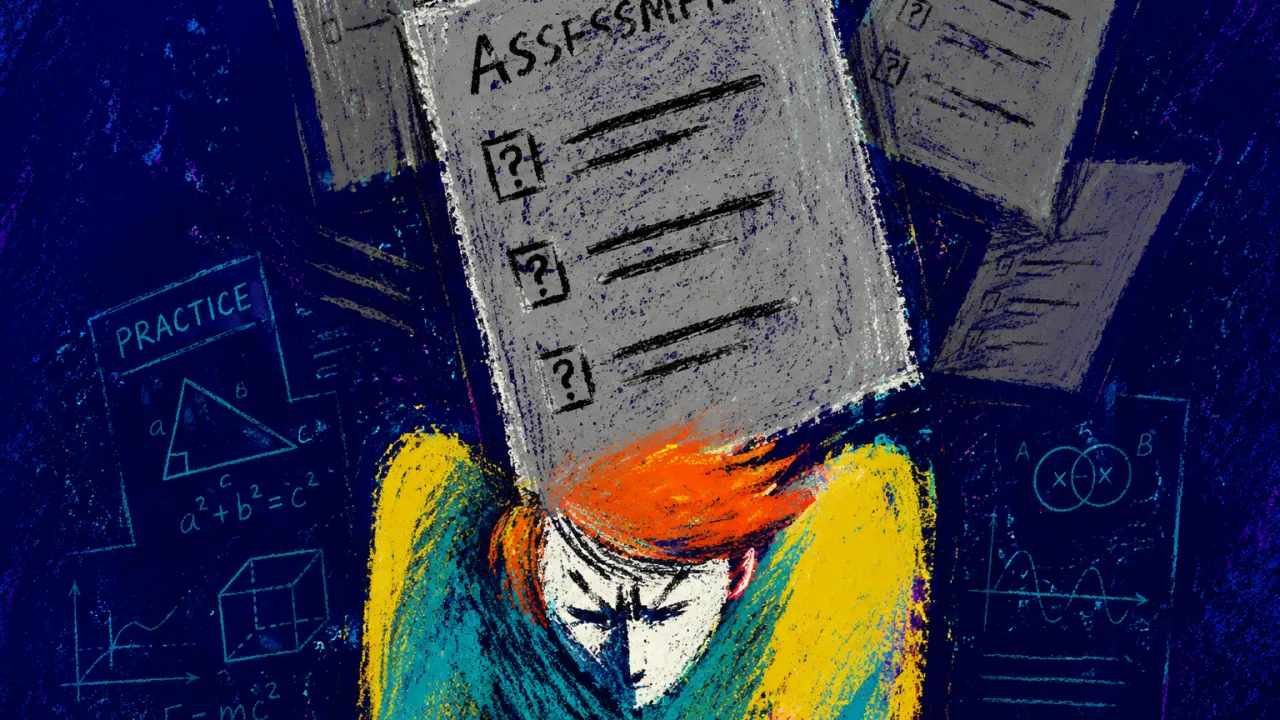
A figure leans beneath descending task panels, shoulders raised, as familiar diagrams fade into the deep indigo background.

What is this situation?

Learning Transfer Trial: you leave the lesson, onboarding session, or guided practice and are immediately asked to use the same material in a task that no longer resembles the examples. The wording changes, the layout shifts, familiar prompts disappear, and a timer, score, or observer turns adaptation into something that can be judged. You may have completed every demonstration correctly, but now an instructor, manager, assessor, or study facilitator decides whether you can recognize which rule carries over, while giving little indication of what counts as close enough. When you ask for clarification, you may hear "use what you learned" or "approach it as you would outside training," even though the new setting includes variables the training never covered. Your shoulders rise as you scan between the old example and the unfamiliar task, trying to work out whether the test is about recall, speed, judgment, or all three. Each pause costs time; each wrong turn may be recorded before any feedback arrives; and the person evaluating you controls the rubric, the pace, and whether another attempt is allowed. The trial can follow you from a classroom to an exam screen, from a training module to a live shift, or from a rehearsal to a supervised performance, making the gap between practice and application the main obstacle. By the end, familiar tools are still in reach, but the setting has changed the demand, much like The Magician standing before a table of recognizable objects, with the task resting on how they are put to use.

Why it's not you?

The problem is not that you failed to learn; the trial changes the cues, removes the supports, and then treats smooth adaptation as proof of mastery. When the training and the assessment do not match, the gap belongs to the design of the test, not to your worth or effort.

Learning Transfer Trial in Tarot Cards

In a Learning Transfer Trial, the taught examples stay familiar while the assessment changes the wording, layout, and available prompts. The way your shoulders rise while you scan between the old example and the new task shows where that mismatch lands in the body. It is an environmental and structural dynamic: the setting changes the cues while the evaluator keeps control of the rubric, making the test itself part of the difficulty. The Tarot Cards below mirror the visible contours of that trial.

The Magician
Upright
With infinity above his head, one hand connecting intention to the physical table, and four different tools available for use, the Magician depicts knowledge becoming flexible action. The image captures the cognitive demand placed on you when familiar procedures must be abstracted from their original examples and rebuilt inside an unfamiliar task. The upright posture keeps the route from understanding to application open, but it does not erase the added difficulty created by changed cues and external scoring. You can see the trial as evidence about which principles have become portable and which parts of the learning environment were too example-dependent, preserving a distinction between cognitive growth and assessment design.
The Hierophant
Reversed
Between two kneeling learners, the Hierophant delivers an authorised lesson while crossed keys, formal vestments, and stone pillars fix knowledge inside an institutional format. Reversed, this tightly ordered classroom loses its usable orientation: the authority of the instruction remains, but the route from approved demonstration to altered problem is obstructed. The inverted structure mirrors a course that teaches one pattern and then assesses you through another without explaining the bridge. You are still expected to obey the institution's claim that the lesson was sufficient, while the missing scaffold, hidden tolerance, and assessor-controlled interpretation reveal a curriculum-to-assessment mismatch rather than an absence of effort.
Justice
Reversed
Seated between pillars, Justice holds a scale for comparison and a raised sword for decision, turning performance into an authorised judgment. Reversed, the instruments remain powerful but lose dependable alignment, matching an assessment that changes the task while leaving you uncertain about what evidence will count as close enough. The image reflects an exam or practical trial where pauses and wrong turns are recorded before feedback, while the assessor controls interpretation and another attempt. You are working inside a measurement system whose result cannot be separated from its hidden rubric, unequal access to clarification, and mismatch between what was taught and what was scored.
Temperance
Upright
The stream passing between unequal cups, the angel's feet occupying two environments, and the path rising beyond the pool make Temperance a picture of knowledge changing containers without losing its organising principle. That structure matches the cognitive work required when you must ignore altered wording and identify what remains invariant. The upright image keeps integration in motion and presents hesitation as part of calibration rather than evidence that learning never occurred. You can see which parts of your understanding travel across contexts and which depended on the original prompt, while also naming how abrupt cue removal makes the trial harder than ordinary independent practice.
Three of Pentacles
Reversed
Inside the stone arch, a craftsperson stands on a bench while two figures inspect the work and hold a plan between them. Reversed, the worker, reviewers, and blueprint remain present, but their shared frame loses alignment, turning demonstrated skill into performance judged through poorly coordinated expectations. The image closely matches a practical assessment in which you apply taught material while an instructor or panel controls a rubric that does not clearly correspond to the training examples. Your work is visible, but the reversed collaboration reveals that the result also depends on whether teacher, task designer, and assessor are evaluating the same version of competence.
Eight of Pentacles
Reversed
Identical pentacles rise beside the workbench while the craftsperson remains absorbed in producing another copy and the town sits beyond the contained practice space. Reversed, the volume of repetition no longer guarantees movement into a broader setting, revealing how a learning system can strengthen one response without building flexible recognition. The image captures the gap between being fluent with guided examples and identifying the same principle after the cues disappear. You can read the trial as a test of whether practice created an adaptable mental model, while keeping visible that abrupt scoring and unmodelled variables can make that model look less developed than it is.

Learning Transfer Trial in Tarot Card Reading Insights

The same Learning Transfer Trial appears in readings when others bring the gap between guided practice and unfamiliar assessment to the cards. The articles below gather Tarot Reading Insights from sessions shaped by that shift.


Psychological Contexts Related to Learning Transfer Trial