Post-Trip Procrastination Finds a Smaller Way Back Into Routine

The Morning the Suitcase Would Not Close
“If you are early in a hybrid career and your first morning back in Toronto starts with Slack, an open suitcase, and a three-page reset list, your post-travel slump may look less like rest and more like waiting for permission to reenter your own life.” I said this gently because recognition works best when it arrives without turning into a verdict.
Jordan (name changed for privacy) sat at the small kitchen counter at 8:18 a.m. on the first hybrid workday after a trip. Slack chimed from the laptop, the washing machine thudded down the hall, and coffee cooled beside a blank reset list. The open suitcase beside the bedroom door was visible from where I sat, its clothes carrying the stale scent of transit into the apartment.
“I want a routine that gives me direction,” Jordan told me. “But after every trip, I postpone the first step until the whole week feels harder to enter. I keep waiting for the version of me who is ready to restart.”
I watched their shoulders rise as they moved the same Google Calendar block again. Their frustration seemed to have the texture of a phone with twelve apps refreshing in the background: plenty of activity, almost no usable battery, and no single process allowed to finish. Beneath it sat guilt, restlessness, and a quieter longing to keep the spacious version of travel alive.
“I do not hear laziness,” I said. “I hear a real conflict between wanting to return to a stable routine and feeling that returning too quickly might take your freedom away. The delay is doing a job: it keeps the trip from feeling fully over. Let us see what that job is protecting, and then draw a gentler route back.”
The Grid That Maps the Return
Before I pulled the cards, I asked Jordan to place both feet on the floor, take one slower breath, and name the question exactly as it was: why do I keep delaying my routine after every trip? I shuffled slowly. For me, this is not a supernatural demand for certainty. It is a small psychological threshold, a way to move attention from the buzzing inbox and the open suitcase toward a question that can be examined.
I chose the Six-card Transformation Path Grid, Context Edition. This spread is designed for a repeating system rather than a one-time decision. It lets me trace the visible post-trip procrastination, the active blockage, the emotional root, the leverage point, the first grounded experiment, and the pattern that could become sustainable. That is one practical way I understand how tarot works: the cards give shape to information that may already be present but scattered across behaviour, body sensations, and private bargaining.
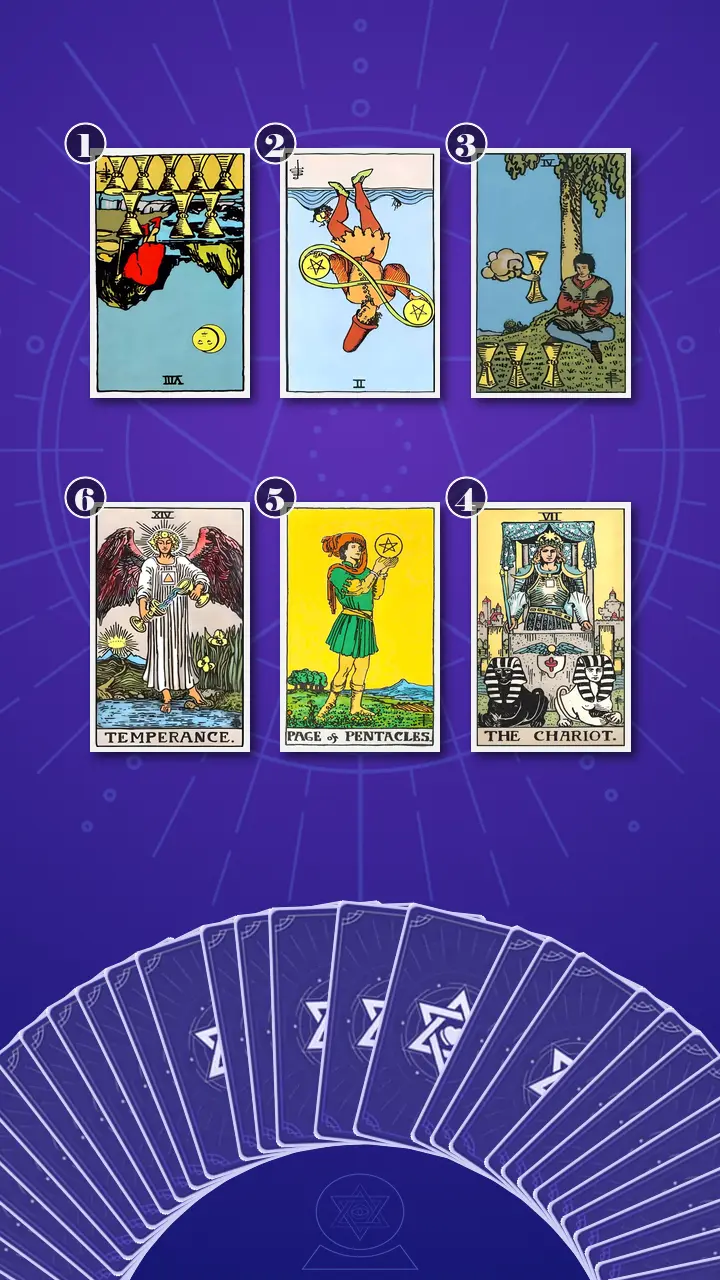
I arranged the cards in two rows of three. The upper row would show the present state, the active blockage, and the root dynamic. The lower row would turn toward the key pivot, the grounded experiment, and integration. I told Jordan that the reading would not decide whether they were destined to be organised or disorganised. Jordan would remain the person steering their life. The spread would only help us see where the steering had become difficult.
The Trip Still Flickering on the Screen
Position 1: The Unfinished Departure
Now I turn over the card representing the present state: the repeated post-trip reentry behaviour, including the open suitcase, the postponed first task, and attention still turned toward the trip. It is the Eight of Cups, in reversed position.
The cloaked figure on the card is walking away from eight cups, but the reversed movement makes the departure incomplete. In Jordan’s modern life, that looked like the first evening home: removing only the charger and toothbrush, leaving the packing cubes untouched, and replaying travel photos for an hour. The physical return had happened, but the emotional departure had not. Closing the suitcase felt less like caring for the apartment and more like admitting that the spacious, present version of Jordan had ended.
I pointed to the moonlit mountain path and the cups left behind. The energy here was blocked movement, not a lack of feeling. Emotional continuity had become excessive, while completion had become difficult. I asked, “What quality from the trip are you afraid the closed suitcase would take away?”
Jordan gave a short, bitter laugh. “That is a little too accurate. Maybe the feeling that my time was actually mine.” Their fingers stopped worrying the edge of a sleeve. They looked toward the bedroom, then back at the card, and I could see the open suitcase becoming more than clutter: it was a small boundary between freedom and the life waiting to be reentered.
“Then the first question is not simply why you have not unpacked,” I said. “It is what the trip is allowed to bring home. If the answer is unhurried time, movement, or fewer notifications, the suitcase does not need to carry the whole trip. It may only need to point toward one quality worth preserving.”
Position 2: The Calendar That Kept Moving
Now I turn over the card representing the active blockage: the way procrastination maintains the reentry spiral through fragmented priorities, recovery-day screen time, and repeated reset planning. It is the Two of Pentacles, in reversed position.
The figure on the card keeps two pentacles moving inside an infinity loop while rough water and a ship rise and fall behind them. Reversed, this is an excess of juggling and a deficiency of completion. I could see the modern version in Jordan’s Monday morning: Slack open, laundry running, a grocery list half-written in Notes, a colour-coded Notion reset page, travel photos in another tab, and a project-status update waiting for one clear decision.
“You are not short on plans; you are overloaded with starting lines,” I said. “The calendar keeps offering a brief escape from choosing. If you move the block to tomorrow, you do not have to confront which task matters now. That relief is real, but it leaves every unfinished task waiting with a little more weight.”
Jordan exhaled sharply and rubbed both palms over their knees. “First I need to catch up, then decide the week, then choose the routine, then I can start,” they said. The words came out in one breath, like a set of gates that could never quite be opened in the right order.
I did not ask Jordan to create a better dashboard. I asked which single task would have a visible finish line if everything else were placed temporarily elsewhere. The reversed Two of Pentacles did not describe a character flaw. It showed a loop in which constant motion provided short-term relief while making the first meaningful action feel increasingly large.
Position 3: The Cup That Felt Too Ordinary
Now I turn over the card representing the root dynamic: the emotional meaning beneath direction stagnation, especially the fear that routine will feel flat, restrictive, or directionless after travel. It is the Four of Cups, in upright position.
The seated figure under the tree has crossed arms and three cups nearby, while a fourth cup is offered from a cloud. The energy is a withdrawal from available engagement. Not because no option exists, but because the option does not yet produce the feeling the person is waiting for. I brought Jordan back to 7:34 a.m. on Wednesday, when a ten-minute gap before a video call held an available breakfast or one category of unpacking, but neither seemed meaningful enough to count.
“I know I could do that,” Jordan said, looking at the card, “but it will not give me the feeling I am waiting for.”
I nodded. “Travel trains attention on novelty, movement, and presence. Ordinary life can look temporarily invisible by comparison. That does not mean your routine is wrong, and it does not mean every task needs to be exciting. It means the first available cup may seem too small because you are asking it to recreate the whole trip.”
I understood the Severance-like fear in Jordan’s description: if work resumed, the freer self might be sealed away from the responsible one. But the Four of Cups suggested a different question. Could ordinary structure become a container for some of that freedom, rather than a place where freedom disappeared?
Jordan became quiet. Their thumb traced a small circle on the coffee mug, then stopped. I saw the recognition arrive in stages: a held breath, a fixed gaze on the fourth cup, and finally a softer posture as they admitted, “I keep rejecting things because they are too small to count.”
When The Chariot Took the Wheel
The room grew still when I reached the lower row. Outside, a streetcar bell rang and faded, leaving a clean pocket of silence around the cards. I turned over the card representing the key pivot: the shift from waiting for motivation to choosing one direction that can hold both travel’s freedom and routine’s structure.
It was The Chariot, in upright position.
The black and white sphinxes face different directions, but the centred charioteer holds the steering role between them. The card did not ask Jordan to choose travel over routine or routine over travel. It showed two legitimate needs pulling differently: freedom and structure. In energetic terms, The Chariot introduced deliberate Fire after Water had remained caught in unfinished departure and Earth had become unstable through over-juggling. The movement was purposeful, but it still belonged to the person inside the chariot.
I told Jordan that I use a diagnostic lens called Micro-Cycle Energy Mapping. I track natural daily and weekly peaks and troughs so that a low-energy return is not mistaken for a moral failure or forced to carry the workload of an ideal day. The first morning home may be a low tide. That does not mean the whole week is lost; it means the first task should be sized for the tide that is actually present.
I also named Rest Phase Legitimacy, my way of protecting the recovery phase that every orbit requires. A genuine recovery period can be necessary and valid. The useful distinction is not rest versus productivity. It is chosen rest that restores contact with the body, sleep, or surroundings versus unstructured scrolling that postpones naming the next small choice. Jordan did not need to punish the need for recovery. Jordan needed a boundary that allowed recovery without leaving the whole return undefined.
At 6:04 p.m. on the Line 1 train, I returned with Jordan to the moment their thumb hovered over the same calendar block they had already moved twice. The carriage jolted, the rails shrieked into Bloor-Yonge, and ten scheduled minutes felt, to them, like surrendering the freedom they had just found.
“You do not need a perfect, all-at-once reset; steer one small block of time like The Charioteer between the paired sphinxes, letting movement reveal direction.”
I let the sentence remain between us, then put the same shift into plainer language. “You do not have to feel fully back before you move forward; one self-chosen block can create direction without taking your freedom away.”
Jordan’s thumb stopped above Save. First, their breath paused and their fingers tightened around the phone, a brief physical freeze at the edge of action. Then their gaze lost focus and drifted toward the dark train window, as if a week of moved calendar blocks were replaying there. Their jaw released before they seemed to notice. Finally, a small, disbelieving “Oh” came from deep in their chest. Their shoulders dropped, their eyes brightened, and the hand holding the phone loosened.
There was relief in the change, but also a new vulnerability. A bounded choice meant Jordan could no longer wait for a perfect mood to make the decision harmless. They looked at me and said, “If I choose the block and choose when it ends, I am not giving away my evening. I am choosing its boundary.” The week was still unfinished. The train was still crowded. But the fear had become specific enough to work with.
“Now, use this new perspective to recall whether there was a moment last week when this insight could have made you feel different,” I invited.
Jordan remembered a Tuesday evening spent rearranging a reset list instead of preparing for the next morning. “I thought I needed the whole route,” they said. “I could have chosen the next turn.” I wrote one sentence beside The Chariot: One chosen block is a direction, not a life sentence.
This was the key movement from waiting for perfect post-trip motivation and an all-or-nothing restart toward self-directed, gradual routine reentry. The cards had not created Jordan’s agency. They had made it easier for Jordan to see where it could be used.
The First Small Proof of Direction
Position 5: The Routine Beta Test
Now I turn over the card representing the grounded experiment: one small, visible, time-bound routine action that interrupts the delay without demanding a total reset. It is the Page of Pentacles, in upright position.
The Page studies one pentacle with a steady gaze. The green field and distant mountains keep the larger journey in view, but the Page does not try to climb the mountains before learning how to hold the object in front of them. The energy here is grounded balance: enough focus to begin, enough humility to observe what happens.
I translated the card into a ten-minute beta test. Jordan could unpack toiletries only, update the top project card only, or prepare the laptop for the following morning only. The first category would not be evidence of being a disciplined adult. It would be information. Treat the first task as data, not a verdict on your discipline.
“But what if I cannot even make ten minutes on the first morning?” Jordan asked. “What if I need to sleep, and then I have failed the experiment before it starts?”
“Then the experiment becomes five minutes, one object, or a second-day start,” I said. “The boundary is yours. Completion means honouring the chosen limit, not doing extra work to prove that the limit was worthwhile.”
Jordan looked again at the single pentacle. Their expression did not become suddenly bright. Instead, the tension around their eyes eased by a fraction. That was more useful than a burst of motivation. The Page offered beginner-minded reentry, a way to learn the shape of a workable return through contact with one tangible task.
Position 6: The Freedom-Structure Blend
Now I turn over the card representing integration: the sustainable reentry rhythm that carries something meaningful from travel into ordinary life and reduces all-or-nothing restarting. It is Temperance, in upright position.
The figure pours one cup into another with patience, one foot on land and one in water. I saw the image as a gradual audio crossfade between away and home, not an abrupt cut that makes one experience erase the other. The energy is integration. Jordan did not need endless postponement, and Jordan did not need an aggressive reset. One ordinary maintenance task could sit beside one quality carried home from travel: an unhurried breakfast, a phone-free walk, curiosity, or fewer notifications.
“I want structure,” Jordan said, “but I do not want to feel trapped by it.”
“Then structure has to be chosen at a scale that leaves room for you,” I replied. “Temperance does not make two cups identical. It lets them exchange what is useful.”
This is where I introduced my Lunar Routine Sync, a one-week experiment rather than a new identity. Each morning, Jordan would notice whether the day felt like a low, middle, or high energy tide, then adjust the expected output instead of judging the tide. A low-energy day could hold one maintenance task and a legitimate recovery phase. A steadier day could hold one focused work block. A higher-energy day could support a little more, but never as a debt owed to the future.
I asked Jordan to pair one necessary task with one restorative quality from the trip. The point was not to recreate the journey in a Toronto apartment. It was to let ordinary life taste slightly more like something Jordan had chosen.
The Suitcase-to-Schedule Bridge
When I placed the six cards together, the pattern was precise. The reversed Eight of Cups showed a physical return without an emotionally completed departure. The reversed Two of Pentacles turned that residue into an overloaded reentry loop, where Slack, laundry, groceries, travel photos, and calendar blocks all competed to become the first starting line. The Four of Cups revealed the disappointment beneath the busyness: ordinary options felt too flat to deserve engagement.
The Chariot supplied the bridge. It did not demand that Jordan stop missing the trip or solve the whole week. It asked Jordan to steer one bounded interval while both needs remained present. The Page of Pentacles made that direction testable, and Temperance showed how one restorative quality could blend into a modest routine. The system was not asking for a total reset. It was asking for a suitcase-to-schedule bridge.
The blind spot was the belief that structure automatically meant surrender. A second blind spot was waiting for motivation to approve the first step, even though motivation often becomes clearer after movement. Direction can be the result of movement, not its entry requirement. The key shift was from waiting to resume everything at once toward choosing one ten-minute, visible action that reconnects travel’s freedom with ordinary structure.
I told Jordan that the Six-card Transformation Path Grid had given us actionable advice, not a prediction. The cards had mapped a post-travel reentry spiral, but Jordan would decide which parts of the map were useful, which boundaries needed changing, and whether to continue the experiment. The querent, not the spread, remained the author of the next move.
The One-Block Reentry
I wrote the next steps in plain language. They were deliberately small enough to begin on a day when the body still felt heavy and the phone still pulled toward travel photos.
- Unpack one categoryOn the first morning home, before opening Slack or a reset video, place a ten-minute timer on the kitchen counter and unpack one category only: toiletries, dirty clothes, or electronics. When the timer ends, stop and leave the next category for another decision.If ten minutes feels too large, use five minutes or one object. Stopping at the chosen boundary counts as completion.
- Run a Chariot Direction SprintBefore opening the full inbox on the first workday back, write one sentence on a sticky note: “For the next 20 minutes, I am steering toward ___.” Fill in one visible deliverable, close unrelated tabs, and place every competing task under “Not in this block.”The block does not commit you to the rest of the week, working late, or repeating the same routine tomorrow. It only gives the next interval a chosen direction.
- Try the Lunar Routine SyncFor one week, notice your natural energy tide each morning and create a two-line calendar plan: one necessary maintenance task and one fifteen-minute version of a travel quality, such as an unhurried breakfast or a phone-free walk around one Toronto block. Keep both inside 30 minutes total.Do not turn the experiment into a streak or tracking system. On a low-energy day, use the Rest Phase Legitimacy rule and make the smallest version, or choose genuine recovery without using it as proof that the whole return has failed.
A Week Later, the Doorway Stayed Open
Four days later, I received a message from Jordan with a photo of the suitcase closed beside the bed. “I did the ten-minute toiletries block before Slack,” they wrote. “Then I took a phone-free walk. I still wanted to be away, and the week was not magically fixed, but I stopped moving the restart date.”
The change was light but not perfect. Jordan had not solved adulthood, work, or every future return. They had completed one visible action, carried one quality home, and allowed the remaining uncertainty to exist without handing it the steering wheel.
I think of that as the real Journey to Clarity: not a dramatic answer delivered by the cards, but a clearer relationship with the next choice. A post-trip slump can soften when recovery is respected, the first task is made small, and direction is allowed to emerge through movement. Jordan found the route by taking ownership of one interval at a time.
When the open suitcase tightens your chest and even one calendar block feels like giving your freedom away, it makes sense that you can want direction and still freeze at the doorway back into routine.
If you let one self-chosen ten-minute action hold both your freedom and your need for direction, what might you be curious to place inside it?