Why Does Checkout Keep Growing?

See how personalized prompts keep expanding each purchase, then explore related Tarot Cards and Tarot Reading Insights drawn from similar questions.

Algorithmic Upsell Pressure
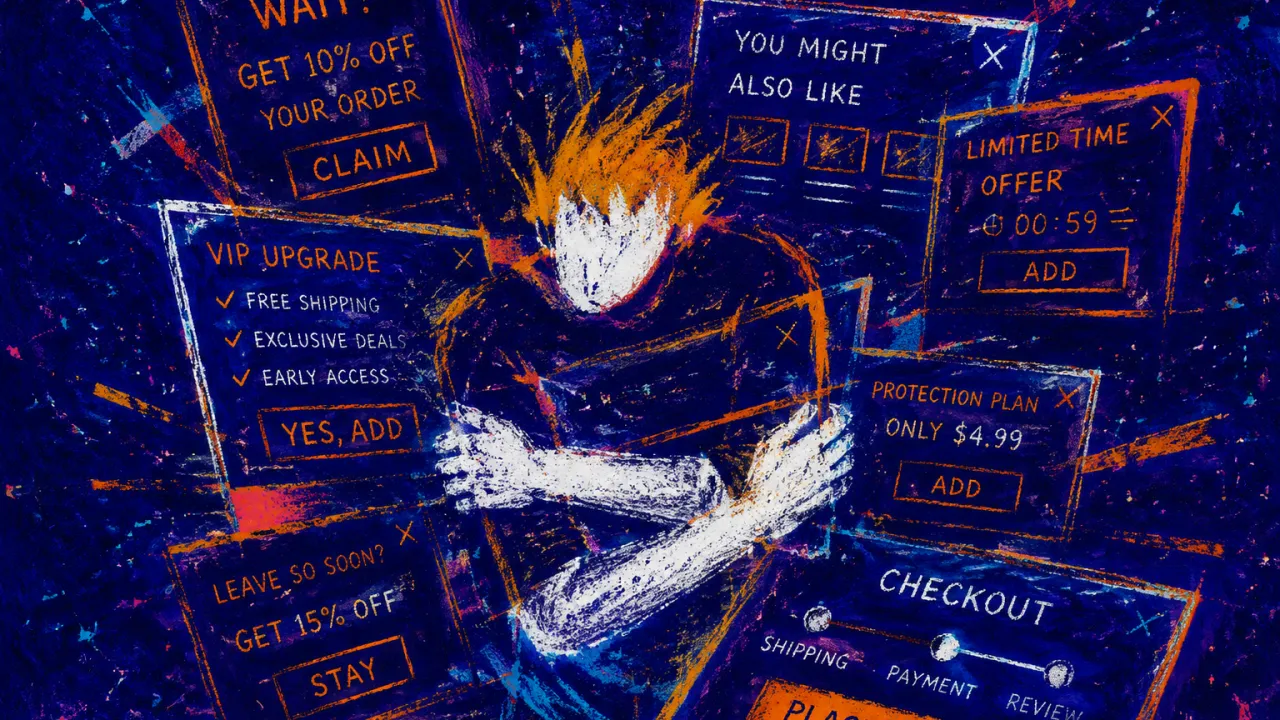
A solitary figure with arms held close as translucent checkout panels encroach from every side, narrowing one open path.

What is this situation?

Algorithmic Upsell Pressure — you open an app to replace a charger, book a flight, order dinner, or renew software, and the straightforward task starts expanding before you reach checkout. The product page highlights a bundle before the single item; the delivery screen ranks the paid option first; a timer counts down beside an offer; and the close button on a trial prompt is lighter and smaller than “Start free.” As you scroll, the recommendations echo what you have viewed or bought before, while labels such as “most popular,” “only a few left,” and “recommended for you” keep presenting extra spending as the normal next step. Decline one offer and another appears at checkout: protection, priority access, a larger size, a subscription, or a tip preset above what you planned. The platform controls the order, color, defaults, and repetition of these prompts, while you are given seconds to compare changing totals and locate the basic option. Your thumb hovers over each button, your shoulders creep upward, and a two-minute purchase becomes ten minutes of backing out, reopening menus, and checking whether a box was preselected. Even after you pay, another upgrade fills the confirmation screen, so completing the transaction does not end the selling. By the time you close the tab, declining has required more attention than accepting, much like the silhouetted figure in the Seven of Cups standing before seven cloud-borne cups filled with competing objects.

Why it's not you?

The difficulty is not a failure of self-control; the buying path is arranged to make the higher-cost option more visible, more convenient, and harder to decline than the basic one. Ranked recommendations, preselected add-ons, countdowns, and repeated prompts are features of the sales environment, not personal failures.

Algorithmic Upsell Pressure in Tarot Cards

Algorithmic upsell pressure turns a routine purchase into a sequence of ranked bundles, preselected extras, and prompts that continue after payment. Your thumb hovers and your shoulders rise inside an environmental and structural dynamic where the platform controls defaults and display order while declining takes extra steps. The Tarot Cards below mirror the visible contours of that pressure.

The Magician
Reversed
The complete toolset remains on the Magician's table, but the reversed orientation disrupts the clear line between the raised hand, the work surface, and the world below. The platform likewise possesses a complete persuasion stack - behavioural history, recommendation models, visual hierarchy, defaults, and timing - while presenting the resulting choice as if it emerged from your preference alone. Because the tools remain visible, the blocked channel can be examined rather than mystified. You can replace a self-control story with systems literacy, recognising how interface resources are organised, whose objective they serve, and why “recommended for you” may describe a conversion strategy more accurately than a personal need.
The Devil
Upright
The central pedestal towers over two loosely chained figures, making a conditional arrangement look like the natural order of the whole scene. Algorithmic upselling works through a similar cognitive frame: premium becomes “recommended,” popularity becomes correctness, urgency becomes necessity, and frictionless acceptance becomes the normal next step. The chains' open circumference shows that these associations are learned and reinforced rather than permanent truths. You can identify which assumptions belong to the sales system - easy means right, popular means appropriate, free means costless - and recover a more accurate account of what the original purchase was meant to accomplish.
Four of Cups
Upright
A fourth cup is extended from a cloud even though three cups are already present and the seated figure's arms are firmly folded. The physical repetition captures a checkout that does not accept “no” as a completed choice: decline the bundle and protection appears; decline protection and a subscription or priority upgrade takes its place. The upright figure can still withhold his hand, making refusal a visible and intact option despite the persistent display. You can read repeated hesitation as evidence that the platform keeps reopening the decision, rather than assuming that one clear choice should remain effortless under continuous prompting.
Seven of Cups
Upright
Seven cloud-borne cups display a laurel, jewels, a castle, a creature, and other emotionally loaded objects before a motionless silhouette. The varied display mirrors recommendation systems that mix aspiration, safety, status, scarcity, and convenience until it becomes difficult to tell which desire existed before the app framed it. The upright figure is still observing rather than consuming, leaving room between exposure and selection. You can examine whether an urge belongs to the original need or was produced by repetition and salience, while keeping responsibility anchored in a system designed to make sponsored possibilities occupy your mental foreground.
Two of Pentacles
Upright
Two pentacles move inside an infinity-shaped ribbon while ships rise and fall on an agitated sea behind the juggler. The changing totals, recurring offers, and subscription conditions of an upsell funnel create the same moving financial surface: the amount you are evaluating refuses to stay settled long enough to become routine. The upright figure remains on his feet and keeps both coins in view, preserving an active capacity to compare what the interface keeps changing. You are not failing because the purchase demands repeated recalculation; the platform has inserted volatility into a task that was supposed to have one item, one price, and one endpoint.
Six of Pentacles
Reversed
One standing figure holds both the scales and the coins while two lower figures wait beneath the distribution. Reversed, the hierarchy, scales, and falling coin flow become visually unstable, matching a transaction where the seller controls both the terms of comparison and the presentation of what is supposedly being offered to you. The same platform can label a trial “free,” preselect a paid add-on, rank premium delivery first, and determine how much effort is required to reach the lower-cost option. You can recognise that the choice is taking place inside unequal bargaining architecture; the party benefiting from the upgrade also controls the scale used to frame it as reasonable.
Eight of Swords
Upright
A blindfolded figure stands inside a loose enclosure of swords, with bound arms, free feet, and a narrow route across the wet ground. The scene mirrors constrained checkout agency: options technically exist, but the basic route is made harder to see through muted close buttons, preselected boxes, ranked packages, and changing totals. The swords do not form a sealed wall, and the figure's feet remain unbound in the upright image. You can distinguish formal choice from usable choice; the difficulty lies in locating and evaluating the exit while the interface controls what is visible, not in an absence of decision-making capacity.
Knight of Swords
Upright
A raised sword, charging horse, and wind-bent trees compress the scene into forward motion. Countdown timers, expiring prices, low-stock warnings, and rapidly changing delivery offers create the same accelerated atmosphere, pushing a comparison task toward immediate commitment before the full cost has settled. The upright knight possesses direction and momentum, but the force of the charge makes pace itself part of the decision. You can identify the timer as a sales intervention rather than a neutral clock; the platform is attempting to set the speed at which your money decision must occur.
Eight of Wands
Upright
Eight parallel wands cross an open sky in rapid succession, all moving in the same direction before any human figure enters the scene. The image resembles the pace of a checkout funnel where one prompt follows another across product, cart, payment, and confirmation screens, leaving little natural pause between offers. The wands' trajectories remain visible in the upright card, so the sequence can be recognised as a sequence rather than experienced as isolated decisions. You can locate the pressure in the platform's cadence: each offer may look small on its own, while their speed and accumulation narrow the time available to recover the original spending plan.
Ten of Wands
Upright
Ten bundled wands fill the foreground, bend the carrier's posture, and block his view of the nearby town. The image turns a simple destination into a burdened approach: every warranty, delivery upgrade, subscription prompt, preset tip, and confirmation-screen offer adds another object to carry before the original errand can end. The town remains visible and reachable in the upright image, so the basic task has not disappeared; it has been obscured by accumulated sales labour. You can locate the exhaustion in the checkout architecture rather than treating a ten-minute opt-out process as evidence that you are bad at ordinary life admin.

Algorithmic Upsell Pressure in Tarot Card Reading Insights

Others facing algorithmic upsell pressure have brought expanding checkouts, ranked add-ons, and hard-to-find basic options into their readings. Here are Tarot Reading Insights from sessions where this buying pressure was part of the question.
Psychological contexts related to Algorithmic Upsell Pressure