Feedback Paralysis: One Critique Note Became a Visible Figma Test
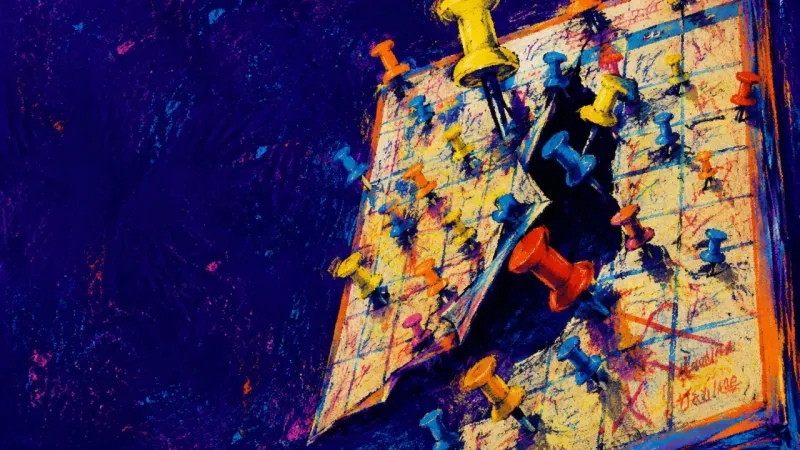
The 9:40 p.m. Figma Spiral: Feedback Paralysis After Critique
If you're the junior product designer leaving a downtown critique room with 27 Figma pins and no idea which one counts, I know the feedback paralysis may begin before the meeting-room door closes.
At 9:40 p.m. on a Tuesday, Casey (name changed for privacy) joined my call from the narrow kitchen table in their Toronto apartment. Their wrist kept lifting from the hot laptop base. Cold coffee made them wince, and the radiator clicked into the quiet as they changed an eight-pixel gap for the fourth time. The central interaction problem remained untouched.
“I went into the panel hoping for direction,” they told me, looking at the crowded feedback document beside their prototype. “Now I can hear the problem, but I can't see the way forward. If I were improving, I wouldn't keep getting the same kind of notes.”
The discouragement seemed to sit across their chest like a wet winter coat, pulling both shoulders down whenever the feedback tab came forward. The more comments accumulated, the less any next step felt available. A panel intended to make improvement possible had become evidence, in Casey's mind, that improvement was out of reach.
“That reaction doesn't mean the feedback was harmless, and it doesn't mean you're incapable of using it,” I said. “Tonight, I want to help you separate what the panel observed from what your mind concluded about you. Let's give this fog a structure, then look for one place where movement is still yours to choose.”
Choosing the Compass: A Shadow Spread for Creative Criticism
I asked Casey to put both feet on the floor and take one unforced breath while holding the actual question in mind: “Why does every critique panel make improvement feel out of reach?” I shuffled slowly. I treat this brief ritual as a transition in attention, not a performance of mystery.
I chose a four-card classic Shadow Spread. I don't use this spread to predict whether a panel will approve a design or whether a career will succeed. I use it as a structured self-exploration tool. It places a visible behaviour, the belief underneath it, a restorative perspective, and a practical response into separate positions, making an emotionally fused problem easier to examine.
That distinction is central to how tarot works in my practice. The cards do not issue a verdict. They provide stable symbols against which I can test observations, interpretations, and choices. Casey would remain the person deciding which feedback was relevant, which boundary mattered, and what to do next.
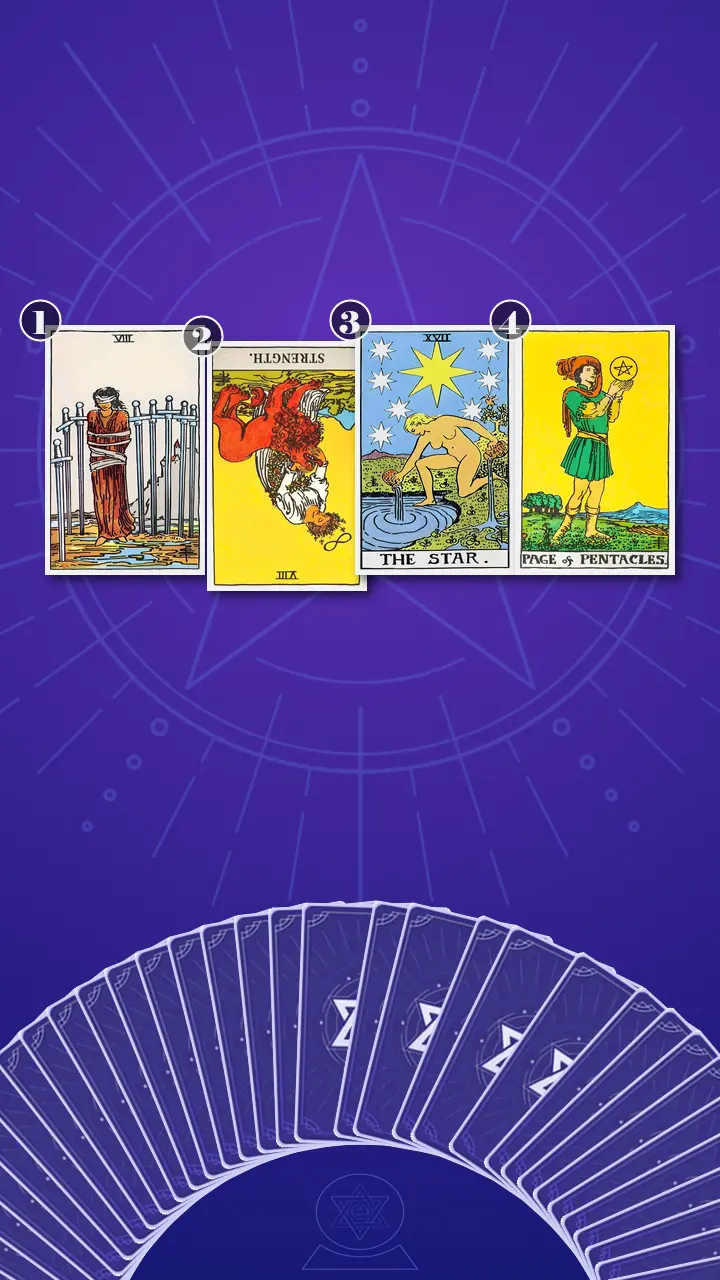
I laid the cards in a line from left to right. The first would show the visible critique response making improvement feel unreachable. The second would expose the hidden helplessness belief turning draft feedback into a judgement about capacity. The third, our bridge card, would reveal a restorative perspective. The fourth would ground that perspective in the smallest credible learning experiment.
The arrangement looked like a narrow passage gradually opening. On the left, behaviour and belief formed the constriction. On the right, perspective and practice offered room. That was exactly the map Casey needed: not a promise of certainty, but a way to distinguish the current state, the root pattern, the available resource, and the next action.
Reading the Narrow Passage
Position One: The Comment Pins That Became Walls
I turned over the card representing the visible critique response: the specific behaviour that makes improvement feel unreachable after a panel. It was the Eight of Swords, upright.
I pointed to the blindfold, the loose binding, and the swords forming an enclosure that was imposing but incomplete. “This isn't saying the panel had no impact or that every problem is imaginary,” I explained. “It shows what happens when real feedback becomes so undifferentiated that your available choices disappear behind it.”
In Casey's modern life, the image was almost literal. They opened a prototype beside 32 comments and treated every coloured pin as an equally urgent barrier. They copied broad opinions, concrete usability concerns, and minor preferences into the same task list. Then they reread the sharpest wording and adjusted labels or spacing because choosing one central issue felt dangerously arbitrary.
I brought their attention back to the kitchen table. The laptop was warm. The Figma pins covered the screen. Casey had changed the same eight-pixel gap for the fourth time while thinking, “If every comment matters, choosing only one must mean I'm missing something.” They wanted direction, but they were scanning for a verdict. They looked busy, but the work producing the least emotional risk was creating the least useful movement.
The Eight of Swords showed Air in excess: analysis multiplying until perspective contracted. Choice was not absent, but access to choice was blocked. Each note had become another sword, and the belief that all notes had to be solved at once prevented Casey from seeing the incomplete part of the enclosure.
“Safe polish feels like work, but it cannot answer the question you are avoiding,” I said. “After your latest panel, what did you repeatedly edit, organise, or reread while the central issue stayed untouched?”
Casey gave a short laugh, but there was no amusement in it. Their thumb pressed into the edge of the coffee mug. “That's too accurate, which is honestly a little brutal. I keep calling it revision, but I'm changing the parts that can't prove me wrong.”
I let the recognition stand without turning it into blame. “The safe edit protected you from exposure for an hour. That makes emotional sense. We only need to notice that the protection has a cost: it cannot produce new evidence about the interaction.”
Position Two: When One Red Metric Swallowed the Dashboard
I turned over the card representing the hidden helplessness belief: the internalised conclusion that turns feedback into evidence of personal incapacity. It was Strength, reversed.
In the Rider-Waite-Smith image, a woman meets a lion's open jaws with gentle, sustained contact. She neither crushes the animal nor runs from it. Reversed, that calm relationship with intensity becomes difficult to access. The Fire of self-trust is not gone, but it is blocked and turned inward as self-criticism.
I asked Casey to return to the moment a reviewer had said, “The interaction still isn't clear.” Casey described the projector fan humming in the glass meeting room, the cold paper cup between their hands, and the effort required to keep their face professionally neutral. Their shoulders had fixed in place before they could ask which transition caused the confusion.
“What did you hear underneath the actual sentence?” I asked.
Casey's eyes moved away from the card. “If I choose the wrong revision, they'll know I learned nothing. They'll realise I'm not ready for this role.”
That was the hidden translation. A comment about an interaction had become a prediction about belonging. Casey then tried to regain control in one of two ways: absorb every suggestion into several competing versions, or avoid the difficult question while polishing details they already knew how to manage.
I remembered Wall Street review rooms where one red metric could swallow an entire performance dashboard if no one restored its scope and time stamp. I had watched intelligent people confuse a signal with a total identity statement. The visual memory came back sharply here. Fair assessment is not a feeling; it requires structure, context, and a defined unit of analysis.
“The panel may have identified a real weakness in the current flow,” I said. “But discomfort is not proof of incapacity. Strength reversed asks you to stop forcing a perfect response and stay in calm contact with one uncertain craft question. What skill is this note asking you to practise, rather than what flaw is it proving?”
Casey's jaw tightened first. Then their gaze lost focus, as if the meeting-room scene were replaying behind the laptop camera. Finally, they released a slow breath and loosened their grip on the mug. “Post-action clarity,” they said. “The skill is showing users what happened after they tapped Continue. That's much smaller than proving I deserve my job.”
When The Star Poured Into Land and Stream
Position Three: The Draft-Not-Identity Bridge
The radiator gave one final click and settled. In the quieter room, I turned over the card representing the restorative perspective: the inner resource that can loosen healing stagnation without denying the difficulty of receiving critique. It was The Star, upright.
The figure on the card poured water into both a pool and the earth, with one foot touching feeling and the other resting on practical ground. I read that balanced flow as The Star's available energy: emotional replenishment without denial, and patient hope tied to observable reality rather than instant mastery.
I named the setup as plainly as I could. At 9:40 p.m., the prototype was still open beside a crowded feedback document. Casey was nudging spacing because it was controllable while the central interaction stayed untouched, and their shoulders became heavier with every reread.
“A critique can be true about the draft without becoming true about your capacity,” I said. “Improvement begins when one note becomes a small, visible test.”
Improvement is not inaccessible because a panel found flaws; tend one small, visible adjustment at a time, as The Star pours water patiently into both land and stream.
For one beat, Casey's breathing stopped. Their fingers hovered above the trackpad, rigid and slightly curled. Their pupils widened, then their gaze slipped away from me and fixed on the feedback tab, as if a week's worth of meetings were replaying in fast, silent cuts. Their mouth tightened before they said, almost angrily, “But doesn't that mean I've been doing this wrong the whole time?” I did not rush to turn that question into reassurance. The anger softened into grief first; their eyes reddened, and one hand closed into a fist against the table. Then the fist opened. Their shoulders lowered by a visible inch, and a trembling exhale left their chest. Relief had arrived, but so had the slight dizziness of realising that clarity returned responsibility to them. They stared at the one usable comment and whispered, “Oh. I don't have to fix my whole ability.” I asked, “Now, with this new perspective, was there a moment last week when this distinction could have made you feel different?”
Casey read one comment aloud: “Users cannot tell what happens after Continue.” They told me that, after the panel, they had converted it into “I don't understand interaction design.” Now they tried a different sentence: “The comment can sting, and it can still describe one testable part of this draft.”
I watched them separate verdict from information in real time. That was the key emotional crossing in the reading: from treating every critique as proof of incapacity toward the first tentative trust that gradual evidence could say something more accurate. It did not remove the sting or guarantee a successful revision. It simply reopened curiosity.
This was where I applied my Institutional Resource Leverage lens. A critique panel is not a jury delivering one unified sentence. It is an institutional resource containing voices with different expertise, priorities, and decision rights. Using that resource well requires proactive clarification: Who owns the priority? Which user problem governs this round? Which reviewer can explain the observation? That is upward management in its healthiest form, not deference or compliance.
“You don't have to combine every senior opinion to prove you're coachable,” I told Casey. “When comments conflict, asking the facilitator to name the priority is a design action. It protects authorship and reduces unnecessary friction. One reviewer may be noticing discoverability while another is discussing post-action clarity. Those are not automatically one task.”
I then asked Casey to open the latest feedback document and set an eight-minute timer. They copied one specific craft note into a blank page and completed two lines: “The smallest thing I could test is...” and “I would learn something if...” If time remained, they could duplicate one Figma frame and make a deliberately rough change.
“Stop when the timer ends,” I said. “Finishing the revision is not the assignment. You don't have to accept, use, or share the result, and you can pause if it feels too exposing. If eight minutes is too much tonight, copy the note and write only the first line.”
Casey selected the comment about Continue from the surrounding noise. On the card, water still moved in two directions. On their screen, feeling and craft reality were finally allowed to occupy separate lines.
The Apprentice Holds One Thing
Position Four: One Frame, One Question, One Piece of Evidence
I turned over the card representing the learning experiment: the smallest practical way to turn one panel note into evidence of agency and progress. It was the Page of Pentacles, upright.
The Page's uncovered gaze rested on a single pentacle. The distant mountains remained visible, but the Page was not trying to climb all of them at once. I read the card's Earth energy as balanced and available: focused study, a tangible object, and enough patience to let skill develop through contact with reality.
For Casey, the modern translation was concrete. They could duplicate one Figma page, label it “TEST - post-tap clarity,” and set a 30-minute timer. They would change only the transition named in the selected comment, leave unrelated polish alone, and prepare one sentence for the next critique. The result did not need to be final or even successful. It needed to be observable.
“The Page is not performing certainty,” I said. “The Page is practising a skill. Their dignity comes from paying close attention to one learnable object, not from pretending the mountains have disappeared.”
I asked Casey to try the Page's inner language: “I do not need to prove I understood everything; I can show what happened when I tested this.”
They repeated it more slowly. Their cursor moved away from the spacing controls and toward Duplicate Page. Then they stopped and looked at me. “I can bring back a mixed result?”
“Yes,” I said. “A mixed result still contains information. Testing feedback is not surrendering authorship, and it does not bind you to a reviewer's preferred solution. You are testing the problem the note identified. You retain the right to accept, modify, clarify, park, or decline the proposed direction.”
The Page completed the spread's elemental movement. Crowded Air had narrowed perception. Blocked Fire had exposed the wound in self-trust. The Star's Water restored emotional space. The Page gave that space an Earth-based form. One visible experiment could now create more evidence than another hour of rereading.
The One-Note Revision Experiment
A Research Sunk-Cost Audit for the Next Critique
I drew the four cards into one coherent line. Previous panels had left Casey with a residue of unprioritised comments. In the present, the Eight of Swords turned those comments into a closed enclosure. Underneath, reversed Strength revealed the belief sustaining the loop: if an imperfect revision returned to the room, Casey feared it would expose a fixed lack of competence. The Star separated emotional impact from craft information, and the Page of Pentacles showed the unused resource: Casey's capacity to study one interaction closely and produce visible evidence.
The pattern was like trying to climb a staircase while staring only at every missed step. Safe polish was repetitive motion on one stair. It was not laziness; it was protection. But its learning return had fallen close to zero.
I named Casey's cognitive blind spot directly: they had mistaken selection for neglect. Choosing one comment felt irresponsible because the other comments still existed. They had also mistaken the physical discomfort of public learning for evidence that learning was impossible. Neither conclusion was required by the feedback itself.
The transformation direction was therefore specific: move from treating every critique as proof of incapacity to selecting one note and running one small revision experiment. Clarity would not come from understanding every comment before touching the work. It would come from producing one new piece of evidence and deciding what that evidence justified next.
I adapted my Research Sunk-Cost Audit to the revision loop. Its blunt question is: “Will the next unit of effort produce new information, or merely protect the effort already spent?” Hours already invested in polishing do not get a vote on the next decision. The next 30 minutes should be judged by expected learning yield.
- Split what landed from what is testable.Immediately after the next panel, open a private phone note titled “What landed / What is testable.” Under the first heading, name one feeling or body response. Under the second, copy one observable craft comment without adding a conclusion about your ability. Stop after five minutes, then take a 10- to 20-minute break before reopening Figma.Tip: The minimum version is one ordinary feeling word and one copied observation. Acknowledging a comment does not require agreeing with it or disclosing your emotional response to the team.
- Run the Research Sunk-Cost Audit on five comments.At your desk the next morning, select only the five comments most relevant to the agreed design question. Label each one test, clarify, park, or decline, and add a five-word project reason. For the strongest test candidate, write: “The next 30 minutes could teach me...” If authority or scope is unclear, send the facilitator one message: “Which user problem should this round prioritise: discoverability or post-action clarity?”Tip: Choose by potential learning, not by how many hours you have already spent. If a comment was disrespectful or identity-targeting, document it and seek appropriate workplace support; this audit is not a substitute for that boundary.
- Build one deliberately bounded prototype test.Duplicate one Figma page and name it “TEST - [short issue name].” Set a 30-minute timer and change only the part needed to investigate the selected note. For the next panel, prepare one sentence: “I tested [specific note] by changing [specific element], and I observed [what became clearer or what remains uncertain].”Tip: If 30 minutes feels too exposing, make one rough frame for 10 minutes. Do not clean unrelated components. A mixed result counts because the goal is visible learning, not instant approval.
“You do not need to solve the panel; you need to test one note,” I told Casey. “That experiment is not a referendum on whether you belong. It is a small, reversible probe, and you remain the person deciding what the result means.”
A Week Later: The Quiet Proof in Version History
Four days later, I received a message from Casey. They had duplicated the page, labelled it “TEST - post-tap clarity,” and changed only the Continue transition. They also asked their lead whether the round should prioritise discoverability or post-action clarity. The answer was post-action clarity, which allowed three competing notes to remain parked.
Casey brought the rough test to the follow-up critique with their one-sentence return brief. One reviewer still preferred a different flow. Another could now identify exactly where the new confirmation state helped. The design was not finished, but the conversation had become specific enough for Casey to make another choice.
That night, they slept through until morning. Their first thought was still, “What if the next version is wrong?” This time, they smiled, opened the evidence log, and wrote down what had moved.
I did not see tarot fix a prototype, guarantee approval, or erase a difficult workplace dynamic. I saw it perform its proper role as an objective cognitive tool: the cards separated the visible behaviour, hidden belief, restorative resource, and next experiment. Casey supplied the judgement, boundaries, and action.
That was the real Journey to Clarity. Casey moved from retreating into safe polish to using one bounded revision experiment to rebuild evidence-based self-trust. The proof was modest and therefore credible: one selected note, one changed transition, one clarifying message, and one return to the room.
Being a learner in the room is not proof that you do not belong in it. When you enter critique wanting a way forward but feel your chest tighten with every new comment, I know how easily the safest eight-pixel edit can become somewhere to hide. Noticing that move already places your hand near the loose binding shown by the Eight of Swords.
If one coloured Figma pin could become information rather than a verdict, which tiny part of your draft might you feel curious enough to test in one duplicated frame before the rest of the backlog gets a vote?