Researching Study Methods Instead of Studying: Let the Material Answer

The 8:47 p.m. Study Block and the Productive Procrastination Loop
I recognized the pattern immediately: Jordan (name changed for privacy) was a Toronto university student with a library seat booked and a deadline approaching, but the first twenty minutes had gone to comparing active-recall videos instead of opening the assigned chapter. At 8:47 p.m. in the third-floor reading room at Robarts Library, five browser tabs glowed beside an unopened economics PDF. The fluorescent lights buzzed overhead, the laptop fan warmed the desk, and cold coffee gave off a faintly sweet smell while their fingers kept tapping the trackpad.
Jordan had opened videos about spaced repetition, a Notion template, an Anki workflow, and one Ali Abdaal-style productivity breakdown that promised a cleaner exam week. They had saved everything. They had not read the first paragraph.
"I keep telling myself I am preparing," Jordan said, rubbing the heel of one hand against their tight chest. "But I am really just researching study methods instead of studying. If I can find the right system, starting will finally feel easy."
I watched the browser fill with polished routines while the actual assignment stayed untouched. Anxiety moved through Jordan's hands like static searching for a place to discharge, and the pressure in their chest made the first page feel less like a page than a locked door. Underneath the overwhelm and shame was a sharper fear: actually studying might reveal whether they could master the material.
"You are not collecting methods because you do not care about studying," I said. "You are collecting certainty because the first attempt feels personal. The conflict is not simply between one app and another. You want to study, and at the same time you are trying to protect yourself from the moment the material gives you an answer. We can look at that without judging you. Let us draw a map of the loop, then find one small place where you still have a choice."
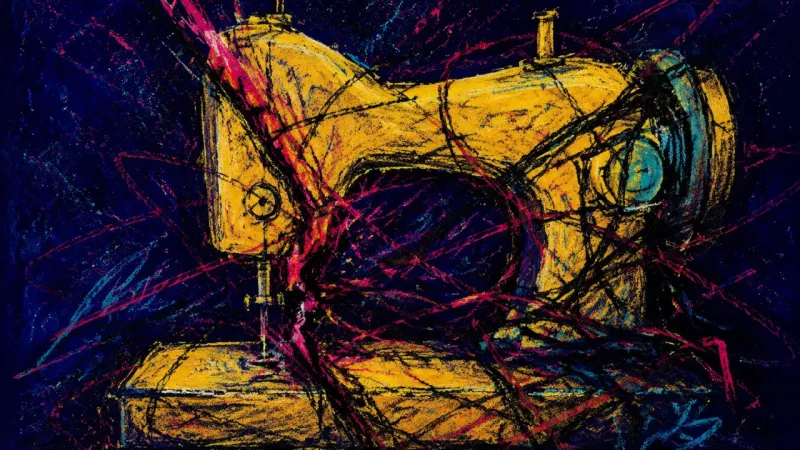
Choosing a Grid for the Noise
I asked Jordan to place the phone face down, take one unforced breath, and name the question exactly as it had arrived: why do I keep researching study methods instead of actually studying? I shuffled slowly while they kept their attention on the question. The ritual was a transition, not a test of belief. It gave the hands one simple rhythm and made room to observe what had been happening before the next search began.
I chose the Transformation Path Grid · Context Edition, an original six-position tarot spread designed for a self-reinforcing loop. For anyone wondering how tarot works in a reading like this, I use the cards as an external thinking surface: each image helps separate a visible behavior from the feeling it protects, the belief underneath it, the available intervention, and the evidence that can follow.
Celtic Cross would have added more layers than this focused question needed, while a Past-Present-Future spread would not have separated the blockage from the root belief or the practical action. This six-position context spread follows the exact movement Jordan needed: current pattern, blockage, root, catalyst, action, and integration. I placed the cards in two columns. The left side traced the crowded descent from browser tabs to delayed discomfort to self-worth fear. The right side offered a crossing point, a bounded task, and a steadier rhythm.
I told Jordan that the first card would show what actually happens in the first ten minutes of a study block. The second would ask what the research habit temporarily protects them from feeling. The third would surface the belief that turns ordinary difficulty into a personal verdict. Across the grid, the fourth card would show the catalyst, the fifth a modest behavior, and the sixth the rhythm that could emerge through evidence rather than certainty.
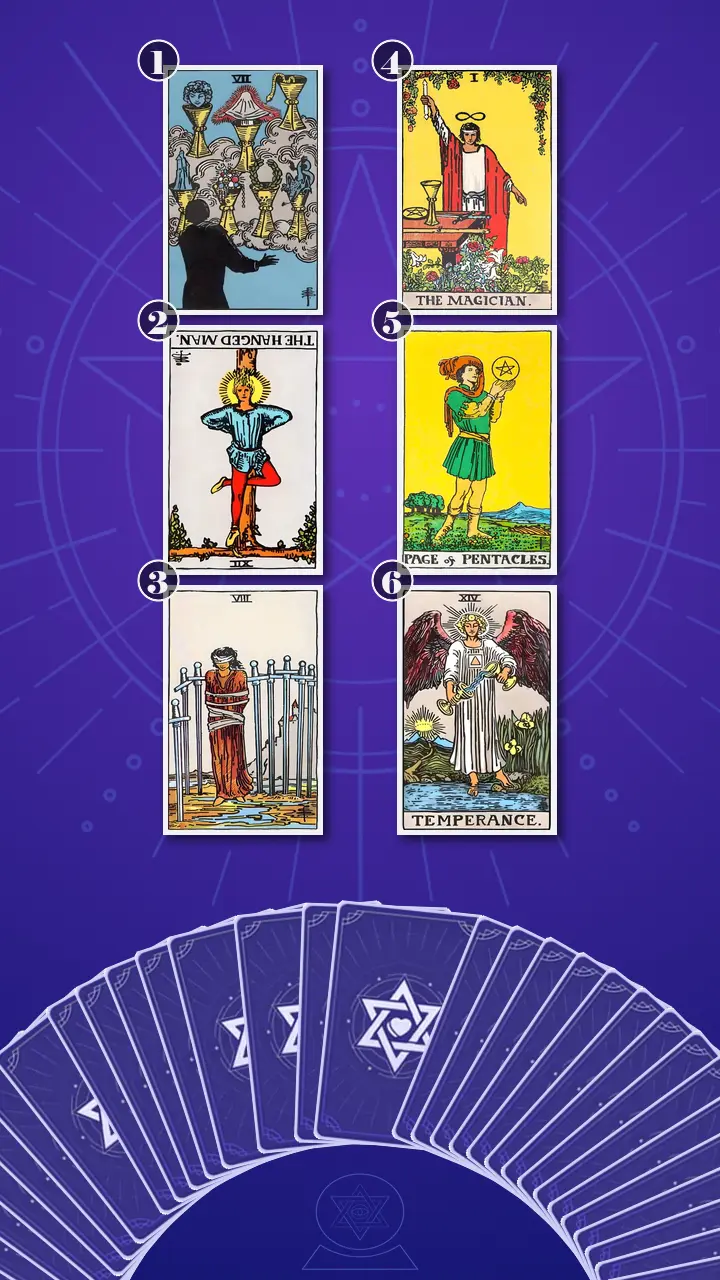
What the Browser Was Really Doing
Position 1: The Seven of Cups and the Browser Full of Rescue Plans
Now flipped, the card representing the current pattern, the repeated habit of researching study methods instead of opening the assigned material, was the Seven of Cups, upright.
This is Jordan at a Toronto library desk with five tabs open for active recall, Notion templates, Anki, and different note-taking systems. Each option promises the clean start they want, so they keep comparing, saving, and imagining the perfect routine while the assigned chapter stays unopened. The floating cups become a browser full of attractive possibilities. Every tab carries a possible rescue, but no hand has reached for one real task.
Upright, the Seven of Cups holds an excess of possibility. The energy is imaginative and capable of seeing many routes, but it is scattered rather than directed. Jordan experiences each new method as a possible guarantee that the next attempt will not hurt. The more persuasive the promise looks, the easier it becomes to remain in preparation, where nothing has yet contradicted the hope of finally finding the perfect system.
"This is not a lack of information," I said. "It is what happens when possibility starts impersonating progress. The useful question is not which method looks most convincing online. It is which one is adequate enough to test for ten focused minutes before you gather more advice."
Jordan did not nod. First, their fingers stopped above the trackpad as if the screen had suddenly become too bright. Then their eyes lost focus, and I could see them replaying the opening of the evening: the PDF, the search bar, the first video, the next tab. Finally, they let out a small, bitter laugh.
"That is too accurate," they said. "Almost rude."
I smiled gently. "The card is describing the pattern, not assigning a character judgment. We are looking at what the pattern does for you, and what it costs you, so you can choose what happens next."
Position 2: The Reversed Hanged Man and the Loading Screen of Readiness
Now flipped, the card representing the blockage, the immediate relief that keeps the research loop alive, was The Hanged Man, reversed.
Reversed, this is the study block that becomes a holding pattern. I saw the scene Jordan had described from another evening at 10:03 p.m. in their small apartment near Bloor Street. They had opened Notion to rebuild a study dashboard before touching a statistics problem set. The radiator clicked, takeout cardboard sat beside the keyboard, and they renamed folders, sorted lecture slides, refilled water, adjusted the playlist, and searched for how to study when overwhelmed. Twenty-eight minutes disappeared while the problem set remained at a safe distance.
The Hanged Man can offer a useful pause, a deliberate change of perspective, and permission to stop forcing an unworkable approach. Reversed, the pause is blocked. Jordan waits for the perfect mental state, the perfect explanation, or the perfect arrangement of folders, and the waiting begins to feel intellectually responsible. The halo around the suspended figure becomes the feeling of being thoughtful and prepared, even while the body stays still and the timer quietly shrinks.
"I am not avoiding it; I am waiting until I can do it properly," Jordan said, repeating the sentence they had used more than once.
I pointed to the card's suspended posture. "That sentence protects you from the immediate sting of beginning. For a few minutes, it lets you feel that the work has not failed because the work has not truly started. But preparation can support the work, and it cannot substitute for contact with the page. The pause can become information if you name the discomfort and then test one short interval."
Jordan's jaw tightened. Their shoulders dropped when they heard the words, then lifted again as the shame arrived behind them. I saw the relief and the stuckness occupy the same small movement. They looked down at their phone timer, as if it had become evidence in a case they had not meant to build.
Position 3: The Eight of Swords and the Personal Meaning of a Hard Page
Now flipped, the card representing the root, the limiting belief beneath the method-searching loop, was the Eight of Swords, upright.
This is the moment a difficult page or slow practice question becomes evidence that Jordan may not be capable enough. At 10:03 p.m. in the Robarts Library, they had reached a statistics problem they could not solve within two minutes. The fluorescent lights buzzed above them. Heat rose into their face. They stared at the blank space beside the problem, refreshed a search for the best way to learn statistics, and felt the first question become much larger than the page in front of them.
The Eight of Swords shows a mental restriction, but the bindings around the figure are loose enough to suggest that the restriction is not an absolute prison. Jordan's interpretation has narrowed the available field. The difficult paragraph becomes a mental firewall. The slow problem becomes a performance review. The surrounding swords repeat the same conclusions: I am behind; I need a better system; if I struggle, it means something about me.
In this position, the upright energy is not a prediction that Jordan will remain trapped. It is a clear picture of blockage through interpretation. The search for a better method is safer than an imperfect attempt because an imperfect attempt might appear to confirm the fear underneath it. I wanted to separate those two things carefully.
"A hard first question is feedback from the material, not a final report on your ability," I said. "What would change if the question were allowed to be difficult without becoming a verdict?"
Jordan's hand moved toward the browser, then stopped halfway. "I would probably ask what the exact point of confusion is," they said. Their voice was quiet, but it had moved from self-accusation toward observation. They looked at the Eight of Swords again, especially the space between the loose bindings and the first available step.
When the Magician Put the Tools on the Table
Position 4: The Magician, Upright, and the First Directed Act
The room became unusually quiet as I reached for the fourth card. Even the library's fluorescent hum seemed to settle into the background. This was the key trigger, the antidote to the loop: the inner resource that could turn existing knowledge and tools into one observable study action.
Now flipped, the card representing that catalyst was The Magician, upright.
The modern scene was simple. Jordan closed the search tabs and placed one textbook section, one pen, one timer, and one chosen method on the desk. The Magician's table held the cup, sword, wand, and pentacle, and I translated each object into something already within reach: the cup for emotional readiness, the sword for the assigned question, the wand for the intention and timer, and the pentacle for the book or worksheet.
Upright, the Magician carries focused agency, practical initiation, and resourcefulness. The energy is not an excess of knowledge. It is the balance between knowing what is available and directing it. Jordan did not need a new identity, a better app, or a flawless routine before beginning. They needed to stop collecting tools as reassurance and use the tools already on the table.
This was where I used my signature lens, Cognitive Tempo Calibration. I do not use that phrase as a diagnosis, and I do not treat one difficult evening as proof of burnout. I use it to notice when the demand of a task and a person's working rhythm have fallen badly out of sync. Jordan was trying to enter a dense chapter with a method-selection process so elaborate that the setup demanded more energy than the first learning task. The problem was not that they lacked effort. The rhythm had become dissonant.
I also ran a brief Focus Disruption Audit. The dissonant chords were specific: the search bar one click away, polished StudyTok routines that made ordinary work look inadequate, the expanding plan, and the private sentence that said difficulty might expose a lack of ability. Once those chords were named, the first intervention became much smaller. The browser could close. The timer could start. The page could answer one question.
Jordan looked at the four objects in front of them. Their inner line seemed to change from what is the best method to what can this attempt show me? I heard myself think of the years I had spent studying sound and attention. When a rhythm falls out of sync, I do not ask the music to become a different song. I listen for the beat that can be restored first.
Jordan was caught between two interpretations of the same moment. Their hands were busy, so preparation felt real, but the study task remained untouched. If they chose one method and still struggled, they feared the result would confirm something painful about their ability. The search loop offered temporary protection, while the actual material waited for a chance to give honest feedback.
Stop treating preparation as proof that you are ready; choose one tool and use it at the table, like the Magician turning scattered resources into deliberate action.
For a few seconds, Jordan's breath stopped and their fingers hovered above the keyboard. Their eyes went slightly unfocused as if they were replaying the last week: the saved videos, the rewritten calendar, the blank practice set, and the moment they had called fear preparation. A flare of anger crossed their face.
"But does that mean I have been doing it wrong this whole time?" they asked.
"No," I said. "It means the research was doing a job. It was helping you avoid a feeling that seemed dangerous. We are giving it a different job now: research can follow a real attempt and help you make one measured adjustment. It does not have to decide whether you are capable."
The anger loosened into a long, uneven exhale. Jordan's shoulders lowered, though not all the way. Their clenched hand opened one finger at a time. Their eyes became bright at the edges, and their voice, when it returned, was smaller but steadier. There was relief in the new perspective, followed by a brief, almost dizzying blankness. Without the old demand to find certainty first, they had to face the ordinary responsibility of choosing one task. That freedom felt lighter than the loop, but it was still new.
"I do not need to become ready," Jordan said slowly. "I need to use what is already here."
"Exactly," I said. "Now, use this new perspective to remember last week. Was there a moment when treating one hard question as feedback instead of a verdict might have changed what you did next?"
This was the key shift from restless comparison to focused engagement. It was not sudden confidence. It was the first small movement from fear-based preparation toward evidence-based adjustment, with self-trust beginning as something Jordan could practice rather than something they had to prove in advance.
Position 5: The Page of Pentacles and One Real Learning Object
Now flipped, the card representing the action plan, the modest and testable study behavior for the coming week, was the Page of Pentacles, upright.
The Page held one pentacle at eye level in a cultivated field. For Jordan, that became one chapter section or two practice questions, not an entire course, degree, or identity question. I asked them to choose a boundary they could see: pages 42 to 45, or questions 1 and 2. The task had to be small enough that it could produce evidence before the mind had time to build another system around it.
Upright, the Page of Pentacles offers grounded learning, patience, and the dignity of being a serious beginner. Its energy is steady rather than impressive. Jordan could study for fifteen minutes, write three questions, and remain with the same method long enough to notice what helped and what did not. The cultivated field was not a finished result. It was a place where repetition could make learning more tangible.
"But I cannot always find ten minutes," Jordan said. "When I start, I can feel the whole chapter waiting, and then I lose the nerve to begin."
I kept the advice flexible. "Then begin with three minutes or one paragraph. The experiment is voluntary. You can stop, change the task, or take a break. The point is contact with the material, not forcing yourself through distress and calling that discipline."
Jordan wrote one line on a plain sheet of paper: one real object. Their posture did not become triumphant. It became slightly more available, as if the desk had stopped asking them to solve everything at once.
Position 6: Temperance and the Study Rhythm That Can Adjust
Now flipped, the card representing integration, the healthier rhythm that can emerge through direct feedback, was Temperance, upright.
Temperance showed an angel blending liquid between two cups, one foot on land and one in water, with a path leading toward distant mountains. I read the two cups as reflection and action. Jordan could plan, but planning would follow contact with the material. They could adjust, but one difficult session would not require the entire system to be replaced.
The upright energy was balance, moderation, and patient integration. It did not promise that every study session would feel calm or that every method would work equally well. It suggested a flexible rhythm: study, observe, adjust one variable, and return. I described it as version control for studying. Keep what helped. Change one thing. Do not rebuild the whole system because one question resisted you.
"The goal is not to find the system that guarantees success," I said. "It is to build a rhythm that can learn from what actually happens. After a few bounded sessions, you can ask what made the next one more workable without turning the review into another performance test."
Jordan traced the path on the card with one fingertip. Their expression still held uncertainty, but it no longer looked like a locked door. It looked more like a route they could inspect one section at a time.
From Browser Tabs to a Workbench
When I gathered the six cards into one story, the sequence became clear. The Seven of Cups showed Jordan surrounded by attractive study systems, turning possibility into a substitute for commitment. The reversed Hanged Man showed how the pause became a loading screen of readiness, offering relief while the clock and shame moved forward. The Eight of Swords revealed why the loop had such force: a hard page had started to feel like a report on intelligence and worth. The Magician did not erase the difficulty. It gathered the available tools and placed agency back in Jordan's hands. The Page of Pentacles made that agency ordinary and specific. Temperance showed how repeated contact with the material could teach Jordan what to adjust.
The blind spot was not simply that Jordan spent too much time online. It was the belief that readiness must be proven before studying can begin, and that studying must then prove capability. That belief made method research look like preparation and made direct evidence feel threatening. The transformation direction was therefore not from careless to perfect or from anxious to invincible. It was from restless comparison to focused engagement, then from focused engagement to evidence-based adjustment and steadier self-trust.
I introduced my Syncopated Study Session, a rhythm protocol I use to break an overwhelming academic task into frictionless micro-beats. It was not another productivity system to decorate in Notion. It was a short sequence that made the first contact less dramatic: place one material on the desk, choose one method already available, set one timer, complete one bounded task, and record what actually happened. The rhythm could be shortened without failing.
- Run a ten-minute reality testOn one weekday this week, at a library desk, coffee-shop table, or kitchen table, place the assigned material, one pen, and a phone timer in front of you. Choose one adequate method, such as reading one section and writing three questions. Work for ten minutes before opening another study-method search. If ten minutes feels too exposed, use three minutes or one paragraph.Move existing browser tabs into a temporary folder before starting. Define success as touching the material, not understanding everything. You may stop, change the task, or take a break.
- Keep a three-line Page of Pentacles recordAfter two fifteen-minute sessions with one chapter section or two practice questions, write three plain facts: one thing understood, one point still unclear, and one next question. Keep the same method during both sessions so the result reflects the task rather than another complete system change.Use plain paper or a basic notes app. Do not format the record or expand the assignment to compensate for lost time. Finding the exact point of confusion counts as useful evidence.
- Review with Temperance, not a rebuildAfter three bounded study sessions, spend eight minutes comparing only the evidence: where attention held, where it drifted, what helped, and what one change could make the next session more workable. Keep one stable element, such as the timer or location, and change only one variable.Keep a small later-ideas note with no more than three entries. Review it only at the planned time, and treat every online routine as an option rather than an instruction.
I reminded Jordan that this was a small-step experiment, not a contract with a perfect future. The point was to let the material answer back before the algorithm offered another routine. One adequate method used for ten minutes could teach more than ten perfect methods saved for later, because direct experience produced evidence that comparison could not provide in advance.

A Small Proof, Not a New Personality
Four days later, I received a message from Jordan while I was making tea. It said, "I did pages 42 to 45 before opening anything else. I understood the definition, got stuck on the example, and now I know what to ask in office hours." It was not a dramatic academic transformation. It was a clean observation, a bounded task, and one next question.
That evening, Jordan told me they slept through the night after finishing the short block, but woke with the familiar thought, what if I am still wrong? They smiled at it, wrote the thought beside the next question, and opened the chapter anyway. The clarity was real, but it was still becoming.
I saw the first evidence of the Journey to Clarity there. Jordan had not found a method that guaranteed success. They had allowed one imperfect attempt to become information rather than a verdict. The cards had not decided their academic future. They had helped Jordan see the tools, the interruption, and the next choice that had been available all along.
I leave the Transformation Path Grid · Context Edition as a focused tarot framework for study anxiety, perfectionistic planning, and the urge to find certainty before beginning. Its invitation is modest: notice the loop, choose one real object, let the material respond, and adjust from evidence.
When a dense page makes your chest tighten and your hands reach for another study guide, part of you is trying to learn while another part is trying not to discover that struggling might mean you are not capable enough. If you let one imperfect study attempt be information rather than a verdict, what small piece of material might you feel curious enough to meet first?