A Deleted Essay Title, Then 137 Rough Words Without Another Reset

The 7:02 p.m. Coursework Fresh-Start Loop
If you are a London uni student working part-time shifts who can build a flawless Monday reset but cannot stay in the coursework tab once the timer starts, this may feel familiar. When Alex (name changed for privacy) appeared on my screen, it was 7:02 p.m. on a Tuesday, and the narrow desk in their flat-share was visible behind one shoulder. Moodle cast a cold blue light across their face. A colour-coded Notion week occupied another tab, the laptop fan hummed, and cold tea had left what Alex described as a bitter film on their tongue.
They typed an essay title while we spoke, looked at it for two seconds, deleted it, and reached for the phone warming beneath their restless palm. A StudyTok video about the perfect essay workflow was paused on the screen.
“I keep preparing to study instead of studying,” Alex said. “Every fresh start works until the actual work begins.”
I asked what usually happened next. Alex told me that tonight's unfinished block would be dragged into tomorrow, where it would become part of a six-hour catch-up plan. Tomorrow always seemed cleaner, more energetic, and more capable than the person sitting at the desk tonight.
I could see the contradiction clearly: Alex genuinely wanted to follow through, but beginning meant allowing their ability to become visible before the work was good. They wanted to keep their promise, so they prepared more; the more perfectly they prepared, the less time remained to begin. Shame sat behind their sternum like a wet stack of textbooks, pressing down whenever the cursor blinked against the blank page.
“I don't think this is a lack of care,” I told them. “I think the preparation may be protecting you from the moment an imperfect sentence appears. We are not going to ask the cards whether you are capable enough. We are going to use them to map what happens between opening the portal and leaving the coursework tab, then find one point where you can make a different choice.”

Choosing a Ladder Instead of Another Reset
I asked Alex to place the phone face down, put both feet on the floor, and take one slow breath while holding the question in mind: Why do I keep avoiding coursework after promising a fresh start? The breath was not a mystical requirement. It was simply a way to stop gathering more input long enough to notice the pattern already present.
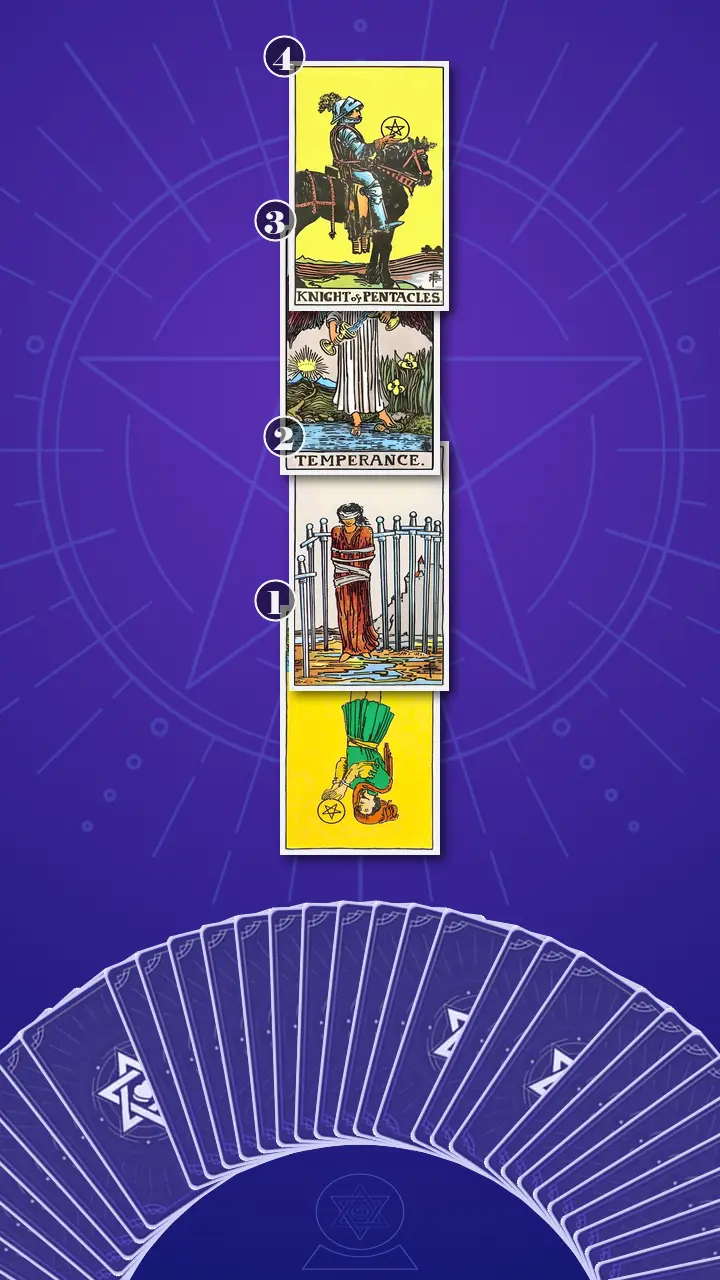
I chose the Four-Layer Insight Ladder, a linear four-card tarot spread. This is how tarot works in my practice: not as a prediction machine, but as a structured reflection tool. The spread was appropriate because Alex's problem had a visible behaviour, a hidden belief sustaining it, a balancing principle capable of changing it, and a practical action through which that change could be tested.
I placed the first card at the bottom of a vertical line to show the observable fresh-start avoidance pattern. The second would reveal the fear beneath the planner edits and digital distraction. I left a wider space before the third card, which would introduce the key shift from dramatic resets to measured continuity. The fourth would ground that insight in a repeatable coursework practice. The arrangement resembled a compact ladder: not an escape from the situation, but a way to climb through it one level at a time.
A larger Celtic Cross might have produced more context, but more information was not what Alex lacked. They already had deadlines, timetables, productivity advice, and multiple systems for organising all three. The Four-Layer Insight Ladder kept the reading focused on the mechanism that mattered.
Reading the Screens Behind the Cards
Position 1: The Student Who Never Reaches the Field
Now I turned over the card representing the diagnosis in observable form: the promise of a fresh start followed by planning, tab-switching, or rescheduling instead of direct work. It was the Page of Pentacles, in the reversed position.
In the Rider-Waite-Smith image, the Page is absorbed by a single pentacle while a cultivated field stretches behind them. In Alex's life, that pentacle had become the grade target, the assessment rubric, and the ideal student identity. The field was the nearly empty assignment in another tab.
I described the modern version back to them. At the scheduled 7:00 p.m. start, Alex opens the module page beside a newly redesigned Notion week. They study the rubric, adjust labels, choose a Spotify playlist, and watch a study-routine video, yet never answer the first coursework question. The wish to learn is real, but it is diverted into trying to look and feel fully prepared before accepting the vulnerable role of a beginner.
This was blocked Earth energy. The Page should bring curiosity into practical contact with the material, but reversed, that energy remains trapped in setup mode. It is like keeping a software project permanently in configuration because the first working version might expose bugs. The system looks increasingly sophisticated while producing no usable coursework.
I gave words to the inner bargain: “I am technically working because I am preparing, but I am avoiding the one screen where my ability becomes visible.”
Alex gave a short laugh, but there was no amusement in it. Their fingers tightened around the cold mug, their eyes dropped to the open tabs, and then their shoulders sank. “That is so accurate it feels a bit brutal,” they said. “The dashboard looks like I have my life together. The document shows that I don't.”
“The card is not calling you lazy,” I said. “It is distinguishing the appearance of readiness from the practice that creates readiness. You are not avoiding the timetable; you are avoiding the moment your work becomes visible.”
Before I moved to the second card, I added, “Tomorrow feels more capable because tomorrow has not opened the document yet.”
Position 2: Eight Tabs That Look Like a Locked Room
Now I turned over the card representing the mechanism beneath the avoidance, especially the fear that imperfect work could expose inadequate ability or worth. It was the Eight of Swords, in the upright position.
The blindfolded figure stands inside an incomplete enclosure. The bindings are loose, and the swords do not form a sealed wall, but from the figure's position, movement appears impossible. I saw the digital equivalent immediately: eight browser tabs filled with deadlines, classmates' messages, study advice, and calendar blocks. The screen looks sealed even though the assignment document remains reachable underneath.
I brought Alex back to Sunday night. Several deadlines are visible on Moodle. A classmate posts “submitted!” in the WhatsApp course chat. The observable facts are that some work is unfinished and time is limited. The enclosure forms when those facts become: “I am too far behind to do anything useful, and a rough paragraph will expose that I do not belong here.” Once that conclusion is treated as a condition, postponement appears to be the only safe option.
This was an excess of Air energy. Analysis had hardened into an internal rule: weak first attempt equals weak ability. The tight chest and restless hands were then interpreted as evidence that beginning was unsafe, rather than signs that beginning felt exposing. The card did not deny the real constraints of deadlines, shift work, or limited energy. It asked Alex to stop merging a practical difficulty with a global conclusion about their worth.
“Finish this sentence,” I said. “If my first paragraph is bad, that proves...”
Alex's breath paused. Their gaze moved away from me and settled somewhere beyond the laptop. After several seconds, they said quietly, “That I was never as clever as people thought. Maybe that I shouldn't be on this course.”
I felt the old precision of a risk meeting return to me. A useful assessment separates verified exposure from the story being built around it. “The constraint may be that you need evidence for paragraph two and have forty minutes before class,” I said. “The conclusion is that needing evidence proves you do not belong. Those are not the same category of information.”
I pointed to the gap between the swords. “A rough draft is evidence of contact, not a verdict on ability. The next step can be difficult without being impossible, and it can be small without being meaningless.”
Alex rubbed a thumb slowly along the mug's rim. Their chest still rose shallowly, but the frantic movement between tabs had stopped. The distinction had not removed the deadline. It had removed one layer of accusation from it.
When Temperance Kept Yesterday Alive
Position 3: The Two Cups of Measured Continuity
The rain outside Alex's window softened, and somewhere in the flat a kettle clicked off. In the quieter room, I turned over the card representing the balancing principle capable of transforming the pattern. This was the key card of the reading: Temperance, in the upright position.
The figure pours water steadily between two cups, with one foot on land and one in water. Nothing in the image suggests a dramatic reinvention. The power lies in proportion, adjustment, and the preservation of flow.
In Alex's coursework, Temperance looked like a short, deliberately imperfect writing period followed by a planned stop. Alex could carry Tuesday's rough paragraph into Thursday's session, adjust it, and continue without declaring the week ruined. Ambition would still matter, but it would be blended with the energy actually available after class, commuting, or a hospitality shift.
This was balanced Water guiding measured Fire. Instead of trying to intensify motivation, Temperance regulated the discomfort of beginning and gave the existing ambition a sustainable job. I described it as version control for coursework: today's rough material is saved, carried forward, and improved instead of deleted for the sake of a clean restart.
In my Wall Street years, I watched elegant strategies fail because they produced no return under real conditions. A model did not become valuable because the deck looked polished; it had to move an actual position within actual constraints. That instinct became one of my signature tools, Academic ROI Auditing.
I applied it to Alex's study loop. Forty-five minutes of planner optimisation produced no claims, no source notes, and no point of re-entry. A twenty-minute imperfect block could produce three rough claims, 137 usable words, or one annotated source plus a clear next step. The shorter block looked less impressive, but its strategic yield was higher because it changed the coursework itself.
At that moment, I could see Alex still trying to solve the problem by finding the correct future version of themselves. The blank document remained a verdict, and the planner remained a shelter. Even moderation sounded suspiciously small beside several deadlines.
A perfect restart is not required; build continuity through one measured action at a time, like Temperance steadily moving water between two cups.
I let the sentence remain in the room before adding, “You do not need tomorrow's perfect version of you; you need today's imperfect effort to remain usable tomorrow. A reset discards yesterday; a rhythm carries something forward.”
Alex did not soften at once. First, their breathing stopped, and two fingers remained suspended above the trackpad as if another tab were about to open. Then their eyes lost focus. I could almost see them replaying the delayed bus, the deleted titles, the Sunday-night task drag, and every timetable abandoned after one imperfect start. Their jaw tightened.
“But doesn't that mean all those resets were pointless?” they asked. The question arrived sharper than their earlier voice, carrying anger alongside grief.
“No,” I said. “They gave you temporary protection when the work felt like a threat to your identity. That protection had a cost, but recognising the cost does not require you to attack the person who needed relief. It gives you the option to negotiate a better form of protection now: a boundary, a smaller unit, and permission to stop.”
Their fingers curled inward, loosened, and finally settled flat beside the keyboard. Their eyes shone slightly. A long breath left their chest, followed by a brief, almost dizzy silence, as though putting down the demand for a total reset had also removed the structure they had relied on.
“Now, using this new perspective, think about last week,” I said. “Was there a moment when this insight could have changed how the situation felt?”
Alex remembered missing an 8:00 a.m. start because the bus was late. They had reached campus at 8:17 with forty usable minutes, but abandoned the block because the clean beginning had been lost. “I could have done one source,” they said. “I didn't need to rescue the day. I only needed to stop erasing it.”
That was the pivotal movement in the reading: not from shame to instant confidence, but from shame-driven fresh starts and anticipatory dread toward cautious self-trust through imperfect, repeatable coursework sessions. Maybe consistency was not never breaking rhythm. Maybe it was refusing to turn one disrupted session into a reason to erase the whole week.
The Knight Who Valued an Ordinary Return
Position 4: Work That Leaves a Point of Re-entry
Now I turned over the card representing the practical expression of the new insight: completing limited coursework sessions consistently without redesigning the whole routine. It was the Knight of Pentacles, in the upright position.
The Knight holds one pentacle steadily while the dark horse stands on already worked ground. This is not the cinematic all-night library session, the perfect Pomodoro streak, or the Sunday-night promise to transform an entire life by Monday. It is the quiet discipline of returning to one defined task when motivation feels ordinary.
For Alex, the modern scene was specific. At an agreed time, they would close the planner, choose one coursework component, and work inside the assignment document or required reading for twenty minutes. At the end, they would record what had actually been produced and leave a handoff such as: “Next: find one source for claim two.” The practice would remain valid if the paragraph was unfinished, the session began late, or it did not rescue the whole week.
This was stable Earth energy. The reversed Page wanted to feel like a capable student before practising. The upright Knight built capability through repetition. Its stillness was not stagnation; it was the absence of unnecessary reinvention.
“Track the task you touched, not the person you think the session proves you are,” I told Alex. “You do not need to decide whether today proves you are disciplined. You need to record what you worked on and where you will resume.”
Alex opened a plain note on their phone, paused, and resisted the urge to choose a template. They typed four headings: date, minutes, task touched, next visible step. The corners of their mouth lifted, but only slightly. “This looks almost too boring to fail dramatically,” they said.
“Exactly,” I replied. “The Knight is not asking you to perform a new identity. It is asking you to practise a craft.”
Finding Clarity Through the Rough-First 20
The Story the Four Cards Told Together
I drew the four cards into one line of meaning. The reversed Page showed genuine student energy diverted into the performance of preparation. The Eight of Swords revealed why: visible imperfection had become fused with a fear of inadequate worth. Temperance replaced the demand for redemption with measured continuity. The Knight of Pentacles turned that continuity into ordinary, repeatable contact with the coursework.
The spread reminded me of Ariadne's thread through a labyrinth. Alex had been standing at the entrance, redrawing the entire map whenever one turn went wrong. The way forward was not a perfect map. It was a continuous thread: one rough claim, one source, one saved paragraph, one note showing where to resume.
The cognitive blind spot was the belief that more preparation would eventually make beginning feel safe. In practice, preparation had become part of the avoidance-reward sequence. It reduced exposure for the evening, compressed the deadline, and made the next beginning more threatening. The transformation direction was not “become stricter.” It was to let coursework become a series of bounded learning sessions rather than repeated tests of identity.
I also adapted my Research Sunk-Cost Audit. Its purpose here was not to decide whether Alex should abandon the degree or recover every missed hour. It was to stop treating the lost week as a debt that tonight had to repay. We assessed what work was already usable, what constraint was real, what next effort could still produce academic value, and whether a tutor, extension route, or university support service could change the equation. Missed time was information, not a command to sacrifice sleep or build another impossible catch-up plan.
Three Actions That Could Survive a Real Week
- Use the Rough-First 20.Before the next scheduled study block, write one target on a sticky note, such as “Draft three rough claims for question two.” Place it over the screen area where Notion or Google Calendar usually sits. At the agreed start time, close YouTube, TikTok, the planner, and the group chat, then work only in the assignment document or required reading for twenty minutes.If twenty minutes feels too exposed after a shift, use the two-minute version or write three deliberately rough bullet points. Stopping when the timer ends is allowed.
- Separate the constraint from the conclusion.When the urge to switch tabs appears, divide a scrap of paper into “Observable constraint” and “Conclusion about me.” Write one sentence in each column. Replace “I cannot write this essay” with a bounded task such as “I do not have evidence for paragraph two, so I will search one database for ten minutes.”Do not force a positive prediction. If the constraint is genuinely unmanageable, use the official tutor, accessibility, clarification, or extension route. Strategic use of institutional support is resource leverage, not a verdict on ability.
- Leave a one-line handoff.When the timer ends, save the imperfect work without polishing it. Add one line at the bottom beginning “Next time, I will...” Then record the date, minutes, task touched, and next visible step in a plain Coursework Contact Log. At the end of the week, count completed contacts rather than perfect days or total hours.Keep the log under one minute. If tracking becomes another productivity project, reduce it to the date and one observable output.
I reminded Alex that none of these actions was a command to override exhaustion, illness, access needs, food, sleep, or recovery. Temperance protects proportion. The experiment was designed to create contact with the task, not to turn a reflective tarot reading into another standard they could fail perfectly.

A Week Later: 137 Rough Words
Six days later, Alex sent me a photo from a campus cafe. A twenty-minute timer had ended beside 137 rough words and a note reading, “Next: find evidence for claim two.” An espresso machine blurred in the background, and Alex said the table had vibrated whenever a train passed nearby.
The paragraph was not finished. The week had not become perfectly consistent. One session had started eleven minutes late, and Alex still heard the thought, “This is not enough.” But instead of rebuilding the timetable, they had reopened the same draft and continued from the handoff.
The next morning, their first thought was still, “What if I fall behind again?” Alex told me they smiled, opened the contact log, and looked for the thread rather than another starting line.
I do not credit the cards with writing those 137 words. Tarot provided a map of the pattern and language for the choice. Alex closed the extra tabs, tolerated an imperfect beginning, and left tomorrow something usable. That was their agency at work: a small piece of grounded confidence built from evidence rather than promised by a fresh start.
When the coursework tab is open and your chest tightens, the hardest part may be wanting to prove you belong on the course while every rough first sentence feels capable of arguing the opposite. Noticing that conflict does not finish the assignment, but it means you no longer have to confuse its shame with the truth about your ability.
If one imperfect block could count as contact rather than proof, what tiny piece of the task would you touch next, and what one-line handoff could let today's cup pour something usable into tomorrow's?