When Preparation Became Protection: Testing One Useful Insight

The 9:40 p.m. Insight-to-Action Gap
If you are a late-twenties hybrid knowledge worker in Toronto who can explain the course perfectly but still has not dated the first ten-minute task, I know the room I am about to describe. I met Jordan (name changed for privacy) over coffee after they had spent another evening preparing to begin.
Jordan told me that at 9:40 p.m. on Tuesday, a course summary glowed on their laptop while an untouched notebook waited beside it. The radiator ticked in the background, cool screen light stretched across the desk, and their fingers colour-coded an implementation board for twenty-five minutes. When the first ten-minute task still had no date, they closed the computer with their shoulders pulled tight.
They gave me the sentence that had brought them in: I keep having breakthroughs that never make it into my calendar. They could finish a useful podcast, workshop, article, or online course feeling briefly lifted, then open their task list and reach for another tab, another saved post, or another way to organise the idea. They wanted to turn something useful into a concrete next step, yet choosing one use for it felt like giving up every other possibility.
I heard frustration as a browser with twenty-seven useful tabs open, all demanding attention while the document that mattered stayed blank. Their hands kept reaching for more information, but their body remained planted in the chair, and their energy dropped the moment learning had to become a dated, visible action.
I said, You are not short on insight; you are short on evidence from using it. I did not hear a character flaw or a lack of intelligence. I heard a protective loop trying to keep every option alive. We could look at that loop without shaming it, then use the cards as an objective map for the next small piece of reality. Today, our Journey to Clarity would not ask for a perfect life plan. It would ask what one useful insight could become before another resource opened.
Choosing the Grid That Could Hold the Loop
Before I shuffled, I asked Jordan to take one slow breath and name the question exactly as it was: Why do I keep delaying the next step after learning something useful? I invited them to notice the physical desk, the open tabs, and the moment their energy usually fell. The breathing was not a mystical requirement. It was a small transition from consuming information to examining a pattern.
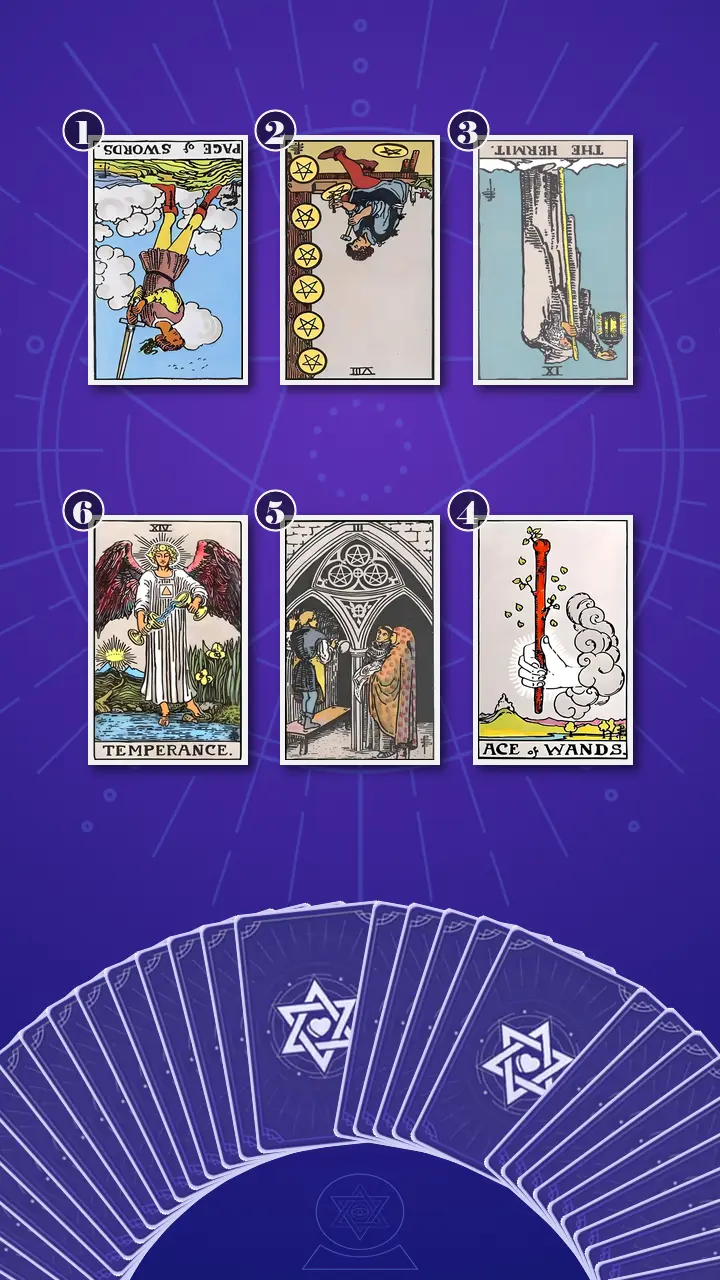
I chose the Transformation Path Grid · Context Edition, a six-card spread arranged in two rows with a serpentine path. I explained to Jordan, and to anyone learning how tarot works through this reading, that I use the cards as visual prompts for pattern recognition rather than as fixed predictions. The spread was appropriate because the problem was a self-reinforcing system: learning triggered preparation, preparation created short-term relief, the missing action produced no evidence, and the lack of evidence then seemed to justify more learning.
The upper row would show the visible delay, the practical blockage, and the deeper belief that kept the loop running. The lower row would turn at the catalytic trigger, move into a concrete action with proportionate feedback, and finish with an integrated learn-act-review rhythm. The cards would not decide Jordan's future. They would help us separate mental motion from observable progress, then return the decision to the person living it.
Reading the Wind-Tossed Row
Position 1: The Sword Held High While the Train Keeps Moving
Now I turned over the card representing the diagnosis-level behaviour in which useful learning generates more note-taking, research, and mental activity while the next concrete task remains untouched. The card was the Page of Swords, in reversed position.
I brought the image into Jordan's ordinary morning. On the Line 1 train between St. Clair and Bloor-Yonge, they had finished a useful article about research synthesis, opened three related tabs, copied quotations into Notion, and arrived at work mentally switched on. By lunch, the original idea had no dated task and had changed nothing in the interview guide. The phone was moving through an increasingly relevant recommendation feed, but the insight had not received one chosen application.
Upright, the Page of Swords is alert curiosity, quick investigation, and a willingness to ask the next question. Reversed here, that Air had become excessive and scattered. Jordan was not lacking ideas; they were allowing every new signal to claim equal importance. The raised sword stayed in the air while the uneven ground beneath it represented the discomfort of choosing one direction before certainty arrived. Mental activation had started impersonating implementation.
I asked, What happens in the first hour after you learn something useful? Jordan looked down at their phone and said, I am clearly engaged, so why does beginning still feel so far away? Then they gave a short, bitter laugh. That sounds ridiculous when you say it out loud.
I told them that curiosity was not the problem. Curiosity was a real strength, especially in UX research. The issue was that the next related article offered relief without requiring a test. I watched their thumb stop over the phone screen, then saw their gaze move toward the folder of saved posts on their laptop. The distinction had become visible: genuine learning gathered material, while productive procrastination kept the material safely untested.
Position 2: The Workbench with One Unfinished Pentacle
Now I turned over the card representing the immediate blockage between understanding and implementation, especially the reluctance to tolerate one ordinary, imperfect repetition. The card was the Eight of Pentacles, in reversed position.
I returned to the 3:15 p.m. work-from-home afternoon Jordan had described. A blank research prompt was open. Their coffee had gone cold beside the keyboard. They had fifty-five minutes to try a method from a workshop, but forty minutes disappeared into choosing a template, adjusting the board, and deciding how the files should be named. When only fifteen minutes remained, they postponed the exercise because a rough repetition no longer felt large enough to count.
The Eight of Pentacles upright honours apprenticeship, craft, and the ordinary repetition through which skill becomes reliable. Reversed, practical Earth was blocked by an over-designed process. The one pentacle under the craftsperson's tool was the rough attempt Jordan kept leaving in order to redesign the whole workbench. The ordered row of finished pentacles looked impressive, but it could only exist because someone had stayed with one unit at a time.
Jordan's fingers closed around the coffee cup. If I cannot do it properly, this attempt will not count, they said. Then they added, more quietly, I hate that this sounds reasonable.
I did not argue with the sentence. I asked what the attempt would actually need to prove. A first experiment could be small enough to stop before exhaustion and still useful enough to produce information. I said, A first attempt is data, not a verdict on your direction. Jordan's shoulders lowered by a fraction, but their mouth stayed tense. I could see the embarrassment of having made preparation look productive, alongside the first possibility that imperfect practice might be allowed to teach them something.
Position 3: The Lantern That Does Not Need to Light the Whole Route
Now I turned over the card representing the deeper cause, belief, or hidden root sustaining the obstacle. The card was The Hermit, in reversed position.
I pictured the late kitchen table at 10:25 p.m. Jordan had written another journal entry about meaningful work while the refrigerator hummed and a dry yellow bulb flattened the room into pools of light. They already had enough clarity to email one colleague or test one research prompt, but they kept asking reflection to reveal the entire route before taking the next step.
The Hermit upright offers purposeful solitude, inner guidance, and a lantern that illuminates the next stretch of ground. Reversed, reflection had become a waiting room. The inner search had not disappeared; it had lost contact with participation, feedback, and limitation. Jordan was preserving control by keeping the draft private. If no experiment began, no result could challenge the hope that a complete and meaningful direction was waiting just beyond one more evening of thought.
Jordan looked at the lantern on the card and said, I am not avoiding action. I am trying to make sure the action means something. I heard the fear beneath that sentence without treating it as a diagnosis. A small choice felt disproportionately consequential because choosing it might reveal that the insight did not contain a complete answer about work, identity, or direction.
I asked, What if the lantern is only responsible for the next few steps? What evidence could a limited experiment provide that private reflection cannot? Jordan's pen hovered over the notebook. Their eyes went unfocused for a moment, as if replaying several evenings of journaling. Then they closed the notebook instead of adding another page. The root was not that reflection was useless. The root was asking private certainty to arrive before lived feedback was permitted to speak.
The Turn at the Bottom of the Map
Position 4: The Spark That Does Not Need a Roadmap
Now I turned over the card representing the catalytic shift that could interrupt further analysis and convert one insight into a bounded experiment within the integration window. The card was the Ace of Wands, in upright position.
The image took me to Friday at 4:48 p.m. in a nearly empty meeting room. Late sunlight reflected off the glass wall, the ventilation system murmured, and a ten-minute timer glowed beside one experimental question in an existing interview guide. Jordan's cursor hovered over Share. The method did not need to be complete. It needed a first form.
The Ace of Wands is not a demand for a dramatic reinvention. Its Fire is the available energy of initiation, the living wand emerging from the cloud before the whole landscape has been mapped. In this position, it asked Jordan to choose the smallest action that could make the insight observable within twenty-four hours. The energy was catalytic because it interrupted the familiar handoff from insight to more consumption.
I said, Another insight can extend the map. One experiment leaves the station. Jordan glanced at the laptop and asked, But if I pick the wrong experiment, how will I know I have not just wasted the insight?
I answered, We are not asking the experiment to settle the direction. We are asking it to return evidence. Ten minutes can tell you what is clearer, where you hesitate, or whether the method deserves another try. Their breathing became more audible. They opened the calendar, but I reminded them that opening it was enough for today if the action itself created pressure rather than curiosity. The point was a bounded ignition, not an intense productivity reset.
Position 5: The Rough Artifact with One Safe Pair of Eyes
Now I turned over the card representing the practical method through which the catalytic shift could be applied: a small output, a clear time boundary, and proportionate feedback. The card was the Three of Pentacles, in upright position.
I translated the craftsperson, the architectural plan, and the two observing figures into Jordan's working life. They could place one rough question in the existing discussion guide and send it to one trusted colleague with a narrow request: What became clearer, and where did you hesitate? The question was not Is my entire direction good? The artifact was not a finished proposal. It was a low-fidelity prototype of learning, shared while another person could still help shape it.
This card grounded the Ace of Wands in Earth. A useful idea became more durable when it touched a real document, a real colleague, and a real piece of feedback. The social contact also interrupted the Hermit's private waiting room. Feedback could be a building material rather than a verdict, provided Jordan chose the person, the scope, and the question.
For twenty years, I have listened to stories unfold over the warm aroma of coffee, and I have noticed how often people ask another person to approve an entire direction when what they actually need is one answerable question. I felt that old recognition settle in me as I watched Jordan write a message boundary: This is a ten-minute test, not a finished proposal. I only want feedback on the question below.
I said, Make the insight observable before you make it impressive. Jordan read the sentence twice. Their jaw loosened, and they began typing the colleague's name. The roughness remained, but it had changed category. It was no longer evidence of unworthiness. It was the condition that made useful feedback possible.
When Temperance Turned Two Cups into a Trail
Position 6: The Flow Between Learning and Living
Now I turned over the card representing the target state in which Jordan could use a repeatable learn-act-review rhythm to develop direction through integration rather than waiting for complete certainty. The card was Temperance, in upright position.
The room grew quiet as I studied the liquid moving steadily between the two cups. One foot rested on land and one in water. Behind the figure, a path continued toward a distant glow. The card did not promise that every experiment would confirm the original idea or reveal an instant purpose. It showed a measured exchange between inner understanding and concrete reality, where direction could be calibrated rather than discovered all at once.
Temperance balanced the restless Air of the reversed Page, supplied practice to the blocked Earth of the reversed Eight, and opened the Hermit's private lantern toward lived participation. Its invitation was simple: pair each useful insight with one scheduled experiment of no more than fifteen minutes, then review what the attempt taught before deciding what comes next.
At this point, I used one of my signature lenses, Syllabus Deconstruction. When a useful course begins behaving like a massive syllabus for a new life, I strip away the paralyzing scale and reduce the assignment to mechanical, emotionless daily tasks. I asked Jordan to stop treating the insight as a demand to become a completely different person. The first line of the syllabus could be one verb: draft, test, send, compare, or observe.
I recognised the evening described in the opening scene. The course summary had been open, the notebook untouched, and Jordan's hands had kept improving the system around the task. By the time the board looked organised, the small window for trying anything had closed. The real question was whether choosing less would feel like losing meaning.
Another insight will not close the gap; one measured experiment will, just as Temperance creates a new flow by pouring steadily between two cups.
I let the sentence settle, then added, You do not need a complete purpose before you move. Make one insight observable, let the attempt return evidence, and allow direction to emerge through adjustment.
First, Jordan's thumb stopped above the keyboard and their breath caught, as if the body had briefly frozen before a difficult button. Then their eyes lost focus and moved toward the cool rectangle of the laptop, replaying the coloured board, the saved posts, and the blank calendar. I saw their pupils widen slightly, and the tight line around their mouth soften. Finally, their clenched hand opened against the table. A long breath left their chest, but relief did not arrive alone. A small tremor of vulnerability remained in their voice when they said, So the experiment does not have to prove that I chose the right life. Their shoulders dropped, followed by a brief, almost dizzying stillness. The map was no longer complete, and that meant the next choice belonged to them. I watched them breathe through the responsibility instead of reaching for another framework.
I asked, Now, use this new perspective to remember last week. Was there a moment when treating one attempt as evidence rather than a verdict might have changed what you did next?
I named the shift plainly: this was the beginning of movement from restless, insight-rich over-analysis and self-doubt toward steadier self-trust through small experiments, proportionate feedback, and ongoing adjustment. Temperance did not take over Jordan's choices. It gave those choices a rhythm in which their own evidence could finally become trustworthy.
The One-Verb Integration Rule
When I placed the six cards together, the story became coherent. The reversed Page showed attention pulled in every direction after learning. The reversed Eight showed why ordinary practice felt too small to carry an important insight. The reversed Hermit revealed the protective belief beneath both patterns: complete private certainty had to arrive before action could test meaning. The Ace of Wands introduced a bounded spark, the Three of Pentacles gave that spark a rough artifact and a safe feedback loop, and Temperance showed how repeated adjustment could turn scattered knowledge into a lived direction.
I told Jordan that the cognitive blind spot was not simply failing to plan. It was confusing preparation with implementation and treating the absence of evidence as proof that more clarity was required. Organising a Notion workspace, renaming files, or saving another productivity video could all be useful in the right context, but none of them answered the practical question: what changed because of what I learned?
The Transformation Path Grid tarot spread for the insight-to-action gap had not asked Jordan to delete their resources, force a thirty-day challenge, or make a career decision under pressure. It pointed toward a smaller transformation: within twenty-four hours of gaining a useful insight, translate it into one verb-led experiment of fifteen minutes or less, then let feedback and review shape the next attempt.
I also used my Study Environment Auditing lens. Physical clutter, too many visible tabs, and a disorganised work surface can quietly consume psychological bandwidth. I did not want Jordan to turn cleaning into another form of productive procrastination, so I gave the audit a hard boundary and connected it directly to the next observable action.
- Make the next insight observableWithin twenty-four hours of the next useful article, podcast, meeting, or course lesson, open the phone calendar and schedule one verb-led experiment for ten to fifteen minutes before opening another related resource. If the desk or browser is pulling Jordan into setup, begin with the Desktop Reset Ritual: spend fifteen minutes clearing only the visible work surface and closing unrelated tabs, then stop and schedule the experiment.Keep a five-minute minimum. The smallest version is one calendar entry such as Draft one interview question. No resource has to be deleted, and the experiment can be stopped or rescheduled if capacity changes.
- Create one rough artifact and ask one narrow questionOn Wednesday at 3:00 p.m., use the existing discussion-guide document to turn one sentence from the latest UX-method notes into one rough interview question. Set a ten-minute timer, then send that question to one trusted colleague with the message, What became clearer after seeing this? Put a Friday check-in date in the same message.Frame the exchange as a ten-minute test, not a finished proposal. If sharing feels too exposed, tell the trusted person when the experiment will happen and ask only whether it happened.
- Review with Keep, Change, NextImmediately after one experiment, open a plain note titled Keep, Change, Next and write one sentence under each heading. Before consuming more material, schedule the next equally small repetition and change only one variable. At the end of the week, compare two attempts by asking what produced usable evidence, not which attempt looked most impressive.Cap the review at five minutes and skip streaks. A missed slot creates no debt. The minimum version is one sentence: The attempt showed me something about what to try next.
I reminded Jordan that these were invitations, not tests of discipline. The point was not to make every idea work. The point was to give an idea a fair contact with reality, then allow Jordan to decide whether to continue, adjust, pause, or let it go. That was the practical form of self-trust: not certainty before movement, but the confidence that their own observations could guide the next choice.

A Small Proof, Not a New Identity
Six days later, I received a message from Jordan. They had used the existing discussion guide, drafted one question in ten minutes, and sent it to a colleague. The next morning, the thought was still, What if I choose wrong? The difference was small but real: they opened the calendar before opening another tab.
I smiled at the message over my coffee. Jordan had not solved a career direction or become a permanently decisive person. They had created one piece of evidence, listened to one proportionate response, and written down what to keep, change, and try next. That was enough to begin the learn-act-review rhythm. Direction was becoming something they could refine through contact, not something they had to locate in advance.
I did not give Jordan a destiny. The cards did not perform the experiment for them. I offered a calm surface where the pattern could be seen, and Jordan chose what to do with what they saw. Finding clarity had begun with a small, imperfect act of ownership.
When choosing one small next step makes your chest drop and your hands reach for another tab, it is often because keeping every possibility open feels safer than finding out whether any one direction can hold your hope.
If one unfinished, fifteen-minute experiment were allowed to be a clue rather than a verdict, which useful insight would you let it test?