Researching Instead of Writing the Thesis: A Claim on the Table
The Twelve-Tab Thesis Morning: When Research Replaces the Draft
I recognize the Toronto graduate researcher who can explain her thesis over coffee but opens Google Scholar the second the document asks for a claim. At 9:06 on a grey Tuesday, Alex sat at her apartment table with a cooling mug beside her laptop. A streetcar bell came through the window, the screen warmed her face, and twelve database tabs stretched across the top like a narrow blue ceiling. She highlighted one uncertain phrase, switched to JSTOR, and watched another article load.
Her hands were moving constantly, but the thesis chapter remained behind the browser windows. Alex had notes, citations, colour-coded folders, and an outline detailed enough to map a small city. What she did not have was the paragraph she had promised herself before a supervisor check-in. She looked at me and said, I can explain the argument out loud, so why does it disappear when I open the document?
I noticed the tight jaw, the shoulders held close to the ears, and the restless finger returning to the search bar. The contradiction was precise: writing what she already knew felt exposed, while continuing to research felt responsible. The work was genuine, but it was also becoming productive procrastination, a protective loop where every new source postponed the moment an imperfect claim could be read. Her anxiety felt physical, like trying to carry a full filing cabinet through a doorway that kept narrowing every time she reached for the handle.
I told Alex that I did not hear laziness or a lack of discipline. I heard a conscientious researcher trying to protect the quality of her thinking from the risk of being seen before it was finished. I wanted to help her separate a real evidence gap from the rule that every gap must be solved before a sentence is allowed to exist. I said, We can look at this without shaming the research. Today, I want to help us draw a map through the fog, so the next move belongs to you.

Choosing the Compass for a Blank Page
I asked Alex to place both feet on the floor, breathe out longer than she breathed in, and hold the question without trying to answer it immediately. I shuffled slowly while she watched the cards move from hand to hand. I explained that the ritual was a transition into focused observation, not a supernatural verdict. It gave her mind one clear room to enter.
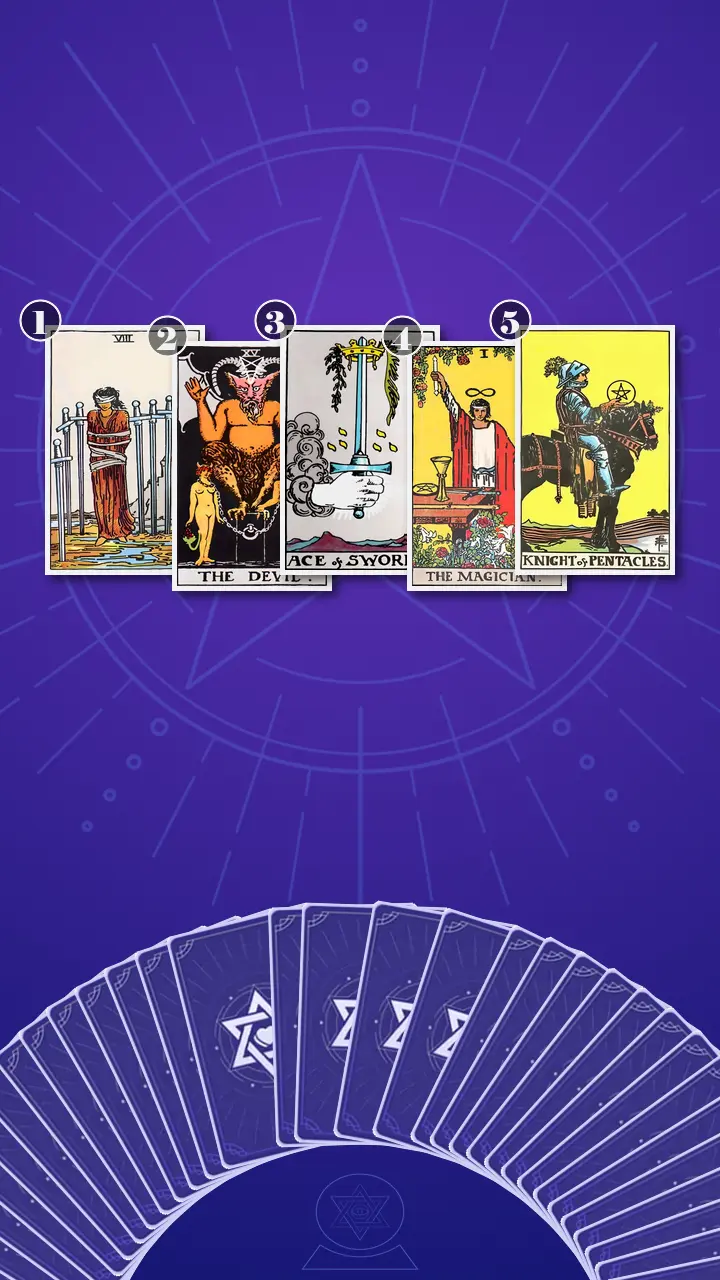
For this reading, I chose The Shadow Spread, Context Edition, a five-card contextualized Shadow Spread tarot reflection for thesis-writing avoidance. This spread suits the question because the problem is not a broad prediction about Alex's academic future. It is one self-reinforcing loop. The sequence moves from the visible behaviour, to the attachment beneath it, to the clarity already available, then to an integrating bridge and a grounded writing experiment. That is how tarot works here: the cards provide an objective symbolic structure for examining behaviour, emotional payoff, and choice. They do not write the thesis, and they do not remove Alex's authority over her research.
I told her the first card would show the presenting shadow, the visible research habit that keeps replacing drafting. The second would reveal the underlying fear and attachment, including what one more source promises to protect. The centre card would identify an inner resource. The fourth would become the integrating bridge, and the fifth would translate insight into a practical next step. I wanted the spread to move from confusion toward finding clarity, without pretending that clarity meant every question would disappear.
Five Swords Around One Sentence
The Research Tab Cage: Eight of Swords Upright
Now turned over for the presenting shadow, the specific visible loop in which Alex repeatedly researches, reorganizes evidence, and postpones writing what she already knows, was the Eight of Swords, upright.
I pointed to the blindfold, the loose bindings, and the ring of swords around the figure. In the card, the enclosure looks complete until the eye notices that the restraints are not as absolute as they first appear. At Alex's desk, the same image was made of Google Scholar, JSTOR, Zotero, a library search page, and an increasingly detailed outline. Every open tab represented a condition she believed had to be satisfied before she could write. Her hands were free enough to search, but the available action had narrowed to more searching.
I said, At 9:06, your thesis document sits behind all those tabs. You highlight one uncertain phrase, search a slightly different version of the same question, and return with six PDFs. The labour is real. The problem is that the work is now arranged around avoiding the sentence that would reveal what evidence you actually need.
The energy here was an excess of Air, thought multiplying faster than action could test it. The restriction was not a lack of intelligence. It was a blockage created by treating every possible qualification as an immediate requirement. I asked, Which constraint is real, and which one are you enforcing by refusing to draft provisionally?
I used the inner line the card brought forward: I am not avoiding the thesis; I am making sure I can defend it. Then I placed that sentence beside the visible fact that the document still contained three heavily edited sentences. Productive activity and visible progress were not the same thing.
Alex gave a small, bitter laugh instead of nodding. She rubbed the edge of her notebook with one thumb and looked at the chapter title rather than the card. I said, I will not use this card to dismiss the hours you have worked. I am using it to show how those hours have been funnelled into a very narrow route. The first useful distinction is between a genuine need for evidence and a rule that says you cannot begin until you feel impossible to criticise.
The Bargain Under the Browser: The Devil Upright
Now turned over for the underlying fear and attachment, the belief that writing before exhaustive research could expose Alex as insufficiently rigorous or unworthy of belonging as a scholar, was The Devil, upright.
The loose chains around the figures gave the card its modern shape. Alex would type, These interviews suggest, imagine a supervisor asking whether the sample supported that wording, and open Scopus before the sentence could become real. Her shoulders would drop the moment she left the document. That small release was not proof of weakness. It was the immediate reward of postponement. One more article gave her ten minutes in which no claim had to be exposed.
I said, The extra source is buying ten minutes of safety, not ten minutes of clarity. The bargain is one more source, then I will write. It feels responsible because it protects the identity of the rigorous scholar. At the same time, it prevents you from practising the thing rigorous work requires: putting an argument on the page where its actual gaps can be found and revised.
Alex's breath stopped halfway in. Her finger hovered above the trackpad, and for a moment her eyes lost focus as if she were replaying a week of searches. Then her mouth tightened and she said, But that makes it sound like I am choosing this. I have been working the whole time.
I stayed with the distinction. I said, You are choosing a behaviour that has been offering protection, but that does not mean you chose the fear underneath it or that you deserve blame for having a nervous system that responds to exposure. A habit can be understandable and interruptible at the same time. I am not asking you to stop caring about evidence. I am asking what the search is protecting you from, and what it is preventing you from practising.
She lowered her hand, pressed her palm briefly against her chest, and let out a long breath. The change was small but visible. The chain had not vanished, but she could now see the clasp.
The Clear Blade Already in the Room: Ace of Swords Upright
Now turned over for the available inner resource, the clarity and discernment Alex already had but was not trusting when she explained her thesis aloud or looked at the central claim in her notes, was the Ace of Swords, upright.
The hand emerging from the cloud held one clean blade, not a storm of competing blades. I connected it to a scene Alex had described before the reading. In meetings, or in a voice note to a trusted classmate, she could explain what the chapter currently showed. The explanation became difficult only when the cursor appeared and the words started to feel permanent. The Ace of Swords separated the claim she could responsibly make now from every question the field might ask someday.
I said, You do not need the whole literature review inside this sentence. The card does not promise total certainty. It offers discernment, the ability to choose a workable scope. A clear claim can include a qualifier such as in this sample or the current evidence suggests. It can be accurate without pretending to be final.
This was a more balanced form of Air. Instead of thought surrounding the writer, thought became a filter. I asked Alex, If a trusted classmate asked what this chapter argues, what would you say in one sentence before you had time to qualify every word?
She looked toward the closed notebook, then opened a blank note on her phone. Her exhale reached the table before her answer did. She spoke slowly: I think the interviews show that the participants describe belonging through everyday routines, not only through formal institutional language.
I asked her to notice what had happened. The sentence had not solved the literature review. It had made the next evidence question visible. She wrote a small note beneath it: Which source helps me define everyday routines? Her shoulders remained raised, but not as high. The first credible movement was not confidence. It was a bounded distinction.
At that point, I thought about sound. In my ten years of studying energy and attention, I have often found that study burnout is less like an empty battery than a rhythm falling out of sync under pressure. The demand on Alex was final-sounding prose, but her mind needed an exploratory beat in which a claim could be heard before it was polished. I call this mismatch Cognitive Tempo Calibration. The Ace of Swords gave us the first shorter beat: one responsible sentence before the database.
When the Magician Put the Tools on the Table
The Bridge: The Magician Upright
The room grew quiet when I turned over the fourth card. Even the streetcar noise seemed to recede behind the refrigerator's soft hum. Now turned over for the integrating bridge, the concrete mental and behavioural shift from proving readiness through more research to using existing knowledge in a first bounded draft, was The Magician, upright.
The Magician stood between potential and action. One hand raised a wand, one hand received, and the table held a cup, a sword, a pentacle, and a wand. I placed Alex's own materials into the same structure: one reason the project mattered, one clear sentence, one supporting citation, and one practical drafting action. Nothing was missing except the decision to combine what was already there.
I then used my Focus Disruption Auditing lens. I listened for the dissonant chords that kept shattering Alex's deep-work flow: the imagined examiner, the uncited phrase, the open browser, the comparison post from someone else's polished submission, and the belief that a rough paragraph was already a public test. The audit showed that the main blockage was not a shortage of sources. It was an attention system being interrupted at the precise instant knowledge had to become authorship.
I said, Your desk is not empty. It is crowded with tools that have been kept separate for safety. A reason, a claim, evidence, and a drafting move can make a workbench. The first paragraph is not proof that you are a legitimate scholar. It is the surface that lets you inspect your thinking.
After three hours of reading, the document was still open behind twelve tabs. Alex's notes were detailed, her jaw was tight, and the same paragraph was waiting. The strange part, which she had already shown me, was that she could explain the argument aloud right then. She was caught inside the thought that readiness had to be found before action could begin.
You do not prove you are ready by collecting more tools; you discover what the argument needs by placing the tools already on the table into one provisional claim.
I let the sentence remain between us. Then I said the card's central message exactly as I had written it in my notes.
You do not need one more source to prove you are ready; place the knowledge already on the table into a first claim, as the Magician turns available tools into action.
Alex froze first. Her inhale stopped, and the fingers that had been gripping her pen stayed suspended above the page. Then her eyes moved from the card to the pile of annotated articles, as if she were seeing the desk from a different height. I watched recognition travel through the details: the citation she had already checked, the explanation she had given aloud, the paragraph she had kept treating as a verdict.
Her lower lip parted. A brief flush reached the skin beneath her eyes, and her shoulders dropped so quickly that she placed one hand on the table to steady herself. She was not simply relieved. The new view carried responsibility with it. If the missing resource was synthesis rather than another article, she could no longer hide inside the comforting idea that the answer would arrive through collection. Her hand opened, closed, and opened again. Then she released a breath from deep in her chest and said, almost too quietly, I may have been waiting for permission that no source can give me.
For a moment, the clarity made her look slightly dizzy. The blank page was still blank, but it no longer meant that she had nothing. It meant that she had a place to make the next thought testable. I asked her, Now, use this new perspective to remember last week: was there a moment when seeing the draft as a working surface rather than a verdict could have made the next move feel different?
She remembered the sentence she had deleted after imagining an examiner's objection. This time, she did not call the deletion evidence of failure. She called it an evidence question that had never been allowed to appear. That was the emotional transformation in its first workable form: from anxious over-researching and scholarly self-doubt toward cautious self-trust, with no demand that she feel fearless.
I told Alex, A provisional claim is a working surface, not a verdict on your intellect. Rigor needs a draft to push against. The Magician did not tell her to abandon research. It showed her how to let research become material for thinking instead of a wall between thinking and writing.
The Still Horse and the Return Cue: Knight of Pentacles Upright
Now turned over for the grounded integration experiment, the practical expression of the shift through a small, repeatable, self-directed writing practice, was the Knight of Pentacles, upright.
The knight held the pentacle carefully while the horse stood still before a cultivated field. I connected that stillness to a recurring calendar block that looked almost boring: the same document, the same twenty minutes, research tabs closed, one evidence question parked for later. This was not a card of dramatic motivation. It was an image of reliable return.
I said, You do not have to become confident before you begin. You can return before you feel fully ready. The grounded energy here is Earth: a bounded piece of prose, a timer, a return cue, and a decision to stop when the block ends. The practice protects the work from both extremes, the frantic all-day research marathon and the fantasy that writing should only happen when inspiration arrives.
I also named the line I wanted her to remember: Write until you find the next research question; do not research until writing feels risk-free. The Knight of Pentacles turns that sentence into a rhythm. The point is not speed. The point is making authorship ordinary enough to repeat.
Alex looked at her calendar and began counting possible windows. Her face still held some doubt, but her hand moved with less urgency. She said, I could do Monday, Wednesday, and Friday, but twenty minutes feels almost too small to matter.
I answered, Its purpose is not to finish a chapter. Its purpose is to make returning predictable. A small session that happens is more informative than an ideal four-hour session that keeps becoming a promise. She nodded, wrote three times in her calendar, and added a plain-text note titled Research Parking Lot.
The note gave her search impulses somewhere to go without letting them take over the session. She wrote one return cue beneath the first block: Next, explain why participant selection matters. The horse in the card remained still, but the path had become visible.
From Insight to a Closed-Tab Writing Block
When I put the five cards together, the story was clear. The Eight of Swords showed thought circling perceived limits, while The Devil showed why the circle kept renewing: another search offered immediate protection from criticism and postponed the exposure of authorship. The Ace of Swords revealed that Alex already had the capacity to make a responsible distinction. The Magician showed her combining reason, language, evidence, and initiative. The Knight of Pentacles gave that shift a material form through repetition.
The blind spot was not simply that Alex needed more time management. It was that she had been treating preparation as proof of readiness and drafting as a final examination of worth. She could not tell which evidence gaps were real until she allowed a provisional claim to reveal them. The key shift was from proving readiness through exhaustive research to demonstrating readiness through a deliberately bounded first draft.
I told her the cards were not asking her to lower academic standards. They were asking her to change the order of operations. Drafting first does not mean submitting an unsupported argument. It means letting a provisional sentence show which sources deserve attention. It turns research from an endless precondition into a response to a defined question.
For the next week, I translated the reading into The Syncopated Study Session, my customized rhythm protocol for breaking overwhelming academic tasks into harmonious, frictionless micro-beats. Each beat had a clear beginning and end. Alex would not have to perform confidence. She would only have to move from one small sound of thought to the next.
- Open the Draft-Before-Search GateBefore opening Google Scholar in the next writing session, type Based on what I know now, I think ___ because ___. Label the sentence [PROVISIONAL]. Under it, add two lines: Evidence already in my notes and Evidence question to check later, with no more than three bullets in each.If the sentence feels too exposed, complete only I currently think... or record a sixty-second voice note and transcribe the clearest clause. This is a diagnostic tool, not a sentence for submission.
- Use the Magician's Existing-Tools CheckPlace one note, one supporting citation, and the thesis document side by side. Fill four lines: Claim, Why it matters, Evidence I have, and Next drafting move. Then write four rough sentences. When a factual uncertainty appears, type [CHECK SOURCE: specific question] and continue instead of opening a new tab.Keep the exercise private if that lowers the stakes. A [CHECK SOURCE] marker is a boundary between drafting and verification, not permission to leave a claim unsupported.
- Build the Knight of Pentacles Writing RhythmSchedule three twenty-minute drafting blocks in the same document this week. Close or minimise research tabs for the duration, place every search impulse in the Research Parking Lot, and end each block with one return cue such as Next, explain why participant selection matters.Stop when the timer ends, even if the session feels unfinished. On a depleted day, use the three-minute version and write one sentence fragment. Reliable repetition matters more than a dramatic burst of motivation.
I watched Alex read the list twice. The first time, she scanned for a hidden demand. The second time, she looked at the smallness of each action. I said, You remain the person who decides whether a source is necessary, whether a claim is accurate, and when a draft is ready to share. The cards have offered a structure for observation. The authorship stays with you.
A Week Later: The Quiet Proof
Four days later, I received a message from Alex while I was making tea. She had used the first twenty-minute block before opening a database, written a provisional claim, and added two [CHECK SOURCE] markers instead of chasing the uncertainties immediately. She did not finish the chapter. She wrote four rough sentences and left a return cue for the next morning.
On Friday, she told me she had slept through the night, though her first thought on waking was still, What if this is wrong? She smiled at the thought instead of opening Google Scholar. The doubt had not vanished. It simply no longer held the only key to the day.
She also sent two rough paragraphs to a trusted writing partner, not because the cards had predicted a successful academic outcome, but because she had chosen a small test of her own process. The message beneath them read, These are provisional, and I know where I need to check the evidence. That sentence was the quiet proof. She had moved from collecting protection to practising authorship.
I think of the Journey to Clarity as a change in rhythm rather than a finish line. Alex did not solve her thesis in one reading. She learned to hear the difference between a source that answers a question and a source that delays the question. She began moving from contracted vigilance, through the discomfort of closing the tabs, toward cautious self-trust and grounded drafting momentum.
If the cursor beside a sentence you can explain aloud has ever made your whole right to belong feel packed into that one line, I want you to know that noticing the pressure is already a meaningful beginning. A working claim can be a place to think, not a verdict on your intellect. When the old search impulse arrives, you still get to choose what happens next.
If that sentence could be a working note rather than a verdict, what small piece of what you already know would you be curious to place on the page next?