The Recovery Plan Is Not a Verdict: One Task Before Confidence

Finding Clarity in the 9:05 p.m. Portal Glow
I met Jordan (name changed for privacy) on a Tuesday night, and she could explain her academic recovery plan perfectly. The second her student portal loaded its overdue boxes, though, she opened a fresh Google Calendar and called it a productivity reset. What she brought into our session was shame-driven avoidance of an academic recovery plan while on academic probation, but it did not arrive as a tidy label. It arrived as eight color-coded blocks and one blank assignment.
At 9:05 p.m., Jordan joined my video call from a narrow desk in her shared Toronto apartment. I heard the radiator clicking through her microphone and saw blue-white portal light catch the edge of yesterday's coffee. She took one sip, grimaced at the cold taste, and pushed her warm phone beneath her palm as another study-method video waited in a browser tab.
'I know exactly what the plan says, and I still do everything except start it,' she told me. 'If I try properly and still fail, I won't have an excuse. Maybe I'll just find out I'm not capable of fixing this.'
I watched her fingers move between the calendar and the unopened assignment. The recovery plan was meant to restore her academic standing, but touching its first real task made probation and possible failure feel immediately testable. Her anticipatory anxiety behaved like a fire alarm wired directly to the portal's overdue boxes: nothing in the room was burning, yet her chest had already prepared to evacuate.
'I don't read this as laziness,' I said. 'You are not avoiding the plan because it means nothing; you are avoiding the moment it might feel like a verdict. The planning lowers the pressure for a few minutes, even though it leaves the assessed work untouched. Let's use the cards to map that loop, find the point where it can change, and give you a next move small enough to be real.'

Choosing a Ladder Instead of Another Verdict
I asked Jordan to put both feet on the floor and take one unforced breath while holding the question in mind: 'Why do I keep avoiding my recovery plan while on academic probation?' I shuffled slowly. I treat this preparation as a transition for attention, not as a performance of mystery.
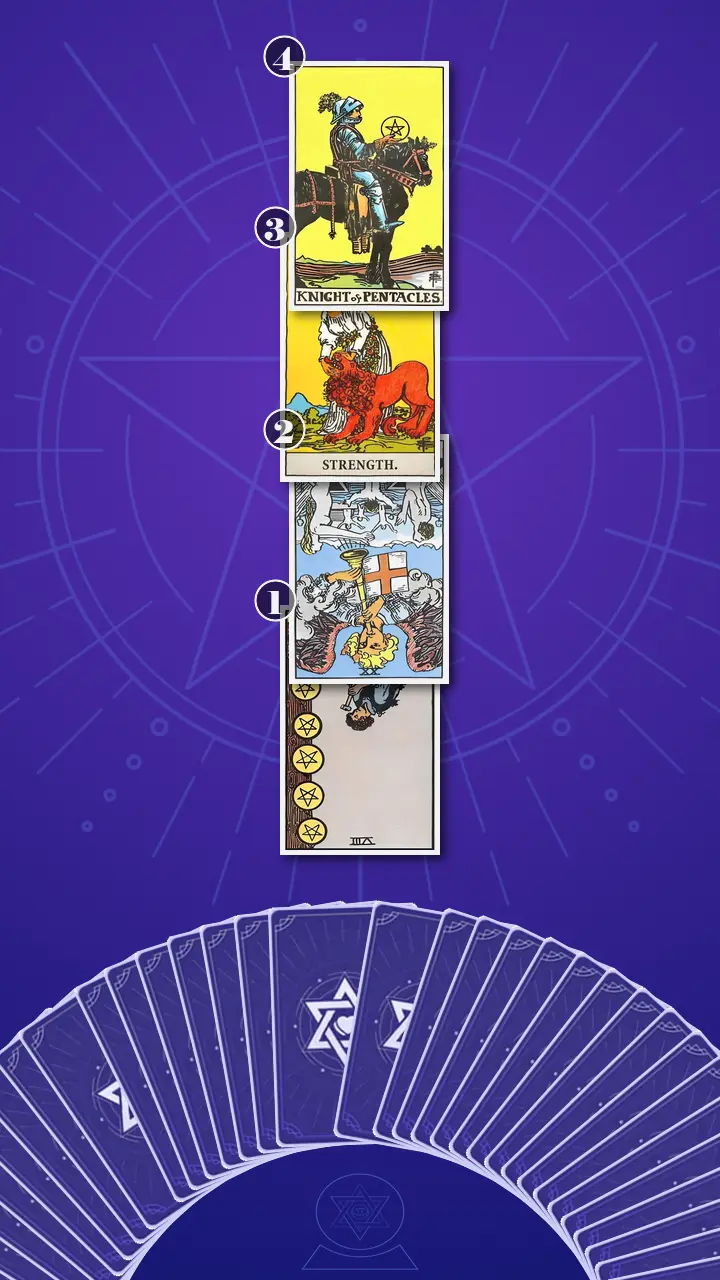
I chose the Four-Layer Insight Ladder, a four-card tarot spread arranged vertically like deliberate rungs. The first position would show the visible behavior. The second would identify the psychological root sustaining it. The third would reveal the internal transformation capable of interrupting the pattern. The fourth would turn that insight into practical recovery-plan behavior.
For anyone wondering how tarot works in a situation like this, I do not use it to predict a grade, guarantee restored standing, or pronounce a hidden fate. I use card meanings in context as structured prompts. A larger Celtic Cross could have introduced forecasts and environmental layers, but Jordan's question required a focused path from symptom to root, then from transformation to action. The Four-Layer Insight Ladder gave us exactly that map without adding noise.
I placed the four cards on one vertical axis, beginning at the bottom. The lower pair would diagnose the loop; the upper pair would show how Jordan could climb out of it one deliberate rung at a time.
Eight Perfect Blocks and One Blank Page
Position One: The Work System That Avoided the Work
I turned over the card representing the diagnosis-level behavior: reorganizing the recovery plan, refining study systems, and leaving the first academic task incomplete. It was the Eight of Pentacles, reversed.
I drew Jordan's attention to the craftsperson's tools and the repeated pentacles. Upright, the card is associated with apprenticeship, concentration, and skill built through ordinary practice. Reversed, that practical energy was blocked. The tools existed, but they were being arranged instead of used. Overpreparation was in excess; direct contact with the work was in deficiency.
'This is your 9:05 p.m. screen,' I said. 'The eight pentacles have become calendar blocks, labelled folders, open tabs, and productivity videos. Everything looks academically relevant, but the assignment document still contains only a title. The thought underneath it sounds like: I am technically doing school things, so why does nothing count as done?'
I explained that planning was not inherently the problem. A five-minute calendar check could support a study block. The blockage appeared when system maintenance consumed the entire block and protected Jordan from producing anything that could be assessed. Planning could lower the panic without moving the assignment.
Jordan gave one short laugh, but there was no amusement in it. Her fingers tightened around the cold coffee before she said, 'That's so accurate it feels a little brutal.'
'Then let's make the distinction precise, not punishing,' I replied. 'The card is not calling you fraudulent or undisciplined. It is showing that a coping strategy once used to create control now has a measurable cost. Which one recovery-plan task have you rewritten on the schedule most often without touching the actual file?'
'The sociology essay,' she said. 'I've moved it six times. I haven't opened the rubric since last week.'
When a Summons Became a Sentence
Position Two: The Internal Judge Behind the Portal
I turned over the card representing the psychological root: the fear that serious effort followed by difficulty would turn academic probation into proof of personal inadequacy. It was Judgement, reversed.
I pointed to the angel's trumpet and the figures answering its call. In its balanced form, Judgement concerns honest review, accountability, and responding to information. Reversed, the call had become distorted. Jordan was opening an official academic message that listed specific corrective steps, then hearing it as a permanent ruling on who she was.
'The portal is delivering data,' I said. 'Your internal judge is turning tracked requirements into a courtroom transcript. The thought becomes: If I try properly and still struggle, the portal will confirm what I already fear about myself. Closing the screen then gives you temporary relief because the verdict remains untested for one more night.'
The energy here was not a lack of accountability. Jordan already monitored every overdue marker. It was an excess of identity-level judgment and a blockage in factual self-review. A missed checkpoint requested a response; shame claimed that it defined the person receiving it.
My mind briefly returned to the risk sheets I had watched update on Wall Street. A red number could demand a fast, serious response, but it was still information, not a moral biography. When fear fused the two, people either overreacted or froze. The useful discipline was to separate the signal from the story built around it.
'A missed checkpoint is information,' I told Jordan. 'Shame is the part writing the sentence. Accountability says, This requirement is overdue; what is the next procedural action? Condemnation says, This proves I am incapable. Only the first statement can help you move.'
I saw her breathing pause. Her eyes stayed on Judgement while one thumb rubbed the edge of her phone case. After several quiet seconds, she said, 'I thought I was avoiding the plan because I didn't care enough. But I care so much that every task feels like evidence against me.'
'That doesn't erase the deadlines,' I said. 'It explains why a reasonable corrective plan has been landing in your body like a summons. Once we know that, we can stop asking shame to manage the case.'
When Strength Put a Hand on the Lion
Position Three: Courage Without Self-Punishment
The radiator stopped clicking just before I turned the third card. The sudden quiet made the room feel wider. I turned over the card representing the key transformation: replacing shame-based self-coercion with enough patient courage to begin one task while discomfort remained. It was Strength, upright.
I asked Jordan to look at the woman's hands resting calmly at the lion's jaws. There was no weapon, no attempt to deny the animal's power, and no dramatic conquest. Strength was balanced Fire: courage regulated through relationship rather than force. In Jordan's daily life, this was the second when the assignment cursor waited, her chest tightened, and her hand reached toward the phone. The card did not require her to enjoy the feeling. It asked whether she could notice the escape impulse without letting it run the whole study block.
At 9:05 p.m., the calendar could be newly color-coded, the productivity videos could remain open, and the assignment could still be untouched. The laptop might feel warm beneath her hands. Closing it would bring immediate relief; beginning would make the fear of not being capable feel testable. That was the lion we were actually meeting.
I brought in a lens I call Academic ROI Auditing, which I usually use to evaluate the strategic yield of an expensive degree, a major pivot, or a high-investment research direction. Here, I narrowed the audit to one forty-five-minute block. Calendar redesign had produced temporary bodily relief but no assessed contact. Twenty minutes of imperfect work could produce one rough paragraph, one precise question for an adviser, or concrete evidence about where support was needed. The highest-yield action was not the harshest one. It was the smallest action that converted time into practice and usable information.
The task is not asking you to prove your worth; it is asking whether you can stay for twenty minutes while doubt is still in the room.
Then I gave Jordan the sentence at the center of the reading.
Your probation is not proof that you are weak; practice calm, repeatable effort, and guide the lion with steady hands instead of force.
I let the words sit without filling the silence. Jordan's breath stopped first, and her fingers remained suspended above the phone as if the old escape route had briefly lost its instructions. Her eyes moved away from the card and went slightly unfocused; I could see her replaying evenings of polished calendars, blank documents, and promises to repair the whole term by Monday. Then her eyebrows pulled together.
'But doesn't that mean I've been doing this wrong for weeks?' she asked, the words sharper than anything she had said before.
'It means the planning protected you from something that felt unbearable,' I replied. 'It also means the protection now costs more than it returns. Recognizing that is not another charge against you. It is the first usable piece of leverage.'
Her jaw loosened. Her fist opened slowly beside the laptop, then she released a breath that trembled at the end. Her shoulders dropped, but the relief was followed by a brief, exposed stillness. I recognized the slight dizziness that can arrive when a person no longer has to carry an old punishment but realizes that choice now belongs to them.
'Oh,' she said quietly. 'Then I don't have to fix my confidence first. I have to choose whether I stay.'
'Exactly,' I said. 'Confidence is not the entry requirement for a twenty-minute task. Now, with that new perspective, think back to last week. Was there a moment when this insight might have changed how the task felt?'
Jordan remembered Sunday evening on the TTC, switching between the recovery-plan reminder and classmates' internship posts. She had searched for a perfect semester-reset template before reaching her stop. 'I could have let the comparison be there and still opened the rubric,' she said. 'Not because the fear was gone. Just because it didn't need the phone.'
I named the transition carefully. This was not a promise about her academic outcome. It was the first movement from anticipatory anxiety and shame-driven avoidance toward cautious self-trust and steady, observable follow-through. She was shifting from waiting for confidence to working alongside discomfort.
Before moving to the final card, I gave her a minimum version she could use within the next ten minutes. I asked her to open a plain note and write two lines: 'Fact: one recovery-plan task is waiting' and 'Next 20-minute action: [one visible verb, one file or page].' She could put the required material on screen, set one timer, and place her phone on Do Not Disturb or beyond arm's reach. She had permission to stop when the timer ended, even if the work was unfinished. If twenty minutes felt too activating, the valid minimum was two minutes, one open document, and one rough sentence.
One Pentacle, One Kept Appointment
Position Four: The Routine That Does Not Need a Comeback Montage
I turned over the card representing practical integration: a modest scheduled task, completed consistently and evaluated through observable follow-through. It was the Knight of Pentacles, upright.
I pointed to the still horse and the single pentacle held carefully at eye level. The knight's lack of speed was the point. This was stable Earth restored after the blocked Earth of the first card. Jordan did not need to cross the whole semester in one leap. She needed to protect one concrete responsibility, record what happened, and return for the next appointment.
'This looks like one realistic calendar block labelled with a verb and an object,' I said. 'For example: Draft paragraph one in SOCI essay.docx. You complete the agreed block without expanding it into a total life overhaul. Then you record the date, the minutes, and the visible action in a plain note before stopping.'
Jordan looked from the eight disrupted pentacles at the bottom of the spread to the single pentacle held steadily at the top. The whole reading had contracted from many impressive obligations to one tangible commitment.
'I'm not repairing the whole term tonight,' she said. 'I'm keeping one appointment.'
'That's the Knight,' I replied. 'Urgency wants a dramatic reset. Reliability wants a return time. Neither this card nor I can guarantee the grade or the probation decision. What it can offer is a method for producing honest evidence that you participated.'
The Handrail Plan for the Next Twenty Minutes
I gathered the cards into one coherent story. Recent low grades, visible recovery checkpoints, weekday time pressure, and classmates' achievement posts had raised the stakes around every task. The Eight of Pentacles reversed showed Jordan maintaining the appearance of work because direct practice felt exposing. Judgement reversed revealed why: academic feedback had fused with a verdict about worth. Strength restored the missing emotional permission to acknowledge fear without obeying it, and the Knight of Pentacles translated that courage into one modest appointment at a time.
The central blind spot was Jordan's belief that stronger pressure would produce stronger performance. In reality, intensity had been masquerading as seriousness while consuming the energy needed to begin. She also assumed confidence had to come before action, although confidence could only grow from evidence of follow-through. The shift was precise: the recovery plan would stop serving as a courtroom and start serving as a handrail.
I also applied Institutional Resource Leverage, another tool from my former commercial life. An academic adviser, accessibility office, teaching assistant, or campus learning service is not useful merely because it exists in a university directory. The resource creates value when Jordan uses it proactively for a specific need. That could mean a two-sentence email identifying an unclear checkpoint and asking for the next procedural step. It did not require a dramatic disclosure or permission from friends.
- Turn one fact into one twenty-minute action. Before the next weekday study block, Jordan would take no more than three minutes to write one neutral fact and one verdict on a sticky note, such as 'Fact: checkpoint two is overdue' and 'Verdict: I am incapable.' From the fact, she would choose one visible action that takes twenty minutes or less, open the exact file, set the timer, and begin before editing the calendar or researching another study method. Tip: Put the phone on Do Not Disturb and across the room for that timer. If twenty minutes feels overwhelming, use the two-minute version: open the document and add one rough sentence.
- Keep two appointments and record only the evidence. On Monday, Jordan would schedule only the next two recovery-plan blocks in Google Calendar. Each label would contain one verb and one object. After each block, she would add a single line to a note titled 'Evidence': date, minutes completed, and visible action taken. After the second block, she would compare the evidence with the next official checkpoint and send one factual question to her academic adviser if any requirement remained unclear. Tip: Limit scheduling to five minutes so the routine cannot become another master-plan project. Use ten- or five-minute appointments when needed, and adjust the plan with official academic or accessibility support.
I made the boundary explicit. These were small experiments in participation, not substitutes for probation requirements, accessibility accommodations, mental-health support, or guidance from an academic adviser. Jordan could pause if distress became overwhelming and adapt the task around legitimate access needs. Tarot had provided a mirror and a decision structure; she retained control over every next step.

A Week Later, One Line in the Evidence Log
Six days later, I received a message from Jordan. It did not announce a transformed semester. It contained a screenshot of a plain note: 'Tuesday, 20 minutes, highlighted three rubric requirements and drafted one rough paragraph.' She had put her phone in her backpack, stopped when the timer ended, and resisted turning the unfinished paragraph into evidence that the block had failed.
She had also sent the academic adviser a two-sentence email about the overdue checkpoint instead of trying to infer the procedure from Reddit posts and old portal messages. The important change was not that every consequence had disappeared. It was that she had replaced a shame-based prediction with observable behavior and one direct use of institutional support.
That night she slept through. In the morning, her first thought was still, 'What if I mess this up?' She told me she smiled, opened the Evidence note, and chose the next twenty-minute appointment.
I saw the quiet proof of our Journey to Clarity in that sequence. The cards had not rescued Jordan or decided her academic future. She had noticed the lion, kept one appointment while doubt remained in the room, and begun rebuilding trust from evidence she created herself.
I know that when the portal is open and your chest tightens, the hardest part may not be the overdue box itself. It may be the fear that doing the work honestly could turn a temporary setback into a verdict on your worth. Simply recognizing that hidden courtroom means you are no longer standing at the beginning without a map.
So I will leave the single pentacle where Jordan left it: if your recovery plan felt more like a handrail than a verdict, which one small part of it would you be willing to meet for twenty minutes, even with doubt still in the room?