From Blank-Page Dread to Curiosity With a 15-Minute Rough Draft
Finding Clarity at the 10:40 p.m. Blank Page
You are the student who can produce six pages after midnight but cannot type one rough sentence on Saturday afternoon. That contradiction is the heart of perfectionism-driven assignment procrastination: you want to do the work well, so you delay the moment when the work might show you something imperfect.
Alex (name changed for privacy) joined my reading at 10:40 p.m. from the desk they used for lectures, Netflix, group chats, and essays in a small Toronto apartment. An assignment brief glowed beside a blank Google Doc. Their colour-coded notes filled half the screen, the desk lamp hummed, and the laptop fan pushed warm air across their hands while their shoulders crept towards their ears.
They had renamed the document twice, adjusted the headings, checked the course chat, and calculated the hours remaining before the deadline. The dread in their body felt like a TTC train stalled in a tunnel: their stomach carried the weight, their shoulders held the brakes, and all that restless energy had nowhere to go.
“I work better under pressure,” Alex said, rubbing one thumb along the edge of the laptop. “But I hate what the pressure does to me. I just need to understand the assignment properly before I start.”
I watched the blank cursor blink between us. “You are not doing nothing,” I said. “You are doing everything around the thing that could evaluate you. That does not make you lazy. It tells me the preparation may be protecting you from something.”
I explained that I would not use tarot to predict their grade or issue a verdict on their academic ability. I would use it as a structured cognitive map, a way to separate the visible behaviour from the fear beneath it and identify a next step Alex could test for themselves. “Let’s see whether we can draw a map through this fog,” I said. “You remain the person who decides where to walk.”

Choosing the Four-Layer Insight Ladder
I invited Alex to place both feet on the floor, take one unforced breath, and hold the question in mind while I shuffled: Why do I keep starting every assignment at the last minute? The pause was not a mystical performance. It was a transition from reacting to the problem to observing it.
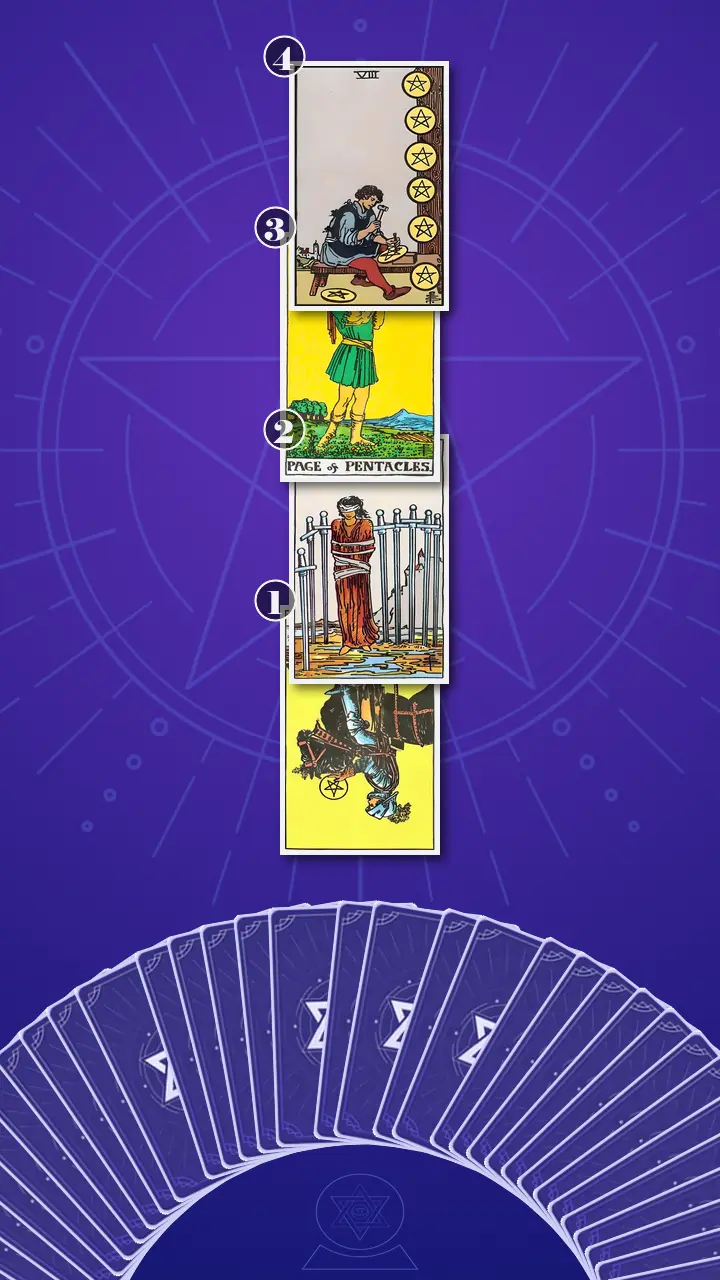
I chose the Four-Layer Insight Ladder tarot spread for procrastination. For anyone wondering how tarot works in a reading like this, I treat card meanings in context as prompts for examining a pattern, not as fixed claims about fate. This focused four-card structure was more useful here than a Celtic Cross because Alex did not need ten different angles. They needed a clean ascent through symptom, root belief, transformative reframe, and practical integration.
I arranged the cards vertically. The bottom position would show the responsible-looking preparation and delay visible on Alex’s screen. The next would expose the private rule that made an ordinary beginning feel like a test of worth. The third, our bridge card, would offer a different meaning for starting. The top card would translate that insight into repeatable work sessions and visible progress.
“Each card supports the one above it,” I told Alex. “We are not asking whether you are capable. We are asking what keeps your capability motionless, and what could help it move without needing a crisis.”
The Lower Rungs of Assignment Paralysis
Position 1: The Fully Equipped Desk That Does Not Move
I turned over the card representing the observable symptom: preparing, reorganising, and waiting until urgency forces the first piece of real work. It was the Knight of Pentacles, reversed.
The Knight had the assignment in hand, every resource available, and cultivated ground behind him, yet his black horse stood completely still. In Alex’s modern life, that was the 10:40 p.m. desk: the brief, notes, laptop, and available time were all present, but the session went into renaming files, adjusting headings, and building a more detailed study plan. The activity looked diligent. When the laptop eventually closed, no assessable piece of work existed.
I read the reversed Knight as a blockage of practical Earth energy. Alex did not lack responsibility, tools, or intention. Their caution had become so rigid that readiness replaced movement. The internal sequence was painfully efficient: I am being responsible. I need one better system. I will start as soon as it feels clear. Each setup task provided brief relief while keeping the vulnerable first attempt safely hypothetical.
“During your last study session,” I asked, “what did you spend the first thirty minutes doing, and what physically existed in the document afterwards?”
Alex’s shoulders lifted. They gave one short, bitter laugh and glanced at the tabs still open behind our call. “That is so accurate it feels rude,” they said. “I made a Notion tracker. Then I changed the categories because the tracker felt confusing. The essay was still blank.”
I let the laugh settle without turning it into an accusation. “The card is not mocking your preparation,” I said. “It is helping us distinguish preparation from contact. A polished system can be useful, but it cannot discover your argument for you.”
I had seen a more expensive version of this pattern during my Wall Street years. Teams could spend hours refining a model, then become startlingly decisive at 2 a.m. because the clock finally eliminated every alternative. The output sometimes looked impressive, but the body still paid the invoice. Alex’s last-minute assignment cycle worked in much the same way. It used a fire alarm as a focus timer.
“Pressure may not unlock your talent,” I told them. “It may simply leave no time to keep judging it.”
Position 2: The Private Document That Feels Public
I turned over the card representing the underlying fear and limiting belief that made beginning feel like an immediate test of Alex’s worth and ability. It was the Eight of Swords, upright.
The figure was blindfolded and loosely bound, surrounded by swords that looked threatening but did not form a sealed prison. I asked Alex to recall a recent campus café session. They had typed one possible claim, imagined a tutor finding it obvious or confused, and deleted it before anyone else could ever see it. Rough notes, a provisional outline, office hours, and clarification questions had all remained available, but fear had edited those options out of the picture.
This was Air energy in excess: analysis folding back on itself until thought became an enclosure. The sequence underneath the blank-page freeze sounded like this: If this sentence is weak, perhaps the whole assignment will be weak. If the assignment is weak, perhaps I am not as capable as people think. A private Google Doc was being treated as if the marker, Turnitin, and the entire class were already watching the cursor.
I offered that as a working hypothesis, not a diagnosis. “What did you predict the rough sentence would prove about you?” I asked.
Alex’s thumb stopped moving. Their gaze drifted away from the screen, as if they were replaying the deleted sentence in version history. After several seconds, they pressed their lips together and said, “That maybe I am not actually smart enough to be in the programme. If the first paragraph is bad, the rest will probably be bad too.”
The admission landed heavily, but I did not rush to contradict it with reassurance. “The discomfort is real,” I said. “The rule is negotiable. The bindings in this card are loose, and there is a gap between the swords. That gap might be a rough outline, one written question, or one specific message to a teaching assistant. You do not have to defeat every anxious thought. You only need one available move that the thought has been pretending does not exist.”
Alex exhaled through their nose. Their shoulders did not fully drop, but one hand opened on the desk. “So I could begin by writing what I do not understand?”
“Exactly,” I said. “Uncertainty can be material. It does not have to be evidence against you.”
When the Page Held Only One Pentacle
Position 3: The One-Question Learning Pass
The room seemed to become quieter when I reached the bridge position. Even the course-chat notifications had stopped after Alex turned their phone face down. I turned over the card representing the key cognitive and behavioural shift from proving competence to learning through a small, imperfect beginning. It was the Page of Pentacles, upright.
The Page did not stare at the distant mountains and demand instant mastery. The figure held one pentacle steadily, examining the object already within reach. In Alex’s life, that meant closing every tab except the brief and a blank document, copying one assignment question, and giving it fifteen minutes of curious attention. Instead of asking whether the answer sounded intelligent, Alex could write three rough bullets and observe what became clearer through doing.
Earth energy returned here in a balanced, beginner form. The Page did not ask Alex to feel confident before starting. The card invited practical curiosity: one paragraph, one question, or one source treated as an object of study. Confusion was no longer a verdict delivered before the work began. It was information generated by engaging with the work.
This was the moment I applied one of my own analytical tools, Academic ROI Auditing. I asked Alex to compare the strategic yield of two fifteen-minute investments. Fifteen minutes of formatting might produce a cleaner document and temporary emotional relief, but no evidence about the argument. Fifteen minutes of rough bullets could produce a sharper question, reveal a missing concept, and leave a visible starting point for the next session. The return was not polished prose. It was decision-quality information.
At 10:40 p.m., with the brief open, the blank document waiting, and the course chat flashing other people’s progress, Alex had been trapped inside one demand: find the finished answer internally before making the first visible mark.
You do not need a finished answer before you begin; hold one small task as steadily as the Page holds the pentacle, and let contact with the work teach you what comes next.
The radiator clicked once behind Alex. I let the sentence remain between us before adding the card’s central reframe.
A first draft is not evidence of how capable you are. It is the place where contact with the assignment begins teaching you what comes next.
Alex did not relax immediately. Their breath paused, and two fingers remained suspended above the trackpad as if even moving them might break something open. Then their eyes lost focus for a moment. I could see them replaying the café sentence, the Sunday study plan, and the nights when panic had finally granted permission to write badly. Their eyebrows drew together. “But doesn’t that mean I have been doing this wrong for years?” they asked, with a flash of anger beneath the hurt.
“It means you found a strategy that could force movement under threat,” I said. “It also cost you sleep, revision time, and trust in your ability to begin. We do not have to put the old strategy on trial. We can update it.”
Alex’s jaw tightened, then trembled once. Their eyes reddened without spilling over. The hand near the laptop curled into a fist, slowly opened, and settled flat beside the blank document. Their shoulders lowered by a few centimetres. A long breath left their chest, followed by a quieter admission: “If I start earlier, I cannot blame the deadline if the work is bad.”
“That is the vulnerable part of clarity,” I said. “It returns choice, but choice can feel exposed before it feels empowering. Now, using this new perspective, think back to last week. Was there a moment when this insight could have made you feel different?”
Alex looked towards the brief. “At the café,” they said. “I could have kept the bad sentence and asked what it was trying to become.”
That was the real shift. It was not a promise that future assignments would feel easy. It was a first crossing from anticipatory dread and deadline-dependent focus towards beginner’s curiosity, steadier concentration, and confidence built through visible progress. A first draft was becoming a learning tool, not a verdict on Alex’s ability.
Position 4: Craftsmanship in Visible Units
I turned over the final card, representing the practical method through which Alex could begin earlier, repeat manageable work sessions, and improve through practice. It was the Eight of Pentacles, upright.
The craftsperson worked on one pentacle while completed pieces remained visible nearby. In Alex’s week, that could look like three short Google Docs sessions: rough bullets on Monday, one imperfect paragraph on Tuesday, and revision on Thursday. Each session would leave a physical unit behind, so the next session would begin with material rather than another blank page.
This was sustained, balanced Earth energy. The reversed Knight had held the pentacle motionless. The Page had studied one pentacle with curiosity. The Eight now shaped the material through repetition. Alex did not need a dramatic burst of motivation. They needed a process small enough to survive an ordinary day.
The two Eights made the contrast especially clear. In the Eight of Swords, repetition appeared as the same predictions circulating in Alex’s mind: What if I misunderstand it? What if my angle is basic? What if this proves something? In the Eight of Pentacles, repetition became three bullets, one paragraph, one revision. The same persistence that had maintained the enclosure could be redirected into craftsmanship.
“You do not need less persistence,” I said. “You need somewhere kinder and more concrete to put it.”
Alex opened their calendar while the card was still on the table. I noticed that they did not create a new colour-coded productivity system. They selected three existing gaps and typed a specific output into each one. The Page had granted permission to be an apprentice; the Eight made apprenticeship observable.
From Tarot Insight to Actionable Next Steps
The Story the Four Cards Told Together
I drew the four cards into one coherent account. Alex had learned to associate good academic work with immediate competence. When an assignment activated uncertainty, they tried to think their way into certainty through research, formatting, and setup. Those activities offered brief relief, but they left practical energy motionless. As the deadline approached, emergency Fire finally overpowered self-monitoring, producing crisis-driven concentration and an acceptable submission. The grade then appeared to prove that the last-minute method worked, while the exhaustion made the next assignment feel even more threatening.
The cognitive blind spot was not simply poor time management. Alex had been mistaking relief for progress and urgency for a special source of talent. The cards suggested something more precise: the assignment was not the enemy, and Alex’s ability was not absent. The decisive variable was their relationship to the first imperfect mark.
The transformation direction was straightforward: stop requiring a draft to prove competence, and use it to build competence. Let contact create clarity. Let revision create quality. Let visible progress, rather than panic, become the evidence that movement is possible.
I also adapted my Research Sunk-Cost Audit into a desk-level question: What did the last ten minutes of research produce? If the answer was a specific fact, quotation, or clarified question, the research had yielded something. If the answer was only that Alex felt slightly safer from writing, it was time to stop paying more minutes into the avoidance loop.
The Fifteen-Minute Route Out of the Loop
“Make the start small enough to repeat, and private enough to be imperfect,” I told Alex. We agreed on two experiments, not permanent rules. Their usefulness would be judged by what Alex learned from trying them.
- The One-Pentacle Learning PassWithin twenty-four hours of receiving the next assignment, Alex would sit at their usual desk, put the phone on Do Not Disturb, and set a fifteen-minute timer. They would copy one sentence from the brief into a file named Learning Pass 1, write three deliberately rough bullets without researching or formatting, and finish with one line beginning Contact with the task clarified...If fifteen minutes felt too exposed, the minimum version was two minutes, one copied prompt, and one unfinished sentence. Stopping when the timer rang was allowed, even if momentum appeared. The timer was a boundary, not a demand.
- Visible-Unit CraftsmanshipFor one current assignment, Alex would open a plain checklist and name three physical outputs, such as a rough claim, one evidence paragraph, and an edit pass. They would schedule three twenty-minute sessions before the deadline, assigning one output to each. If a genuine gap blocked the next unit, Alex would use Institutional Resource Leverage by sending one narrow question to a tutor, teaching assistant, or class discussion board.Only work that physically existed in the document would be ticked off. If Alex missed a session, they would not redesign the schedule. They would choose the next unfinished unit and give it five or ten minutes.

A Week Later: The Quiet Proof
Six days later, I received a screenshot from Alex. Learning Pass 2 contained a rough paragraph, two comments, and a question for their teaching assistant. They had slept properly. Their first morning thought was still, What if it’s bad? This time, they opened the file anyway.
I did not read that message as proof that tarot had fixed Alex’s procrastination. The cards had provided a map; Alex had made the move. Their Journey to Clarity began when they stopped asking a private first draft to certify their worth and allowed one imperfect paragraph to teach them what the assignment required.
When a blank document makes your shoulders climb towards your ears, it can feel safer to protect the idea that you are capable than to type the rough sentence that might seem to question it. Noticing that protection is already movement: the pentacle is no longer frozen at eye level, and the first workable unit is close enough to touch.
If your next fifteen minutes were allowed to be a private learning pass, which single pentacle would you be curious to hold first: one copied question, three rough bullets, or the unfinished sentence you usually delete?