Finding Clarity in the 9:38 p.m. Draft Spiral
If you’re a grad student in a city like Toronto and a scholarship renewal email turns into a three-hour rewrite session where you never hit send—welcome to achievement-anxiety mode.
Maya appeared on my screen with the light of her laptop bleaching out the warm tones of her apartment. It was 9:38 PM there—Toronto-night quiet, the radiator doing that sharp little click-click like a metronome, and the faint hum of street traffic pressing up against the window. She had the renewal email open in one tab and the scholarship criteria page in the next, like she was cross-checking her pulse against an instruction manual.
Her fingers kept hovering over the keyboard and then retreating to backspace. I watched her jaw shift like she was chewing on a sentence that wouldn’t go down. When she tried to say “I accomplished…,” her throat caught—like the words were a too-big pill and she couldn’t swallow without gagging.
“I know I did things this term,” she said, a little too fast, “but none of it feels like it counts on paper.” She glanced off-screen—probably at the draft—then added, quieter: “If I send a normal email, it’s like I’m admitting I’m normal.”
I let that land. In my day job, I guide people through the night sky at a Tokyo planetarium—ten years of watching what happens when a room full of strangers goes quiet under a dome of stars. There’s a specific kind of silence that happens when someone is about to see something true. Maya had that silence in her shoulders: lifted, braced, waiting for impact.
“I get why this feels heavy,” I said. “You want to secure the renewal by clearly presenting what you’ve done… but the moment you put yourself on record, it starts feeling like a verdict on whether you deserve the money—and the place you’ve built in your program.”
Her eyes flicked back to the camera. A tight little laugh escaped. “Yeah. That’s… painfully accurate.”
“Okay,” I said gently. “Let’s make this a Journey to Clarity. Not ‘how do we write the perfect email,’ but ‘what pattern are you in—and what’s the next doable step out of it.’”

Choosing the Compass: The Four-Layer Insight Ladder for Scholarship Renewal Email Anxiety
I asked Maya to take one slow breath—not as a mystical ritual, just as a clean transition from spiraling to observing. While she exhaled, I shuffled my deck the way I do before every reading: steady, deliberate, like setting a telescope’s focus ring before you look for a faint star.
“Today, we’ll use a spread called the Four-Layer Insight Ladder · Context Edition,” I told her. “It’s built for questions like yours—when you’re not asking ‘what will happen,’ but ‘what is happening inside me when I freeze?’”
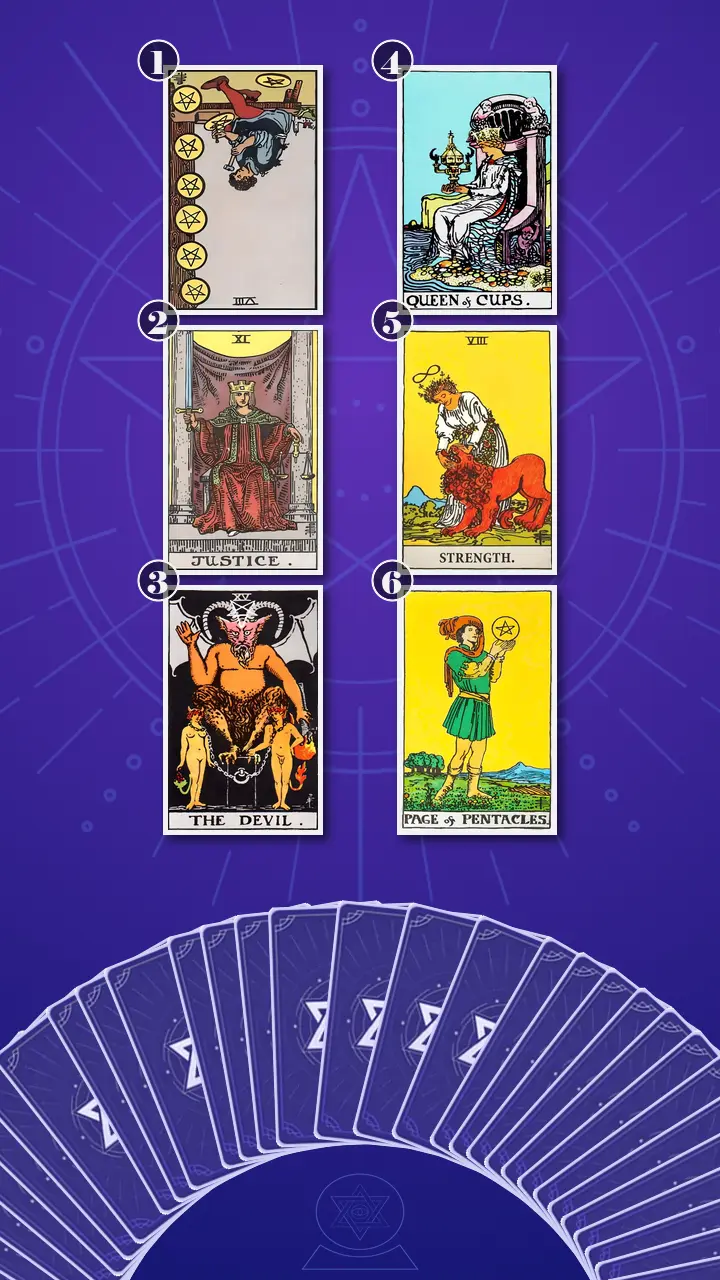
For you reading this: this is why this spread works so well for achievement-anxiety and self-advocacy under evaluation pressure. The left column isolates the loop—surface behavior, then the evaluation lens, then the root attachment that makes the whole thing feel life-or-death. The right column builds the exit ramp—regulation, the key reframe, and a practical next step you can actually do within a week.
“We’ll read it like a ladder,” I said. “Down the left side first—what you do, what you think the rules are, and what fear is underneath. Then we cross over to the right—what settles your nervous system, what changes the whole frame, and how to send something grounded.”
Reading the Map: How Tarot Works When You Feel Stuck
Position 1 — Surface pattern: what your hands do on the keyboard
“Now we’re turning over the card that represents the surface pattern: the concrete achievement-anxiety behavior that shows up while drafting the scholarship renewal email.”
Eight of Pentacles, reversed.
In my mind I saw the classic image—someone bent over a bench, repeating the same motion, pentacles lined up like a performance wall. And immediately, Maya’s reality snapped into place: 10:47 PM, swapping ‘completed’ for ‘successfully completed,’ reordering bullets, rereading the same sentence until it feels impressive enough. Reopening the criteria page like it’s going to hand her the exact phrase that makes her safe.
This is Earth energy—work ethic, craft, diligence—but in a blocked state. The work is real, but the flow is stuck. It’s craft turned into compulsive polishing because finishing feels like stepping onto a stage.
“This is the loop,” I said, keeping my voice calm and nonjudgmental. “Edit → tiny relief → doubt → edit. Your brain thinks it’s doing ‘responsible drafting,’ but it’s actually doing self-worth management.”
Maya let out that same tiny, bitter laugh again. She pressed her lips together, then nodded once, like she’d just been caught on camera. “That’s literally me rewriting the subject line for 40 minutes,” she said. “Like I’m A/B testing my personality until it converts.”
“Exactly,” I said. “Stop drafting a flawless identity. Start documenting real impact.”
Position 2 — Evaluation lens: the courtroom you didn’t agree to enter
“Now we’re turning over the card that represents the evaluation lens: the perceived rules, standards, or scrutiny shaping how the email feels.”
Justice, upright.
Maya’s shoulders tensed before I even finished naming the card—like her body recognized the idea of being weighed and measured. In Justice, the scales and the sword are clean and simple: criteria and decision. But when anxiety gets involved, that simplicity can become sharp.
Her modern-life version was immediate: Maya reads the renewal instructions like she’s in court. She’s not just answering a prompt—she’s building a case. She highlights the criteria, then silently adds a hidden one: “And I must sound exceptional or I’m out.”
Justice here is Air energy in a too-tight state: hyper-analytical self-auditing, negative forecasting, and “what if this proves I don’t belong.” It’s not that standards are bad. It’s that the standards have quietly turned into a sentence.
“A rubric isn’t a courtroom—unless you make it one,” I said. “So let’s do a quick internal cross-examination.”
I narrated two columns out loud, like I was writing them in the air:
What the renewal actually asks for: clear progress, clear impact, clear next steps.
What your anxiety is asking you to prove: that you’re exceptional as a person, that you never slip, that you’re not ‘needy,’ that your story is flawless.
Maya’s eyes softened—still serious, but less frantic. “Where did I even get that rule?” she murmured, half to me, half to herself.
Position 3 — Root driver: the chain under the perfectionism
“Now we’re turning over the card that represents the root driver: the deeper belief that turns a practical email into a threat to self-worth.”
The Devil, upright.
The Devil always changes the room. Even through a screen, the energy gets heavier—not because the card is ‘bad,’ but because it refuses to let us pretend. I’ve seen this card in readings for breakups, for burnout, for binge-scrolling at 2 a.m.—and for exactly this: the moment a normal administrative process gets welded to identity.
Maya’s scenario was painfully clear: her draft isn’t blocked because she lacks achievements—it’s blocked because the email has been welded to her sense of deservingness. Every time she writes a clean bullet, her mind raises the bar: “Okay, but is it impressive enough?” The chain is the moving goalpost.
“The chain isn’t the committee,” I said softly. “The chain is the rule you made up that says funding equals worth.”
Here, the energy is concentrated and binding. Like a browser tab you can’t close—an always-on scoreboard. And it shows up in the body exactly the way Maya described: chest tight, jaw clenched, and that sticky throat when it’s time to claim impact.
Maya went still—one of those silences that isn’t empty. She swallowed. Her gaze dropped to the bottom of her screen, unfocused, like she was replaying the last week of drafts and deletions. Then she nodded once. No smile this time. Just: “Yeah. That’s the chain.”
Position 4 — Regulating resource: the inner climate shift
“Now we’re turning over the card that represents the regulating resource: the inner capacity that helps your nervous system settle enough to write clearly and honestly.”
Queen of Cups, upright.
I exhaled when I saw her. Water in the spread—finally. The Queen of Cups holds a lidded cup: feelings contained, not dumped into the email as self-defense. The shoreline behind her is calm. Not numb. Calm.
Maya’s modern-life version is simple, almost boring, which is exactly why it works: she pauses before typing and notices her body—tight chest, tense hands, stuck throat. Instead of forcing “better wording,” she shifts into a steadier internal tone, like talking to herself the way she’d talk to a friend: specific, kind, not dramatic.
This is emotional regulation as a balancing energy. Not a pep talk. Not “just be confident.” More like: your system comes out of fight-or-flight long enough to do the actual task.
“Switch the camera from the laptop screen to your nervous system,” I told her. “Feet on the floor. Warm mug. One breath before you type. That’s not fluff—that’s the difference between writing like a human and writing like a defendant.”
Maya’s shoulders lowered a fraction. She reached for a mug off-screen—when she brought it back, her hands looked steadier. “I hate that this helps,” she said, almost embarrassed. “But it does.”
When Strength Took the Wheel: The Reframe That Breaks the Loop
Position 5 — Key shift: self-leadership under evaluation pressure
“Now we’re turning over the card that represents the key shift: the most important inner reframe that breaks the achievement-anxiety loop and restores self-leadership.”
As I turned the card, the planetarium memory hit me—hundreds of nights watching people try to control the sky with their expectations. You can’t grip the stars into place. You can only learn the rhythm and stand under it with steadiness.
Strength, upright.
The room felt quieter. Even the radiator on Maya’s end seemed to pause between clicks. Strength isn’t the energy of forcing yourself. It’s the energy of staying present. A gentle hand on a lion: the inner critic is loud, but it doesn’t have to drive.
Setup (the familiar trap): You know that moment when it’s 9:41 PM, your renewal email is open, and you keep rewriting the same two lines like the right wording will finally make you feel safe?
Delivery (the turning sentence):
Stop wrestling your draft into perfection and start holding your inner critic gently, like Strength’s steady hand on the lion, while you write what’s true and send it.
There was a beat of silence—long enough for the sentence to echo.
Maya’s reaction came in a chain of three small, unmistakable steps. First: a freeze—her breath caught, and her fingers stopped mid-hover above the trackpad. Second: the cognitive seep—her eyes went slightly unfocused, like she was watching herself hover over “Send” in her own memory. Third: emotion finally moved—her shoulders dropped on a shaky exhale.
Then the unexpected thing: her brows pulled together, and she looked almost angry. “But if that’s true,” she said, voice tight, “doesn’t that mean I’ve been… doing it wrong? Like I wasted all this time?”
“No,” I said immediately, steady and clear. “It means you were trying to get safety the only way your system knew: by controlling the output. That’s not ‘wrong.’ That’s protective. Strength just offers a different kind of protection—self-led, not fear-led.”
I leaned into my signature lens—what I call Black Hole Focus. “In astrophysics, the event horizon is the boundary where you stop getting information back. Past it, you don’t ‘try harder’ and get more certainty—you just lose energy. Perfectionism is your email’s event horizon.”
“So Strength looks like drawing the boundary before you cross it,” I continued. “One honest draft. One revision. That’s your event horizon. Past that point, you’re not improving the message—you’re feeding the black hole.”
Her face softened again. Not fully relaxed—more like someone setting down a heavy bag and realizing their hand is still cramped from carrying it.
“Now,” I said, “I want to give you something very concrete, because your nervous system needs proof, not vibes.”
I guided her through the practice exactly as it came through in the reading: set a 10-minute timer. Open a blank doc and write a facts-only mini-draft with this structure: (1) 1 sentence: what you worked on this term; (2) 3 bullets: one output + one impact + one collaboration (dates/counts if you have them); (3) 1 sentence: next step for the coming term. No adjectives. No ‘I’m excited to…’. When the timer ends, stop—even if it’s imperfect.
“And if your chest tightens or your jaw clenches,” I added, “hand on your sternum. Three slow breaths. Remind yourself: I’m allowed to send a finite summary. You can choose one revision later, but you’re not allowed to reopen it tonight.”
Then I asked her the integration question while the card’s meaning was still warm in the air: “Now, with this new lens—can you think of a moment last week when you hovered over ‘Send,’ felt that spike, and reopened the doc ‘one last time’? If Strength had been driving, what would have happened instead?”
Maya swallowed. “Tuesday,” she said. “I could’ve… just stopped. Like, actually stopped.” Another exhale. “Courage can look like one honest draft and one revision. That feels disgusting and relieving at the same time.”
“That’s how you know it’s real,” I said. “This is the shift from achievement-anxiety and perfectionistic self-surveillance to calm self-leadership. Not overnight. But right here.”
Position 6 — Actionable next step: make it a deliverable, not a performance
“Now we’re turning over the card that represents the actionable next step: how to draft and send the renewal message in a grounded, doable way within the next week.”
Page of Pentacles, upright.
The Page of Pentacles is the energy I trust when someone says, “Tell me what to do when I’m stuck.” It’s not glamorous. It’s practical follow-through. The page holds one pentacle at chest level—one tangible proof at a time.
Maya’s version is beautifully unromantic: treat the email like a simple deliverable. Three bullets with dates/outputs. One sentence about what’s next. Attach what’s requested. Schedule the send so your brain can’t turn reopening the draft into a nightly ritual.
This is Earth energy in functional balance. Not “convince them you’re amazing.” Just: communicate what happened, what changed because of it, and what you’re building next.
The Courtroom-to-Progress-Report Switch: Actionable Next Steps
When I looked back across the whole ladder, the story was almost painfully coherent.
The Eight of Pentacles reversed showed the visible habit: you keep polishing because “send” feels like exposure. Justice showed the lens: you turned a rubric into a courtroom and added extra rules no one asked for. The Devil revealed the engine: worth-binding—funding as proof of belonging—so your mind keeps moving the goalposts. Then Queen of Cups returned choice by regulating your nervous system. Strength delivered the key reframe: gentle self-leadership under evaluation pressure. And Page of Pentacles made it real: facts, structure, done.
The cognitive blind spot was this: you keep trying to solve a nervous-system problem with more evidence. But the fear isn’t missing information—it’s the belief that a finite summary could “prove” you’re not enough.
The transformation direction is simpler (and harder): shift from proving you deserve the scholarship to documenting your impact with one honest draft and one revision.
To make this actionable, I offered Maya a framework that blends my astronomy brain with your very human grad-student reality. I call it a Planetary Memory Palace: let the scholarship criteria be the Sun, and let each bullet “orbit” one criterion. No extra planets. No hidden moons. Just a clean system that doesn’t drift into anxiety-space.
- 90-Second Nervous-System Reset (Queen of Cups)Before you open the draft: feet flat, shoulders down. Inhale for 4 counts, exhale for 6 counts, three rounds. Then write one private sentence: “It makes sense this feels high-stakes; funding is safety.” After that, write the next sentence as a fact anyway.If opening your laptop spikes you, do the first sentence in your phone Notes app. The goal is steady, not inspired.
- 20-Minute Evidence Dump (Eight of Pentacles, rebalanced)Set a 20-minute timer and list everything you did this term—messy, unranked, no wording polish. Include “small” things: meetings, drafts, code fixes, TA improvements, literature reviews. Don’t decide what counts yet.Expect the thought “this is too normal.” That’s the Devil tugging the chain. Keep listing anyway.
- Three-Bullet Renewal Draft + One Revision Rule (Strength → Page of Pentacles)Draft a “facts-only” email: 1 sentence on what you worked on; 3 bullets written as action + output + impact (include dates/counts if you have them); 1 sentence: “Next term, I’m focused on ___ (one concrete deliverable).” Then do exactly one timed revision pass (15 minutes) and schedule the send.Use Black Hole Focus: treat “one revision” as your event horizon. After that, you’re not improving—you’re soothing anxiety. Close the doc for the night.

A Week Later: The Quiet Proof
Six days later, I got a message from Maya while I was walking through the planetarium’s darkened dome before the first show. The projector was warming up, that low mechanical purr that always reminds me: the sky is beautiful, but it’s also a system—repeatable, navigable.
Her text was short: “Did the timer thing. Wrote the three bullets. One revision. Sent it at 11:00 AM like it was a deliverable. I didn’t die.”
Then, a second message: “I still woke up and thought, ‘What if it wasn’t enough?’ But I made coffee, read the email I sent, and it sounded… normal. And clear. And I didn’t hate myself.”
That’s the kind of clarity I trust—the kind that doesn’t promise certainty, but does return you to yourself. From achievement-anxiety and perfectionistic self-surveillance to calm self-leadership and grounded pride after pressing send.
When an email starts to feel like it has to prove you deserve your place, your body treats the draft like a verdict—tight chest, clenched jaw, and that stuck-in-your-throat feeling right before you say something true about your own work.
If you didn’t have to sound extraordinary to be legitimate, what would your most honest three-bullet version of this term look like—just for you, just as facts?
This story is adapted from psychological research, written so that those in a similar struggle can see their own pattern in it — and find their next step clearly.These insights are not a substitute for professional psychological, medical, legal, or financial advice.
Learn more about our Journey to Clarity.
How did this insight land for you?
🫂 This Resonates Deeply
🌀 Living This Story
✨ Now I See Clearly
🌱 Seeing New Possibilities
🧰 Useful Framework
🔮 The Confirmation I Needed
💪 Feeling Empowered
🚀 Ready for My Next Step
Author Profile
 AI
AI“After a decade of guiding people through the stars, I’ve come to see life much like the orbits of planets: everything has its inevitable cycles. When you feel lost, please don't blame yourself; you might just be in a natural low tide. I’m here to sit under the night sky with you, offering a gentle cosmic perspective to distinguish temporary pain from the beautiful breakthroughs just around the corner.”
In this Study Tarot Reading :
Core Expertise
Service Features
Also specializes in :
Explore Related Patterns:
Achievement FusionMaya says that sending a normal email would feel like admitting she is normal, and the renewal message becomes welded to her sense of deservingness. That line is the core hinge of the story: the email is no longer just an update about academic progress; it has become a symbolic test of whether her achievements are enough to justify funding and belonging. Achievement Fusion fits because the task, the outcome, and the self have collapsed into one psychological object. A clean bullet about work completed should be evidence for a renewal process, but Maya's mind treats it as evidence for or against her legitimacy. Every time she writes something concrete, the bar moves again because the real demand is not clarity; it is identity protection. You are not looking at simple ambition here. The pattern is the fusion of achievement with worth, where a finite administrative message starts carrying the emotional weight of a verdict. Seeing that fusion creates a way out: the email can return to being documentation of impact rather than a trial over whether you deserve your place.
Action ParalysisMaya's fingers hover over the keyboard, retreat to backspace, and keep the email trapped in draft mode for three hours. She has achievements to report and a clear task in front of her, but the final action, pressing send, becomes the point where the whole system freezes. Action Paralysis fits because the blockage is not a lack of desire or a lack of information. The action is suspended by evaluation pressure: sending would make the message real, visible, and no longer endlessly adjustable. Rewriting preserves the feeling of doing something while protecting her from the exposure of completion. You can see why the exit strategy has to be behavioral as well as cognitive: one honest draft, one revision, then close the document. That boundary matters because the pattern keeps disguising avoidance as preparation. Once the mechanism is visible, the next step is not to think harder; it is to lower the stakes enough for action to become possible.
Certainty SeekingMaya keeps reopening the criteria page, rereading the same sentence, and searching for wording that will finally feel safe enough to send. The checking looks responsible on the surface, but the repeated return to the same material shows that information is being used as emotional reassurance. Certainty Seeking fits because her mind is trying to remove evaluation risk before taking action. The scholarship instructions ask for clear progress, impact, and next steps, but anxiety adds a hidden requirement: find the exact phrasing that guarantees she will not be judged as ordinary, needy, or insufficient. That guarantee is not available, so the search keeps restarting. You can feel the trap in the courtroom framing. The more Maya tries to secure certainty through evidence, the more the email feels like a case she has to win. The pattern names the mechanism: the issue is not a lack of preparation, but an attempt to make uncertainty disappear before pressing send.
PerfectionismMaya's hands keep returning to backspace, the subject line gets rewritten for 40 minutes, and the scholarship criteria page stays open like it might reveal the one phrase that makes the email safe. The visible behavior is not just careful editing; it is a loop where polish temporarily lowers anxiety, then doubt returns and demands another pass. That loop points to Perfectionism because the draft has stopped being a communication task and has become a self-worth management system. Instead of asking, "Does this clearly document my progress?" the nervous system starts asking, "Does this prove I am exceptional enough to deserve my place?" The standard keeps moving, which makes completion feel dangerous. You can see the pattern most clearly in the difference between the actual renewal requirements and the hidden rules Maya adds. The email only needs progress, impact, and next steps, but her anxiety turns it into a performance of flawless legitimacy. Naming Perfectionism here gives you a clean audit point: the problem is not that the work is unfinished; it is that the finish line has been psychologically tied to being beyond criticism.
Shame BindingMaya can name that she did things this term, but once those achievements have to appear on paper, they start to feel like they do not count. Each clean bullet meets a new internal objection: it may be true, but is it impressive enough to justify the scholarship, the money, and the place she has built? Shame Binding fits because the story links evaluation with personal worth in a way that makes ordinary self-advocacy feel exposing. The committee is not shown doing anything harsh in the narrative; the pressure comes from the internal rule that funding equals deservingness. That rule binds the practical outcome to the self. You can hear the shame logic in the fear of sounding normal. Normal becomes coded as insufficient, and insufficient becomes coded as personally unsafe. Naming Shame Binding does not pathologize the fear; it shows where the emotional charge is attached, so the renewal email can be handled as evidence of work rather than evidence of human worth.
Explore Related Struggles:
Inner Tribunal LockMaya reads the renewal criteria as if she has entered a courtroom, even though the actual request is clear progress, clear impact, and clear next steps. The official rubric stays simple, but an extra rule appears inside the process: she must sound exceptional, never slip, and make the story flawless. You are looking at a draft where the evaluator outside the screen is no longer the only judge. The sharper pressure comes from an internal court that keeps demanding stronger proof after the practical requirement has already been met. That is why reopening the criteria page does not settle her; the hidden standard is not written there. Inner Tribunal Lock names the moment external evaluation gets absorbed into an internal verdict system. The email is no longer just being reviewed; Maya is being cross-examined by a standard she never formally agreed to. The way out begins when the actual criteria are allowed to outrank the invisible prosecution.
Performance-Worth FusionMaya's renewal email stops being a progress report the moment each bullet has to answer a bigger question: does this prove I deserve the funding and the place I have built here? The story shows her work is real, but the draft has been welded to worth, so every clean sentence becomes another moving goalpost. You can feel the bind in the line between "I did things this term" and "none of it feels like it counts on paper." The task asks for evidence, but the pressure asks for legitimacy. Once performance becomes the proof of personal worth, a normal email starts to feel dangerous because normal no longer feels allowed. Performance-Worth Fusion fits because the blockage is not a lack of achievement or a lack of writing skill. The struggle is the fused equation underneath the draft: if the email is not exceptional, then the self may not be valid enough to belong. Seeing that equation gives you a place to separate the work from the verdict.
Visibility-Execution SplitMaya's hands keep approaching the keyboard and pulling back, with the draft open for hours and the send threshold untouched. Even the phrase "I accomplished" catches in her throat, as if naming her work out loud makes the whole body brace for impact. You can see the split between execution and visibility: the email is technically simple enough to send, but sending means putting a claim about herself on record. The task requires completion, while the body treats completion as exposure. Visibility-Execution Split fits because the stuck point is not the first sentence or the formatting. The freeze happens where action would make her visible. Once that is named, the goal can shift from becoming fearless to making visibility small, factual, and survivable enough to complete.
Evidence DisconnectionMaya knows she did things this term, yet the work loses weight the moment it has to appear on paper. The evidence exists, but it does not feel usable, so she keeps searching the criteria page for wording that might finally make the facts count. You can hear the mismatch in the repeated polishing: more information is being gathered for a problem that is not actually missing information. The draft needs concrete outputs, but her system is trying to convert those outputs into permission to feel legitimate. Evidence Disconnection captures the gap between real impact and internally accepted proof. The facts are not absent; the bridge between fact and recognition is unstable. Naming that bridge allows the email to become a record of work done, not a trial over whether the work is impressive enough to exist.
Monitoring-Safety FusionMaya keeps the renewal email in one tab and the criteria page in the next, checking the instructions as if they might reveal the phrase that makes her safe. Each edit gives a small hit of relief, then doubt returns and the monitoring starts again. You can see how checking becomes a substitute for safety. The rubric is supposed to guide the message, but it turns into a device for scanning herself: does this sound exceptional, flawless, not needy, not too normal? The more she monitors, the less the draft can simply become done. Monitoring-Safety Fusion fits because the checking is not random procrastination. It is an attempt to manufacture security under evaluation by keeping every sentence under surveillance. The practical exit is not to stop caring; it is to let the criteria define the task without letting monitoring become the only way to feel protected.
Explore Related Emotions:
Not-Enough PanicMaya says she knows she did things this term, but none of it feels like it counts on paper. That line carries the whole pressure system, because the problem is not missing evidence. The problem is that ordinary evidence feels emotionally unsafe once it has to represent you. Not-Enough Panic shows up in the jump from documented work to personal worth. Each bullet should be a record of impact, but the inner bar keeps moving, asking whether the wording is impressive enough, whether the achievement is special enough, whether a normal email will expose you as merely normal. The label matters because it separates your actual progress from the spike around presenting it. You do not need the panic to disappear before writing; you need to recognize when it is turning a finite summary into a test of your whole legitimacy.
Rulebook ShameMaya reads the renewal instructions and silently adds a rule no one wrote, that she must sound exceptional or she is out. The shame gathers around the gap between the actual rubric and the private rulebook that says ordinary progress is not enough to show. Rulebook Shame is the sting that appears when you judge your own work by standards that keep multiplying. The criteria ask for progress and impact, but the inner rulebook asks for flawlessness, exceptional tone, and a version of you that cannot be questioned. Seeing the rulebook helps loosen its authority. You can still respect the real criteria while refusing the extra shame that says a clear, normal email is somehow an admission of failure.
Self-Audit AnxietyThe renewal email is open in one tab and the scholarship criteria page is open in the next, like your draft has to be checked against an instruction manual for being acceptable. What begins as responsible review becomes a running internal audit. Self-Audit Anxiety fits because the standards in the story do not stay external and simple. Clear progress, clear impact, and clear next steps get mixed with hidden demands to sound exceptional, never slip, never seem needy, and never appear ordinary. Once that audit is named, the rules can be separated. There is the actual renewal request, and then there is the extra courtroom your mind builds around it. The first needs a clear email; the second will keep asking for more proof.
Verdict DreadAt 9:38 PM, the renewal email sits beside the criteria page while your shoulders stay lifted, braced, waiting for impact. A normal scholarship update has become a courtroom in miniature, with every sentence treated as evidence and the send button treated like the moment the decision lands. Verdict Dread fits because the body in the story is not responding to an email as an email. It is responding to the imagined judgment underneath it, whether your work is enough, whether you deserve the money, and whether your place in the program is secure. Naming it gives you leverage. The task is still real, but the emotional charge becomes visible as a judgment frame rather than proof that you need to keep rewriting until certainty appears.
Visibility PressureWhen Maya tries to say 'I accomplished,' her throat catches as if the sentence is too large to swallow. The pressure gathers at the point where private effort has to become public language. Visibility Pressure names the strain of being seen through your own self-description. The email is not only asking for facts; it is asking you to present your impact to people who can evaluate it, and that makes ordinary wording feel exposed. The pressure does not mean you have to inflate the message. It means visibility has become loaded, so the next useful move is to make the message specific enough to be honest and bounded enough to stop performing.
Completion AnxietyAt 10:47 PM, one word becomes a slightly shinier word, the bullets get reordered, and the same sentence is reread until it feels impressive enough. The draft keeps moving, but it is not moving toward completion; it is orbiting the fear of being done. Completion Anxiety fits because sending removes the comfort of another revision. While the draft stays open, you can still chase relief through adjustment. Once it is sent, the message has to stand as a finite summary, and that finiteness is what feels charged. The one-revision boundary matters because it protects completion from becoming a nightly ritual. It gives you a clean edge where the task can end before anxiety turns more editing into a substitute for safety.
Performance FreezeHer fingers hover over the keyboard, retreat to backspace, and her throat catches right before the words 'I accomplished' can come out. The freeze is not abstract; it is visible in the hand, jaw, and voice at the exact moment the work has to be claimed. Performance Freeze names the suspended state between capability and expression. You have the material, the draft is open, and the criteria are known, but the act of putting yourself on record makes the body stall as if visibility itself is the risk. That distinction is useful because it keeps the focus off laziness or lack of discipline. The stuck point is the performance threshold, the moment where doing the task becomes being evaluated through the task.
Grounded AgencySix days later, Maya writes the three bullets, does one revision, and sends the email at 11:00 AM like it is a deliverable. The action is plain, but that plainness is exactly the point. Grounded Agency names the moment the task becomes navigable again. You are no longer trying to produce a flawless identity through a renewal message; you are choosing a structure, respecting a limit, and letting the email do the job it was actually built to do. The agency is grounded because it is practical rather than performative. Timer, bullets, one revision, close the document. Those limits return choice to you without demanding total certainty first.
Hard-Won ComposureMaya reaches for a mug off-screen, and when she brings it back her hands look steadier. The shift is small, bodily, and unglamorous, but the apartment no longer feels entirely ruled by the draft. Hard-Won Composure fits because the calm in the story is not a sudden burst of confidence. It is built through containment, one breath, feet on the floor, a warmer internal voice, and enough distance from the laptop screen to write like a person rather than a defendant. This composure has weight because it is earned inside pressure, not outside it. You are not pretending the renewal does not matter; you are creating just enough steadiness to stop letting the pressure write the email for you.
Clarity ReliefAfter the email is sent, Maya wakes up with the thought that it might not have been enough, then reads what she sent and finds that it sounds normal and clear. The relief is not dramatic; it is the quiet recognition that the message can be ordinary and still stand. Clarity Relief fits because the fog lifts when the email stops carrying the full burden of self-worth. Facts, impact, and next steps create a clean channel where the work can be seen without being inflated into a performance. The relief does not come from guaranteed approval. It comes from seeing the draft accurately, as a clear summary rather than a verdict on who you are.
Explore Related Contexts:
Academic Performance PersonaMaya is asked to send a renewal email, but her drafting behavior shows her trying to manufacture a version of herself that will survive review. She rewrites the subject line, polishes ordinary verbs, and treats the phrase “I accomplished” as something too exposed to say without armor. The academic environment requires translation: meetings, drafts, collaborations, and term progress have to become institutional language. Under pressure, that translation turns into persona management, where the email must not only report work but project the image of a high-performing scholar who clearly belongs. Academic Performance Persona is the right label because the story is not about laziness or lack of evidence. You are watching a student prepare a public academic self for evaluation, and the path out comes from replacing identity performance with specific, limited, verifiable progress.
Access as Proof PressureMaya names the core pressure directly when she says that sending a normal email would feel like admitting she is normal. The scholarship renewal has stopped being only a request for updated information; it has become a gate where continued access seems to require proof that she is exceptional enough to deserve funding and belonging. The phrase matters because money and place are fused together in the story. Maya is not just trying to keep a financial resource; she is trying to keep the academic position that resource appears to validate. A clean bullet point starts to look too small for what the system seems to be asking her to prove. Access as Proof Pressure captures that external bind. You are dealing with a context where support feels conditional on performing legitimacy, and the first practical move is to return the email to its actual function: documenting impact, not proving human worth.
Evaluation Pressure LoopMaya keeps hovering over the keyboard, backspacing, swapping words, reordering bullets, and reopening the criteria page as if the next phrase might finally make the message safe. The visible loop is edit, relief, doubt, edit, but the external structure underneath it is evaluation: an institutional renewal process that has to decide whether her progress is enough. The criteria are not hostile on their own, yet Maya reads them like a courtroom. She silently adds a rule the scholarship process never states: that a normal email could expose her as normal, and normal might not be enough to keep the support. Evaluation Pressure Loop fits because the pressure is not located in one sentence or one mistake. You are watching a system of scrutiny get internalized into the drafting process, where each attempt to reduce risk creates another round of review before the email can leave the screen.
Performance Defense ModeMaya approaches the renewal email as if each sentence could be used for or against her. She is not just making the message clearer; she is building a defense, rereading the same line until it feels strong enough to answer an imagined charge of not being impressive, not deserving, or not secure. The courtroom image in the reading is grounded in the actual behavior around the criteria page. A rubric becomes a trial structure, and the draft becomes the case file. That makes the send button feel like exposure because once the message leaves her laptop, the defense is no longer under her control. Performance Defense Mode names the social posture created by that pressure. You are in a context where achievement must be argued before it can be trusted, and agency returns when the email is treated as a deliverable with evidence rather than a legal brief for belonging.