Six Figma Comments in Notion, Then One CTA Changed in Twenty Minutes

The Comment Bubble and the Productive Procrastination Loop
If you are an early-career designer in Toronto who turns feedback into a colour-coded Notion board before touching the draft, I already know the strange competence of that move. From the outside, it looks organised. Inside, your hands remain suspended above the one edit that matters.
At 4:47 p.m. on a Tuesday, I sat with Alex at a downtown Toronto desk after a hybrid-team critique call. Alex opened a commented Figma prototype, copied six yellow annotations into Notion, renamed the file onboarding-v7-final, and cleared three Slack notifications. The fluorescent lights buzzed overhead. Burnt coffee lingered in the room. Each time Alex glanced at the untouched comment bubbles, their shoulders crept closer to their ears and their jaw tightened.
Alex looked at me and said, I know feedback is normal, but it still feels like I got caught. I keep preparing to revise instead of revising. I want the work to improve, but starting the first edit feels like opening evidence that I am not good enough. That was the real contradiction: the desire to improve the work pressed against the fear that engaging with feedback would expose inadequate competence.
I could see the apprehension in the body before Alex named it. It was as if an invisible elastic band had been pulled from the back of their neck to the blinking cursor, making every breath short and every ordinary comment feel heavier than it was. The pattern had a familiar shape: feedback-triggered perfectionism, followed by productive procrastination that looked responsible while leaving the actual draft unchanged.
I told Alex that feedback can sting without becoming a verdict. We would not use the cards to predict a career outcome or decide whether they belonged in the room. We would use them as an objective map of the pattern, so Alex could see where the reaction began, what it was protecting, and what small action could return ownership of the work to them. Our Journey to Clarity would begin with one honest question: what does the comment actually ask for?

Choosing a Compass for the Revision Spiral
I asked Alex to put both feet on the floor, take one slower breath, and hold the feedback question in mind without trying to solve it. Then I shuffled slowly. The pause was not a supernatural test. It was a practical transition from reacting to observing, giving the mind a clean surface on which to notice its own habits.
For this reading, I chose The Shadow Spread, a five-card tarot spread for tracing a visible behaviour back through its hidden fear, protective detour, conscious resource, and constructive integration. The issue fits this structure because the delay is not caused by missing instructions or a simple scheduling problem. It is maintained by a worth-based interpretation of feedback, followed by a cycle of planning, avoidance, deadline pressure, and self-criticism.
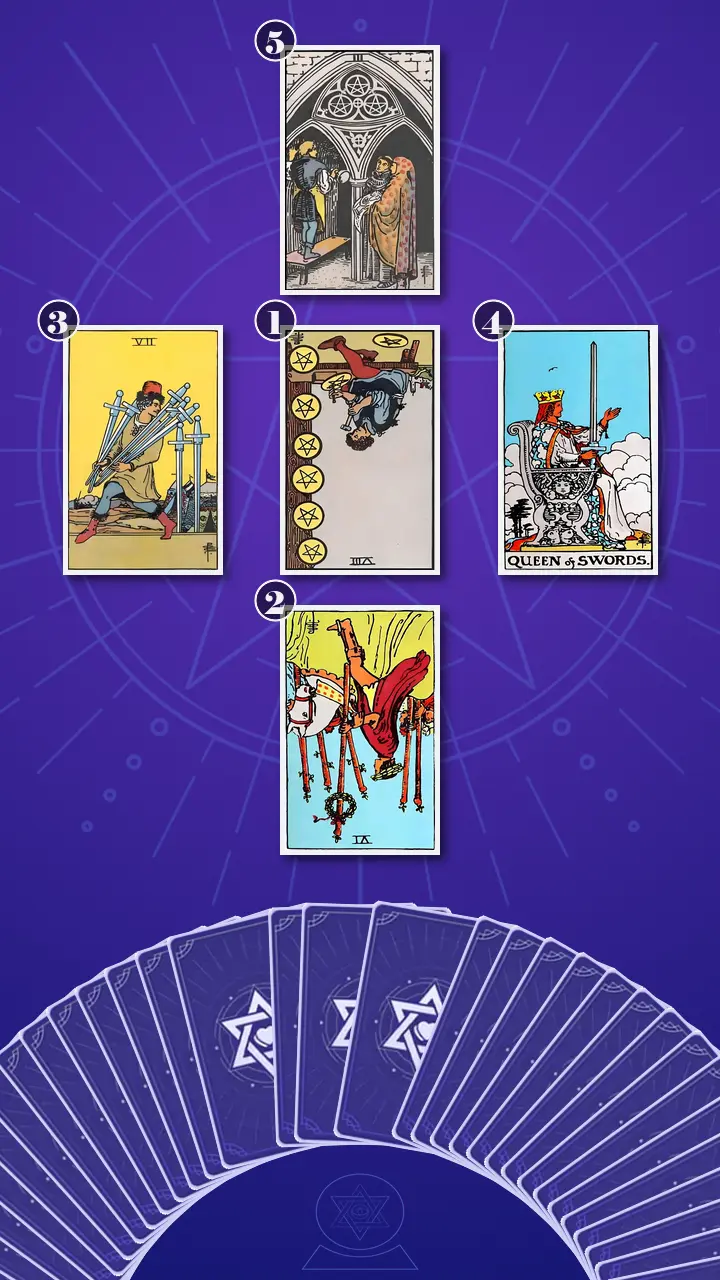
For anyone wondering how tarot works in a practical reading, this is the useful part: the cards provide a sequence of precise questions. The five-card Shadow Spread moves from what can be seen on the screen to what is happening underneath it, then toward a response that can be tested in real life. Position 1 shows the conscious shadow, the revision delay itself. Position 2 reveals the hidden wound beneath it. Position 3 identifies the protective strategy. Position 4 offers the clear inner resource. Position 5 translates the insight into an integrated practice.
I placed the first card in the centre, the second below it, the third to the left, the fourth to the right, and the fifth above the centre. The arrangement resembled a small compass. The hub was the current behaviour. The downward point led into the fear. The horizontal line showed the detour and the resource. The upward point suggested a more workable relationship with feedback, not a perfect one.
Reading the Map Without a Verdict
Position 1: The Workbench Behind the Tracker
Now I turned the card representing the observable revision delay: opening and organising the commented draft without making the first edit. It was the Eight of Pentacles, in reversed position.
In the upright image, a craftsperson sits at a workbench, repeating a skill one unit at a time. Reversed, that rhythm is interrupted. The energy is not a lack of diligence. It is blocked craftsmanship. Alex understood the task, but the ordinary repetition of editing had become tangled with the need to prove competence before beginning.
The modern scene was already on the desk in front of us: Figma comments copied into Notion, a new version name, carefully sorted priorities, cleared Slack messages, and no changed copy. The tracker was immaculate because the tracker offered distance. A revision pass would put Alex back at the workbench, where the first imperfect change could be seen.
I explained that this card did not call Alex lazy or disorganised. It showed an overcorrection. Alex was trying to secure a complete plan and a large uninterrupted block of time before touching one sentence. That made the deadline closer and made the first edit feel more consequential. The Eight of Pentacles reversed asked for a smaller return to practice: one comment, one bounded pass, no judgement of the whole draft.
Alex did not nod. They gave a short, bitter laugh and said, That is too accurate. Almost cruel. Their fingers stopped above the edge of the notebook, then pressed flat against the paper. I said, Let the accuracy be information, not punishment. The card is showing the protection, not passing a sentence on you. When Alex looked back at the unchanged prototype, their shoulders lowered by a fraction.
Position 2: The Invisible Leaderboard
I moved to the card beneath the centre, the position revealing the underlying fear that feedback could expose inadequate competence and threaten self-worth. It was the Six of Wands, in reversed position.
The Six of Wands usually carries recognition, confidence, and public approval. Reversed, the fire of confidence has become unstable. Recognition is no longer something Alex can receive as useful information; it has become something they must constantly recover. A practical note about a screen begins to feel like a loss of professional standing.
I brought up the Wednesday critique call that Alex had described. A teammate had received enthusiastic praise for a polished onboarding flow. Alex had kept their camera composed, taken detailed notes, and smiled at the right moments. Ten minutes later, alone at the desk, they reread one comment: make this more direct for first-time users. The literal note was small. The story that arrived behind it was much larger: they think I should already know this; they can see I am not ready for this role.
I asked Alex to notice the distance between those two sentences. The first belonged to the work. The second belonged to an invisible leaderboard that nobody had announced. The reversed Six of Wands showed the deepest blockage in the spread: approval had become the condition for safe action, so revision felt like stepping onto a stage while already expecting the audience to withdraw its applause.
Alex stared at the tabletop. Their breathing paused, their eyes moved briefly out of focus, and then their thumb began rubbing the same corner of the notebook again and again. I asked, When you read that comment, what did you fear it would prove beyond the actual onboarding message? Alex answered quietly, That I am behind. That everyone else knows how to take feedback and I am still making beginner mistakes. I let the silence stay long enough for the answer to become something observed rather than something obeyed.
Position 3: The Side Quest That Feels Like Progress
Now I turned the card representing the protective strategy: the planning, tracking, and low-stakes work that substitutes for direct revision. It was the Seven of Swords, in upright position.
This card is often associated with strategy, indirect action, evasion, and carrying away only part of what must be handled. I did not read it as deception. In Alex's case, it showed a clever nervous system choosing manageable pieces of the task while leaving the exposed edit behind.
I returned to the Thursday evening scene Alex had described on Line 1 southbound. The train brakes squealed. Someone's takeaway smelled sharply of garlic. The phone screen warmed Alex's palm while they marked a Jira ticket in progress, replied thanks, I will take a pass, added deadlines, and scheduled a focus block for Friday. Each action created a visible trace of responsibility. None changed the commented paragraph.
I said, I did something, so I could postpone doing the thing is the emotional logic here. The relief is real, but temporary. The phrase I wanted Alex to keep was simple: a perfect revision plan can be a very polished way to avoid one imperfect edit.
The card showed air turned into a detour. Alex was not refusing the work. They were moving around the moment of exposure. I asked, At the end of the twenty minutes spent organising, what had changed in the draft, and what discomfort had been briefly avoided? Alex looked down, then let out another small laugh, this one without the earlier sting. Their hand moved toward the laptop, but stopped before opening it. That pause was useful. It was the first moment in which the pattern had become visible before it completed itself.
Position 4: The Clean Line Between Work and Worth
I turned the card representing the conscious resource available for meeting the shadow. It was the Queen of Swords, in upright position.
Her upright sword offered a clean line between evidence and interpretation. Her open hand kept that clarity from becoming defensiveness. This was not an invitation to reject every comment or pretend criticism should feel easy. It was an invitation to translate each note into a concrete claim, question, or requested action, then decide what deserved attention.
I wrote two headings on a plain page: What the comment says about the work and What I am telling myself it says about me. Under the first, I wrote make the onboarding message more direct. Under the second, Alex wrote they think I do not understand UX writing. Both statements were emotionally real. They were not equally useful as instructions.
I said, The comment is about the work. The spiral is about worth. That distinction did not erase the sting. It stopped the sting from becoming the only available interpretation. A vague annotation could become a product question: what user behaviour is this meant to support? A genuinely unclear note could become a focused clarification request rather than an invitation to guess what the reviewer secretly thought.
For a moment, I remembered my years on Wall Street, where a single red number could quickly become a story about an entire company. The discipline was to define the metric before arguing with the feeling. I use the same discipline here. Clarity is not emotional denial. It is knowing which part of the experience is evidence, which part is prediction, and which part still needs a conversation.
Alex read the two columns twice. Their jaw remained tight, but their breathing became lower and steadier. I asked, What would change if you did not have to decide whether you were good enough before deciding what the comment was asking for? Alex answered, I might be able to start before I feel ready.
When the Shared Blueprint Turned Revision Into Craft
Position 5: The Work That Gets Stronger in Company
The room grew quieter when I reached the card above the centre, the position translating the key shift into an integrated practice: treating feedback as collaborative craft and completing one bounded revision step. It was the Three of Pentacles, in upright position.
The card showed an artisan working within a stone structure while two collaborators studied a shared plan. Its energy was grounded, practical, and relational. Revision was no longer a private exam that Alex had to pass before returning to the team. It was part of how useful work became stronger: one visible change, one specific question, one exchange of information at a time.
I told Alex that the scene was closer to a pull-request conversation than a public ranking. The reviewer could bring context about users, constraints, or the intended decision. Alex still retained professional judgement. Like The Karate Kid only in the limited sense that repeated correction can become embodied skill, the value was in practice, not submission to an unquestionable authority.
At this point I used one of my own diagnostic lenses, Institutional Resource Leverage. In academic work, I ask whether a mentor or university network is being treated as a distant judge or engaged as a strategic source of context through a precise question. The same logic applied here. The reviewer was not a tribunal. They held information Alex could use. Returning one revised section with one focused question would turn that relationship into a working resource without handing over ownership of the work.
The Setup
It was Sunday night in the imagined scene. The tea beside the laptop had gone cold, and the same Figma comments had been opened four times. Alex had planned the revision, labelled it, scheduled it, and waited to feel ready while the cursor blinked in the unchanged sentence.
The Sentence That Changed the Reading
Feedback is not a verdict on whether you belong; treat each comment as one mark on the shared blueprint, and let the Three of Pentacles turn revision into craft.
The Reinforcement
For three seconds, Alex did not move. Their breath stopped halfway in, and the hand resting near the trackpad held still. Then their eyes left the card and went unfocused, as if they were replaying every tracker, renamed file, and polite message that had once felt like progress. I watched recognition travel through their face: the brow loosened, the pupils widened, and their eyes became bright. The fist around the pen opened one finger at a time. Their shoulders dropped, followed by a long, unsteady breath. A small laugh came out, embarrassed and relieved. The release was not clean triumph. It carried a brief dizziness, the hollow feeling after setting down a heavy bag, and a vulnerable pause before taking responsibility for the next choice. Outside, the office vent clicked off, making the cursor's tiny blink sound almost audible. I waited, then asked, Now, use this new perspective to think back: was there a moment last week when this insight could have made you feel different?
Alex looked toward the window. Tuesday at 4:47, they said. I could have changed the CTA before I built the whole system around changing it. The sentence did not make the old reaction disappear. It gave the reaction a different place in the sequence.
This was the first meaningful movement in the emotional transformation from shame-tinged apprehension and approval anxiety to grounded confidence through visible, bounded, collaborative iteration. Alex did not need certainty before acting. They needed a smaller object of attention and a relationship with feedback that allowed both discernment and participation.
The One-Comment Pass Toward Finding Clarity
When I placed the five cards together, the story became straightforward. The Eight of Pentacles reversed showed hands frozen at the workbench while preparation impersonated progress. The Six of Wands reversed revealed why a routine comment felt so large: Alex had attached it to recognition, belonging, and future stability. The Seven of Swords showed the protective detours that briefly lowered the discomfort while leaving the central edit untouched. The Queen of Swords restored a clean distinction between a requested change and an identity story. The Three of Pentacles returned the work to shared structure.
The cognitive blind spot was not simply poor time management. Alex had been treating readiness as a prerequisite for contact with the draft, as though the whole feedback set had to be understood and emotionally neutral before one sentence could change. The deeper shift was from treating feedback as a full verdict to selecting one comment and completing one time-limited revision pass within twenty-four hours.
Before we finished, I adapted The Research Sunk-Cost Audit, my framework for deciding whether a stalled academic project should pivot or persevere. I asked three practical questions: what effort has already been spent, what information would the next small experiment produce, and what decision actually needs to be made now? The point was not to justify every hour already invested by forcing a perfect revision. The point was to separate sunk effort from the next useful piece of evidence.
For Alex, that evidence could be modest. One changed sentence could reveal whether the comment had been understood. One clarification question could reveal whether the reviewer meant user comprehension, tone, or flow. A small visible iteration could show that revision is where competence becomes visible, not where it gets disproved.
- One comment, one pass, twenty minutes.Within twenty-four hours of the next critique, Alex will open the actual commented Figma file before opening Notion, Jira, Slack, or email. They will choose one comment that requests an observable change, set a twenty-minute phone timer, and make one revision pass on that item. When the timer ends, they will write one factual line: Comment, edit tried, result noticed.If twenty minutes feels impossible, use the five-minute version and change one sentence. This is not a promise to finish the document or accept every comment. It is one contact point with the work, with the task board kept in another tab.
- The Work-versus-Worth Two-Column Check.When one note feels especially charged, Alex will write its literal request under What the comment says about the work and the identity story under What I am telling myself it says about me. They will circle one item in the first column that can be tested in the current draft, then either make that edit or write one clarification question.Do this with one comment, not the whole page. The exercise does not require pretending the note feels pleasant. If the wording is vague, ask what user behaviour the change is meant to support instead of guessing.
- Return one piece of the shared blueprint.After revising one defined section of the prototype, Alex will send it back to the reviewer with a maximum of three sentences: what changed, what remains uncertain, and what input would help. The question will stay focused on one screen, paragraph, or user problem rather than the entire project.Send the bounded update before starting another revision block. A work in progress does not surrender ownership of the work. If direct messaging feels high-stakes, draft the note first, then check that it describes the specific uncertainty rather than asking for general reassurance.
These next steps were intentionally small. They did not ask Alex to become fearless, eliminate every comment, or produce a flawless first response. They created a bounded craft loop: notice the contraction, separate evidence from the worth story, make one useful change, and invite one precise piece of shared information.

A Quiet Proof in Toronto Light
Three days later, I received Alex's message. They had opened one section before Notion, changed a CTA in twenty minutes, and sent a focused question. That night they slept fully. Morning still began with the thought, What if I am wrong? This time, they smiled, made coffee, and returned to the file.
That was the proof. The tarot did not revise the prototype, and it did not guarantee that every reviewer would agree. Alex did something more useful: they used the reading to make their own judgement visible. Grounded confidence began as evidence gathered through action, not as a mood that had to arrive first.
When a single yellow comment bubble makes your shoulders rise and your chest go tight, improving the draft and protecting your place in the room can feel like the same impossible task. I have seen how gently that knot can loosen when the two tasks are named separately. The comment belongs to the work. The spiral belongs to a story about worth. You do not have to solve the story before touching the next mark on the blueprint.
If one comment could be held as a small piece of shared craft rather than a measure of your worth, which one would you be curious to touch first?