One WIP Capstone Paragraph Moved Submission Dread Toward Feedback

The 8:40 p.m. Google Docs Spiral
I meet plenty of final-year students who know exactly which section is unfinished, yet every quiet evening reserved for writing becomes a round of productive procrastination: six research tabs, a cleaner source folder, and no new paragraph. That was how Maya, a 24-year-old communications student in Toronto, arrived at our reading.
At 8:40 on a Tuesday evening, Maya joined our video call from her kitchen table. Blue laptop light sharpened the tired shadows beneath her eyes, the fan whirred beside a mug of coffee that had gone cold enough to taste metallic, and two placeholder bullets sat beneath the heading marked “Conclusion.” While she explained the problem, I watched her adjust the reference-list spacing, check a message, and rename a source folder. Her shoulders rose a little higher after every click.
“I know what I need to do, so why can’t I just do it?” she asked. “The last section has to make the whole thing make sense. I keep working on it without actually moving it forward.”
The feeling had settled across her body like a wet graduation gown: heavy at the shoulders, tight beneath the jaw, and impossible to forget while the document was open. She wanted to finish badly enough that finishing had begun to feel dangerous. A completed capstone would bring relief, but it would also become visible, reviewable, and final. Incompletion still allowed the comforting possibility that the finished version might eventually prove everything she hoped it would.
I named the pattern carefully. Completion avoidance and capstone anxiety can hide inside tasks that look responsible. The internal script often sounds like, “I know I need to draft the conclusion, but first I need to fix the references, find one more source, or build a clearer plan.” The closer the work gets to real, the more perfection can masquerade as preparation.
“I don’t hear laziness in what you’re describing,” I told her. “I hear a protection strategy that gives you a few minutes of relief from being evaluated, then leaves you with a tighter deadline. I’m not going to use tarot to predict your grade or tell you what you must do. I want to use it as an objective reflection tool. Let’s give the fog a structure, separate the academic task from the story attached to it, and find one next move that still belongs to you.”

Choosing the Four-Rung Ladder
I asked Maya to close the capstone for a moment, place both feet on the floor, and take one unforced breath. I shuffled while she held a single question in mind: “Why do I keep avoiding my capstone now that finishing feels real?” The pause was not a mystical performance. It was a transition from reacting to the document toward observing what happened around it.
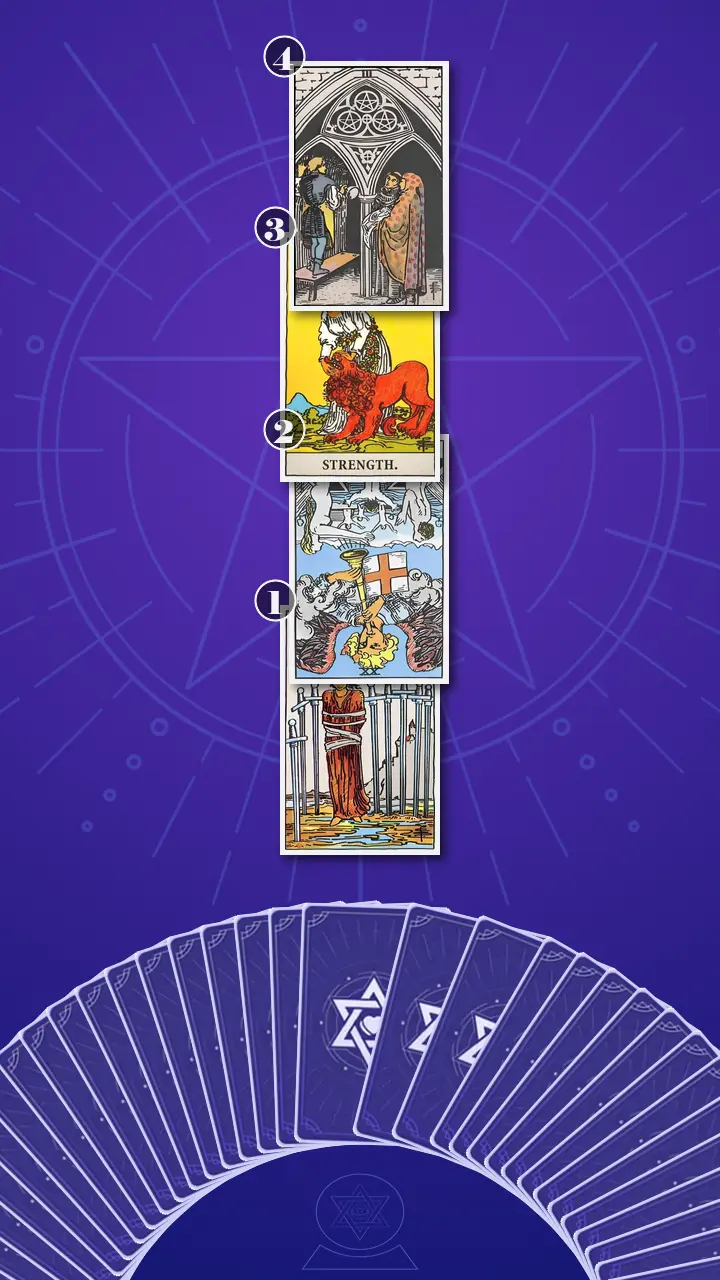
I chose the Four-Layer Insight Ladder, a four-card tarot spread designed to move from a visible symptom to its hidden root, then toward an inner resource and a grounded practice. This was an inner-excavation question. Maya already knew which paragraph needed work; another productivity diagnosis would not explain why that paragraph carried so much emotional weight.
For anyone wondering how tarot works in a reading like this, I treat the spread as a sequence of cognitive prompts rather than a fixed prophecy. Card meanings in context help me make an invisible pattern visible enough to examine. Maya remained free to disagree, keep what was useful, reject what was not, and decide whether any suggested action felt appropriate.
The first position would show the observable freeze response: the moment polishing replaced exposed drafting. The second would identify the underlying fear that made a near-final draft feel like a personal verdict. The third, our key position, would reveal the capacity that could support imperfect progress. The fourth would ground that capacity in a practical process of feedback and completion.
I arranged the cards in a vertical line, like a staircase. The lower two cards formed the diagnostic base; the upper two formed the ascent. I wanted the eye to travel from the sentence Maya could not start toward the piece of work she might be able to show. The last step did not need to become effortless. It only needed to become usable.
The Swords Around the Cursor
Position One: The Busy Screen and the Unwritten Sentence
The card I turned over first represented the observable freeze response: the exact moment Maya substituted polishing and planning for drafting the unfinished section. It was the Eight of Swords, upright.
I pointed to the blindfolded figure, the loose bindings, and the ring of swords planted around her. The restriction in this image is emotionally convincing, but it is not complete. Open ground remains nearby. That distinction mattered because Maya’s document was accessible and several modest choices were still available, yet perfectionistic forecasting had narrowed her field of vision until only two options seemed real: write something impressive or do not write yet.
“This is your 8:40 p.m. scene,” I said. “The cursor waits under the conclusion heading while you reopen Zotero, standardize references, check one notification, and tell yourself, ‘I know I need to write the next claim, but first I need a clearer plan.’ The screen looks busy, but the only task carrying a risk of visible imperfection stays untouched. Formatting can look like progress while protecting you from the sentence that could be judged.”
The card showed an excess of Air energy turning into blockage. Thought, comparison, and imagined consequences had stopped serving movement. Maya was opening the academic equivalent of Google Maps, zooming in on every possible wrong turn, and never pressing Start even though several workable routes remained: four rough sentences, three bullets, one question for a reader, or seven minutes of private drafting.
I asked, “The last time you opened the capstone, what did you do during the ten minutes before you either wrote the unresolved section or avoided it?”
Maya gave a short laugh, but there was no amusement in it. Her fingers tightened around the cold mug and then released. “That is painfully accurate. Honestly, it feels a little brutal. I tell myself I’m being responsible, but I’m doing the safer parts because the next real part could be judged.”
“Accuracy can sting without becoming an accusation,” I replied. “The freeze is real in your body, but it is not evidence that you have no agency. This card is not calling you incapable. It is asking us to notice which choices temporarily disappear when flawless progress becomes the only progress you permit yourself to count.”
When the Deadline Became a Trumpet
Position Two: The Private Courtroom
The card I turned over next represented the underlying fear that turned a near-finished capstone into a personal verdict and maintained the postponement cycle. It was Judgement, reversed.
The angel’s trumpet dominated the image. Below it, figures rose into visibility with their arms lifted, while distant mountains marked a threshold beyond the old landscape. Upright, Judgement can signal answering a call and entering a new phase. Reversed here, that call had become overheated into an internal trial.
“An advisor’s email asks for a near-final draft, and the submission portal makes the date visible,” I said. “The factual message is, ‘Your project has reached the review stage.’ But the message you hear is, ‘Now everyone will discover whether you deserved their confidence.’ One weak paragraph stops being a local craft problem and becomes imagined evidence about your intelligence, readiness, and right to belong.”
This was blocked Fire. The deadline should have supplied direction, but private self-judgement was consuming its motivating energy before Maya could act. She rehearsed future criticism, reread old comments, and delayed sending even one unfinished paragraph. The postponement brought a clean breath of relief. Then the deadline tightened, visible progress shrank, and the demand for a flawless draft grew stronger.
Looking at the trumpet, I flashed back to the closing bell and deadline alerts from my Wall Street years. I remembered how easily a signal marking the next stage of a process could feel like a judgement on the person responsible for it. The most useful response was rarely more private panic. It was a cleaner structure: What is the event? What interpretation am I adding? What decision is actually required now?
“When you picture sending the draft,” I asked, “what is the most personal conclusion you imagine your advisor drawing from one weak paragraph?”
Maya’s jaw tightened before she answered. Her eyes shifted away from the card as if she were rereading an email only she could see. “That I was never ready. Not just that the paragraph needs work. That they were wrong about me.”
I let the room stay quiet for a few seconds. Rain traced a thin line down her kitchen window, and the laptop fan seemed suddenly louder. “That is the hidden weight,” I said. “The capstone has been asked to do two jobs: communicate your research and prove your worth. No conclusion can safely carry the second job. Another round of private polishing cannot settle it because personal worth is not an academic criterion.”
When Strength Put a Hand on the Lion
Position Three: Rough-Paragraph Courage
The card I turned over in the key position represented the inner capacity that could soften Maya’s self-judgement and support courageous, imperfect progress. It was Strength, upright.
The atmosphere changed when I placed the card above Judgement. I showed Maya the woman’s calm hands resting around the lion’s open jaws, the infinity sign above her head, and the white robe threaded with flowers. Nothing in the image suggested crushing the lion, pretending it was harmless, or waiting for it to disappear. The woman stayed in contact with its intensity while guiding what happened next.
“This is like setting a short timer, putting both feet on the floor, and writing four rough sentences,” I said. “Halfway through the first one, the urge to repair an earlier paragraph appears because editing familiar work lets you feel competent again. Strength does not demand that you defeat the urge. It lets you say, ‘The urge to perfect is here, and I can still write the next plain sentence.’”
The energy had shifted from blocked Fire into balanced Fire: courage without punishment, discipline without self-attack, and movement without a promise of certainty. Strength is not feeling calm first; it is staying with one rough sentence while your inner critic gets loud.
I used what I call an Academic ROI Audit, a diagnostic lens I developed for expensive degrees, research pivots, and other high-investment decisions. I made the boundary explicit: I was auditing the return of Maya’s next action, never the value of Maya herself. Twenty minutes of reference formatting produced brief emotional relief but no new information about the conclusion. Seven minutes of rough drafting could produce a usable sentence, expose a genuine gap, or create a specific feedback question. Even an awkward paragraph offered a higher strategic yield because it returned evidence rather than temporary cover.
I brought her back to 8:40 p.m.: capstone open, shoulders high, twenty minutes gone to reference formatting. She knew the conclusion needed words, but fixing what was already finished had given her one clean breath of relief. The problem was not ignorance; it was the meaning attached to exposure.
Stop treating an imperfect draft as proof that you are unworthy; guide it forward with steady self-trust, like Strength's woman calming the lion.
I stopped speaking and let the sentence remain in the quiet between us.
For one beat, Maya did not move. Her breath paused halfway in, and her fingers hovered above the trackpad as though the next click had lost its instructions. Then her pupils widened slightly and her gaze went unfocused; I could see her replaying evenings of citation edits, renamed folders, and closed documents. Her face tightened before it softened. “But doesn’t that mean I was wrong this whole time?” she asked, with a quick flare of anger under the words. “Did I just waste weeks?” I told her no. The strategy had protected her from exposure for a few minutes at a time, and now it was costing more than it returned. Protection was not a moral failure; the audit simply showed when a strategy had stopped serving its purpose. Her fist loosened. Her shoulders descended in two uneven stages, and a long breath left her chest. Relief arrived, but so did a brief, disorienting blankness: if fear was no longer allowed to choose the task, she would have to choose it herself.
“Now, using this new perspective, think back to last week. Was there a moment when this insight could have made the experience feel different?” I asked.
“The advisor email,” she said, more quietly. “I could have written one messy paragraph and asked one question instead of rereading every old comment. I still would have been scared, but I would have had something real to respond to.”
That answer marked the key emotional shift. I was watching Maya move from anticipatory dread and self-judging completion avoidance toward patient self-trust, imperfect progress, and openness to focused feedback. It was not certainty, and it did not need to be. It was the first recognition that courage could operate while fear was still in the room.
A Draft Becomes a Workshop
Position Four: One Paragraph, One Reader, One Question
The card I turned over at the top of the ladder represented the practical integration point: a concrete way to return the capstone to a shared process of craft, feedback, and completion. It was the Three of Pentacles, upright.
I showed Maya the craftsperson standing on a bench, the two people holding architectural plans, and the carved structure rising around them. No one in the scene appeared to be conducting a solo audition. The work was visible before it was complete, and the conversation was part of how it became stronger.
“In your life, this can be one highlighted paragraph in a Google Doc,” I said. “You label it ‘Work in progress’ and ask a trusted peer, tutor, or advisor, ‘Does the claim in the second sentence follow from the evidence above?’ Their response gives you information about one construction decision. It does not answer whether you are good enough, because that is not the question you have invited them to evaluate.”
The Three of Pentacles carried balanced Earth energy. After the Eight of Swords narrowed the options, Judgement reversed exposed the private verdict, and Strength restored steady Fire, this card turned insight into something tangible: a paragraph, a boundary, a question, and a revision.
I also brought in Institutional Resource Leverage, another framework from my strategic background. A mentor relationship or university network is a resource, but using it well does not mean surrendering authority or trying to please the most senior person in the room. It means proactive upward management: choosing the right person, defining the scope, naming the decision you need help with, and setting a boundary around the response. Maya would remain the owner of the capstone. The reader would contribute local expertise, not a global verdict.
“A work-in-progress label is a boundary, not an apology,” I told her. “You can say, ‘I’m not ready for full-document notes yet. One response to this argument question would help.’ You can also decline unsolicited copyedits, ask whether the person has capacity, or show two sentences during a live conversation instead of sending the whole section.”
Maya looked back at the unfinished conclusion and tapped one of its placeholder bullets. Her mouth pulled into a small, uncertain smile. “I know who I could ask,” she said. “And I know the exact paragraph. I think sending one question feels different from asking, ‘Please tell me whether this whole thing is good.’”
The Draft-Not-Verdict Plan
I read the four cards as one coherent account of why Maya felt stuck. The past weeks of repeated micro-edits had trained her to associate postponement with immediate relief. The Eight of Swords showed that habit at the surface: productive-looking activity narrowed her choices until exposed drafting seemed unavailable. Judgement reversed revealed why the bind carried so much force: submission had become an identity test. Strength made the next stair usable by replacing self-attack with steady contact, and the Three of Pentacles opened onto ordinary craft, where visible work could receive specific input and keep developing.
The cognitive blind spot was not simply perfectionism. It was the belief that enough private polishing could remove the vulnerability of public feedback. It could not. Polishing familiar pages lowered discomfort without answering whether the unresolved claim worked. The transformation direction was therefore precise: move from treating submission as proof of personal capability to treating it as one bounded stage in a continuing craft process.
I then applied my Research Sunk-Cost Audit. Maya had been asking the conclusion to justify every hour, tuition payment, late night, and expectation invested in the degree. I asked her to evaluate the remaining work by future usefulness instead. Did the claim serve the research question now? Which evidence genuinely belonged in the conclusion? What was the smallest coherent contribution a reader could review? Past effort was not a debt the final paragraph had to repay. The audit did not tell her to abandon or preserve any argument automatically; it returned the decision to present evidence and purpose.
I gave Maya two experiments, not commandments. Each was deliberately small, and either could be reduced or stopped if it became too activating.
- Run the seven-minute unresolved-section sprint.During one evening this week, open a duplicate titled “Capstone WIP.” Place the note “Meaning first; citations and polish later” above the conclusion. Set a seven-minute timer and write four rough sentences or three bullets only inside that section. Put formatting thoughts in a separate parking-lot comment instead of acting on them.If seven minutes feels too large, use ninety seconds or write one deliberately imperfect sentence. Stop when the timer ends. The draft remains private unless Maya later chooses to share it.
- Create a one-question feedback loop.Choose one paragraph, label it “Work in progress; feedback requested on the argument, not copyediting,” and send it to one trusted peer, tutor, or advisor. Ask one local question, such as, “Does this claim follow from the evidence above?” Add the boundary, “I’m not ready for full-document notes yet; one response to this question would help.”Choose someone who has respected limits before and ask whether they have capacity. The minimum version is discussing two sentences live or sending the question first without attaching the draft.
These actions were intentionally less dramatic than the pressure Maya had placed on the capstone. They did not promise a perfect conclusion, a particular grade, or a frictionless submission. They created what she actually needed: contact with the unresolved section, information about one craft decision, and evidence that she could move without first resolving every doubt.
A Week Later: The Quiet Proof
Five days later, I received a message from Maya. “I did the seven minutes,” she wrote. “The four sentences were rough, but they existed. I cleaned up one claim after the timer, labelled the paragraph WIP, and sent it with one question. I didn’t send the entire capstone. I didn’t need to.”
She had slept through the night. Her first thought in the morning was still, “What if it’s wrong?” She told me she smiled, opened the WIP file, and read her advisor’s two-sentence response as information instead of a sentence on her future.
I did not read that message as proof that the whole pattern had vanished. I read it as a credible first movement from submission dread toward steadier self-trust. The Four-Layer Insight Ladder had done its job as a mirror, but the cards had not written the sentences, set the boundary, or sent the question. Maya had made each of those choices.
That was the quiet proof from our Journey to Clarity: finishing did not require Maya to become fearless, and feedback did not require her to place her identity on the review table. Her capstone could remain important without becoming the sole measure of her worth. Submission could be a stage in the craft, not a verdict on the person.
If your own finish line has started to feel like a verdict, and opening the file pulls your shoulders toward your ears, I hope you remember what I witnessed at that Toronto kitchen table: noticing that another pass at the references is buying safety rather than clarity already makes one hidden choice visible.
If the lion of self-judgement were allowed to stay in the room without choosing your next click, what one WIP sentence could you let exist today as a stage of the work, not proof of who you are?