After a Wrong Answer: Choosing Practice Over Searching for Study Tips

The 8:06 p.m. Spiral of Productivity-Content Procrastination
If you are a Toronto university student who can explain active recall, spaced repetition, and Pomodoro, yet still open StudyTok after the first difficult question, I do not assume you need more discipline. I wonder whether productivity-content procrastination has started disguising itself as responsible preparation.
Maya, a 22-year-old university student, described the pattern to me from her apartment near Spadina. At 8:06 p.m. on a Tuesday, she opened a statistics practice set and missed question one. The laptop fan whirred beside her; her phone felt warm against her palm; a tight band spread across her chest as she tapped TikTok before reading the feedback.
Forty minutes later, she had saved three videos about active recall, compared blurting with flashcards, and opened a new Notion template. Question two remained untouched. She had sat down to learn statistics, but she had improved the container and tested none of the contents.
“I keep preparing to study instead of studying,” she told me. “What if everyone else has found a method that I missed? I want proof the system works before I risk wasting time.”
I heard restless self-doubt moving through her like a cursor that could not stop blinking long enough to form a sentence. She genuinely wanted to learn the material, yet the first sign of uncertainty sent her searching for a method that might protect her from discovering what she did not know.
“You are not avoiding learning because you do not care,” I said. “You are trying to remove its uncertainty before you begin. We are not going to shame that protective response. We are going to understand it, then find where your choice returns.”
I told her that our Journey to Clarity would not produce a verdict about whether she was a good student. It would help us map the moment when actual learning gave way to method-hunting, then identify one practical place where she could interrupt the loop.

Choosing the Compass: The Four-Layer Insight Ladder
I asked Maya to place both feet on the floor, take one slow breath, and hold one precise question in mind: “Why do I keep chasing new study tips instead of actually learning?” I shuffled slowly. The purpose was not to perform a mysterious ritual; it was to give her attention a clear threshold between replaying the problem and examining it.
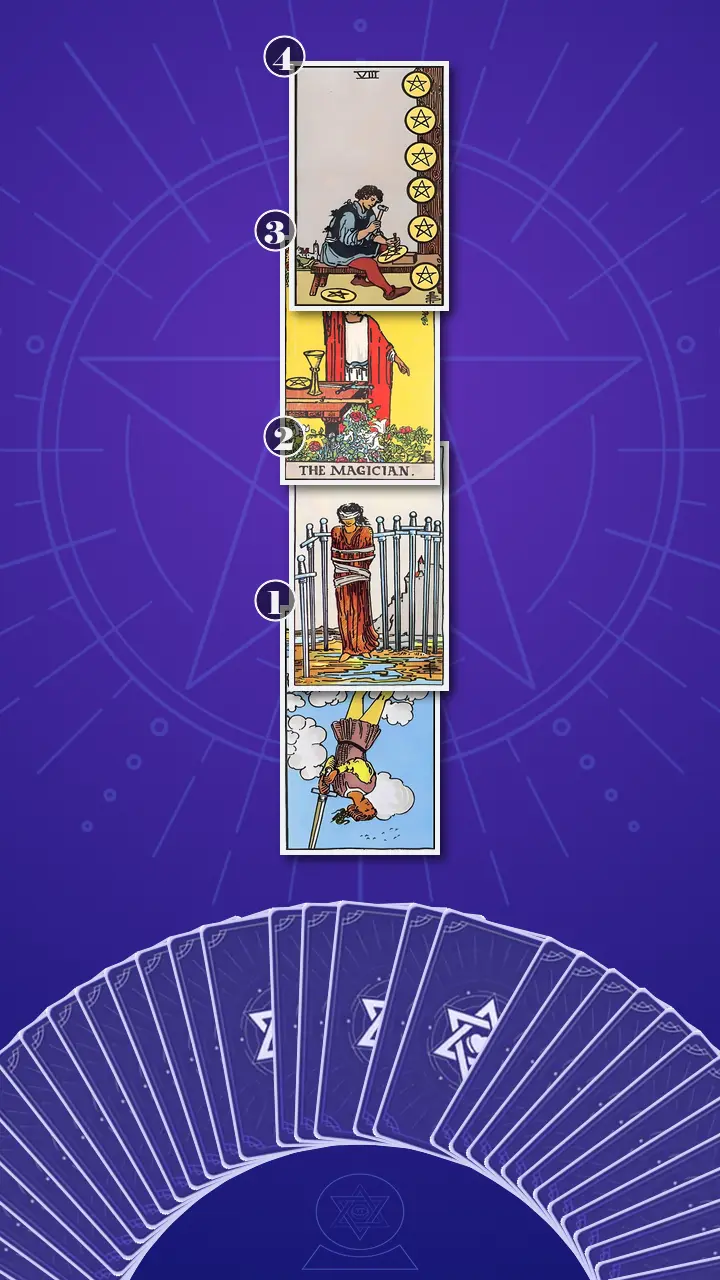
I chose the Four-Layer Insight Ladder, a four-card present-root-transformation-integration tarot spread. This was the smallest structure capable of tracing her single self-reinforcing loop: uncertainty triggered method collection, method collection displaced practice, and limited practice created more uncertainty.
For anyone wondering how tarot works in my practice, I use it as a Jungian mirror rather than a prediction machine. The images externalise a pattern so we can inspect it without confusing the pattern with the person. Card meanings in context help me ask better questions; Maya's lived evidence determines whether an interpretation is useful.
The bottom card would offer the diagnosis, showing the visible habit replacing her planned study session. The second would expose the mechanism beneath it, especially the fear that imperfect practice might reveal inadequate ability. The third would mark the transformation, the capacity that could interrupt method-hunting. The top card would provide integration, turning the insight into repeatable behaviour.
I arranged the cards vertically like a ladder. The eye would climb from a browser-tab spiral, through the hidden rule controlling it, toward agency and grounded practice. I left a little extra space around the third card, the point where analysis would have to become choice.
When the Wind Became a Wall
Position One: The Restless Researcher
I turned over the card representing the diagnosis: the observable habit and chaotic mental energy replacing Maya's planned learning sessions. It was the Page of Swords, reversed.
I pointed to the Page's raised sword, sideways gaze, and wind-bent landscape. The mind in this card was not inactive. It was alert, curious, and ready to investigate, but every gust of outside information changed its direction before that curiosity could serve a defined task.
In Maya's life, the image was almost literal. She missed the first question, opened one study-advice video, encountered three competing recommendations, and began comparing active recall, blurting, and a new flashcard format while the original problem stayed unanswered. Her cursor darted between StudyTok, YouTube, and Notion; the cursor beside question two did not move.
The Page showed Air energy in excess and disorder. Curiosity had become an escape route. The recommendation algorithm was effectively chairing her study session, giving every new creator a vote while the practice set had no voice at all.
Through a Jungian lens, I called this the shadow of the Restless Researcher. It was not a lazy part of Maya. It was a mentally agile part trying to protect her with information. Its inner line was persuasive: “I am only checking one thing before I continue.” Then the clock jumped forward forty minutes.
Maya gave a short laugh, but there was no amusement in it. Her fingers tightened around the edge of her sleeve, then released it. “That is so accurate it is almost cruel,” she said. “I always think the next tab is the one that will settle it.”
“Then let us be precise about what this card is and is not saying,” I replied. “Your curiosity is real, and it can become an academic strength. The problem is not that you seek information. The problem is that information gathering takes over at the exact moment practice could give you more relevant information.”
I asked what had happened in the sixty seconds before her most recent advice search. Her eyes moved away from the card. “I got the answer wrong,” she said. “Before I even checked why, I felt as if the whole method must be wrong.”
Position Two: The Unlocked Enclosure
I turned over the card representing the mechanism: the underlying fear that imperfect practice would remove Maya's sense of control and expose inadequate ability. It was the Eight of Swords, upright.
The blindfolded figure stood among eight swords, but the enclosure was incomplete and the bindings were loose. The card did not deny that Maya felt constrained. It asked whether the rule creating the constraint was as absolute as it appeared.
I brought her back to an afternoon at Robarts Library. The lecture slides, textbook, practice questions, and an adequate routine were already open. Fluorescent lights hummed above her, dry radiator air caught in her throat, and her jaw locked while she watched an Anki-versus-Quizlet comparison instead of attempting the next problem.
“If I choose wrong, I will lose time,” I said, giving language to the loop. “If I wait, I can still imagine choosing perfectly.”
The Eight of Swords showed Air becoming blocked and self-restricting. Maya was treating uncertainty about the best method as evidence that she could not begin, even though the gap between the swords was already present: one question, one attempt, one piece of feedback.
Having travelled and worked across cultures, I have learned how quickly a repeated rule can acquire the weight of unquestioned custom. Maya's private rule, “I must identify the best method before I begin,” had started to feel like a law of learning rather than a frightened thought.
“A wrong answer is data about the material, not a verdict on your ability to learn,” I told her. “Question one can reveal that a formula needs review. It cannot tell us your fixed capacity, and it cannot judge an entire study method before the method has produced enough evidence.”
Her breathing paused. Her gaze settled on the opening between the swords, then lost focus as if she were replaying the library scene. Finally, she exhaled through her nose and lowered her shoulders by a fraction.
“The sentence underneath it is probably, ‘If I use my current method and still struggle, maybe I am not as good at learning as people think,’” she said quietly. “My friends think I am organised because I know all these techniques. I do not want anyone to see how little I sometimes finish.”
“That makes sense,” I said. “The setup is controllable and publicly impressive. Practice is private, messy, and capable of surprising you. A cleaner setup can reduce anxiety without increasing knowledge. Seeing that distinction is not an accusation. It is the first opening in the enclosure.”
When the Magician Took Back the Next Twenty-Five Minutes
Position Three: The Hand That Points to Earth
The radiator in my room clicked off just before I turned the third card, and the sudden quiet gave the moment a sharper edge. I opened the position representing transformation: the inner capacity that could interrupt method-hunting and redirect attention toward what was already available.
The card was The Magician, upright.
I showed Maya the table holding the four suit emblems. Nothing essential was missing. One hand raised the wand; the other pointed toward the earth. The Magician did not wait for a tool to create readiness. The Magician assigned each tool a purpose and turned intention into a visible result.
In Maya's modern study scene, the table held a practice set, course notes, a timer, and a blank page for rough recall. The transformation began when she closed the recommendation tabs and decided what those existing tools would do for one defined block. This was balanced energy: thought, emotion, motivation, and physical action directed toward the same outcome.
I returned to the familiar setup. At 8:00 p.m., the practice set was open, the first answer was wrong, and her hand was reaching for a warm phone. Forty minutes later, the folders looked cleaner, but question two still waited beneath the laptop's blue light.
Readiness is not hidden inside the next study tip; choose one tool and put it to work, as the Magician turns what is already on the table into deliberate action.
I let the sentence remain between us for several seconds.
You do not need a more impressive system. Readiness is built when you direct one tool you already have toward one completed, imperfect act of learning.
Maya's first response was not relief. Her eyebrows pulled together, and a flash of anger sharpened her voice. “But does that mean I have been doing all of this wrong? I have spent so much time trying to fix the system.”
“It means the system-search was protecting you from a threat it could not actually remove,” I said. “That is different from saying you failed. Protection can be intelligent and still become outdated. We can respect why it formed without allowing it to direct the next session.”
I used my Performance Anxiety Decoupling framework to separate three judgments Maya had fused together: the result of one question, the usefulness of a study method, and her core worth as a learner. One wrong answer could evaluate what she recalled at that moment. Several comparable sessions could help evaluate a method. Neither had the authority to evaluate her value, intelligence, or future.
“The Magician is not telling you to feel confident before you work,” I said. “It is asking you to stop outsourcing permission to the next expert. Take admin rights back from the recommendation feed. For the next twenty-five minutes, the timer measures a boundary, the notes answer specific gaps, and the practice set creates evidence. You remain the person directing them.”
First, Maya's breath stopped, and her fingertips hovered above the Magician as if touching the card might make the responsibility more real. Then her pupils widened and her gaze moved past me, replaying some private sequence of cold tea, renamed folders, and untouched questions. Her eyes reddened slightly. The hand gripping her sleeve loosened one finger at a time, and her shoulders sank with a long exhale that sounded almost like relief. Then came the vulnerability beneath it: her face went briefly blank, as if clarity had removed a familiar excuse and left open space behind. “So I do not have to know whether the method works for the whole course,” she said, her voice lower and a little unsteady. “I only have to decide what I am doing with it tonight.”
“Now, using this new perspective, think back to last week,” I said. “Was there a moment when this insight could have made the experience feel different?”
She remembered the first statistics problem. “I could have checked the worked solution and tried question two,” she said. “The wrong answer could have told me what to review instead of telling me to redesign everything.”
I could see the first step in the emotional transformation: from restless self-doubt and endless method comparison to grounded self-trust built through completed practice and feedback. It was not certainty. It was the willingness to let one imperfect attempt produce information before comparison took over.
At the Workbench, Repetition Changed Sides
Position Four: What the Eight of Pentacles Builds
I turned over the card representing integration: the observable study behaviour through which focused agency could become repetition, feedback, and developing skill. It was the Eight of Pentacles, upright.
The craftsperson concentrated on the single pentacle beneath the chisel while completed pieces accumulated behind the workbench. The distant town suggested temporary separation from background noise, not permanent isolation. This was Earth energy in balance: progress made visible through work that could be attempted, reviewed, and repeated.
In Maya's life, the card looked like three short sessions using the same adequate method. She would complete a small set of questions, mark what she missed, and record the next point to review. Only after comparable attempts had accumulated would she decide whether the method needed adjustment.
The repeated eights in the spread gave us a precise contrast. In the Eight of Swords, repetition rehearsed the thought, “What if this method is wrong?” In the Eight of Pentacles, repetition built skill through attempted questions, crossed-out work, corrections, and specific feedback. Repetition itself was neutral. Maya could repeat the enclosure or repeat the craft.
“This is almost like a Git history of learning,” I said. “Each completed attempt records what changed, what failed, and what the next useful step might be. Planning without practice leaves no history to inspect.”
Maya looked from the eight surrounding swords to the eight accumulating pentacles. Her index finger traced a small line between the cards. “More tabs give me the feeling that I am moving,” she said. “Finished questions would show me whether I actually moved.”
“Exactly. Do not choose a method forever. Give one adequate method enough time to produce evidence.”
The One-Tool Learning Block
I gathered the four cards into one causal story. The reversed Page showed the visible habit: genuine curiosity scattered across advice feeds. The Eight of Swords revealed why the habit felt necessary: if Maya could secure the perfect method, she might avoid evidence that felt threatening to her identity. The Magician returned authority to her, and the Eight of Pentacles grounded that authority in repeated work.
The pattern was like continually sharpening pencils without writing the first sentence. A difficult question triggered a threat; method comparison offered brief control; that relief displaced practice; the absence of completed work then seemed to prove that another method was needed. Productivity-content procrastination sustained itself by solving the discomfort for a few minutes while preserving the original uncertainty.
Maya's cognitive blind spot was not simply that she spent too much time online. It was that she had begun treating relief as evidence. If a new template made her chest loosen, it felt like a better system. Yet emotional relief could not tell her what she had learned. Only attempted work, mistakes, review, and feedback could do that.
“But what if twenty-five minutes with the wrong method really does waste time?” she asked.
“Then we do not make a lifetime contract with it,” I replied. “We run a bounded experiment. You stay free to adjust, seek help, or stop. The only change is that the method must produce one piece of learning evidence before it goes on trial.”
I gave her two deliberately small next steps.
- The One-Tool Learning Block On Tuesday evening at her usual desk, Maya would begin with my Inner-Critic Mute Protocol: write, “This block can reveal what I need to review; it cannot measure my worth.” She would place her phone across the room, close every tab except the practice set, one necessary reference, and a blank rough-work document, then use the laptop timer for twenty-five minutes and attempt three questions before opening study-advice content. Any search urge would go onto a sticky note for later. Treat this as a test for one block, not a permanent choice. If twenty-five minutes feels too charged, use seven minutes or one question. When the timer ends, write one sentence beginning, “This attempt showed me...”
- The Three-Session Evidence Check In a plain Google Doc, Maya would create four columns: date, questions attempted, errors noticed, and next review target. She would use the same method for three comparable practice blocks, spend no more than two minutes updating the log, and review the evidence on Sunday afternoon before changing the system. Keep the minimum version to one attempted question and one sentence about what it revealed. The log must record learning, not become another dashboard-design project.
The goal was not to suppress every urge to search. It was to let the urge exist without automatically giving it the next action. That distinction preserved Maya's autonomy: a blocker, timer, or sticky note would support her choice, never punish her into compliance.

A Week Later: The Quiet Proof
Six days later, I received a message from Maya. She had placed her phone on the other side of the room and started with the seven-minute version. She attempted one statistics question, checked the error, and wrote: “This attempt showed me that I understand the formula but keep missing when to use it.”
She continued for another eighteen minutes by choice. Across three sessions, she attempted eight questions, recorded four specific gaps, and sent a teaching assistant one content-based question instead of asking for a new study system. She did not feel certain that her method was optimal. She finally had evidence that it was capable of teaching her something.
She slept through the night after the third block. In the morning, her first thought was still, “What if this is the wrong method?” She told me she smiled, opened the evidence log, and answered with what she had actually done.
That was the quiet proof of our Journey to Clarity. The cards had not rescued Maya or selected her future. They had helped us make a protective loop visible. Maya created the change when she met one difficult question, kept her hand away from the next tab for seven minutes, and allowed the answer to be imperfect.
When the first hard question tightens your chest and sends your hand toward another tab, improving the system can feel safer than risking an answer that seems capable of judging you. If you recognise that moment, remember the Magician's table: noticing that the tools are already there does not mean you must master the whole course tonight. It means you are no longer entirely inside the old loop.
If one imperfect attempt could count as information rather than a verdict on your ability, which single question will you place on the Magician's table before you ask the algorithm what to do next?