Self-Help Consumption Loop: Turning One Saved Idea Into Action

Six Tabs at 11:40 p.m.
You have a Notion dashboard, a half-used habit tracker, and enough saved advice to teach a workshop, yet at 11:40 p.m. you are still researching how to begin the same task. I used that sentence to reflect the pattern back to Jordan, a 28-year-old junior content strategist who joined our video session from a west-end Toronto rental.
Six browser tabs cast cool blue light across Jordan's face. A podcast voice leaked from one earbud until they tapped pause; the radiator clicked behind them, their phone looked warm in their restless hand, and a half-finished tracker sat beside the portfolio paragraph hidden beneath the browser. I watched their jaw tighten whenever the cursor passed over that untouched document.
“I keep waiting for the one insight that will make action automatic,” Jordan said. “I know what I should do, but I keep researching how to do it correctly. What if understanding the pattern is the only thing I'm actually good at?”
I heard the contradiction clearly: Jordan wanted meaningful change badly enough to keep searching, but the search protected them from finding out what an imperfect attempt might reveal. Shame had turned each unfinished task into a courtroom light, as if one awkward draft could illuminate every abandoned plan at once.
“I don't see a lack of commitment here,” I said. “I see a strategy that has become costly. We won't use tarot to predict whether you will change or to judge how disciplined you are. We'll use it as a structured mirror, so we can map what the content is doing for you, what it is replacing, and where your choice can re-enter the loop. That is our journey to clarity tonight.”

Choosing a Ladder Instead of Another Maze
I invited Jordan to take one unforced breath and hold the question, “Why do I keep consuming self-help content instead of changing?” I shuffled slowly. The pause was not a mystical performance; it was a way to let the recommendation noise settle long enough for one question to remain in focus.
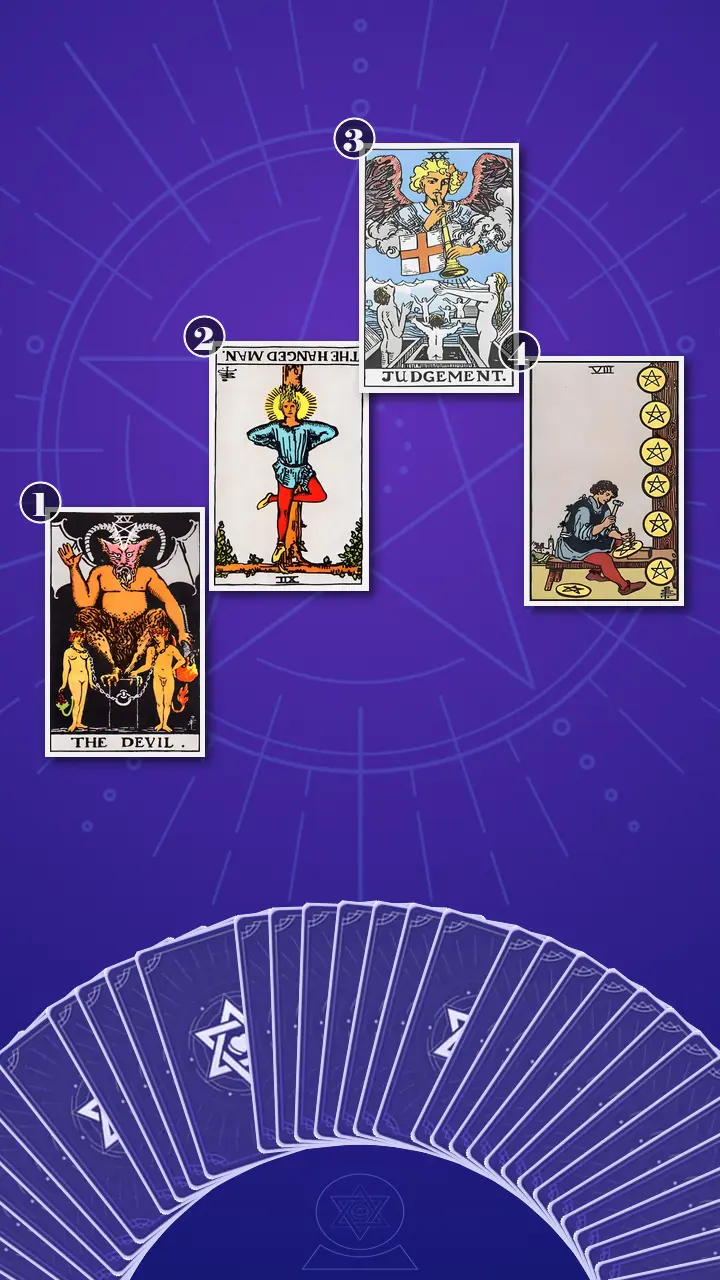
I chose the Four-Layer Insight Ladder · Context Edition, a four-card tarot spread arranged like a rising staircase. I chose it because Jordan was not deciding between two equal options. They were describing a causal loop: a visible habit, a hidden protective mechanism, a recognition capable of interrupting it, and a practical experiment that could produce lived evidence.
A ten-position Celtic Cross would have added more context than this question needed. I wanted the smallest map that could show the whole mechanism. The first position would name the self-help consumption loop as it appeared on the screen. The second would expose the shadow pattern keeping Jordan suspended in preparation. The third would reveal the central turning point. The fourth would translate the reading into one observable next step.
This is how tarot works in my practice: the cards externalize a pattern so its parts can be examined without making the person identical to the problem. The card meanings in context would offer hypotheses, while Jordan's real experiences would determine which hypotheses deserved to stay.
The Loose Chain in the Autoplay Queue
Position One: The Relief Ritual That Looks Like Progress
I turned over the card representing the exact visible symptom: consuming self-help content, saving new frameworks, and postponing the behavior those materials were meant to support. It was The Devil, upright.
I directed Jordan's attention to the loose chains around the figures' necks. I did not read those chains as punishment, addiction, or moral failure. I read them as the familiar sequence of cue, click, relief, and replaced action. The next insight may be useful, but it is not neutral when it replaces the next action.
I translated the card through a recent evening Jordan had described. At 9:18 p.m., they left a difficult portfolio draft and opened a recommended productivity video. The video named their discomfort so accurately that saving it felt like movement. Autoplay began, two more resources entered the queue, and the draft remained unchanged.
The Devil showed an excess of attachment to temporary control. Jordan's Watch Later queue and Notion resource database could always accept one more link, so the loop behaved like an algorithm trained on hesitation: each uncertain moment taught both the feed and the habit to serve another explanation. The private script was, “I'm not avoiding it. I'm making sure I understand it properly first.”
“What exact action did the last video replace?” I asked.
Jordan gave a short laugh that landed harder than a sigh. “That's so accurate it's kind of brutal. It replaced three sentences in my case study.” Their hand moved toward the trackpad, then stopped.
“Let the accuracy describe the mechanism, not your character,” I said. “The loose chain matters because it shows us a point of choice. We are not pretending the relief is fake. We are asking whether you still want to pay for that relief with the untouched task.”
Position Two: The Halo Above an Unsent Email
I turned to the card representing the hidden mechanism: the repetition and disowned fear that kept Jordan suspended in preparation. It was The Hanged Man, reversed.
The halo around the figure told me that genuine insight was already present. The reversed suspension showed that insight had become blocked energy: Jordan could examine the pattern from five intellectual angles while refusing the one perspective that required participation before certainty.
The card returned us to 11:40 p.m. The podcast kept playing while Jordan changed headings in a cleaner Notion page, highlighted another nervous-system explanation, and rearranged six saved videos. The email that would test their communication insight remained unsent behind the browser. Their working assumption was, “Once I find the angle that makes this feel certain, I'll start.”
Insight becomes a hiding place when action must wait for certainty.
Through a Jungian lens, I do not treat the shadow as a bad or defective self. I treat it as material that has not yet been allowed into the conversation. Here, the disowned fear was not simply “This draft may be imperfect.” It was, “If I try and repeat the pattern, the result might prove I am incapable of changing.” More research kept that feared verdict outside the room.
I asked Jordan to think of one email, application, boundary, or routine they had researched more than once. Their breath became shallow. Their fingers pressed together, their eyes left the screen, and then their shoulders lowered by a fraction.
“The email asking my manager to clarify priorities,” they said. “I've watched communication videos instead of sending it because if I still phrase it badly, then what was all that learning for?”
“That question makes every attempt carry the weight of your entire self-improvement history,” I said. “No wonder another framework feels safer. But you are not missing the introduction; you are standing at the first rep.”
When Judgement Cut Through the Feed
Position Three: The Trumpet Before the Algorithm
The radiator clicked once and went quiet. Without the podcast, I could hear the soft Toronto traffic beyond Jordan's window. I turned over the card representing the recognition that could interrupt the limiting pattern. It was Judgement, upright, the catalyst of the spread.
I clarified the name immediately. Judgement was not delivering a sentence about Jordan's past behavior. Its upright energy was an activating call: honest self-recognition, accountable choice, and a willingness to let one action be visible without using it to decide personal worth.
I brought us back to the scene beneath the symbols: at 11:40 p.m., six tabs glowed over the half-finished tracker while the podcast promised clarity. Jordan's jaw tightened, and the portfolio task was still waiting under the browser window.
“You do not need one more explanation to become ready; the moment you name what the next video is replacing, insight stops being a hiding place and becomes an instruction.”
I used what I call Limiting Belief Deconstruction, an audit of the subconscious rule that activates when someone is close to leveling up. I separated the mechanism into four parts: the trigger was an exposing task; the hidden rule was that action had to become incapable of revealing uncertainty; the protective move was more research; and the cost was never receiving the real-world information that could update the rule.
As Jordan studied the trumpet, I remembered conversations I had held across countries and cultures, each carrying a different version of the same hope: that perfect understanding might spare someone from being seen mid-attempt. In those moments, I have learned that another answer is often less important than having the protective logic understood without judgment.
Stop treating another self-help insight as the trumpet you are waiting for; let Judgement's trumpet call you to acknowledge the repetition already visible and answer it with one small behavior.
For a second, Jordan froze. Their fingers hovered above the trackpad and their breath stopped high in their chest. Then their pupils widened and their gaze slipped past the card, as if an old sequence were replaying behind the screen. Their mouth tightened before they said, with a flash of anger, “But doesn't that mean I've been doing it wrong this whole time?”
I let the question remain between us before answering. “It means the strategy protected you from a verdict you were afraid to receive. It also kept you from gathering better evidence. Seeing that is not a retroactive conviction.” Jordan's eyes reddened slightly. Their clenched hand opened, one finger at a time, and a long breath left them with a faint tremor. Relief appeared, but so did the vulnerable blankness that follows clarity. “Then I actually have to see what happens when I try,” they said.
“Only if, when, and at the scale you choose,” I replied. “Now, with this new perspective, think back to last week. Was there one moment when this recognition could have made the experience feel different?”
Jordan recalled closing the manager-email draft when a confidence video appeared. “I thought I was waiting for clarity,” they said slowly. “I was actually waiting for action to become incapable of exposing me. I could have said, 'This video is replacing the first three lines.'”
I invited them to picture choosing one useful idea they had already saved, closing the content source, and setting a ten-minute timer for one visible application: three lines of a draft, a low-stakes message, one small decision, or one cleared surface. At the end, they could record one factual sentence without rating their productivity or character. If ten minutes felt too activating, two minutes would count. They could stop whenever they wanted, and the exercise was not permission to force a high-stakes conversation, override rest, or cross a boundary.
This was the reading's key emotional crossing: not from ignorance to expertise, but from shame-driven insight collecting and suspended preparation toward grounded practice. Jordan did not have to trust themselves completely. They only had to let one freely chosen action produce something real enough to observe.
Position Four: One Pentacle on the Workbench
I turned over the card representing the small, embodied practice that could replace further consumption with one observable experiment. It was the Eight of Pentacles, upright.
I pointed to the craftsperson bent over the workbench. Unlike a polished transformation reel, the image did not show a dramatic new identity. It showed one piece receiving attention, then another. Its grounded earth energy balanced the overfed mental activity at the beginning of the spread. Repetition was no longer compulsive consumption; it could become deliberate workmanship.
I offered Jordan a concrete picture. On a Wednesday afternoon, they might open one previously saved communication note, use its first technique in a real low-stakes message for ten minutes, and write, “I drafted four clear sentences; I noticed I wanted to research after sentence two.” That observation would be evidence of practice, not proof of permanent change.
“This rep doesn't have to prove I've changed,” Jordan said, testing the sentence. “It only has to give me something real to observe.” Their shoulders loosened, and for the first time that night both hands rested still beside the laptop.
“Exactly,” I said. “A ten-minute attempt is evidence, not a verdict.”
From Mirror Tabs to One Workbench
I gathered the four cards into one causal story. Comparison posts, abandoned resets, and unfinished tasks had taught Jordan to experience ordinary practice as a test of worth. The Devil showed the current relief ritual. The reversed Hanged Man revealed how preparation prolonged the pause. Judgement interrupted the ritual with honest witnessing, and the Eight of Pentacles converted repetition into craft. Jordan had been standing in a browser full of mirror tabs, mistaking each sharper reflection for a door while the workable document remained underneath.
The cognitive blind spot was not a failure to understand self-help concepts. It was confusing reduced tension with changed behavior and treating every attempt as testimony about identity. The transformation direction was therefore precise: stop treating new insight as a prerequisite for action, apply one already-understood idea first, and review the result as information. The cards did not choose that path for Jordan. They made the path visible enough for Jordan to choose, modify, or decline it.
The Two Smallest Next Steps
I adapted my Cognitive Reframing Protocol for the practical advice. The protocol translates a vague fear of failure into three kinds of data: the feared prediction, the observable risk, and a bounded response. Instead of “If this draft is awkward, I cannot change,” Jordan could write, “This low-stakes draft may need editing; I can work on it privately for ten minutes and decide what to do afterward.”
- The Trumpet-Before-Algorithm Pause Before opening one recommended self-help item this week, Jordan would pause on the app screen and type in Notes: “Right now, this content would replace ____.” They would use a concrete verb such as draft, send, ask, book, or begin, then return to that action for two minutes before deciding whether the content was still needed. Tip: This is not a content ban. Necessary information for work, support, or accessibility still has a purpose; the pause only distinguishes reference material from relief used to delay a known step.
- The Ten-Minute Proof-of-Practice Before consuming new self-help content that day, Jordan would select one idea from an existing saved post or note and apply only its first instruction to one low-stakes task for ten minutes. When the timer ended, they would write: “I did ____. I noticed ____.” They could repeat the same practice on three non-consecutive days if it remained useful. Tip: No new dashboard, score, streak, or identity label. Use the phone timer already available, fall back to two minutes when needed, and choose a private draft whenever immediate contact would feel unsafe or cross a boundary.
“Do not build a new identity,” I told Jordan. “Make one visible mark. Your task is not to prove that the loop has vanished. It is to notice the next link and decide whether you want to add it.”

A Week Later: One Visible Mark
Five days later, I received a message from Jordan. They had opened the saved communication note, used its first technique on the email asking their manager to clarify priorities, and worked for ten minutes without opening another resource. Their factual log read: “I wrote four clear lines and sent them after one review. I noticed the urge to research after line two.”
Jordan slept through that night, then woke with “What if I handled it badly?” as their first thought. They told me the thought stayed, but it no longer opened YouTube. They smiled, still a little shaky, at the ordinary size of the experiment.
I did not read that email as proof that Jordan's life had been solved. I read it as the first observable movement from temporary control toward lived self-trust. Tarot had offered the map, but Jordan had paused the recommendation, written the lines, and chosen what happened next.
Many of us know the moment when the next video feels easier than touching the task: the jaw tightens, the hand keeps scrolling, and one imperfect attempt starts to feel like a verdict on whether we are capable of changing at all. I hold onto what Jordan's reading revealed: noticing that the algorithm has been trained on hesitation means the next click is no longer completely invisible.
If your next attempt did not have to prove anything about you, which tiny piece of something you already know would you be curious to take from the mirror tabs to the Eight of Pentacles' workbench for ten minutes?