The Finish-First Degree Loop: Turning Saved Tabs into Evidence

The 11:40 p.m. Degree Sunk-Cost Loop
If you are a final-year university student in Toronto who can name every remaining deadline but not what those deadlines are leading toward, Sunday Scaries may look like opening the course portal instead of the career document.
Alex (name changed for privacy) described the previous Wednesday to me so precisely that I could almost hear it. At 11:40 p.m., the fan inside her warm laptop whirred beside a mug of coffee that had gone cold. One browser window held an assignment due in three days. Behind it, a document titled Possible Directions contained nothing except a blinking cursor.
She looked at that cursor for less than a minute. Then her shoulders crept toward her ears, she closed the document, and she spent another hour adjusting references in an essay that was already good enough to submit.
“I can finish the next assignment,” she told me when she sat opposite me, “but I cannot explain what it is moving me toward. I keep treating graduation like it will hand me a direction.”
I watched her press both palms around her tea as if the heat might steady the thought. The frustrated ambivalence looked less like indecision and more like standing with one foot on a moving TTC train and the other on the platform, using every muscle to avoid admitting that the train might not be heading where she wanted to go.
Her question was direct: “Why do I keep sacrificing my direction just to finish this degree?”
I heard the contradiction underneath it. Alex wanted a personally meaningful direction, yet finishing had become the condition she believed she must satisfy before she was allowed to pursue one. Coursework supplied measurable progress, temporary calm, and proof that the past still counted. Career exploration asked her to risk discovering a preference that might disrupt the plan.
“You can be good at finishing and still be unclear about where you are going,” I said. “I am not going to use tarot to tell you whether to stay or leave. Let us use it to see what is controlling the decision, what the current pattern is costing, and where your agency can re-enter. We are drawing a map through the fog. You will still choose the destination.”

Choosing the Compass: A Five-Card Decision Cross
I asked Alex to place both feet on the floor, take one unforced breath, and hold the question in mind while I shuffled. I use that pause as a shift in attention, not as a performance of mystery. It gives the nervous system a moment to leave the deadline and enter the decision.
I chose the Decision Cross · Context Edition, a five-card tarot spread for degree completion and career direction. The structure was deliberately compact. A Celtic Cross would have added more layers than the question needed; this decision required a clean view of the present dilemma, the motive for continuing, the hidden fear, the cost of waiting, and the principle that could restore deliberate movement.
I placed the first card at the centre. It would show how the Sacrifice-Agency Split was operating now. The card to its left would examine the conscious pull toward finishing, including competence and measurable progress. The card to its right would reveal the hidden fear around time, tuition, and control. Below the centre, I would measure the cost of postponing exploration. Above it, the final card would offer an integrating stance without issuing a stay-or-leave prediction.
This is how tarot works in my practice: the spread does not override evidence or personal autonomy. It separates a crowded problem into visible components, and the card meanings in context give us a shared language for patterns that are difficult to see while living inside them.
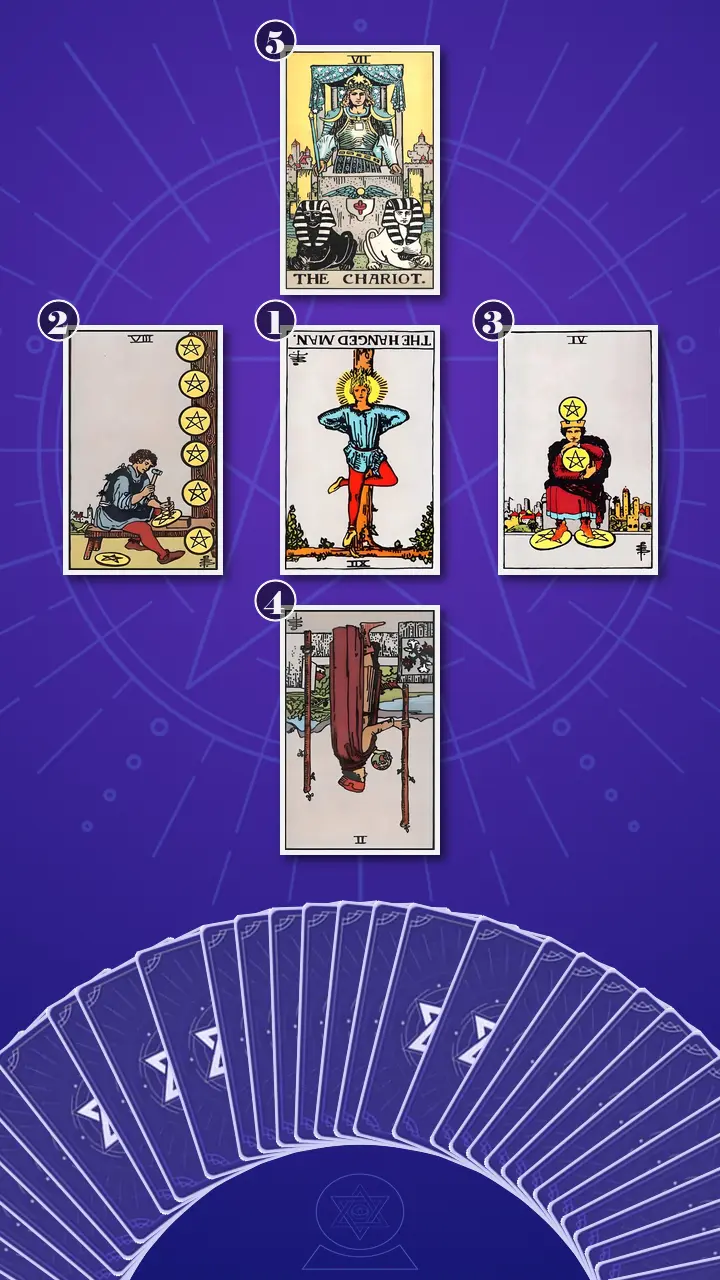
Work, Grip, Postpone
Position One: The Sacrifice That Forgot Its Purpose
The first card I turned represented the observable Sacrifice-Agency Split: Alex was meeting degree requirements while repeatedly postponing actions that could clarify a personally meaningful direction.
It was The Hanged Man, reversed.
I pointed to the ankle bound to the living tree, the inverted body, and the halo that still suggested an available perspective. Upright, the card can describe a purposeful pause or a sacrifice made consciously in service of insight. Reversed, that energy was blocked. A temporary suspension had become an indefinite role, and Alex had stopped reviewing who chose the sacrifice, what it was for, and when its usefulness should be reassessed.
“This is your 11:40 p.m. split screen,” I said. “The assignment is nearly finished in front of you. The blank Possible Directions document is behind it. You close the second window and improve references, not because the paper requires another hour, but because academic activity protects you from the exposed feeling of testing what you might prefer.”
I gave the pattern its inner sentence: “I am not doing nothing. I am doing everything except gathering evidence about my direction.”
The card was not criticizing diligence or the degree itself. It was showing how useful sacrifice had become an overextended blockage. In the language of Severance, Alex could remain highly functional inside the role while feeling disconnected from the larger life that the role was supposed to support.
Alex gave a short laugh, but the sound had a bitter edge. “That is so accurate it is almost cruel.”
I let the reaction settle before answering. “Accuracy is only useful if it gives you more choice. This is not an indictment of how you coped. You found a reliable task when the larger question felt impossible to measure. Now we can ask whether that coping strategy still deserves control of the calendar.”
I asked her which exact degree task she had done the last time she postponed career exploration, and what feeling had become quieter once she started it. She looked down at her cup.
“I deleted a career block on Monday so I could do optional edits,” she said. “The guilt went away immediately. Then I was annoyed at myself for the rest of the day.”
Position Two: The Workbench of Green Completion Ticks
The next card represented the conscious pull toward finishing: the satisfaction of competence, visible progress, and preserving the value of effort already invested.
It was the Eight of Pentacles, upright.
I showed Alex the craftsperson concentrating on a single pentacle while completed pieces accumulated in an orderly row. The distant town remained outside the immediate workbench, much as working life remained outside the frame whenever Alex focused on the next module, reading list, or assignment.
“This card honours something real,” I said. “You complete the reading, improve the essay, and watch another green tick appear in the learning portal. For an evening, you feel capable because the work has instructions, standards, and an endpoint. The inner sentence is: At least here I know what good work looks like, what is due, and when I am done.”
The Eight carried balanced diligence and genuine skill-building, but Alex sometimes used that strength in excess. Competence became emotional cover. The clearer the academic task, the easier it was to avoid a career question with no rubric.
I asked which part of her latest assignment developed a craft she wanted to use again, and which part felt valuable mainly because it could be checked off. Alex's fingers stopped worrying the edge of the tea bag.
“I liked interviewing people for the research,” she said. “I did not care about polishing the theoretical section for the third time. But the polishing made me feel more responsible.”
I nodded. “That distinction matters. Skill and direction can overlap, but they are not identical. You can be proud of the work you have done without assuming that every available hour must be given to completing more of it.”
Position Three: When Protection Becomes Immobilization
The third card represented the hidden influence: the control-based fear that changing the plan might make past effort meaningless and expose uncertainty about the future.
It was the Four of Pentacles, upright.
The figure pressed one pentacle to the chest and pinned two beneath the feet. I saw the same posture in the scene Alex had described from the cafe back room: the milk steamer hissing through the door, fluorescent light flickering over syrup boxes, her phone cold in her hand as she reviewed tuition already paid, credits completed, and the possible cost of another semester. A saved internship page waited behind the numbers.
“The calculation is materially relevant,” I said. “Tuition, OSAP, rent, shifts, and extra semesters are not imaginary concerns. But the calculation is also ending the inquiry before your present priorities can speak. The inner sentence is: If I loosen my grip on this plan, what happens to everything I already paid for?”
The Four showed an excess of protective Earth. The degree had become both an asset Alex possessed and the ground on which she felt unable to move. Protecting value had quietly turned into controlling the future.
Years earlier, on a Wall Street trading floor, I had watched intelligent people defend a position because of how much capital, time, and reputation had already entered it. The market never refunded an old investment simply because someone increased their exposure. That memory is why I developed a diagnostic lens I call Sunk Cost Decoupling: I separate what a past investment has already produced from the question of what deserves the next unit of time, money, or attention.
“Your past three years do not become blank if your future use of the degree changes,” I told her. “The skills, friendships, credits, discipline, and self-knowledge already exist. Their value is not held hostage by one predetermined ending. Past effort can keep its value without controlling your next move.”
Alex's breathing paused. Her thumb froze against the cup, and her gaze slipped past the table as if she were replaying every credit calculation she had used to close the question. Then a low breath left her chest, and her shoulders dropped by a fraction.
“I always think of the number of credits first,” she said quietly. “Before I even think about whether I want the option in front of me.”
“That number belongs in the decision,” I said. “It just does not get to be the entire decision.”
Position Four: A Future Kept Inside the Browser
The fourth card represented the cost of treating completion as a prerequisite for direction: delayed exploration, thinner evidence, compressed curiosity, and shrinking personal agency.
It was the Two of Wands, reversed.
I drew her attention to the small globe held within the battlement and the wand fixed to the wall. Reversed, its future-facing Fire was blocked. Imagination existed, but movement remained contained.
“This is Robarts Library with six tabs open,” I said. “A graduate scheme, a community arts internship, a UX certificate, an alumni profile, a career thread, and a role you might actually want to ask about. You bookmark all of them. When your cursor reaches the contact button, your stomach flutters, and you return to the assignment tab.”
The future remained safely available because no possibility had been tested. Alex could imagine ten lives as long as none of them asked her to reveal a preference. It resembled an algorithm trained only on what she saved: without a message, application, conversation, or field test, it received no new data.
“Saved possibilities are not the same as gathered evidence,” I said. “A 20-minute conversation is not a declaration of identity. It is a reversible test. It can tell you one energizing detail, one draining detail, and one assumption that was wrong without forcing you to quit, stay, or announce a five-year plan.”
Alex exhaled and looked at the face-down final card. “I have a UX researcher saved on LinkedIn,” she said. “She graduated from my program. I have opened her profile about ten times.”
“Then the first movement may be smaller than a career decision,” I replied. “It may be one bounded message that turns a saved tab into evidence.”
When The Chariot Took the Driver's Seat
Position Five: Direction Before Perfect Certainty
The room became unusually still when I reached the final card. Rain traced a thin line down the window, and a streetcar bell sounded once beyond the glass, as if the city itself had briefly underlined the question of destination.
This card represented the integrating principle: the self-directed stance that could coordinate degree completion and exploration without instructing Alex to stay or leave.
It was The Chariot, upright, the bridge card of the reading.
I pointed to the black and white sphinxes facing slightly different ways and the centred driver beneath the star-patterned canopy. The opposing forces had not disappeared. The driver's power came from giving them a consciously held direction. This was balanced Chariot energy: aligned self-command, disciplined choice, and movement without a demand for perfect internal agreement.
Alex was still caught in the 11:40 p.m. rule: the assignment could remain open, but the direction document had to close. She believed she first had to resolve the whole question of finishing or changing course. Until then, the measurable task would always receive the next hour.
A finish line can close a degree; it cannot choose your direction. Agency begins when completion serves a destination you name, not when graduation finally grants you permission.
I paused, then gave her the card's message without softening its clarity.
You do not need to remain suspended until the degree gives you permission; choose one direction experiment now and, like The Chariot's driver, make competing pulls serve a destination you name.
Alex stopped breathing for a beat. Her index finger hovered above the table, halfway between the reversed Hanged Man and The Chariot. Her eyes lost focus, and I watched recognition move across her face as though she were replaying the deleted calendar block, the blank document, and every practical answer she had given when friends asked what she wanted. Her eyelids tightened; then her eyes shone. A breath left her in a slight tremor, her shoulders lowered, and her hand opened flat beside the cards.
The release lasted only a moment before a sharper feeling arrived. Her jaw set again. “But doesn't that mean I have been doing this wrong for years?” she asked. The question carried anger, grief, and the new vulnerability of realizing that clarity would return responsibility to her.
“No,” I said. “It means the strategy that protected you from uncertainty has reached its limit. You were not foolish for using structure. The new information is that structure now needs a destination. We are not putting your past on trial; we are changing who gets to direct your next week.”
I invited her to use the new perspective on one recent moment. “Think back to last week. Was there a point when this insight could have made the situation feel different?”
Alex looked again at the two cards. “Monday morning. I deleted the career block because the essay was not technically finished. I thought those two things could not coexist. I could have kept twenty minutes and still submitted the essay.”
I used my second diagnostic lens, Strategic Path Valuation, to clarify what The Chariot was asking. I did not reduce Alex's life to salary or prestige. I asked her to evaluate competing macro-directions by their longer-term return in usable skills, energy, autonomy, financial sustainability, relationships, and future options. A direction with genuine long-term value should become more legible when tested; it should not require endless sacrifice merely to protect an old narrative.
“The question is not which sphinx wins,” I said. “The question is what destination allows you to coordinate them. Finishing may remain part of the route. Exploration must also receive protected road space. Neither gets unlimited control simply because it is louder.”
I saw the shift begin: from finish-first frustration and sunk-cost paralysis to evidence-informed self-direction and steadier agency. It was not certainty, and it did not need to be. Direction is not graduation's reward; it is a practice Alex could begin before the finish line.
The Calendar Becomes a Steering Wheel
I gathered the cards into one sequence: work, grip, postpone. The Eight of Pentacles showed Alex working competently. The Four showed her gripping accumulated credits as proof that the work must end in one specific way. The reversed Two of Wands showed the resulting postponement, with possible futures kept safely inside the browser. The reversed Hanged Man held the whole loop in suspension; The Chariot restored movement by introducing a destination, boundaries, and evidence.
The blind spot was not simply that Alex might be pursuing the wrong degree. It was the belief that completion had to happen before direction was allowed to receive time, and that the value of the past depended on keeping the original plan untouched. That belief made running toward the finish line feel responsible even while the compass remained unopened.
I also noted what the spread lacked. Pentacles dominated, but no Cups or Swords appeared. Alex had abundant Earth for effort and accumulation, yet felt preference and explicit decision language had little space. She tracked hours, credits, and completion rates, but her dashboard had no field for “Would I want to do this again?”
I told her the transformation did not require an abrupt withdrawal or a grand announcement. It required one protected experiment and self-chosen criteria for interpreting what she learned. I translated that into three small next steps.
- Protect a Direction-Before-Certainty Block.On Sunday, schedule one 30-minute block before the week's least urgent degree task. Title it “Direction gets time before certainty.” Begin with: “For the next 30 minutes, I am testing curiosity, not choosing my entire future.” End by recording one thing that pulled you in, one that pushed you away, and one that remains unknown.Tip: If coursework feels too loud, keep a five-minute version. Naming one field, person, or daily task still counts as evidence that direction can receive time before completion.
- Run a Boundary-First Field Test.By Wednesday, choose one saved role and contact one alumnus, professional, or friend-of-a-friend. Ask for a 20-minute conversation about one energizing part of the work, one draining part, and one surprise. State clearly that you are exploring the day-to-day reality and are not asking for a referral.Tip: If outreach feels too exposed, use the minimum version: read or watch one credible first-person account and record the specific tasks described. Do not replace the test with another hour of general browsing.
- Use the 5-Year Horizon Stress Test.Within 72 hours, open a note titled “What completion is for.” Imagine the current finish-first pattern continuing for five years, then answer three prompts in ten minutes: “Finishing supports me if...,” “The degree does not get unlimited access to...,” and “New evidence that would change my plan is....” Make one calculated Hold-or-Pivot micro-decision about the next week only: hold the automatic schedule, or pivot enough time to protect the direction experiment.Tip: Cap the first draft at three personal, observable criteria. This is a stress test of the pattern, not a demand to decide the entire degree within 72 hours.
“These steps are not predictions,” I told Alex. “They are ways to produce information your current loop cannot generate. Tarot has shown us the structure. You decide what the evidence means and what happens next.”

A Week Later: The Quiet Proof
Six days later, I received a message from Alex. She had kept the Sunday calendar block even though an essay still needed its final read. She sent the boundary-first message to the UX researcher, received a yes, and held the conversation on Wednesday afternoon.
Her debrief was brief: interviewing users pulled her in; constant presentation revisions pushed her away; and she had wrongly assumed the role was mostly visual design. She had not chosen a career. She had gathered one piece of reality that no saved tab could provide.
She also submitted the essay without the extra hour of cosmetic editing. The act felt uncomfortable, she wrote, but the discomfort did not become a crisis. It became evidence that coursework and exploration could coexist without either one erasing the other.
She slept through the night after the plan became clear enough. In the morning, her first thought was, “What if I am wrong?” She told me she smiled, left the direction block where it was, and got up.
That was the quiet proof I wanted from this Journey to Clarity: not a magically solved life, but a choice that felt like hers again. The five-card Decision Cross had not supplied Alex's destination. It had helped her distinguish chosen effort from automatic obligation so she could place her own hands back on the steering wheel.
When the future comes up and your chest tightens, counting credits or reopening the course portal can feel safer than admitting that finishing and choosing your direction are no longer the same thing. If you can notice that reflex without judging yourself, you have already created a small space between the old finish-first rule and your next move.
If you allowed direction to exist before certainty, which saved possibility would you turn into one tiny piece of real-world evidence this week, and where would you protect it on your own Chariot calendar?