Deleting "I Felt Jealous" Kept the Direction Blurry—Until One Test

The Deleted Sentence at 10:47 p.m.
If you are a late-twenties product designer in Toronto who can turn ambiguity into a clean deck but freezes after a LinkedIn promotion post, you may recognize the loop I saw with Casey (name changed for privacy). At 10:47 p.m. on a Tuesday, Casey sat in a small condo under the blue-white glow of a laptop, typing into a note titled "Next Direction." The radiator clicked against the quiet, the tea beside the keyboard had gone cold, and Casey's jaw tightened while the sentence "I felt jealous when I saw that announcement" disappeared from the screen.
Casey replaced it with a three-column comparison table, then kept adjusting the columns long after every option looked reasonable. They had come to ask me, "What direction am I missing by hiding the feelings I dislike?" They wanted those feelings to reveal a path, but feared that letting jealousy, anger, disappointment, or grief remain visible would make one of them take over and define the choice.
The discomfort sat across Casey's chest like a seat belt pulled one notch too tight: shallow breathing, a locked jaw, and the strange flatness of having many possible roads but no inner signal about which one mattered. I told Casey I did not see a personal failure in that loop. I saw someone trying to navigate after muting half the directions. "We can make a map without forcing an answer," I said. "Our Journey to Clarity starts by noticing what the map has been told to leave out."

Choosing the Shadow Spread
I asked Casey to place both feet on the floor, take one unhurried breath, and hold the question without trying to improve it. I shuffled slowly. The point was not to perform a mysterious ritual; it was to create a clean transition from the speed of the week into a focused conversation with information Casey usually edited away.
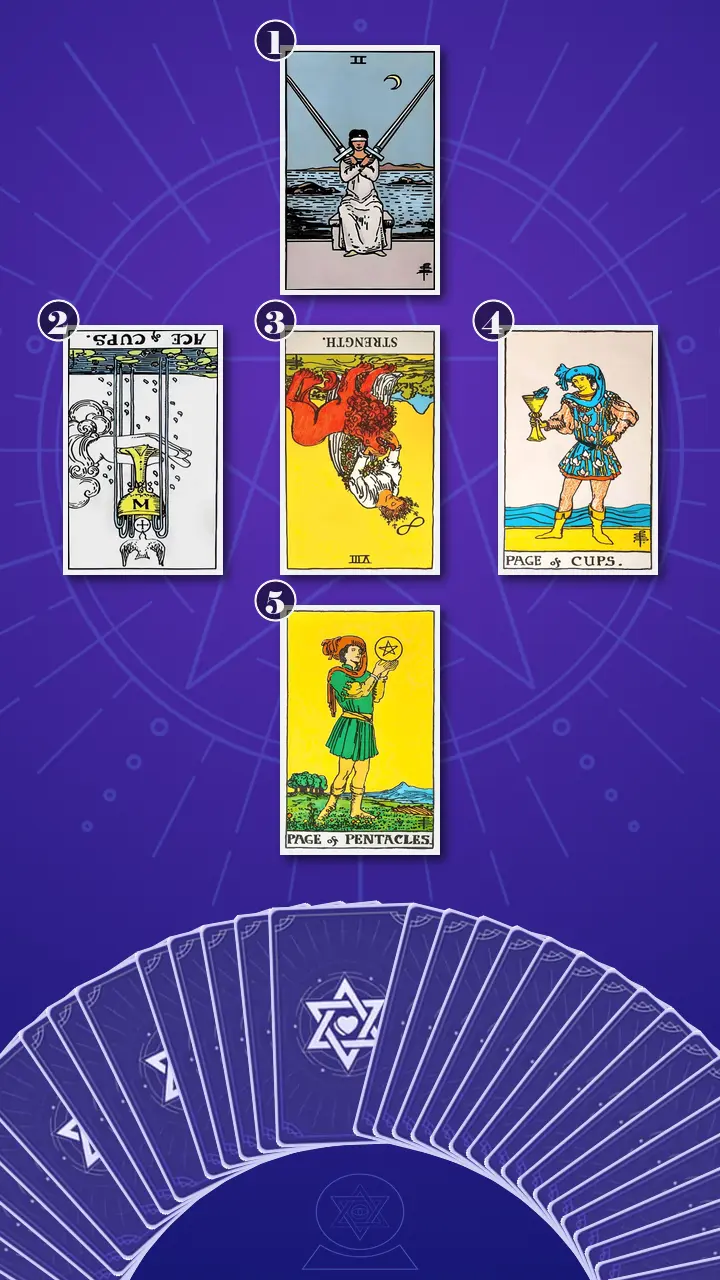
I chose a five-card Shadow Spread, a tarot spread for suppressed feelings and choice paralysis. It fits this question because it separates five things that are easy to collapse into one blur: the visible coping pattern, the feeling being rejected, the fear that makes suppression feel protective, the constructive direction inside the feeling, and one practical way to integrate the information. A Celtic Cross would add environmental and outcome layers that were not necessary here. This inner-self inquiry needed a clear present pattern, hidden material, root fear, transformative message, and grounded next step.
I explained to Casey and to the reader that this is how tarot works in this setting: the images give an objective cognitive tool a shape we can examine together. The cards do not decide which job, relationship, or city someone should choose. They help us notice patterns, ask better questions, and distinguish a feeling from an instruction. In this cross, position one would show the controlled behavior on the surface, position three would expose the fear beneath it, position four would hold the overlooked direction, and position five would turn insight into an experiment.
The cross looked like a small keyhole-shaped compass on the table. I would begin at the upper point, move through the hidden-material line, and finish at the lower point where the emotional information could become usable evidence.
The Spreadsheet With the Feeling Missing
Position 1: The Mask That Looks Like Research
Now I turned over the card representing the observable behavior used to hide disliked feelings and preserve a controlled outward state. It was the Two of Swords, upright, the conscious mask through which the shadow issue appears.
The blindfolded figure held two swords crossed over the chest while distant water remained behind them. In Casey's life, that image was a polished comparison spreadsheet containing compensation, commute, growth, rent impact, and portfolio value. Both career options stayed perfectly balanced because the column that might have said "I feel relieved imagining this one" had been silently removed. The outward result was calm competence. The private result was a decision that could not use all of its available information.
The upright air was not balanced in the sense of being free. It was overused. Neutrality had become a shield, while emotional information had been placed in the deficient position. Casey's Sunday Notion reset showed the same crossed-sword posture: two reasonable plans held across the chest, the emotionally relevant signal kept outside the table. The inner monologue sounded like this: "I can decide once I have more information," followed by the quieter correction, "except I have excluded the information that feels least presentable."
Casey gave a small, bitter laugh rather than nodding. "That is too accurate," they said. "I keep calling it research." Their breath paused and their thumb froze over the phone; their eyes went unfocused as if replaying the Sunday dashboard; then their jaw loosened just enough for a rueful exhale.
"I am not asking you to distrust logic," I said. "I am asking whether logic has been asked to work with one of its most relevant inputs removed. The question for this card is simple: which recurring choice stays unresolved because one emotional fact has been ruled inadmissible?" Casey looked back at the spreadsheet, and for the first time the neatness of it seemed to have a physical cost.
Position 2: The Cup Turned Away
Now I turned over the card representing the emotional material being rejected before it can reveal a need, value, or boundary. It was the Ace of Cups, reversed, the disowned feeling held outside conscious acceptance.
The cup was inverted, its streams displaced instead of received. I connected it to the moment on the packed 504 streetcar when a former colleague's promotion appeared on Instagram. Wet coats crowded the aisle, rails squealed around the turn, and the warm phone in Casey's hand seemed to heat their face. First came the reaction, then shame about having the reaction, then the label "comparison fatigue," then a saved folder of career articles. What Casey felt and what Casey allowed themselves to call it were two different things.
The reversed water showed blocked receptivity, not an absence of feeling. The current was already there, but the container had been turned away before it could hold anything. This was the same deleted-sentence loop from the condo: a specific emotional line appeared, embarrassment made it look dangerous, and a neutral phrase such as "tired" or "stressed" took its place. The temporary relief maintained the larger directionlessness.
I asked, "Before you called that reaction stress or comparison fatigue, what was the word you deleted?"
Casey looked down at their hands. "Jealous," they said. The word arrived quietly, but their chest tightened around it.
"Jealousy is not a character reference. It can be a clue," I told them. "It might point toward creative visibility, recognition, autonomy, community, or something else. We do not have to decide which one yet. We only have to let the reaction exist long enough to ask what it may be protecting, requesting, or revealing." Casey rubbed a thumb along the edge of the card, an embarrassed smile briefly sharing space with recognition.
I also made the limit clear. I was not asking Casey to force a complete emotional debrief or turn every reaction into a life thesis. The reversed Ace of Cups did not require a flood. It asked for one honest sentence and a container small enough to remain safe and voluntary.
Position 3: The Lion Behind the Composure
Now I turned over the card representing the fear of losing control that makes emotional suppression feel protective and keeps the limiting cycle active. It was Strength, reversed, the root fear and protective belief beneath the visible pattern.
The image did not show domination. A woman rested her hands gently at a lion's jaws, meeting instinct with relationship rather than force. Reversed, the image exposed Casey's belief that strength meant never being visibly affected. After a tense stakeholder meeting at 6:12 p.m., Casey had sat alone in a glass-walled conference room while the espresso machine hissed outside. Their chest felt braced, their breath had gone shallow, and instead of naming anger they reopened the slide deck and rewrote three headings.
The reversed fire was not too much intensity. It was too little trust in Casey's capacity to stay present with intensity. The limiting rule sounded like a false binary: "Either I shut this down now, or it takes over." Under that rule, tightening the jaw looked like self-command, explaining the situation looked like maturity, and waiting until complete neutrality looked like objectivity. Yet the silence only pushed the feeling into late-night replay.
Casey held their breath for a moment, then released it through their nose. "If I let it stay," they said, "I am afraid it will become the whole conversation." Their shoulders remained high, but their hands had stopped gripping the edge of the chair.
"That fear makes sense as a protective strategy," I said. "It does not need to be argued out of existence. We can test its prediction in a very small way: ninety seconds of contact is not the same as surrendering the steering wheel." I have spent a decade guiding people beneath different night skies, and I have learned to respect the first bodily signal without treating it as prophecy. A tightened chest may mark a boundary, a loss, a wish, or an old alarm. It marks a location. We can investigate without obeying.
This was the central blockage. Casey did not lack intelligence or discipline. They had mistaken suppression for control because the possibility of being emotionally affected felt more threatening than the cost of staying directionless.
When the Page of Cups Looked Back
Position 4: The Message That Does Not Give Orders
The room became unusually quiet as I moved to the card representing the overlooked direction or inner information that becomes available when the disliked feeling is approached with curiosity. This was the bridge in the reading: the Page of Cups, upright.
The Page looked directly into the cup while an unexpected fish rose from it. Behind the figure, blue waves moved without asking for a dramatic decision. I connected the image to a private note Casey could reopen with a different title: "What is this feeling trying to protect?" The answer might be, "I want more creative visibility." That answer would be a direction-shaped clue, not an order to quit a job, announce a career pivot, or prove anything to anyone.
The energy had shifted from blocked water to receptive water. The Page did not make the feeling pleasant or morally flattering. The Page made it available for a conversation. Casey could ask, "What are you trying to protect, request, or reveal?" and keep the right to decide what, if anything, to do with the answer.
This is where I use one of my signature diagnostics, Cognitive Spiral Mapping. I mapped Casey's loop aloud: reaction, shame, deletion, research, temporary composure, then the return of directionlessness. The spiral felt like being stuck, but I told Casey that feeling stuck can sometimes be an orbital slingshot phase before a major intellectual breakthrough. I did not romanticize the discomfort or promise that it would resolve itself. I used the map to identify the moment where a different response could create momentum: the two minutes after the feeling is named and before the spreadsheet opens.
At 10:47 p.m., the honest sentence was already on Casey's screen: "I felt jealous when I saw that announcement." The radiator clicked, cold tea sat beside the laptop, and the familiar urge rose to delete it before it became evidence of being a bad or out-of-control person.
You do not need to silence a feeling to stay in control; meet it with the Page's open cup, listen for its message, and choose one response deliberately.
For a few seconds, Casey did not move. Their breath stopped halfway in and their fingers hovered over the trackpad. The blue light caught in their widened eyes, and their mouth opened as if an explanation were ready, then closed when no explanation arrived. Their gaze went past the screen, replaying the promotion post, the hot flush on the streetcar, and the deleted sentence. Then their shoulders lowered by a fraction. The hand near the laptop unclenched, one finger at a time. Casey's eyes grew glossy, not with a cinematic release but with the recognition of how long they had been working to appear unaffected. When they finally spoke, their voice was thin and practical. "I can hear it without letting it run the meeting." A shaky breath followed, and with it came a brief, almost dizzying blankness: if the feeling did not have to be defeated, Casey would have to choose what happened next. I gave that new responsibility room rather than filling the silence. "Now, use this new perspective to revisit last week. Was there a moment when this insight could have made you feel differently?"
A feeling is data, not a directive. This was the first meaningful crossing from guarded discomfort, through the unease of naming what had been edited out, toward curiosity and grounded self-trust. The emotional transformation was not from feeling too much to feeling nothing. It was from mistaking emotional suppression for control and analysis for clarity to receiving emotional information while keeping the freedom to choose.
Reversible Evidence and the First Real Direction
Position 5: The Calendar Block at Eye Level
Now I turned over the card representing a small, practical method for integrating emotional information without allowing it to dictate a major decision. It was the Page of Pentacles, upright, the conscious practice through which the shadow material could be acknowledged and integrated into daily life.
The Page held the pentacle at eye level with steady attention. I translated that image into a bounded Friday calendar block: thirty minutes to update one portfolio case study, message one former collaborator, attend one Toronto design meetup, or research one role without applying. The cultivated field suggested patient learning; the distant mountains kept a longer path in view without demanding that Casey reach it this week.
The element had arrived at earth. The feeling from the Page of Cups could now become observable evidence. The task was not to prove jealousy correct or force a career pivot. It was to ask what happened, what felt more or less aligned, and what Casey learned after one small test. "Do not make it a life decision," I said. "Make it a small test."
Casey opened the calendar while I was still speaking. Their thumb paused over Friday at 4:30 p.m., then selected a thirty-minute block. There was no triumphant smile. There was a quieter change: the hand that usually opened another research tab had made one finite appointment with reality.
Finding Clarity Without a Final Verdict
The five cards told one coherent story. The Two of Swords showed how Casey's polished neutrality kept emotional data outside the decision. The reversed Ace of Cups revealed that the missing information was not an absent feeling but a feeling turned away before it could be held. Strength reversed named the root fear: contact with intensity had been confused with loss of control. The Page of Cups offered curiosity, and the Page of Pentacles gave that curiosity a small, material form. The cross did not predict an external outcome. It explained why every option had felt equally reasonable and emotionally blank.
I used my Gravity Well Identification lens to name the downward pull. The gravity well was not automatically Casey's job, Toronto, or any particular relationship. It was the obsolete habit of treating neutral language as proof of control: deleting the sentence, opening the spreadsheet, asking for more reassurance, and calling the resulting quiet clarity. That habit had once protected Casey's composed work self. Now it was pulling personal evolution back toward the same orbit.
The cognitive blind spot was assuming that a decision becomes objective when all emotional noise disappears. The cards showed a different possibility: the decision becomes more informative when feeling, meaning, and action are kept distinct. The feeling can signal a need, value, or boundary. The meaning can remain provisional. The action can be small, reversible, and checked against practical reality. This was the key shift from immediately suppressing an unwanted feeling to naming it, asking what it may signal, and testing one response before deciding what the feeling means.
To make that shift usable, I introduced my Orbit Expansion Strategy. I asked Casey to map three coordinates whenever the old loop began: the feeling that appeared, the need, value, or boundary it might be pointing toward, and one bounded action that could create evidence. The purpose was not to launch into a new life. It was to add a little momentum beyond the cognitive gravity well while keeping the experiment within a chosen time, cost, and stop point.
- Keep the first sentenceFor seven days, open the same private phone note at a consistent time and write one line beginning, "I notice I feel..." Before opening a comparison table, research tab, or Slack thread, add, "This might be protecting, requesting, or revealing..." Then set a two-minute timer and notice whether the feeling sits in the jaw, chest, stomach, shoulders, or breath.If the word feels too exposed, write "I notice something tight, flat, or hot" and stop when the timer ends. You do not have to explain, share, or act on the note.
- Turn one clue into reversible evidenceChoose one feeling-to-need hypothesis, such as "jealousy may point to wanting more creative visibility," and place a twenty- to thirty-minute block on this week's calendar. Use it to update one portfolio case study, draft one message to a collaborator, attend one local design event, or research one role without applying.Set the time, cost, and stop point before you begin. No quitting, public announcement, or irreversible commitment is required. The minimum version can be a ten-minute draft or one unsent message.
- Practice one steady boundaryBefore the next difficult work or personal conversation, take ninety seconds to name the body cue first, then write one sentence you may need: "I need a little more time to respond" or "I can do this tomorrow, not tonight." If useful, say to one trusted friend, "I do not need advice yet. I just want to say the part I usually edit out."Use consent and choice. Ask whether the other person has capacity, decide whether advice is welcome, and pause whenever the conversation stops feeling useful. Speaking the sentence alone still counts as practice.
These next steps respected both sides of Casey's reality: the emotional signal mattered, and rent, work, timing, and ordinary capacity mattered too. The cards had not asked Casey to become a different person overnight. They had offered a way to gather better information without handing the steering wheel to any feeling.

A Week Later, the Note Stayed Open
Six days later, I received a message from Casey while morning light was spreading across the same desk. "I left the sentence there for two minutes," they wrote. "It pointed to wanting more creative visibility, so I used the Friday block to update one case study. I still woke up wondering if I was wrong, but I did not need certainty before starting."
The change was small and slightly bittersweet. Casey had slept through the night, yet the first morning thought was still, "What if I am making the wrong call?" This time, they smiled at the question, opened the calendar, and let the next piece of evidence arrive before building another perfect roadmap.
I did not believe the cards had given Casey a direction. I believed Casey had begun reclaiming the part of direction that had been edited out. That is the practical heart of this Journey to Clarity: a feeling can be heard without being obeyed, examined without becoming an identity, and translated into a choice that remains yours.
When I see a tight jaw, shallow breath, and an honest sentence deleted so composure can survive, I no longer mistake that silence for a lack of inner wisdom. I hear the effort it takes to keep one unwanted feeling from becoming the whole story.
If you let the next uncomfortable feeling be one small piece of information, what gentle, reversible thing might you be curious to test before asking it to prove anything?