The 9:47 p.m. Slack Reflex
It’s 9:45 p.m., you make tea, sit down, and immediately start rewriting tomorrow’s plan in your Notes app because the silence feels suspicious.
Taylor said it like they were confessing something minor—like they were admitting they double-dipped a chip. But their body told the truth: jaw tight enough to ache, shoulders lifted like they were bracing for impact, fingers still making the micro-movements of someone who’s been answering pings all day.
They were in a Toronto condo living room that looked exactly like so many of my clients’ weeknights: laptop clicked shut, kettle’s soft roar fading into the constant city hum, TV casting that idle bluish glow that makes everything feel both cozy and slightly unreal. The couch gave under Taylor’s weight—and still their system didn’t land. Their phone lit up (no notification, just the screen waking), and their thumb opened Slack before they even decided to. You’re done, and then… you’re not done.
“I did everything on my list,” they told me, voice careful, like if they phrased it right they might finally crack the code. “So why do I feel worse now. I just… keep checking. And then I start ‘one more small thing.’ I want one kind next step, not a whole new productivity system.”
I watched the way they swallowed, as if their throat was trying to hold back a whole week’s worth of unfinished alarms. Their restlessness wasn’t loud—it was like a phone vibrating on silent somewhere in the room, impossible to ignore once you know it’s there.
“If you can’t relax after you’re done, it’s not laziness—it’s a system that never learned ‘done = safe,’” I said gently. “Let’s not blame you for a pattern that was rewarded for years. Let’s make a map for it. Tonight’s journey is about finding clarity—enough clarity to take one kind step toward an actual downshift.”

Choosing the Compass: The Four-Layer Insight Ladder
I invited Taylor to put both feet on the floor and take one slow breath—not as a mystical ritual, but as a nervous-system handoff. “Just for the next few minutes,” I said, “we’re not fixing. We’re noticing.”
I shuffled while they held the question in plain language: To-do list done—why can’t I relax, and what’s one kind next step?
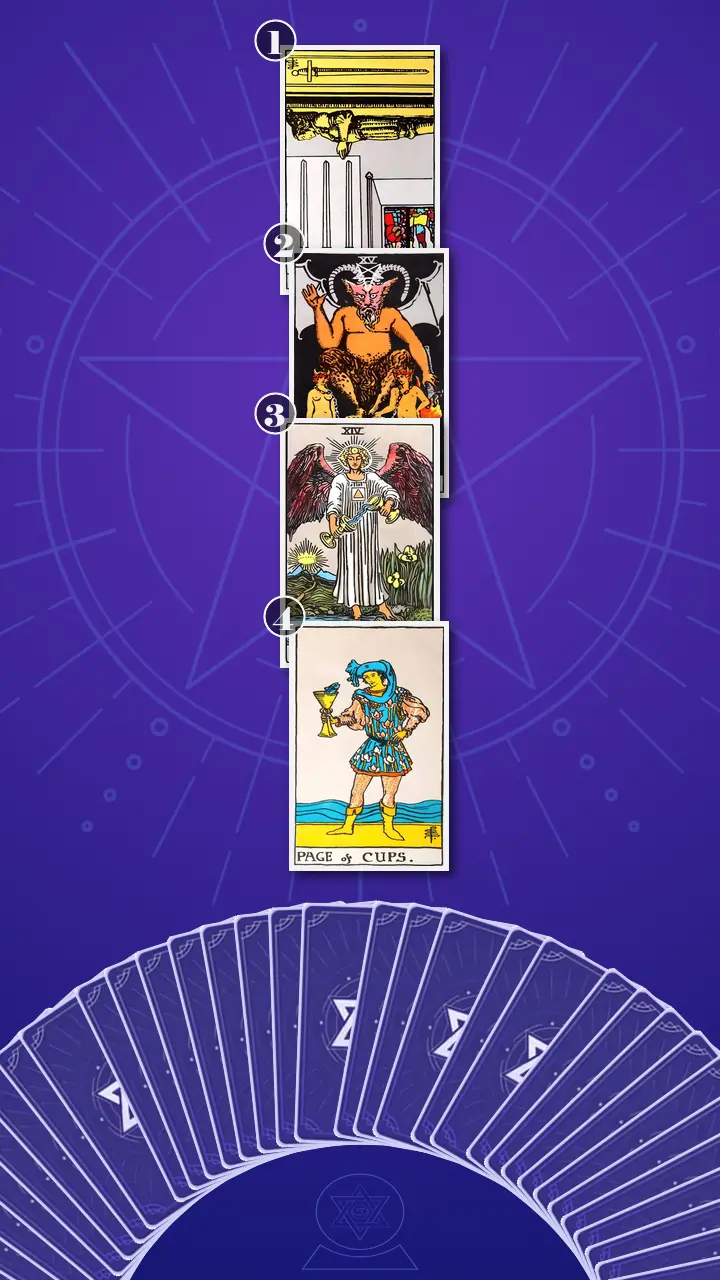
“Today I’m using a spread called the Four-Layer Insight Ladder · Context Edition,” I explained. “It’s a simple 4-card linear ladder—symptom → root driver → key shift → gentle action.”
For you reading this: this kind of tarot spread works well when the problem isn’t about predicting a future outcome, but about changing an internal loop—especially the kind that shows up at night as decision fatigue, productivity guilt, and that wired-but-tired feeling after work. Four cards is enough to show the mechanism without overwhelming someone whose mind is already spinning.
Card 1 will show what “can’t relax after the to-do list is done” looks like in real behavior and nervous-system energy. Card 2 will name the belief underneath—the hook that keeps the system in doing-mode. Card 3 is our pivot: the reframe that turns rest into something you can access without earning it. Card 4 gives one kind next step for the next 24–72 hours—small, doable, and human.
Reading the Map: A Tarot Spread for Restlessness and Overthinking
Position 1: Surface Symptom — Four of Swords (reversed)
“Now flipped over,” I said, “is the card that represents the surface symptom: what ‘can’t relax after the to-do list is done’ looks like in real behavior and nervous-system energy.”
Four of Swords, reversed.
I didn’t need to reach for poetic language; Taylor’s life was already speaking in the card’s vocabulary. “You’ve finished the list, sent the last email, and even prepped lunch for tomorrow. You sit on the couch with tea… and your body stays wired like you’re still in a meeting. Within two minutes you’re up again: wiping the counter, reopening your planner, re-ordering tomorrow’s tasks, checking Slack ‘just in case.’ Nothing is actually on fire—your nervous system just doesn’t believe ‘quiet’ means ‘safe.’”
In the traditional image, the figure is finally meant to rest. Reversed, that rest is blocked—like a car parked in the condo garage, engine still revving because you never shifted into neutral. This is Air energy (mind, thinking, scanning) running too hot: not balanced, not helpful—just overactive.
I leaned in, not to intensify, but to be precise. “This isn’t you failing at relaxing,” I said. “This is your body staying in contracted mode. ‘Done’ happens on paper, but it doesn’t register in your nervous system. So your mind keeps reopening tabs.”
Taylor let out a tight, almost-laugh—half humor, half wince. Their eyes flicked down to their hands like they were catching themselves doing it in real time.
“That’s… yeah,” they said, and the honesty landed with a bitter edge. “It’s like—my list is checked off and I still… start another list. Every night.”
Position 2: Root Driver — The Devil (upright)
“Now we open the card that represents the root driver: the belief or attachment that keeps the mind in doing-mode even when there’s nothing left to do,” I said.
The Devil, upright.
“The list isn’t the real chain,” I told them, keeping my voice steady. “The chain is the identity hit you get from being the responsive one. You keep your phone close during downtime because being available feels like being valuable. Rest starts to feel like a risk: if you go offline, you imagine tomorrow punishing you with surprises. So you do the safest thing you know: monitor, optimize, stay ‘on.’”
The Devil is famous for its chains—but the chains are loose. That’s the detail that matters in modern life. This isn’t fate. It’s habit. It’s an invisible contract you forgot you signed: Proof-Of-Worth Premium, billed nightly in anxiety.
“Not because you love work,” I added, letting the truth have its shape, “but because being reachable feels like being worthy.”
I saw Taylor’s gaze go soft and far away, like the moment in Severance when the elevator doors close and you realize you never actually left. Their breath paused—then came back shallow.
“Oh,” they said quietly. The word was small, but it carried weight. “I’m not chasing tasks. I’m chasing permission.”
“Exactly,” I said. “Your ‘one more thing’ is often a safety ritual, not a character flaw.”
Position 3: Key Shift — Temperance (upright)
When I reached for the third card, the room felt quieter—not because the city outside had softened, but because Taylor stopped fighting their own experience for half a second. Even the TV’s idle glow seemed less demanding.
“Now we turn over the card that represents the key shift: the regulating reframe that turns rest into something you can access without earning it,” I said. “This is the pivot.”
Temperance, upright.
Temperance is the alchemist. In the image, water pours between two cups—steady, patient, unhurried. One foot on land, one in water. A path leading toward a rising sun. Not an on/off switch. A dimmer.
“Instead of trying to ‘finally relax,’” I said, “you build a repeatable in-between: a 10-minute off-ramp right after the last task. You close tabs, put the work device away, wash one mug, change into softer clothes, lower the lights—small cues that tell your body the context has changed. You’re not doing less forever; you’re mixing effort and recovery so you don’t swing from overdrive to collapse.”
Then I used the lens my family taught me—my Nature Empathy Technique, the way I read humans the way I read weather. “I want to name something I’m seeing in your body,” I told Taylor. “Your jaw is doing what your mind has been doing—clenching to create certainty. That’s a body signal. It’s not wrong; it’s communication.”
“In elemental terms,” I continued, “your Air is overactive—thoughts scanning like they’re on shift. The Devil showed Earth gripping tight—worth equals output, control equals safety. Temperance is Fire used wisely: not a blaze, but a controlled warmth that recalibrates. And when Fire does that, it finally becomes possible to arrive in Water—softness, feeling, real rest.”
They nodded once, almost reluctantly—like agreeing would make the next part real.
The Aha Moment: The Two-Cup Transition
Setup: It’s 9:45 p.m. You close the laptop, the kitchen light feels too bright, and your thumb is already hunting for Slack like it’s a reflex—because silence is when your brain starts forecasting tomorrow.
Stop treating rest as a prize you unlock, and start pouring yourself from “doing” into “being” like Temperance moving water cup to cup.
I let the sentence hang there. Like a drop of water held at the lip of a cup, right before it falls.
Taylor’s reaction came in a chain—fast, physical, honest.
First, a freeze: their breath stopped mid-inhale, and their fingers hovered above their phone as if they’d been caught reaching for it in a dark room.
Second, the mind trying to argue its way back into control: their eyes narrowed, then unfocused—like they were replaying every night they’d ever tried to “earn” permission to rest by doing one more thing. Their mouth tightened, almost angry. “But if I don’t keep momentum,” they said, “things will slip. And then I’ll spiral.”
Third, the release—small, but real: their shoulders dropped a fraction, like a backpack strap finally loosened. They exhaled through their nose, slow and shaky. The skin around their eyes went pink in that way that isn’t exactly crying, but is definitely the body surrendering a little.
“You won’t relax by finishing more; you relax by practicing the transition,” I said, keeping it practical, keeping it kind. “Relaxation isn’t something you unlock by completing more—it’s something you practice by teaching your body, in small transitions, that stopping is safe.”
They stared at Temperance again. “So… the goal isn’t perfect rest,” Taylor murmured. “It’s… training.”
“Yes,” I said. “This is you moving from wired vigilance into the first hint of permission—toward a steadier calm that doesn’t require earning.”
I asked them the question that turns insight into lived memory. “Now, with this new lens—think back to last week. Was there a moment when you finished something and immediately went into checking or planning? If you’d had an off-ramp right then, what would have changed in your body?”
Taylor blinked slowly. “Thursday,” they said. “I finished a deck for Monday. I was done early. And I felt… guilty. Like I’d stolen time. I could’ve… just stopped. Even for ten minutes.”
I nodded. “That’s the training ground. Not a perfect night routine. A small, repeatable handoff.”
Position 4: One Kind Next Step — Page of Cups (upright)
“Now we flip the card that represents one kind next step: a gentle, doable action for the next 24–72 hours that supports integration,” I said.
Page of Cups, upright.
The Page holds a cup at chest height, and a fish pops up—an unexpected little feeling, a surprise softness that can’t be forced.
“One kind next step tonight,” I told Taylor, “is to pick a single comfort that isn’t a project—one song on repeat while you wash your face, a 7-minute walk around the block with no podcast, or sitting by the window watching streetlights flicker on. The rule is: you don’t measure it. You let it be small and sincere, like practicing ‘I’m allowed to feel okay without producing anything.’”
I watched their hands unclench slightly on the mug. It wasn’t a dramatic shift. It was the kind that actually lasts.
“Tonight’s goal isn’t perfect rest,” I reminded them. “It’s a small downshift you can repeat. If it feels awkward, that doesn’t mean it’s failing—it means it’s new.”
The Off-Ramp Ritual: Actionable Advice That Doesn’t Become Another Task
Here’s the story the ladder told, in plain language: you finish the day (Four of Swords reversed), but your mind stays braced because “done” doesn’t feel safe. Underneath, there’s a Devil-contract—worth equals output—so you keep checking and planning to buy a feeling of permission. Temperance doesn’t ask you to be less ambitious; it asks you to stop using overdrive as regulation. It offers a transition ritual—an off-ramp—so your body can learn a new rule: stopping is safe. Then Page of Cups makes it human: one small comfort, no metrics, no optimization.
The cognitive blind spot I want you (and Taylor) to hear clearly is this: you’ve been treating rest like a reward you earn after perfect performance—so your brain tries to “solve” discomfort with more planning. But what you actually need is a daily regulation practice that protects your future capacity.
So I gave Taylor a plan that is deliberately too small to become a new system:
- The 10-minute Off-RampRight after your last task, set a timer called “Off-Ramp.” Close your laptop, plug it in, and leave it there. Put your phone in another room (or at least face-down across the room). Choose exactly one low-stimulation action: make tea, take a shower, slow stretch, or sit by a window—nothing else.Expect your brain to protest. Discomfort doesn’t mean it’s wrong; it means the pattern is changing. If “another room” is too intense tonight, start with “out of reach.”
- Shower Water-Flow Meditation (Temperance in real life)If you choose a shower as your off-ramp: stand under the water for 2 minutes with no agenda. Feel the temperature, the sound, the way water moves from your shoulders down your arms—like pouring from one cup to the next. When your mind tries to plan, label it once: “planning,” then return to the sensation.Keep your eyes open if you feel too activated. You’re not trying to “win calm.” You’re practicing the handoff.
- One No-Optimization ComfortWithin 24–72 hours (tonight counts), do one small comfort for 7–10 minutes max: one song on repeat, a warm drink on the balcony, or a short walk with no podcast. No tracking. No researching the “best” version. Let it be enough.If your brain tries to turn it into a project, choose the simplest version on purpose. The point is sincerity, not improvement.
Before we ended, I added one more option from my own toolkit, made for city living: “If you have even a sliver of balcony,” I told Taylor, “do my 5-minute balcony energy awakening practice tomorrow—stand outside, feel the air on your face, name the weather without judging it, and let your shoulders drop one notch. It’s a body cue that the workday is not the whole world.”

A Week Later: The Quiet Proof
A week later, Taylor messaged me at 10:12 p.m.
“Did the Off-Ramp,” they wrote. “Phone in the hallway. Ten minutes. Showered and just… listened to the water. Didn’t fix anything. It was weird. But I didn’t open Slack.”
Then, after a pause bubble, another text: “I still felt itchy. But my jaw wasn’t locked. That feels like… proof.”
I pictured it clearly: a person who used to treat silence like a threat, standing under water like Temperance—same life, same responsibilities, just poured into a different cup for ten minutes.
They told me they celebrated by sitting alone on the balcony in a hoodie, watching streetlights flicker on. They didn’t feel euphoric. They felt quieter. The next morning, their first thought was still, What if I mess up?—but this time they noticed it, exhaled, and didn’t reach for Slack.
That’s what a Journey to Clarity often looks like in real life: not a grand transformation, but a small, repeatable downshift—permission practiced until it becomes believable.
We’ve all had that moment where the list is finished, the room is finally quiet, and instead of relief your jaw stays tight—because part of you is terrified that slowing down will prove you’re not enough.
If rest didn’t have to be earned tonight, what’s one tiny ‘off-ramp’ you’d be willing to practice—just enough to teach your body that stopping is safe?
This story is adapted from psychological research, written so that those in a similar struggle can see their own pattern in it — and find their next step clearly.These insights are not a substitute for professional psychological, medical, legal, or financial advice.
Learn more about our Journey to Clarity.
How did this insight land for you?
🫂 This Resonates Deeply
🌀 Living This Story
✨ Now I See Clearly
🌱 Seeing New Possibilities
🧰 Useful Framework
🔮 The Confirmation I Needed
💪 Feeling Empowered
🚀 Ready for My Next Step
Author Profile
 AI
AI“As the seventh generation of a Highland healing family, I see modern anxieties as a simple, temporary disconnection from nature's rhythm. I bring 67 years of lived seasons not to instruct you, but to hold space for you. Using tarot as a mirror, I want to gently guide you out of the chaos, helping you breathe deeply and rediscover the organic, steady heartbeat of your own life.”
In this Introspection Tarot Reading :
Core Expertise
- Somatic Shadow Sensing: Identifying where chronic mental fatigue and unexpressed emotions are physically trapped within your body's architecture.
- Ecosystem Bandwidth Restoration: Using the metaphor of nature's self-cleansing cycles to diagnose and clear the 'mental static' of an overstimulated nervous system.
Service Features
- The Grounding Transmutation Ritual: A sensory, physical practice designed to literally discharge excessive mental rumination into the earth, instantly restoring bodily presence.
Also specializes in :
Explore Related Patterns:
Certainty SeekingTaylor's mind treats a quiet living room like an unsolved risk, so tomorrow's plan gets rewritten and the jaw tightens as if certainty could be clenched into place. The fear is not simply that a task will be missed; it is that an unplanned moment could expose them to a surprise they cannot control. That is the cognitive trap inside Certainty Seeking. Planning offers a quick hit of control, but it also trains attention to keep scanning for the next possible slip. When you tell yourself that momentum is the only thing preventing a spiral, rest starts to look like negligence instead of regulation. The gentler move is to practice enough structure, then stop before certainty feels complete. You are not waiting until the mind has no objections; you are letting the body learn that uncertainty can be present without taking over the evening.
Permission SeekingTaylor says it directly when the insight lands: they are not chasing tasks, they are chasing permission. The completed list does not grant relief because the mind has turned rest into something that must be authorized by more proof, cleaner preparation, or one final check. Permission Seeking is the mechanism where an internal yes gets outsourced to performance. You wait for the perfect signal that it is finally acceptable to stop, but the signal keeps moving because the rule was never really about the task list. It was about trying to feel allowed. The kind step is to make permission behavioral before it feels emotionally believable. A ten-minute off-ramp, one song, or a shower without optimization gives you a small lived experience of stopping without earning extra approval first.
Productivity as SafetyTaylor finishes the list, makes tea, and immediately starts rewriting tomorrow's plan because silence feels suspicious. The behavior is not about another useful task; it is a safety ritual that tries to convert uncertainty into output, so the body can feel protected by motion. The deeper rule is that done happens on paper before it happens in the nervous system. When you learned to regulate through planning, responsiveness, and control, rest can feel like dropping guard rather than recovering. Productivity as Safety names the loop where producing more becomes a substitute for feeling safe enough to stop. The kind next step is not another system but a small off-ramp that proves safety without performance. You are training your body to recognize completion as a real boundary, not as the opening bell for the next round of optimization.
Achievement FusionTaylor describes being reachable as if it carries proof of value, and the story names the hidden contract clearly: worth equals output. The body keeps bracing after the workday because slowing down threatens more than the schedule; it threatens the identity of being the responsive one. Achievement Fusion shows up when performance stops being something you do and becomes evidence for who you are allowed to be. In that frame, finishing early can feel like stealing time, and rest can trigger guilt because it no longer reads as neutral recovery. The shift is to separate capacity from worth in one observable way. When you put the phone in the hallway or choose one comfort that is not a project, you are giving the system a new reference point where value does not have to be re-earned at 9:47 p.m.
Compulsive CheckingTaylor's phone wakes with no notification, and their thumb opens Slack before a choice has even formed. That reflex matters because the checking is no longer a response to information; it is a way to discharge the discomfort of quiet. The loop keeps selling itself as responsible, especially when you can call it 'just in case.' But each check teaches the nervous system that silence needs verification, so relief stays brief and the urge returns. Compulsive Checking fits because the action repeats even when there is no new signal to process. The repair begins when the check is delayed, moved out of reach, or replaced by a low-stimulation cue. You are not proving you can ignore responsibilities forever; you are creating a small gap where choice can come back online.
Explore Related Struggles:
Availability-Worth FusionTaylor keeps the phone close during downtime because being available feels like being valuable, and the story names that as the real chain under the list. You can feel how the Slack reflex is not only about work access; it is a tiny test of whether you are still useful when nobody is actively asking for anything. Availability-Worth Fusion forms when responsiveness becomes a stand-in for personal value. The cost is that rest starts to feel like disappearing from the proof system, so you keep one channel open, one task ready, one future surprise pre-managed. The part of you seeking worth is not wrong; it just has a very narrow and exhausting way to collect evidence.
Monitoring-Safety FusionNo notification arrives, but the screen wakes and Taylor's thumb opens Slack before a conscious decision catches up. The room is quiet, the workday is over, and still the system acts as if safety depends on another scan. Monitoring-Safety Fusion is the point where checking stops being information gathering and becomes a substitute for feeling safe. You are not chasing productivity for its own sake; you are trying to lower the threat of tomorrow by staying slightly on duty tonight. The loop feels protective in the moment, but it teaches the body that quiet is suspicious unless it has been inspected.
Rest-Permission SplitThe laptop is shut, the tea is made, and the list is complete, yet Taylor immediately starts rewriting tomorrow's plan because the silence feels suspicious. You can see the split in the timing: the day has offered an endpoint, but the body still waits for some extra proof that stopping is allowed. That is the core friction in Rest-Permission Split. Rest is not being blocked by laziness; it is being held behind a permission gate built from completion, usefulness, and one more small task. You get stuck between a checked-off list and an unchecked sense of legitimacy, so downtime arrives on the calendar before it arrives inside you.
Transition Ambiguity LockThe condo living room has all the cues of an evening, but Taylor's body is still operating like it is in a meeting. The shut laptop, tea, shower, and balcony are available, yet none of them automatically tell the system that the work context has actually ended. Transition Ambiguity Lock sits in that gap between external completion and internal arrival. You do not need a bigger productivity system; you need a recognizable handoff from doing to being. Without that handoff, rest has no doorway, so the phone and planner remain the most familiar route back to a state that feels organized.
Moving Finish Line TrapTaylor says the list is done, then starts another list. The story repeats the same physical sequence: couch, tea, laptop closed, then planner reopened, counter wiped, tasks reordered, Slack checked just in case. Moving Finish Line Trap captures the way completion keeps slipping forward the moment it is reached. You are not failing to finish; the definition of finished keeps mutating into another micro-proof of readiness. That leaves you with the strange exhaustion of having done enough on paper while your evening is still being billed for a task that never announces its endpoint.
Productivity Shame BindThursday gives the clearest snapshot: Taylor finished a deck early and felt guilty, like they had stolen time. Even the possibility of stopping for ten minutes carried a charge, as if ease needed to be justified by more output. Productivity Shame Bind turns open time into evidence that you might not have done enough. You can complete the visible work and still feel exposed by the unused space that follows. The struggle is not a lack of appreciation for rest; it is the learned pressure to make every quiet minute prove its innocence.
Explore Related Emotions:
Hypervigilant AnxietyTaylor shuts the laptop, makes tea, and sits down, yet their jaw stays tight, their shoulders stay lifted, and their thumb opens Slack before a conscious decision has even formed. The workday has ended in the room, but not inside the body. That mismatch creates the emotional logic of Hypervigilant Anxiety: the nervous system keeps scanning for a missed demand even when there is no active notification. Quiet does not read as relief; it reads as a gap where something could go wrong. You are not looking at simple busyness here. You are looking at a body that has learned to treat availability as protection, so the absence of urgency feels unsafe until a new cue teaches it otherwise.
Permission AnxietyTaylor names the core realization in plain language: 'I'm not chasing tasks. I'm chasing permission.' That sentence shifts the story away from workload and toward the inner authorization they have been trying to earn. Permission Anxiety captures the feeling of needing approval from an invisible standard before rest can begin. The phone, the planner, and the extra task all become ways to request emotional clearance: am I allowed to stop now? You can reclaim agency here because the loop is visible. Once the craving for permission is named, the next step can be kind and specific instead of another attempt to become worthy through output.
Productivity AnxietyTaylor keeps checking, rewriting tomorrow's plan, and beginning one more small thing after the visible work is complete. The behavior keeps reaching for a task because a task gives the mind something concrete to hold. Productivity Anxiety is the feeling underneath that reach: the sense that output is the safest way to manage uncertainty. If tomorrow might bring surprises, planning becomes an emotional shield, even when it starts draining the very capacity it is trying to protect. You are not failing to relax because you need a more optimized evening. The story points to a deeper loop where productivity has been asked to do the job of emotional safety.
Rest GuiltTaylor finishes the list and still starts another one, then remembers a Thursday when being done early felt like stolen time. The discomfort is not caused by an unfinished task; it appears exactly when the task is finished. Rest Guilt fits because stopping has become emotionally loaded with the fear of taking something unearned. Being reachable has been linked with being valuable, so rest arrives with a quiet accusation attached to it. You can see the cost in the way comfort has to be defended from productivity. The kind next step is not a better system; it is a small experience of rest that does not need to prove its legitimacy.
Standby Mode AnxietyTaylor's phone lights up with no notification, and Slack opens almost automatically. The scene is domestic and quiet, but their attention remains positioned as if a work signal could arrive at any moment. Standby Mode Anxiety names that in-between state where you are technically off, yet still emotionally available for interruption. Nothing is happening, but the body is prepared as if something might. The story shows why the phone in the hallway matters. It is not a productivity hack; it is a boundary cue that lets your body experience being unreachable without the whole evening collapsing.
Explore Related Contexts:
Always On AvailabilityTaylor has already finished the visible workday: the list is done, the laptop is shut, tea is made, and the couch is available. Yet the phone remains close enough that a screen waking without a notification still sends their thumb straight to Slack, turning a quiet evening into another moment of workplace readiness. That reflex points to an external availability system that has trained responsiveness into the body of the evening. Slack, pings, and the expectation of being reachable do not stay inside office hours; they follow Taylor into the condo living room and keep the work role alive after the tasks are technically complete. You are not looking at a simple inability to relax. The story shows a modern work environment where being available has become part of proving value, so stopping feels operationally risky even when nothing is actually on fire. Naming it as Always On Availability gives you a clearer target: the pressure is not just inside you, it is also built into the communication structure around your workday.
Hustle Culture TrapTaylor does not stop at a completed list. They send the last email, prep lunch, sit down with tea, and still begin rewriting tomorrow's plan because completion has not become a believable endpoint. Even finishing early on Thursday produces guilt, as if unused time has been stolen rather than returned. That is the outer shape of a Hustle Culture Trap: output becomes the price of permission. The pressure is carried through personal habits, but it is fed by a wider work culture that rewards constant responsiveness, planning, and visible usefulness. You are dealing with a social rule that has become hard to see because it sounds responsible on the surface. The trap says rest must be earned through perfect performance, so every pause gets converted into another chance to optimize. The story's useful pivot is to stop treating recovery as a reward and start treating it as part of the infrastructure that keeps you capable.
Response Time PressureTaylor names the role clearly without needing corporate language for it: being reachable feels like being valuable. The phone stays close during downtime because going offline seems to invite tomorrow's surprises, and monitoring becomes the safest available strategy. Response Time Pressure captures the external demand underneath the nightly checking. The work is not only the deck, the emails, or the list; it is the expectation that Taylor should stay close enough to react quickly, even outside the visible work window. For you, this label turns a vague sense of guilt into a concrete workplace pressure pattern. If responsiveness has become part of how value is measured, then rest will keep feeling like a professional risk until you build a boundary that separates completion from constant readiness.
Work Life Boundary CreepThe Toronto condo living room is set up for an ordinary night off: kettle fading, TV glow, laptop clicked shut, body sinking into the couch. Then the boundary slips. Taylor rewrites tomorrow's plan, reopens the planner, checks Slack just in case, and turns a finished evening into another work-adjacent shift. Work Life Boundary Creep fits because the story does not show one dramatic interruption. It shows the slow leakage of work logic into domestic space, where tea, the couch, and a closed laptop cannot hold the line against planning, checking, and one more small thing. You can use this label to separate the person from the pattern. The issue is not that you need a more ambitious routine; it is that your rest environment has been colonized by tiny work access points. A kind next step becomes less about forcing calm and more about rebuilding a visible boundary your body can recognize.
Recovery Infrastructure TrialTaylor's next step is deliberately concrete: close the laptop, move the phone away, take ten minutes, shower, listen to the water, or sit by the balcony without turning comfort into a project. A week later, the phone is in the hallway and Slack stays closed. Recovery Infrastructure Trial fits because the story is not selling relaxation as a personality trait. It shows Taylor testing physical supports that make recovery easier to access: distance from the device, a short timer, low-stimulation sensory cues, and a protected off-ramp after the final task. For you, this is the constructive side of the whole reading. The goal is not a perfect night routine; it is a small external structure that helps your body register that the context has changed. When the environment carries part of the transition, rest becomes less dependent on forcing yourself to feel calm.
Routine Reset TrialTaylor's old sequence is immediate and automatic: finish the list, sit down, feel the quiet, check Slack, rewrite tomorrow. The new sequence is just as specific but less punishing: set a ten-minute off-ramp, put the phone out of reach, choose one low-stimulation action, and let it be enough. Routine Reset Trial describes a practical transition that is still being tested. It is not a fully established lifestyle overhaul; it is a small replacement pattern at the exact point where the old loop usually restarts. You can trust the smallness of this because the story's problem happens in a small window. The reset gives that window a new script, one that protects agency without demanding another self-improvement system.
Slack Scope CreepSlack keeps appearing at the exact moment the workday should be over. Taylor checks it just in case, starts one more small thing, and lets tomorrow's plan enter the evening before the evening has had a chance to become its own space. Slack Scope Creep names the way a communication tool quietly expands the perimeter of work. No manager has to visibly assign a new task in the scene; the channel stays open enough for Taylor to generate more monitoring and micro-work on their own. You gain leverage by treating Slack as a boundary object. The problem is not only the app, but the role it plays at 9:47 p.m.: it turns the possibility of work into an actual interruption. Putting distance between you and the channel gives the day a more honest endpoint.