One Blank Answer Triggered Forty-Five Minutes of Setup, Then a Retry

Finding Clarity in the Sunday Study-App Spiral
I started with the sentence I had come to recognize: “You are a Toronto undergrad working two cafe shifts, and at 8:40 PM on Sunday you are comparing Notion and Anki instead of opening Monday's chapter: this is productivity-tool hopping disguised as preparation.”
Jordan (name changed for privacy) settled into the chair across from me with a cold coffee beside their open textbook. The campus library's fluorescent lights buzzed overhead; their phone felt warm in one hand, while three study-app tabs glowed on the laptop and a Notion dashboard waited on the screen. After one practice question came back blank, I watched them import the chapter into a new template, rename categories, and move between windows for nearly forty-five minutes.
They looked at me and said, “I keep getting ready to study instead of studying. I want to learn the material, but every time it gets difficult, I start looking for a better tool.” Their calendar was immaculate, their folders were colour-coded, and Monday's deadline was getting closer while the actual questions remained untouched.
The uncertainty moved through them like a metronome with a loose spring: too fast behind the jaw, too shallow in the breath, too restless in the hands. It carried frustration, guilt, and the quieter fear that staying with one tool long enough to test their understanding might reveal a real gap.
I told Jordan that I did not hear laziness in the pattern. I heard a mind trying to create safety around an uncomfortable moment. “You are rearranging a toolbox while the assignment stays untouched,” I said. “Let us make the loop visible without judging you for having built it. Our Journey to Clarity today is simply to find the next honest beat.”

Choosing the Compass: The Four-Layer Insight Ladder
I asked Jordan to take one ordinary breath and name the question they were avoiding, not an ideal plan for the entire semester. Then I shuffled slowly, using the movement as a transition from reactive clicking to deliberate attention. Tarot, for me, is not a verdict or a promise; it is a visual thinking tool that helps a hidden pattern meet observable evidence.
I explained to Jordan, and to anyone wondering how tarot works for study procrastination, that I would use the Four-Layer Insight Ladder spread. Its four positions are the smallest structure that can hold this particular chain: the visible behaviour, the root mechanism, the turning point, and the action that grounds the insight. A larger spread could add interesting details, but it might pull attention away from the tightly bounded question of why study-app switching replaces learning.
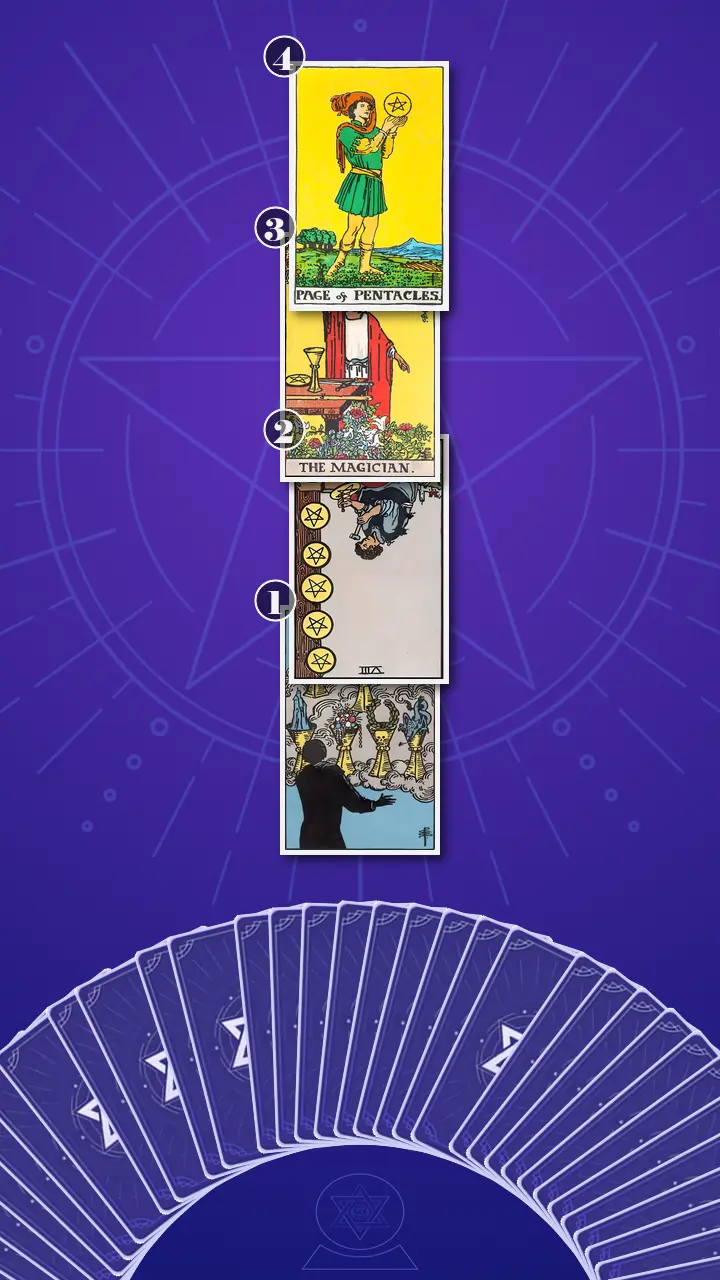
I placed the cards in a vertical line, with the present-state layer at the bottom and the action layer at the top. The first position would show the observable tool-switching and chaotic attention. The second would uncover the fear and perfectionistic defence sustaining it. The third, the Catalyst, would identify the shift from method-shopping to focused agency. The fourth would turn that shift into a small practice built on repetition and feedback.
From Seven Possibilities to Eight Repetitions
The Seven Cups Above the Desk
Now turning over is the card representing the observable tool-switching behaviour, choice overload, and chaotic attention described by the present-state layer: Seven of Cups, in the upright position.
In the Rider-Waite-Smith image, a silhouetted figure faces seven cups floating in a cloud, each holding a different temptation or threat. In Jordan's real life, those cups were seven attractive study futures hovering above the desk: Notion promised a cleaner knowledge base, Anki promised perfect recall, Quizlet promised quick cards, and every comparison video suggested that the next system would make learning feel easier.
This is an excess of Water energy: imagination, possibility, and emotional investment are moving everywhere, but no choice is being held steadily. Jordan reaches the first dense paragraph or the first question they cannot answer, then searches for the best study app, imports the notes, and imagines becoming the kind of student who has finally figured everything out. The choice feels productive because it creates motion, but no tool stays in their hands long enough to support one real answer.
A polished system can create the feeling of progress without asking for evidence. I asked, “When the first answer goes blank, which cup do you reach for: a new app, a new template, another video, or a different task?”
Jordan gave a short, bitter laugh. “That is almost rude. I do all four.” Their mouth tightened after the laugh, and their fingers moved away from the laptop for the first time. I let the recognition stand without turning it into shame. Naming the pattern was already a way of stepping outside it.
The Workbench That Keeps Getting Rebuilt
Now turning over is the card representing the hidden belief, emotional driver, and self-reinforcing mechanism sustaining the present state: Eight of Pentacles, in the reversed position.
Upright, the Eight of Pentacles is the image of apprenticeship: one craftsperson, one workpiece, repeated contact, gradual skill. Reversed, the rhythm is interrupted. The hammer and chisel never reach the material twice in a row because the worker keeps redesigning the workbench.
That was Jordan's forty-five-minute template migration after a blank recall attempt. They were changing tags, importing lecture slides, and rebuilding folders instead of attempting, checking, correcting, and attempting again. Earth energy was available but blocked; effort could not consolidate into learning because the practice cycle stopped precisely when feedback became uncomfortable.
I said, “If I keep improving the setup, I do not have to see the blank.” Jordan's thumb pressed hard against the edge of the laptop. Their shoulders lifted, and their breathing became shallow as they looked at the row of completed pentacles on the card.
With my Focus Disruption Auditing lens, I named the specific dissonant chord: a difficult paragraph or missed question triggered the thought that the method was wrong; a new setup brought short-term control; the interrupted practice then left the gap untouched, making the next deadline feel heavier. The issue was not every notification or every app. It was the moment when a question became evidence about competence, and comparison became a way to postpone the evidence.
I also use what I call Cognitive Tempo Calibration. Here, the demand of an honest question suddenly moved faster than Jordan's natural study rhythm. Switching tools lowered the pressure for a minute, but it also broke the slower beat through which memory becomes more reliable. A blank answer was not a verdict on who they were. It was a location on the map.
When the Magician Closed the Tabs
The Catalyst on the Table
The room seemed to narrow around the third card. I could still hear the fluorescent hum, but the screens no longer looked like separate invitations; they looked like a choice Jordan could make.
Now turning over is the card representing the key shift from searching for the ideal system to directing one adequate tool toward a defined learning task: The Magician, in the upright position. This is the Catalyst of the reading.
The Magician stands with one wand raised and one hand pointing downward toward a table holding the four suit emblems. The image does not show a person waiting for a missing resource. It shows someone deciding how to direct what is already available. Jordan's laptop, textbook, notes, timer, and course calendar were enough to begin one real task. Their value would come from intention, not from becoming a more impressive study identity.
At 8:40 on Sunday, in the Toronto library, Jordan had the textbook open, three app tabs glowing, and forty-five minutes disappearing into settings after one blank answer. The thought sounded responsible: I need a better system. The assignment stayed untouched; each new category offered shelter from seeing a real gap.
You do not need a perfect system to become ready; choose one tool, begin one real task, and let the Magician's raised wand direct the resources already on the table.
First, Jordan's fingers froze above the keyboard and their eyes widened as if the sentence had interrupted a familiar reflex. Then their gaze lost focus; I could see them replaying the Sunday tabs, the polished dashboards, and the moment a blank answer had turned into an app review. Finally, their breath left in a low, uneven exhale. Their shoulders dropped, their clenched hand opened against the table, and the corners of their mouth moved between relief and disbelief. The fluorescent buzz remained, but it no longer felt like an alarm. A small release arrived with a brief, dizzying vulnerability: without the perfect setup to blame, the next choice belonged to them. Their voice was quiet when they said, “I thought I needed a better system. Maybe I need one direction.” I nodded, leaving room for both the relief and the responsibility.
I asked, “Now, with this new view, can you remember a moment last week when seeing the problem as a direction rather than a verdict might have changed your next move?”
This was the first step from anxious comparison and temporary control through polished systems toward grounded confidence built through imperfect, repeated contact with the material. The Magician did not erase Jordan's uncertainty. It gave that uncertainty somewhere useful to go: toward one question.
The Page Holding One Pentacle
Now turning over is the card representing how the new understanding can be grounded through a practical next step: Page of Pentacles, in the upright position.
The Page holds one pentacle at eye level in a cultivated landscape. After the Seven's crowded possibilities, the Eight's interrupted workbench, and the Magician's coordinated tools, this single object receives undivided attention. The Page does not need to perform mastery. The Page needs to stay close enough to one piece of material for curiosity, correction, and repetition to become possible.
I translated the card into one chapter objective, five closed-book questions, and a simple answer-check-correct-retry loop. Jordan looked at the timer and said, “But after a cafe shift, even twenty minutes can feel impossible.” I answered, “Then we make the beat five minutes. The practice is allowed to be small. It is not allowed to become a test of your worth.” Their hands rested flat on the table, and the restless tapping stopped.
The One Adequate Tool
When I linked the four cards, the story became practical. The Seven of Cups showed attractive possibilities replacing contact with the chapter. The reversed Eight of Pentacles showed why: a blank answer exposed a gap, and rebuilding the workbench offered immediate control without requiring an uncertain response. The Magician returned agency by gathering the laptop, textbook, timer, notes, motivation, and attention around one intention. The Page of Pentacles made that intention modest enough to repeat.
Jordan's blind spot was not a lack of organisation. It was treating visible organisation as proof of learning and treating a blank answer as proof of inadequacy. The transformation direction was therefore not a dramatic reset or a permanent promise to one app. It was a bounded experiment: choose one adequate tool for seven days, direct it toward one defined learning task, and measure progress by questions attempted, ideas recalled, and errors reviewed.
I introduced my Syncopated Study Session, a rhythm protocol I use when an academic task feels too large to enter. I break the work into frictionless micro-beats: choose the instrument, name the single objective, attempt before checking, mark the gap, and stop before the session turns into another identity project. Required course platforms, accessibility tools, and materials stay available. The freeze applies only to optional comparison and redesign.
- The seven-day adequate-tool freezeFor the next seven days, use the familiar app already holding the course notes at the campus library. Before each block, write one objective such as Explain the causes of the policy in five sentences, then close optional app-review and template tabs.When the urge to switch appears, write I am testing a tool, not marrying it and return to the next question. Review the experiment after seven days rather than making a permanent decision today.
- The twenty-minute question-first blockOn Tuesday at 7:30 PM, after the cafe shift and in the library, set a twenty-minute timer. Choose one chapter objective, answer questions on a blank sheet without notes, and check the material only after each attempt.Mark each result as recalled, partly recalled, or not yet recalled. On a low-energy day, use two questions or five minutes. Stop when the timer ends; you do not need to finish the chapter or prove competence.
- The one-error learning loopAfter one missed practice question this week, spend five minutes writing what the question is asking before opening the answer. In the existing app, create three plain columns labelled Attempt, Correction, and Retry, and add only that question.Before opening TikTok, YouTube, or another study-workflow review, complete one retrieval attempt first. Describe the gap neutrally as missing definition or unclear sequence, then decide whether more content actually serves the current objective.
These are actionable next steps, not a new performance standard. If one week feels too large, Jordan can test one session first. The point is to collect evidence about learning, not to force certainty about the method.

A Small Proof, Not a Perfect Reset
A week later, I received a message from Jordan: “I froze the optional tools. After my cafe shift, I did the twenty-minute block. I got two answers wrong, but I checked the corrections instead of rebuilding everything.” That was not a solved semester. It was the first visible proof that a question could create direction instead of panic.
On Sunday morning, after one ordinary night's sleep, Jordan opened the same app and met another blank answer. Their stomach dipped. They wrote missing definition, checked the reading, and returned to the question. The fear was still there; it no longer got to choose the tab.
I told Jordan that this was the heart of the Journey to Clarity. The cards had not selected a study method for them, and they had not promised perfect grades. They had helped Jordan notice where attention was being redirected, then choose a smaller, more honest rhythm. The change belonged to Jordan: grounded confidence beginning through repetition.
When one blank answer makes your jaw clench and your fingers race toward a new tab, it can feel safer to perfect the system than to risk seeing where you are still a beginner. Yet beneath the polished setup, the wish to understand is real, and one adequate tool can carry that wish into a single answer.
After the tabs are closed and one ordinary question is still in front of you, what small piece of curiosity might you let yourself follow for the next ten minutes?