Advice-Consumption Paralysis: Turning One Rough Draft Into Data

Advice-Consumption Paralysis at 11:48 p.m.
I recognized Jordan (name changed for privacy) as the early-career city worker who could explain three productivity systems from memory, yet still found that one blank after-work document could send them into an hour of “how to start” videos. At twenty-seven, they worked as a junior digital marketing coordinator in Toronto. Assigned briefs got finished; the portfolio project meant to test what they personally wanted remained an immaculate title page.
During our video consultation, Jordan showed me a photo from the previous Tuesday. At 11:48 p.m., a document titled First Draft sat behind fourteen tabs about focus, career direction, copywriting frameworks, and ideal routines. The laptop fan had blown warm air across their fingers while headlights swept the ceiling and wet tyres hissed along the streetcar line outside. Their eyes stung, their jaw ached, and they were creating a folder for the three systems that looked most promising.
“I keep preparing for a version of my life that never gets scheduled,” Jordan said. “I know what to do in theory, which somehow makes not doing it feel worse.”
I could feel the contradiction before I touched the cards: Jordan wanted to begin an actual life through direct action, but they required more advice before granting themselves permission to start. Their restless frustration felt like a streetcar pressing against its brakes, the whole body pitched forward while the wheels stayed locked. Motivation became uncertainty; uncertainty became comparison; comparison offered a few minutes of relief; then the blank page returned with more emotional weight than before.
“You are spending real energy on change,” I told them, “while keeping the one action that could create feedback just out of reach. I am not going to use tarot to predict which career or project you should choose. I want us to use it as an objective map of the loop, then find the smallest place where your own choice can interrupt it. What if the next useful piece of information has to come from doing?”
Choosing the Four-Layer Insight Ladder
I moved two perfume blotters away from my reading cloth, invited Jordan to put both feet on the floor, and asked them to take one unforced breath while holding the real question in mind: “Why do I keep consuming advice instead of starting my actual life?” I shuffled slowly. The pause was not a mystical performance; it was a practical transition from reacting to observing.
I chose the Four-Layer Insight Ladder · Context Edition, a six-card tarot spread for procrastination and overthinking. When I explain how tarot works in a situation like this, I describe it as structured pattern recognition. The cards give us distinct positions from which to examine behavior, trigger, fear, maintenance, leverage, and integration. They do not remove Jordan's agency or announce an unavoidable future.
I used this spread because the problem was narrow but self-reinforcing. More options created a stronger need for certainty. Research temporarily relieved that need, but inaction prevented real feedback. The missing feedback then appeared to prove that more research was necessary. A ten-card Celtic Cross would have added scale without adding useful precision; the six-card ladder was the smallest map that could show both the closed circuit and its exit.
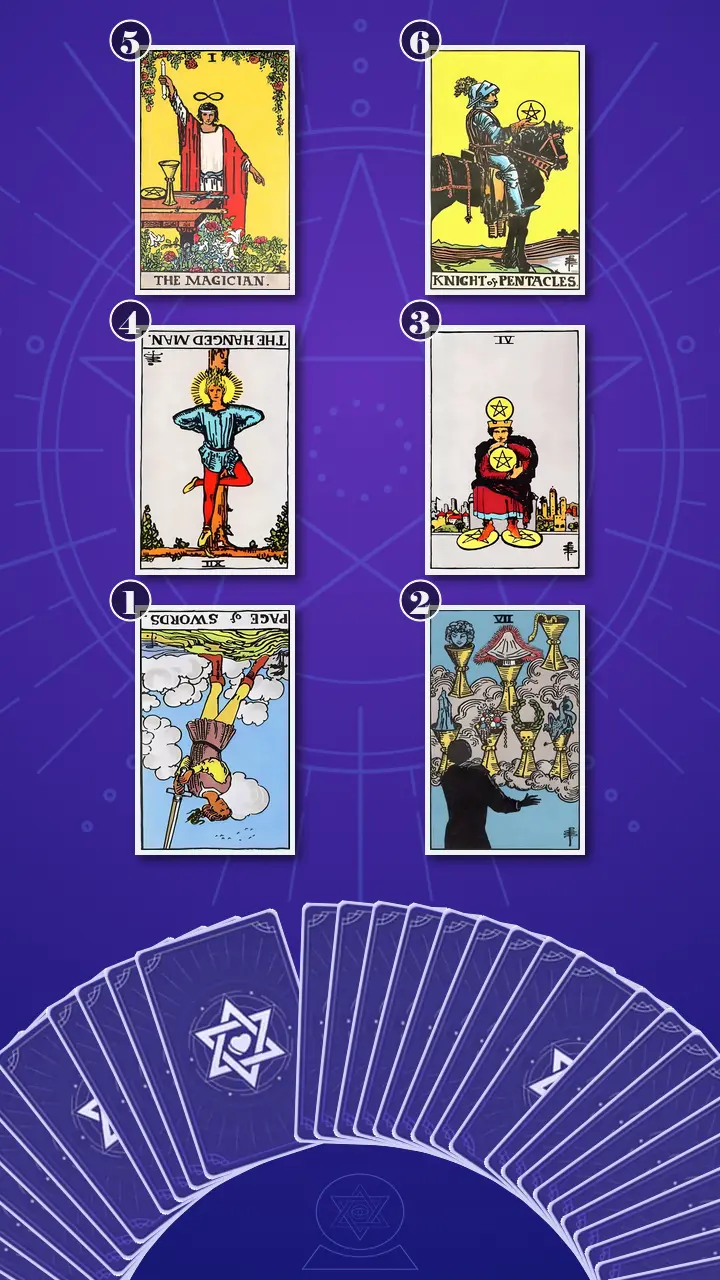
I laid the cards in a two-column switchback. The first two positions would show the visible behavior and immediate trigger. The middle pair would uncover the fear and the mechanism that kept feeding it. The final two would identify the leverage point and the ordinary practice capable of carrying that insight into Jordan's week. I pointed out that the fifth card sat like a hinge between a closed lower loop and an open upper route.
The Sword That Kept Turning Sideways
Position 1: The Preparation Everyone Can See
I turned over the card representing Jordan's diagnosis-level behavior: consuming, saving, and organizing advice instead of beginning the originally chosen task. It was the Page of Swords, reversed.
I showed Jordan the Page's body, poised as though movement might happen at any second. The sword was raised, but the gaze had turned sideways. Wind bent the trees and drove the clouds behind the figure. The image looked less like laziness than attention kept permanently on alert.
In Jordan's life, the picture became 6:24 p.m. after a hybrid workday. They opened a portfolio draft and promised to begin after one copywriting guide. That guide linked to three frameworks; each framework generated a comparison tab; the document disappeared behind a row of useful sources. The internal sequence was almost frictionless: “I will start after this one guide. That guide mentioned another method. I should compare them before choosing.”
I read the reversal as blocked Air: an excess of vigilance and comparison combined with a deficiency of grounded follow-through. Jordan's curiosity was genuine, but its energy had become divided. Every new source created another angle to monitor, so the learner identity protected them from becoming a visible beginner.
I also ran what I call a Sensory Overload Audit. I asked Jordan to notice what had occupied that one small desk: the fan's heat, Slack residue from the workday, autoplay audio, a blinking cursor, street noise, notification badges, and fourteen competing visual windows. None of those inputs was catastrophic. Together, they quietly spent the psychological bandwidth the draft needed.
Jordan did not nod. They gave a short, bitter laugh, glanced towards the tabs still open on their screen, and said, “That is so accurate it is almost rude.” Their finger hovered over the trackpad, their eyes shifted as if mentally counting windows, and then their shoulders released by less than an inch.
“Recognition can sting,” I said. “But I am not calling your curiosity a flaw. I am showing you where a useful strength has lost its boundary. Preparation becomes avoidance when the task never gets a turn.”
Position 2: Seven Possible Selves on the Morning Train
I opened the position representing the immediate trigger: exposure to persuasive methods and possible identities that intensified choice overload. The card was the Seven of Cups, upright.
I traced the seven cups floating in a cloud, each holding a different promise, warning, or mystery. Upright did not mean that abundance was automatically helpful. Here, Water and imagination were in excess. Possibility had become projection, and projection made every temporary choice feel like a verdict on Jordan's entire future.
Jordan remembered seeing a former classmate's “Thrilled to announce...” post on a crowded Line 1 train. Before the next few stops, they had opened a freelance roadmap, a product-management certificate, a creator-business thread, a graduate program, a move-abroad vlog, a minimalist routine, and a high-performance schedule. The train brakes squealed, damp wool and takeaway coffee filled the carriage, and one peer update became seven polished lives.
I compared it to a personalized streaming screen that keeps offering better options until choosing one decent film feels strangely risky. The feed had learned to interpret every pause as a request for another possible self. Jordan's inner operating system translated that abundance into: “Any of these could fix the feeling, so choosing one means losing six.”
“Which of those lives did you actually want to inhabit for an ordinary Tuesday afternoon?” I asked.
Jordan looked away from the cards. Their lips parted, then closed. After a few seconds they said, “Honestly? I do not know. I wanted the feeling that the post seemed to prove: that I had picked something and moved.”
I heard the distinction settle. Jordan was not choosing among tested desires; they were comparing complete identities generated under the pressure of feeling behind. The card invited a smaller question: not “Who must I become?” but “Which ordinary experience am I curious enough to try?”
Position 3: Information Held Like Insurance
I turned to the position identifying the underlying fear: that imperfect action might expose a lack of control or prove Jordan could not trust their own judgment. The card was the Four of Pentacles, upright.
I focused on the pentacle pressed against the figure's chest and the two coins pinning both feet to the ground. The same objects that appeared to provide security also prevented movement. The distant city carried on behind the seated figure while every available resource remained tightly guarded.
In context, the pentacles became Jordan's saved posts, Substack newsletters, decision matrices, course tabs, and carefully tagged Notion library. Choosing one method would mean releasing the fantasy that enough information could guarantee the correct move. Keeping everything preserved felt prudent, especially while paying Toronto rent and trying not to waste limited time or money. Yet the archive grew while Jordan's feet remained planted in front of the same blank page.
I described the energy as Earth contracted into excess control. Security itself was not the problem. The imbalance appeared when stored knowledge was asked to eliminate uncertainty rather than support a reversible experiment. Movement became deficient because every option had to remain available.
“Complete this without making it sound sensible,” I said. “Keeping every option protected me from...”
Jordan's elbows drew inward. Their shoulders rose, their jaw tightened, and the cursor on their screen stopped moving. I watched their gaze lose focus as an old sequence replayed behind it. Then they breathed out and said, “Finding out that my own choice was mediocre. If I keep every option, I cannot choose wrongly. If I do not choose, nothing can show me I was wrong.”
“That is the protective logic,” I replied. “It deserves understanding, not ridicule. But information is being used as insurance against a kind of uncertainty no archive can remove. We are not looking for reckless action. We are looking for the minimum amount of uncertainty you can safely tolerate during one low-stakes test.”
Position 4: When Reflection Becomes the Waiting Room
I opened the position exposing the maintaining mechanism and its cost: prolonged reflection feeling productive while the absence of lived evidence reinforced the belief that more guidance was required. It was the Hanged Man, reversed.
I pointed to the halo around the suspended figure. Insight was already present. Reversed, the card suggested that the pause had outlived its useful purpose. Surrender was blocked, while suspension itself had become excessive.
Jordan could already explain advice-consumption paralysis. They could identify perfectionistic preparation, quote several frameworks about avoidance, and describe why a blank document felt exposing. At 11:48 p.m., however, those insights were being reorganized while First Draft remained empty. The loop sounded like: “I understand why I do this. I found a better explanation. I will begin tomorrow.” Another calendar block moved; another folder improved; no paragraph existed to react to.
Jordan gave me a tired half-smile. “So, Chidi from The Good Place, except with a Second Brain dashboard.”
“With one important difference,” I said. “You can see the exact next action. Reflection is valuable when it changes perspective. Once it stops producing new information, it can become a loading spinner that still looks active after the process has stalled.”
I let the silence hold for a moment before adding, “You are not short on insight; you are short on evidence from doing. The perfect roadmap cannot give you feedback from a road you have not taken.”
Jordan's eyes shone briefly, not with a dramatic revelation but with the sharper frustration of recognizing an expired strategy. Their hand closed around their mug, loosened, and rested flat on the table. They already knew the next step. What they had lacked was permission to let the step be imperfect enough to teach them something.
When the Magician Cleared the Air
Position 5: The Hands That Turned Knowledge Into Matter
The room seemed to become quieter as I reached the card positioned at the hinge of the ladder. A radiator clicked behind me. Through Jordan's microphone, the wet traffic softened into a low hiss.
I opened the position identifying the leverage point: redirecting existing knowledge and available tools into one focused, testable act. The card was the Magician, upright.
I followed the Magician's raised wand down to the other hand pointing towards the earth, then to the four suit implements already arranged on the table. I read this as elemental energy moving into balance. Air could name an idea, Water could care about it, Fire could initiate it, and Earth could give it a visible form. The Magician was not shopping for a fifth tool.
In Jordan's modern-life version, the gesture became simple: close the recommendation feed, leave one blank document visible, choose the laptop and marketing experience already available, and set a seven-minute timer. Three rough campaign lines would be enough. The question was no longer which system could certify readiness; it was what Jordan could make with what was already there.
At that moment, fifteen years at a perfumer's bench returned to me in one restrained flash. I remembered a formula I had once blurred by adding one more beautiful material, then another. Every note was defensible on its own; together, they occupied so much of the same air that the fragrance lost its shape.
I call this diagnostic lens Spatial Boundary Scenting. Jordan's laptop had become an office, comparison chamber, advice marketplace, recovery screen, and creative worktable at the same time. Slack urgency bled into LinkedIn envy; LinkedIn envy bled into productivity content; productivity content occupied the atmosphere meant for Jordan's own experiment. The Magician did not add a more powerful note. The card restored a boundary: one surface, one intention, one tool, one brief act.
I brought us back to 11:48 p.m.: the blank First Draft behind fourteen tabs, the fan warming Jordan's hands, their eyes stinging, and that immaculate new folder. They had been trying to protect the start, I said, but the start had never been given a turn. They already had enough information for one small test. The clarity they were waiting to consume might only become available after they made something real.
You do not need another map to prove you are ready; use the tools already on the table, and let the Magician's directed hands turn one idea into one completed experiment.
For one beat, Jordan's breath stopped. Their right index finger froze above the trackpad, and their pupils widened as if the previous week's evenings were replaying in quick succession: the blank document, the comparison table, the renamed folder, the moved calendar block. Then their mouth tightened. “But if that is true,” they said, their voice suddenly sharper, “doesn't it mean I wasted all that time? That I already knew and still chose not to do it?” I did not rush to polish the feeling into relief. I told them the research had not been fraudulent; it had protected them until the protection began charging more than it returned. Their clenched hand opened one finger at a time. Their shoulders descended, followed by a long breath that trembled at the end. Relief crossed their face, then a brief blankness: without the old requirement to find certainty, Jordan now had the vulnerable responsibility of choosing a small action themselves. A streetcar bell sounded through their microphone, one clean note above the rain.
“Now, using this new perspective, think back to last week,” I said. “Was there a moment when this insight might have made you feel differently?”
Jordan remembered opening the portfolio document at 6:24 p.m. They had already typed one rough subject line before deciding it was too ordinary and searching for a better framework. “I could have treated that line as data,” they said slowly. “Not as proof of whether I am talented.”
I watched focused curiosity replace the demand for a verdict. This was the key emotional crossing: from restless certainty-seeking and self-doubt towards grounded curiosity and evidence-based self-trust. It was not confidence arriving fully formed. It was Jordan becoming willing to gather one piece of evidence that belonged to their own life.
Position 6: The Unimpressive Practice That Leaves Receipts
I opened the final position, which grounded the shift in a small, repeatable practice capable of generating direct feedback. The card was the Knight of Pentacles, upright.
I framed the motionless dark horse, the single pentacle held steadily at eye level, and the cultivated field stretching behind. The Knight was not chasing every horizon. I read the card as Earth restored to balance: patient, bounded, and dependable rather than contracted around control.
For Jordan, the image became three ordinary 25-minute calendar blocks devoted to the same portfolio document. Monday, Wednesday, and Saturday. One visible endpoint for each session, such as one hundred rough words or one completed slide. New routine ideas could go into a parking-lot note, but the method would not be revised until all three sessions were complete.
“This is not impressive enough to post,” Jordan said, looking at the card.
“Exactly,” I replied. “It is repeatable enough to teach you something. The Knight does not ask you to reinvent yourself after work or sacrifice recovery to prove commitment. Showing up for a modest block is the success condition. Polish is optional.”
Jordan opened their calendar while we were still speaking. I saw hesitation return when they reached Saturday, then watched them choose a time and leave the session at twenty-five minutes rather than expanding it into an all-weekend reset. Self-trust, I reminded them, becomes credible when it has receipts from small completed actions.
The Exit Route Beneath One Desk Lamp
I read the spread back as one connected story. Jordan's stable role had trained them to respond well to assigned tasks, external deadlines, and defined approval. Their personally chosen work offered none of those rails. The reversed Page showed attention scanning for instructions; the Seven of Cups multiplied that search into competing life scripts; the Four of Pentacles held every useful rule as protection; and the reversed Hanged Man turned understanding into an extended waiting room. With no lived evidence, uncertainty kept returning and restarting the circuit.
The Magician changed the operating verb from collecting to using. The Knight changed it from bursting to repeating. Jordan had been standing in a library reading every map while refusing to step outside, not because they lacked intelligence or desire, but because a road could expose their imperfect judgment in a way a map never would.
I named the cognitive blind spot directly: Jordan had assumed clarity must precede action. For this low-stakes project, some clarity was unavailable until action created real feedback. Advice could support a test, but it could not serve as the permission slip for having a life. The transformation direction was therefore precise: apply one idea in a time-boxed experiment before consuming another source.
I gave Jordan two actions, not a new personal operating system. I also made the boundary explicit: these experiments were for reversible, low-stakes tasks, not decisions involving safety, health, consent, legal matters, or major finances. “Do not build a better system for avoiding the first draft,” I said. “A private, imperfect artifact counts.”
- The 72-Hour Clear-Air Start Within the next 72 hours, use my Physical Boundary Protocol: make one desk lamp the sensory trigger for a seven-minute output block. Lamp on means the task document stays visible, every recommendation feed moves into a temporary group called After the Test, and Jordan writes three intentionally rough sentences with the first familiar structure that comes to mind. Lamp off means the laptop closes and recovery happens in another seat, with no productivity autoplay following them there. Tip: Stop when the timer ends, even if momentum appears. If seven minutes feels exposing, write one private sentence. The clear boundary matters more than the quantity.
- The Three-Session Evidence Log Schedule three 25-minute blocks during the next week for the same document and give each one a visible endpoint, such as draft 100 words or finish one slide. After every block, add one line to a plain note titled Evidence From Doing: what became easier, what became harder, and what the next visible action is. Wait until all three blocks are finished before changing the routine, template, or project goal. Tip: Use ten minutes if twenty-five is unrealistic, and allow one no-penalty reschedule. Capture tempting new methods in a parking-lot note without opening them during the test.
I asked Jordan to notice that neither action required them to publish, purchase, announce a pivot, or commit to a permanent identity. The experiment preserved choice without preserving paralysis. Tarot had supplied a map of the pattern; Jordan would decide whether to move a single card from “research” to “doing.”

A Week Later, the Draft Had a Version History
Six days later, I received a screenshot from Jordan. The document held 186 imperfect words, and two of the three calendar blocks had check marks. They had woken that morning thinking, “What if this goes nowhere?” Then they smiled, switched on the desk lamp, and opened the draft before LinkedIn.
The message beneath the screenshot was brief: “Doing showed me that the first paragraph was too big, so I wrote three subject lines instead. That was more useful than another framework. I still want to research, but it does not feel like an emergency.”
I did not read this as a life solved or a future guaranteed. I read it as the first credible evidence of the journey from restless certainty-seeking to grounded curiosity. The cards had not written those lines, closed the tabs, or protected Jordan's recovery. Jordan had. Tarot had simply made the choice visible enough to claim.
If a blank page makes your chest tighten, staying informed can feel safer than making the imperfect move that might test your judgment. I want you to remember Jordan's desk lamp: noticing which atmospheres have bled into your chosen work already begins to clear the air.
Before the recommendation feed adds another possible self, what tiny, private artifact could you make under one clear light, using only the tools already on your own Magician's table?