When Self-Tracking Became Self-Judgment: Separating Fact from Story

The Low Score That Turned Self-Tracking into a Character Verdict
I recognized the familiar sentence before Jordan had fully sat down: a 29-year-old product analyst in Toronto, closing a flexible workday by reconciling sleep, focus, and movement scores, then seeing one low number and calling themself undisciplined before they had even left the screen.
At 8:47 p.m., I watched Jordan ride the TTC Line 1 home after a long product sprint. They moved between Apple Health, a focus timer, and a habit app while the fluorescent carriage lights buzzed overhead. The phone glass was warm in their hand, the train smelled faintly of wet coats, and their thumb kept refreshing the same dashboard as if another tap might change the day.
Jordan placed the phone between us. “Numbers are supposed to keep me honest, but they are the first thing I use against myself,” they said. “If I stop tracking, how will I know whether I’m slipping?” The surface question was why self-tracking kept turning into self-judgment. Under it sat a harder contradiction: they wanted data to make self-understanding feel safer, yet feared that messy data would reveal a messy, unworthy self.
I could see the shame in the tight line of their jaw and the way their shoulders had climbed toward their ears. It was not an abstract feeling. It looked like a phone notification that kept asking for one more data point before they were allowed to rest, followed by the heavy fatigue of having reviewed the dashboard too many times.
I did not tell Jordan to delete every app or promise that one card would solve the pattern. I said, “The record may be useful, but it has been promoted to judge. Let’s give it a smaller, more honest job. Today’s Journey to Clarity is about drawing a map between what happened and what you decided it meant.”
Choosing a Map That Does Not Judge
I asked Jordan to place both feet on the floor, take one slow breath, and name the question without trying to improve it. I shuffled gradually, using the movement to mark a transition from dashboard mode into observation. There was nothing here that needed to be mysterious. The cards were a structured cognitive tool, a way to put several parts of a repeating problem on the table at once.
I chose the Transformation Path Grid (6) · Context Edition. When I explain how tarot works in a reading like this, I describe it as a map for a loop rather than a prediction of a fate. This question was not really a decision between two options, and it was not a timeline waiting for a guaranteed outcome. It was a system that kept converting information into punishment.
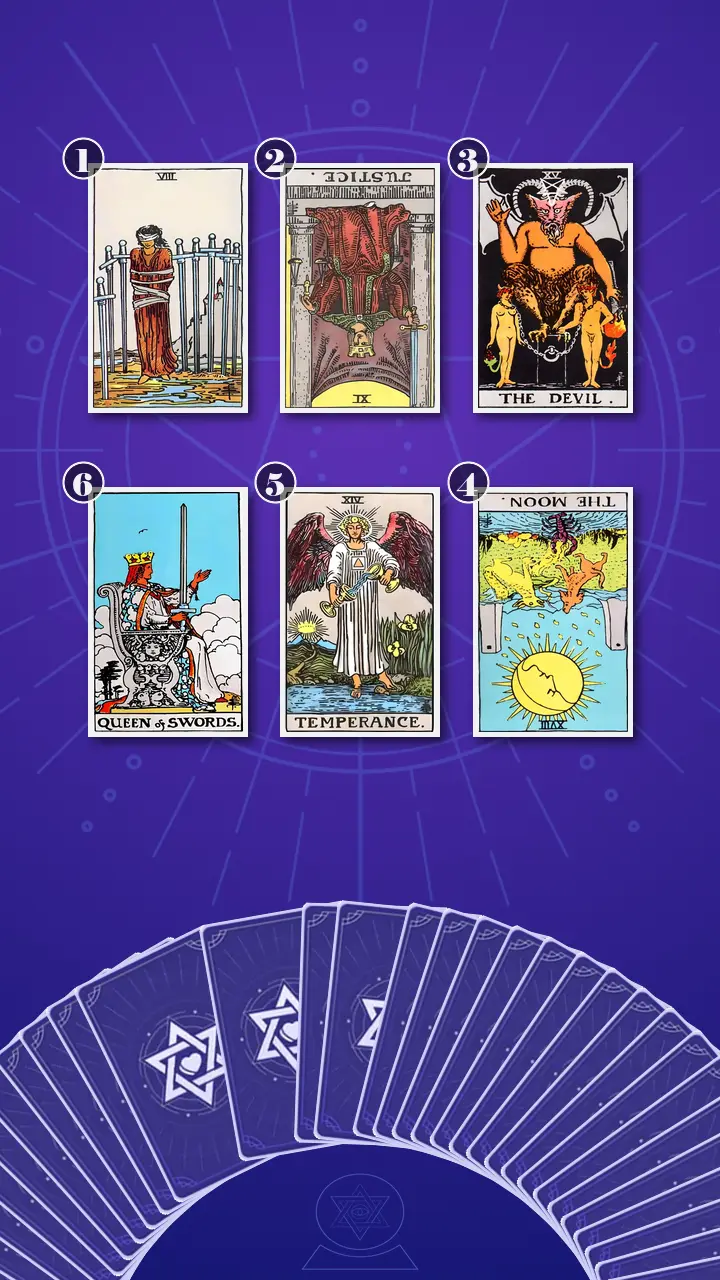
The six-card spread was the smallest structure that could hold the full chain: the visible trigger, the repeating blockage, the hidden root, the turning point, the practical experiment, and the integrated lesson. I would read the top row as the pressure structure, then descend into the hidden loop and return through awareness, moderation, and clear boundaries.
The first position would show the observable moment when self-tracking becomes self-judgment. The second would expose the checking loop that briefly promises relief. The third would reveal the critical authority beneath it. The fourth would mark the place where data and judgment could separate. The fifth would offer a bounded experiment, and the sixth would clarify what self-tracking can become when it supports self-knowledge without speaking for Jordan’s worth.
Reading the Pressure System
The Fence Made of Notifications
At the top-left of the grid, I said, “Now I’m turning over the card that represents the observable moment when self-tracking becomes self-judgment, including checking, recalculating, and interpreting a metric as a verdict.”
It was the Eight of Swords, upright.
I pointed to the blindfold, the bound hands, and the ring of swords surrounding the figure. In Jordan’s modern scene, the swords became the phone-lit dashboard after a low focus score. They checked the same screen, recalculated tomorrow’s target, and treated the self-created rules as a fence. Rest looked irresponsible, changing the plan looked like failure, and the distant goal of being completely in control remained visible but unreachable.
The upright energy here was a blockage, not a prophecy. Thought had become enclosure. The metric was not providing too little information; it was narrowing the range of choices Jordan could imagine making with that information. I asked, “Which rule is actually binding you, and what piece of context is already available outside the dashboard?”
First, Jordan’s thumb froze above the phone and their breath paused. Then their eyes lost focus as the last few evenings replayed in the reflection of the screen: the extra check, the revised target, the deleted note. Finally, they gave a short laugh with no amusement in it. “That’s too accurate,” they said. “A little cruel, honestly.”
I let the reaction stand. “We don’t have to turn that recognition into another verdict,” I said. “The card is showing the shape of the cage, not declaring that you are the cage. If one bad day should be data, not a character reference, then the first act of freedom is noticing which sentence came from the number and which sentence you added.”
The Tilted Scorecard
I moved to the top-center position. “Now I’m turning over the card that exposes the Repetition Compulsion loop: the urge to tighten rules and check again for relief, which produces more Quantified Self Burnout.”
The card was Justice, reversed.
The scales were tilted. The sword was upright, but instead of clean discernment, I saw the sharp sentence that cut away context. I brought Jordan back to a mixed day they had described: a late meeting, an urgent bug, four focused hours, and a body already running on too little sleep. The raw record contained all of that, but the summary had said, “I failed again.”
I used the inner-monologue pattern that often makes this distortion visible: “The number says I logged four hours, so the verdict must be that I was irresponsible again.” Then I asked, “What evidence was left off the scale?”
Reversed Justice was an excess of evaluation and a deficiency of proportion. It did not ask Jordan to abandon accountability. It asked whether the standard was fair, whether one low number had been weighted above the whole day, and whether a dashboard had been allowed to issue a moral score it could never support.
Jordan’s shoulders dropped by a fraction, then tightened again. They looked at the card as though it had caught an administrative trick they had been performing on themself. “I keep treating the lowest number as the most honest one,” they said.
“That is the unfair scorecard,” I replied. “The number is real; the sentence about your worth is an addition. Before changing a target, separate the raw observation from the verdict and ask what the scale has hidden.”
The Subscription That Charged for Rest
I descended to the top-right position. “Now I’m turning over the card that reveals the Shadow Possession dynamic beneath the loop, especially the disowned critical voice and the fear that an imperfect record proves a lack of self-worth.”
I turned over The Devil, upright.
The loose chains around the figures’ necks mattered to me. They were not locked into place, yet the figures remained under the authority of the horned presence above them. For Jordan, the chains became the repeated check that felt voluntary but quietly decided when they could close the laptop, eat dinner, or sleep.
Jordan knew the tracker was making the evening worse, but still checked it before stopping work. The pattern sounded like a subscription that quietly renewed every time they opened the app. “I know this is hurting,” their inner voice said, “but I need one more check before I can relax.” Control was the product, and obedience was the hidden monthly charge.
I thought of Severance turned inward: an attempt to divide clean data from lived experience, while the rules followed the person through every boundary. The Devil was not a warning that Jordan was bad or doomed. It named an attachment. The dashboard had borrowed the authority of an objective system, and the critical voice had learned to speak in numbers.
Here I used my signature Hero’s Journey Alignment lens. I told Jordan, “This looks like the classic Refusal of the Call before a major character evolution. The call is not to stop tracking, and it is not to become careless. It is the call to stop asking the system for permission to trust yourself. The old plotline says control must arrive before rest. The next plotline lets discernment begin while the record is still imperfect.”
Jordan’s hand closed around the edge of the chair. Their gaze moved from the card to the phone, then back to the loose chains. “So the checking is not proof that I need better data,” they said. “It might be proof that I’m using data to avoid the feeling underneath.”
“Exactly,” I said. “We can respect the part that wants certainty without allowing it to run the whole evening.”
When the Moon Made the Story Visible
The Caption Before the Scene
At the bottom-right of the grid, I said, “Now I’m turning over the card that identifies the turning point where Jordan can notice data and judgment as separate, shifting from asking what is wrong with the self to asking what context and choice are present.”
It was The Moon, reversed.
I looked at the crayfish rising from the pool, the two towers, and the winding path beneath the uncertain moonlight. Reversed, the card did not promise that every ambiguity would disappear. It showed confusion becoming visible enough to name. Something that had been directing the reading from below was beginning to come into language.
I asked Jordan to picture a low focus score lighting up a dark apartment. The first sentence often arrived before the day had been reviewed: “My focus score dropped,” followed instantly by, “I am falling behind everyone.” I asked them to write three separate lines: data, story, and another possible story.
As Jordan wrote, a streetcar bell sounded faintly beyond my window. The pause felt small, but it was real. Data: “My focus score dropped.” Story: “I am falling behind.” Another possible story: “The sprint included an urgent bug, three Slack interruptions, and a late meeting.” The number had not changed. The space around it had.
Jordan’s fingers stopped moving. Their eyes fixed on the first line, then shifted to the second as if watching an auto-caption appear over a video and realizing it was not the whole scene. They swallowed, exhaled, and said, “The sentence arrived before I even checked what happened.”
“That is the interpretive gap,” I said. “Not a loophole, and not an excuse. It is the moment when the number can remain an observation instead of becoming a verdict.”
When Temperance Poured Between Two Cups
The Bridge from Audit to Observation
I paused before the bottom-center card. The room seemed to quiet around the grid, and the radiator clicked once before settling. “Now I’m turning over the card that translates the transformation into a one-week experiment: observe one metric with context, then choose one bounded adjustment without adding a new rule.”
The card was Temperance, upright.
The angel pouring water between two cups gave me the clearest image in the reading. One cup could hold the metric. The other could hold workload, sleep disruption, mood, transit, or ordinary life. One foot stood on land and one in water. The answer was not rejecting measurement or surrendering to it. It was giving measurement a wider container.
Temperance brought balance after the Moon had made the hidden story visible. Its energy was moderation, the ability to hold data, feeling, and context together without surrendering discernment. For Jordan, that meant one chosen metric, one scheduled review, and one modest response instead of rebuilding the entire tracking system after a low result.
At 8:47 p.m. on the TTC, after a long product sprint, Jordan had compared sleep, focus, and movement scores. Their phone was warm in their hand, shoulders tight, and one low number had already become a story about discipline. Now that story sat between us.
You do not need to make the record perfect before trusting yourself; blend the number with lived context and take one measured step, like Temperance pouring between two cups.
Then I said, “A metric can describe what happened without becoming evidence of who you are. Add context before you change the system, so the number stays a data point instead of becoming a character reference.”
Jordan’s thumb stopped above the screen. For a few seconds, their face held completely still, and their shoulders remained lifted as though the next check might still be required. Their eyes moved from the phone to the two cups on the card, and I could see an old memory entering the room: the low score, the immediate self-criticism, the frantic redesign of tomorrow. Their jaw loosened first. Then their closed hand opened against their knee. A breath left them slowly, with a faint tremor at the end. Relief did not arrive as cheerful certainty. It arrived beside a small, dizzying blank space where the verdict had been. “But doesn’t this mean I’ve been doing it wrong?” they asked quietly. I said, “It means a useful tool was asked to carry a moral claim. You can revise the relationship without condemning the part of you that wanted safety.” Jordan nodded, looked down at the blank line in their notebook, and whispered, “Maybe I can leave one thing unfinished.” I asked, “Now, using this new perspective, can you recall whether there was a moment last week when seeing the number as a description rather than a verdict might have made you feel different?”
I named the shift plainly: this was one step from shame-driven compulsive checking and metric-based self-judgment toward contextual self-trust and bounded discernment. Temperance did not ask Jordan to become perfectly calm. It gave them a way to make the next decision without turning the next number into a referendum on their entire character.
The Clear Boundary Around the Claim
I moved to the bottom-left position. “Now I’m turning over the card that clarifies what self-tracking can become when it supports self-knowledge rather than self-punishment, returning to the question with self-trust and boundaries.”
I turned over the Queen of Swords, upright.
Her upright sword, direct gaze, open sky, and butterfly-carved throne offered a precise counter-image to the blindfold at the beginning. She did not need every possible metric. She needed to know exactly what a fact could claim and where its authority stopped.
I translated her into a sentence Jordan could use after a difficult week: “My focused work time was lower during a week with late meetings.” That sentence was accurate. It did not need to become “I am lazy” or “I am behind.” The Queen’s clarity was not softness without accountability. It was accountability without moral inflation.
“What does this entry actually show, and what am I adding to it?” I asked. “A tracker can show a pattern without becoming the person who decides what the pattern means.”
Jordan wrote the question at the top of the page. Their posture was still tired, and their first instinct was still visible in the way they glanced toward the phone. But they did not pick it up. They drew a line beneath the raw metric and left the rest of the page open.
Context Before Correction
When I read the full grid back to Jordan, the story became coherent. The Eight of Swords showed the visible symptom: a low score narrowed the available choices. Reversed Justice showed the obstacle: a tilted internal scorecard gave one number more weight than workload, sleep, effort, or ordinary variation. The Devil revealed the root: the need for control had become attached to the fear that an imperfect record would prove Jordan was not disciplined enough to deserve respect.
The reversed Moon supplied the first release. It separated the raw metric from the alarming interpretation that arrived before context. Temperance turned that awareness into a bounded practice. The Queen of Swords gave the practice a firm edge, so the record could remain honest without being allowed to speak beyond its evidence.
The cognitive blind spot was not a lack of discipline. It was the belief that more precise measurement would remove uncertainty, even while the defense strategy kept converting uncertainty into another task. Each extra check briefly reduced discomfort, then made the next fluctuation feel more dangerous. The key shift was simple and demanding in the best way: separate the observation from the verdict by recording one contextual fact and one compassionate next experiment before changing any target or rule.
I also used my Vision Actualization lens. I asked Jordan to rewrite the limiting narrative that said, “I am not ready to trust myself until the record is clean.” The revised line was, “I am ready to practice discernment while the record is still human.” That was not a motivational slogan. It was a new line of dialogue for the next scene.
Then I introduced my Character Bible Directive, a creative visualization protocol for specifying a future self through exact psychological and behavioral details. I asked Jordan to describe the person they wanted to embody, not as an idealized productivity avatar, but as someone whose choices could be observed. The psychological specification was: can tolerate one messy row without filling the gap with a verdict. The behavioral specification was: checks one metric at a scheduled time, adds one context fact, chooses one proportionate response, and closes the app. The boundary specification was: if the exercise becomes another performance test, stop without punishment.
This was my actionable advice and the next step of the Transformation Path Grid (6) Context Edition. I kept it deliberately small because a complicated recovery system would simply become the next system Jordan had to obey.
A Small Script for the Next Seven Days
- Run a one-metric, no-new-rule week.Choose one existing metric, such as focused work time or sleep duration. At one preselected review time each day for seven days, write the raw observation, one context fact, and one neutral description. Keep the target exactly as it is for the full week.Use paper or an existing notes app, not a new tracking platform. If it starts feeling like a performance test, skip the review or use the two-minute version.
- Give the dashboard a closing time.Set one recurring review window, such as 7:30 p.m. on Wednesday, and disable nonessential tracker notifications until then. Review only the chosen metric and one context note, set a ten-minute timer, and close the app when the timer ends. If the information is incomplete, record “no decision today.”Place the phone across the room or close the laptop as a visible stop cue. The review is allowed to end before certainty arrives.
- Use the data-not-character boundary.After one triggering entry, make two columns titled “What the number shows” and “What I am adding to it.” Write one alternative explanation grounded in the actual day, then choose one small response that does not require a new rule, such as moving one task, sending one message, or ending the review.Replace “I failed” with an observable sentence, read the entry once, and leave it unchanged for the rest of the day. Context is not an excuse added after the fact; it is part of the record.
I told Jordan that none of these steps required abandoning data, pretending every result was fine, or turning compassion into another target. The point was to keep observation, context, interpretation, and action in separate places long enough for choice to return.

The First Clean Sentence
Six days later, I received a message from Jordan. It read: “I slept through the night after Wednesday’s review. This morning I still thought, What if I’m wrong? I wrote the late meeting beside the low focus score, and I left the entry alone.”
The change was small and quietly bittersweet. Jordan had slept well, but uncertainty still greeted them before breakfast. This time, they did not treat that first thought as a command. They added context, smiled at the imperfect record, and let the morning continue.
I read the message twice. The cards had not fixed Jordan, and they had not taken over the decision. They had helped Jordan see the mechanism clearly enough to choose a different next move. That is what finding clarity looked like here: not a perfect log, but a bounded practice and the first evidence of self-trust.
At the end of the Transformation Path Grid (6) Context Edition, I had not handed Jordan an answer to obey. I had handed them a boundary around the mirror. The tracker could describe a pattern, but Jordan remained the author of what happened next.
When one messy row in a tracker makes a jaw lock and a hand reach for the phone again, the record may be carrying two different jobs at once: helping someone notice what happened and trying to prove whether they are worthy. Noticing that split is already a small opening in the fence.
If the next metric could remain an observation instead of a verdict, what small piece of context would you let sit beside it: the late Slack call, the wet TTC ride, the tired body, or something only you can see?