From the Familiar-Choice Burnout Loop to Self-Trust: Pause First

The Familiar-Choice Burnout Loop at 5:47 p.m.
If you are the dependable late-twenties agency person in a high-cost city, you may know the Career Burnout Loop of answering an urgent team message before you have even opened the brief. I know the pattern because I have watched it arrive in the body first.
I met Jordan, a 28-year-old non-binary account manager, at a glass-walled digital agency near downtown Toronto. At 5:47 p.m., Slack flashed an urgent rescue project over an already packed calendar. Fluorescent lights hummed above us, stale coffee coated the back of my tongue, and I watched Jordan's restless fingers type, “Sure, I can take it.” The boundary checklist remained open in Apple Notes behind the message, untouched.
“I know how this ends, and I still say yes,” Jordan told me. “Why do I keep making the same choice when I know it drains me?” Ten seconds of relief arrived when the reply sent. Then the Friday deadline appeared, dinner disappeared from the calendar, and the familiar high-drain commitment began to feel like something work had made happen.
I heard frustration in the tight rhythm of their words. It moved through their chest like a Slack notification that kept vibrating after the phone had gone silent, with exhaustion settling into their limbs and a quieter embarrassment underneath: I knew the cost, so why did I act as if there was no choice? I told Jordan that I did not see a character flaw or a fixed fate. I saw a familiar-choice burnout loop, reinforced by relief, narrowed attention, and delayed evidence. Our work today was to give that loop a shape, then find the small place where Jordan could take the pen back.

Choosing a Map Through the Repeat
I invited Jordan to put both feet on the floor, take one slow breath, and hold the question without trying to solve it immediately. I shuffled at an unhurried pace. The movement was not a performance of mystery; it was a clean transition from reacting to observing.
For this reading, I chose the Transformation Path Grid · Context Edition. I explained that the spread suited a repeating choice because we were not comparing two clearly defined options. We were tracing a system: the trigger, the immediate reward, the narrowed decision frame, the interruption point, the practical method, and the sustainable way forward.
For anyone learning how tarot works, this is where card meanings in context matter. The cards do not make the decision or predict an inevitable outcome. They give attention a structure, so a pattern that usually moves too quickly can be examined before it takes over.
I laid six positions in two rows of three. The top row would show the visible behavior, the familiar reward that maintained it, and the root belief beneath the blockage. The lower row would show the catalytic shift, the repeatable action, and the integrated stance. We would begin at the upper left, move across to the apparent dead end, drop down, and then travel back through a more sustainable route.
I told Jordan that the first card would show the observable pattern of accepting a familiar option before checking capacity. The second would identify the relief and predictability that kept the repetition-compulsion loop active. The third would reveal the decision blind spot. Then Judgement would show the critical interruption, the Knight of Pentacles would offer a practical process, and the Eight of Cups would show what self-directed departure could look like without demanding perfect certainty.
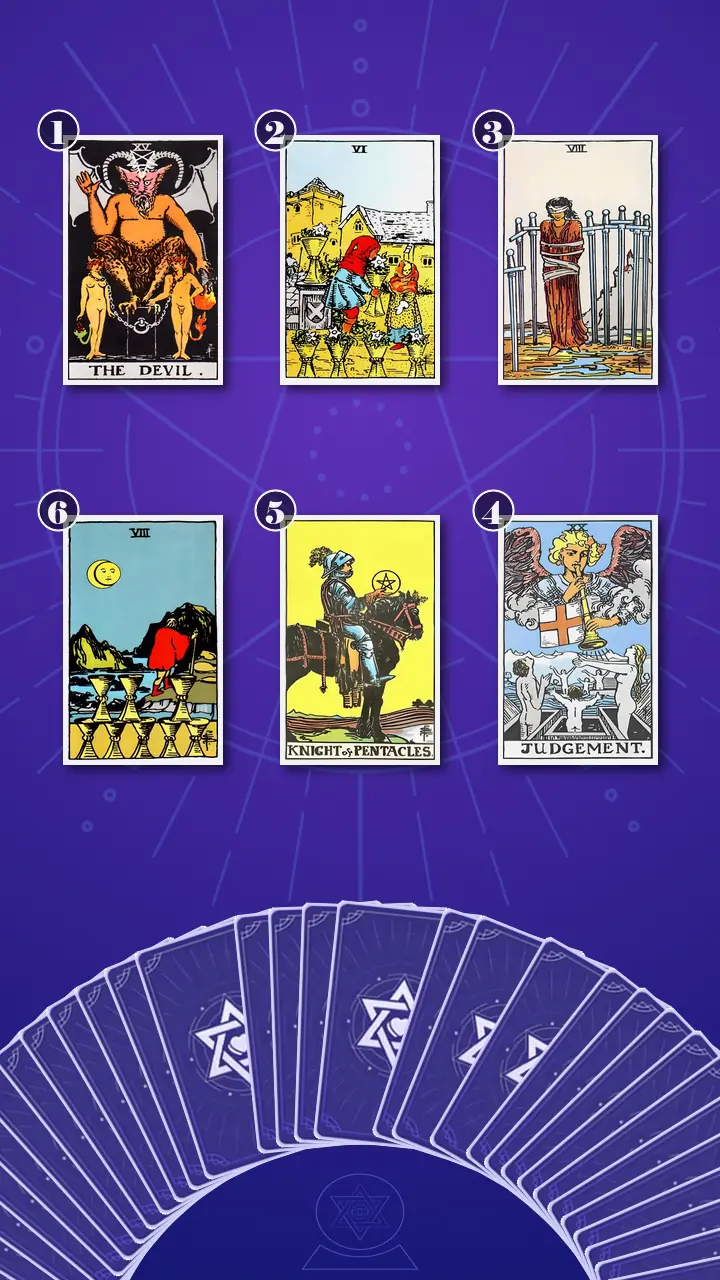
The Chain, the Cup, and the Blindfold
The Devil and the Ten-Second Relief
I turned over the card for the observable pattern of accepting a familiar option before checking capacity and experiencing the depletion that followed. The card was The Devil, in upright position.
I pointed first to the two figures and the loose chains around them. The image held attachment, compulsion, and participation that had begun to feel like an external command. In Jordan's modern life, it was the 5:47 p.m. agency-chat scene: a familiar coworker sent an urgent project request, the packed calendar was visible, and Jordan replied yes before opening the brief. Ten seconds of relief followed because uncertainty had ended. Then the real workload appeared, dinner was cancelled, and the choice felt compulsory even though no one had removed the options to ask for scope, delay the answer, negotiate ownership, or decline.
Upright, the energy was an excess of attachment and a blockage of accurate choice. I did not read it as addiction, punishment, or proof that Jordan secretly wanted burnout. The loose chains were the crucial detail. The pull was powerful, but powerful was not the same as unavoidable. The immediate reward was control over uncertainty; the later cost was depleted energy and resentment.
I asked, “What happens in the ten seconds before you type yes?”
Jordan gave a small, bitter laugh and looked toward the phone. “I know the chain is loose, but the request still feels mandatory. I know what this costs, but right then saying yes feels easier than finding out what happens if I don't.”
I watched their thumb press once against the edge of the phone case, then stop. “That is not weakness,” I said. “That is relief acting like an emergency exit. We can respect why it works for ten seconds without pretending it works for the whole week.”
Six of Cups and the Warm Familiar Role
I turned over the card for the immediate emotional payoff that kept the repetition-compulsion loop active, especially the relief and predictability offered by familiarity. The card was Six of Cups, in upright position.
The flower-filled cup being offered reminded me of the coworker's familiar praise: “You always know how to sort these projects out.” I connected that image to the reassuring identity Jordan received before counting the hours, emotional labour, concentration, and personal plans the task would displace. Before the request became exhausting, it let Jordan feel needed, competent, and safely recognizable to everyone in the room.
The upright energy was balanced as emotional recognition but excessive as a decision criterion. Familiarity supplied warmth, yet it supplied no evidence about present capacity. The old role of dependable fixer had become easier to defend than a new response. I said the sentence I wanted Jordan to keep: Familiar is a feeling, not a capacity check.
“Before it becomes exhausting, it lets me feel like the person who can handle it,” Jordan said. Their expression softened, then their gaze dropped to the table. I saw the comfort and the cost arrive together. The point was not to shame the wish to be valued. It was to separate being valued from being sustainably available.
Eight of Swords and the False Binary
I turned over the card for the decision blind spot and the underlying fear that choosing differently could expose poor judgment or loss of control. The card was Eight of Swords, in upright position.
I asked Jordan to imagine the Slack or Teams reply box as a decision form displaying only two buttons: Accept and Let everyone down. That was the narrowed field of attention. The blindfold did not mean that no options existed; it showed that the options had temporarily disappeared from view. The visible gap among the swords gave us the opening: ask for scope, reply tomorrow, negotiate the deadline, share ownership, or decline.
Upright, the air element had become constricted. Analysis was present, but it arrived after the commitment, when Jordan used a pros-and-cons list as a defence brief for a decision already made. The underlying fear was precise: “If I pause, they will decide what my pause means. If I choose differently and regret it, that will prove I cannot trust myself.” The false binary turned temporary uncertainty into an apparent threat.
Jordan's breathing shortened. I watched their hands become still, as if the imagined reply box had frozen in front of them. “I usually think I am choosing between being helpful and being unreliable,” they said. “I don't even see the question about scope until later.”
“The fastest answer is not always the most honest one,” I said. “Reliability can mean giving an accurate answer after checking capacity, not offering the quickest possible yes.”
When Judgement Asked the Calendar to Speak
The Trumpet Before the Reply
The room seemed to quiet around the fourth card. Even the traffic beyond the glass felt farther away. I turned over the card for the critical interruption point: reviewing the documented cost of previous choices before making the next commitment. The card was Judgement, in upright position.
I let the trumpet become a calendar alert that arrived before, rather than after, the commitment: Check what happened last time. I asked Jordan to picture three lines of evidence: late-night work, cancelled dinners, and Sunday recovery. The purpose was not to build a prosecution file. It was to allow the real cost to enter the decision at the moment it could still help.
My artist's mind went to an editing room. A film can replay the same painful scene until the editor notices that the next cut is available. I use that image in my signature lens, Hero's Journey Alignment: sometimes stagnation is the classic Refusal of the Call before a character evolves. I do not mean a supernatural assignment or a demand to make a dramatic life change. I mean that Jordan had stayed in one painful scene long enough to mistake its familiarity for the whole plot.
At 5:47 p.m., an urgent message lands beside a packed calendar. Jordan types yes, feels the tension drop for ten seconds, cancels dinner, and wonders why knowing the pattern did not stop it. The mind turns the next reply into a verdict: a different choice might expose a loss of control.
Repeating the choice does not prove you are incapable of change; answer Judgement’s trumpet by reviewing the real cost before you respond and choosing from present evidence rather than the old script.
For one beat, Jordan froze. Their breath stopped halfway in, their pupils widened, and their index finger hovered above the edge of the Judgement card. Then their gaze lost focus as the evidence replayed: the cold bowl of pasta, the cancelled dinner, the late-night project notes, the Sunday spent recovering. Their jaw tightened. “But doesn't that mean I was wrong every time?” The question came out sharper than the rest. I did not rush to make the moment comforting. I said, “It means the old answer had a cost. It does not turn every past yes into a moral failure, and it does not decide every future yes for you.” Jordan looked down, swallowed, and let out a breath that trembled at the end. Their shoulders lowered by a fraction; their closed hands opened against the table. A small flush gathered around their eyes, followed by a bewildered half-smile. The relief was real, but so was the brief blankness of responsibility now that the next response belonged to them.
I asked, “Now, use this new perspective to think back to last week: was there a moment when this insight could have made you feel differently?”
Jordan nodded slowly. “You are not missing the lesson; you are consulting it too late.” I repeated the line once, then let the silence hold it. This was the first movement from contracted frustration, exhaustion, and self-doubt toward grounded self-trust: not certainty, not a perfect new identity, but a willingness to let past depletion count before the next reply.
Knight of Pentacles and Process-Based Dependability
I turned over the card for the practical method that could support change: a repeatable 24-hour pause and capacity-checking protocol for recurring requests. The card was Knight of Pentacles, in upright position.
The dark horse stood still. The pentacle was held at eye level, not waved like a prize. I connected that steadiness to a phone placed face down while the calendar and project scope were checked. The Knight did not ask Jordan to summon a dramatic burst of motivation. Upright, the earth energy restored the missing structure: one consistent process between trigger and commitment.
I suggested a holding reply: “Thanks for thinking of me. I need to review scope and capacity, and I'll confirm by 10 a.m. tomorrow.” Then I asked Jordan to check three facts before answering: What is the deliverable? Who owns the final decision? What happens if I cannot take this? If 24 hours was genuinely unavailable, the reduced version could take ten minutes, confirm the scope, and apply one energy criterion.
Jordan's shoulders relaxed as they entered the message into their phone. “A pause is not a refusal, and urgency is not consent,” I said. Dependability could become a method instead of a performance of instant availability. Jordan looked at the holding reply, then at the crowded calendar, as if both had finally become evidence rather than opposing authorities.
Eight of Cups and the Unfilled Evening
I turned over the card for the integrated capacity to leave a familiar but depleting option without requiring perfect certainty. The card was Eight of Cups, in upright position.
The cloaked figure walked away from carefully stacked cups beneath the moon. I connected that image to Jordan recognizing an unclear owner and a deadline inside forty-eight hours, then declining or renegotiating the rescue assignment with a concise reply. The cups acknowledged the investment in being the reliable fixer. The walking figure showed that investment did not require continued participation.
Upright, the water energy had changed direction. Six of Cups had carried familiarity toward Jordan; Eight of Cups allowed feeling to move away from what no longer sustained them. I was careful here. This card did not mean quitting a job, confronting every coworker, or treating discomfort as proof that departure was always correct. It meant defining one observable exit sign and allowing mixed feelings while responding to it.
I pointed out the repeated eight. In Eight of Swords, the figure stood inside a narrowed view. In Eight of Cups, the figure moved despite uncertainty. The intensity had not vanished; participation had changed. Jordan looked toward the space where an evening plan might have been written. “I could decline and still feel bad,” they said. “I just wouldn't have to interpret feeling bad as evidence that I made the wrong call.”
From Insight to Action: The Before-I-Say-Yes Gate
When I placed the six cards together, I could see the full mechanism. The Devil showed the loose chain of the familiar urgent request. Six of Cups explained the warmth inside the role of being needed. Eight of Swords revealed the false binary between immediate acceptance and personal failure. Judgement called for a review before the next response. Knight of Pentacles supplied the method. Eight of Cups showed that a respectful exit could be chosen while disappointment, uncertainty, and care remained present.
Like Groundhog Day, the scene had kept returning until Jordan's participation changed. The familiar option was not safer simply because it was recognizable. It was more familiar. The actual safety question required evidence: hours added, sleep lost, restorative plans cancelled, concentration spent, and recovery time required.
I named the cognitive blind spot directly: Jordan had been treating familiarity as evidence of correctness and instant availability as evidence of dependability. The pros-and-cons list was not failing; it was arriving one decision too late. The key shift was to move from asking, “Can I make this work if I reorganize myself enough?” to asking, “What does my present capacity and past evidence show before I answer?”
I then used my second signature lens, Vision Actualization. I asked Jordan to rewrite the limiting narrative that said, “I must answer quickly or I will lose control,” into a working sentence: “I can be dependable by giving an accurate answer after checking capacity.” This was not an affirmation offered as a guarantee. It was a new line in the script that had to be proven through small, observable behavior.
For the practical work, I used my Character Bible Directive, a creative visualization protocol for writing the exact psychological and behavioral specifications of a future self. I told Jordan to describe the future account manager not as fearless or endlessly available, but as someone who could tolerate temporary uncertainty, ask for scope, protect existing commitments, and leave a declined evening unfilled long enough to feel what choice had created.
- Record the past costBefore Friday, open the last three completed rescue projects in the agency tracker. In a pinned Apple Notes page titled “What happened last time?”, write one factual line for each: the request, the extra hours, the personal plan displaced, and one body or energy signal. Read only those three lines before the next similar request. Five minutes is enough.Keep the record factual, with no verdict about your character. If three projects feel like too much, begin with one.
- Install the 24-hour capacity gateSave this holding reply in Slack or Teams: “Thanks for checking with me. I need to review scope and capacity, and I'll confirm by 10 a.m. tomorrow.” When a familiar request arrives, use the reply, check your calendar and recovery time, and ask what the deliverable, final owner, and fallback plan are. If 24 hours is impossible, take the ten-minute version before committing.Use one energy criterion this week: if accepting requires cancelling an existing restorative or personal plan, review alternatives before saying yes.
- Write the future self's character bibleSet a ten-minute timer on Sunday and write two short sections. Under psychological specifications, write, “I can be uncertain and still use a method.” Under behavioral specifications, list the holding reply, the three scope questions, and one exit sign such as unclear ownership plus a deadline inside forty-eight hours. Test the page by declining or renegotiating one matching request, then leave the first thirty minutes of the freed evening unscheduled.You do not have to explain your entire energy history. A concise capacity boundary is enough, and mixed feelings are allowed to remain.
These were actionable next steps, not instructions to reject every opportunity. The Transformation Path Grid had not made the choice for Jordan. It had made the leverage point visible: pause, inspect, and let present evidence speak before the familiar pull becomes a command.

A Week Later: The Quiet Proof
Five days later, Jordan sent me a screenshot: the saved holding reply had gone out before a familiar rescue request. They declined after checking scope. That night, they kept the freed evening unfilled for thirty minutes, then felt the old question, “What if I am wrong?”, and smiled without answering it.
I did not call that a solved life. I called it the first visible proof of grounded self-trust. Jordan had not become a different person by force. They had allowed a pause to exist, let past depletion count as data, and chosen from present capacity rather than the old script.
When the urgent ping lands and your chest tightens, saying yes may feel like control for ten seconds even while part of you already knows which evening will disappear. If you can notice that sequence, you are already looking at the scene from outside it. Clarity is not always a final answer. Sometimes it is the first moment when the old pattern stops being the only voice in the room.
If familiarity no longer got the deciding vote, what small pause would you want to give yourself before your next reply: the three lines of past cost, the 24-hour capacity gate, or the message you write before you say yes?