The Message That Would Not Stay Sent
I recognized the pattern before my querent sat down: they were a London junior communications coordinator who could answer a Slack message in seconds, yet when their partner said they needed the evening to cool off, they sent a polished follow-up and refreshed WhatsApp between work pings. The question behind the behavior was painfully precise: why do I keep texting when my partner asks for space?
Jordan had come straight from the Northern line to my reading room, carrying the warm-phone feeling of the journey in their hand. At 7:14 p.m. in their small flat, their partner had asked for the evening alone; Jordan had typed an apology beside an open laptop while the kettle clicked off and the radiator ticked. The message stayed unread. The blue light from the screen rested on their knuckles, and their thumb kept returning to the same thread.
They told me, I know they asked for space, but space feels like a verdict. If I stop reaching out, they will think I do not care. If I give them too much room, I might lose them before I get a chance to fix this. I could hear the central contradiction in every sentence: Jordan wanted reassurance through immediate contact, while also wanting to honour a clearly stated boundary. Their chest had tightened as if a belt were being pulled one notch closer each time the chat failed to change. Their hands searched for the phone before their mind had found a new fact. When silence feels like a verdict, the phone starts looking like a lifeline.
I did not treat that urge as evidence of bad character, and I did not promise to reveal what their partner secretly felt. I told Jordan that the reading could help separate the present request from the old alarm attached to it. We would use the cards as an objective reflection tool, then return every decision to Jordan. Our work was simple in purpose, even if the feelings were not: we would draw a map through the fog and look for finding clarity without forcing contact into existence.

Choosing a Map for the Silence
I invited Jordan to place both feet on the floor, take one slow breath, and name the exact question rather than the worst possible outcome. I shuffled slowly. The sound of the cards moving against one another gave the room a steadier rhythm, a practical transition from the bright, fast world of notifications to a space where we could observe before reacting.
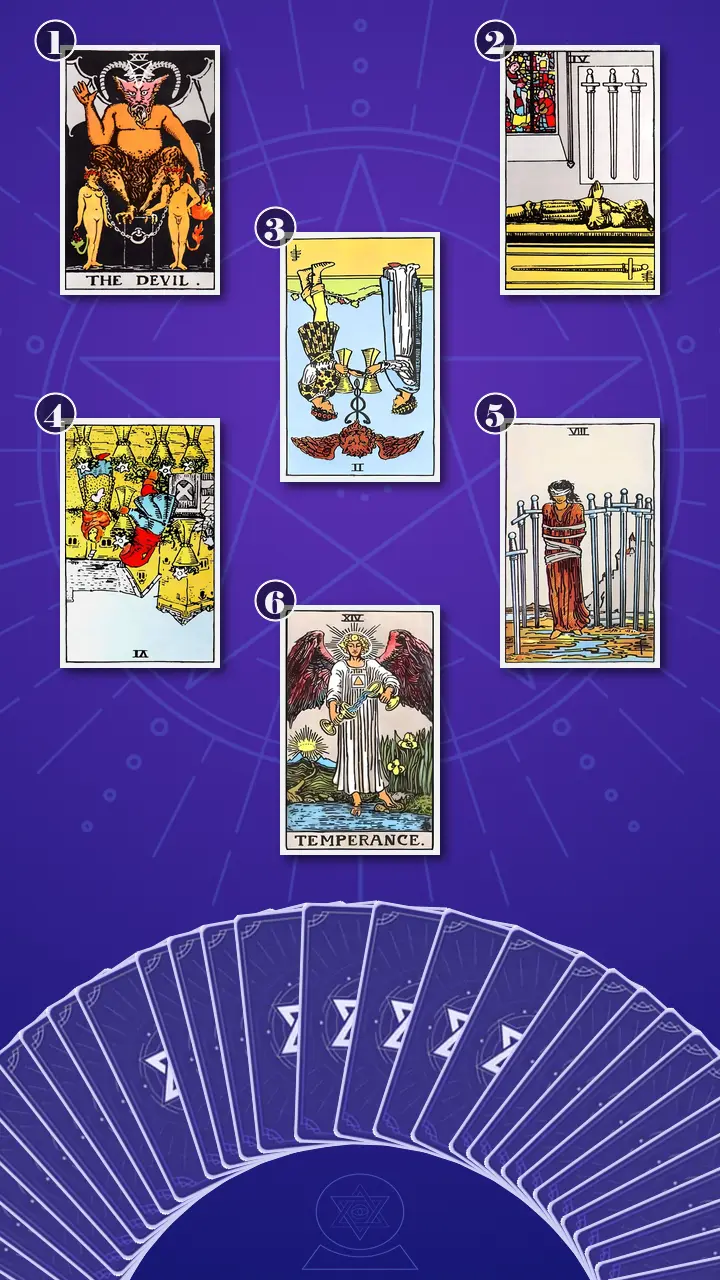
For this consultation, I chose the Relationship Spread · Context Edition, a six-card relationship tarot spread designed for communication boundaries and post-conflict anxiety. It fits because the issue is relational dynamics, not a request to control or predict another person. The structure lets me examine Jordan's contribution, the partner's explicit request for space, the shared mismatch in timing, the history underneath it, the belief that makes the pause feel impossible, and one self-led next step.
I explained the route before turning anything over. The first position would show the observable contact-chasing and the contracted energy behind it. The second would hold only the partner's stated need for time, without pretending to read private thoughts. The third would show the current mismatch. The fourth and fifth would trace the old memory and the mental bind, while the sixth would offer a constructive practice that could honour both connection and choice.
Reading the Rhythm Behind the Reach
Position 1: The Phone as a Lifeline
Now I turned over the card representing the observable contact-chasing after conflict and the contracted emotional energy that made stopping feel urgent. It was The Devil, in upright position.
I pointed first to the loose chains around the figures' necks. They were not an image of an unchangeable fate; they were an image of a choice that had begun to feel narrower each time it was repeated. After their partner requested the evening alone, Jordan kept the phone face-up beside the laptop, sent one more explanation, then another apology, and felt a brief drop in chest pressure when a typing indicator appeared. The action looked like repair, but The Devil's chains translated into contact being used to make uncertainty feel controllable.
Upright, this card showed attachment in excess and choice in blockage. The contact was not meaningless, and Jordan's care was not fake. The problem was that the nervous system had made immediate response the only acceptable proof that the relationship still existed. I said, Contact can lower the panic for a minute without solving the mismatch. Then I asked what Jordan hoped the next message would prove. Did it need to show care, secure belonging, prevent a departure, or make the last exchange feel reversible?
Jordan gave a small laugh with no warmth. First, their breath caught and their thumb stopped above the screen. Then their gaze slipped away from the card, as if an old sequence were replaying behind their eyes. Finally, their mouth tightened and their shoulders lifted before they said, That is almost too accurate. It makes my attempts to repair look like the thing keeping the alarm switched on. I let the recognition stand without turning it into blame. The Devil was naming a loop, not sentencing Jordan or the relationship.
Position 2: The Boundary Inside the Quiet
Now I turned over the card representing only the partner's stated request for space and the relational boundary Jordan was being asked to acknowledge. It was Four of Swords, in upright position.
The recumbent figure and the suspended swords gave the pause a physical shape. Thoughts could remain present without becoming another message. I connected it to the modern scene Jordan had described: when the partner asked for space, the pause could become a concrete container, with a mutually agreed check-in time if both people wanted one, the phone on Focus mode in the kitchen, and unresolved thoughts written down instead of sent. This was not evidence about the partner's hidden feelings. It was a boundary about timing.
I returned Jordan to the 7:14 p.m. flat. I asked them to imagine the notification vibrations stopping, the phone placed in another room, and the radiator becoming audible again. The stillness felt uncomfortable, but it did not require a conclusion. I said, A partner's boundary is information about timing, not a final ruling on your worth.
Jordan looked toward the kitchen as though the imagined phone were already there. Their fingers unclenched from the edge of the chair, then curled once more before relaxing. If the pause had a shape, they said, maybe it would be easier not to treat every minute as a new emergency. That was the first believable opening: a pause could be uncomfortable and respectful at the same time.
Position 3: Two Cups Moving at Different Speeds
Now I turned over the card representing how post-conflict timing had become mismatched, with one person seeking immediate reassurance while the other sought cooling off and distance. It was Two of Cups, in reversed position.
The two facing figures still held their cups toward one another, but the exchange had lost its shared timing. Jordan had a twelve-line message ready while their partner was still trying to create distance. The card did not tell me that care was absent. It showed that care could not become reciprocal while one person kept reopening the conversation and the other was asking for silence.
I described the energy as blocked emotional exchange. Jordan's words might be careful, apologetic, and full of good intentions, while the emotional tempo beneath those words was racing. I use a simple rule when I need to understand this kind of argument: connection can be sincere and still arrive at the wrong speed. No one needed to be cast as the villain for the mismatch to be real. Connection is reciprocal; it cannot be forced into existence by one person's refresh button.
Jordan lowered their eyes to the two cups. Their expression held recognition and irritation together. I keep thinking that if I explain it more clearly, they will finally meet me there, they said. But maybe I am asking for mutual repair before we have reached the same moment. I noted the distinction carefully: a request for reconnection could be valid later, while pursuit during an agreed cooling-off period could make that later conversation harder to reach.
Position 4: Yesterday Inside Tonight
Now I turned over the card representing the familiar history and earlier emotional material sustaining the repetition compulsion beneath the current contact-chasing pattern. It was Six of Cups, in reversed position.
The child offering a flower-filled cup became an old hurt being carried into a new chat. Before writing, Jordan had reread screenshots from an earlier rupture and heard tonight's request for space through yesterday's pain. A sentence such as I need time had started to sound like the wording used during a previous breakup scare. The old story entered the new conversation before the present facts had been separated from it.
Reversed, the card showed past memory intruding into the present, not because the past was unimportant, but because it had been given the whole microphone. Jordan's attempts to prevent history from repeating were pulling old examples into the first new message, making a current boundary carry more weight than the words themselves contained. I asked them to write two lines in their mind: what the partner had actually said today, and what earlier conflicts had taught Jordan to expect.
Jordan rubbed the pad of one thumb against the other. Their breathing slowed, then became uneven. The screenshots feel more convincing than the sentence in front of me, they admitted. I heard the shame underneath that confession and answered gently, That makes sense if the old rupture taught your body to prepare before your mind has evidence. It does not mean the old meaning is the only meaning available now.
Position 5: The Send-Now-or-Be-Left Interface
Now I turned over the card representing the internal belief and observable urge that made respecting space feel impossible, especially the assumption that no contact meant the relationship was being lost. It was Eight of Swords, in upright position.
The blindfolded figure, the bindings, and the ring of swords looked like a digital choice architecture. In the 8:47 p.m. loop, Jordan's threat-focused mind offered only two buttons: send another text or lose the relationship. Unread messages, old screenshots, read receipts, and imagined future outcomes formed the surrounding enclosure. The card's blockage was real in experience, but it was not proof that every other option had disappeared.
I wrote the inner operating system aloud: If I do nothing, the relationship disappears. Then I placed it beside the observable facts: the partner had requested space, there was no new reply, and Jordan's body was searching for certainty. The facts and the fear were both present, but they were not the same category of information. I asked Jordan to name three available choices: no further contact for a defined interval, writing a draft without sending it, or asking a friend for company without asking that friend to interpret the partner's online status.
Jordan's breathing paused. Their eyes went unfocused as they considered a version of the evening that did not revolve around the chat. Then their hand loosened around the phone, and their shoulders dropped by a fraction. I had mentally deleted all three of those choices, they said. The release was small and came with a tremor of responsibility. Seeing an open path did not force Jordan to take it; it simply returned the ability to choose.
When Temperance Taught the Pause to Breathe
Position 6: The Bridge Jordan Could Choose
The room grew quieter as I reached for the final card, the one placed directly beneath the central relationship dynamic as its grounded integration. I turned over Temperance, in upright position, representing the transformation from urgent pursuit into one self-directed practice that could honour the partner's boundary while clarifying Jordan's own needs.
The angel blending liquid between two cups, with one foot on land and one in water, offered balance rather than a guarantee. In daily life, it looked like one clear repair message only when that message fit the boundary already understood by both people, followed by a shower, a walk, tea, or ten minutes of work without monitoring the screen. Care and space could occupy the same frame. Jordan did not have to erase their needs in order to respect someone else's.
Here I used my Communication Dissonance Audit. I listen to an argument for the mismatch in emotional tempo and frequency, not only for the words spoken. Jordan's message could be polished and sincere while their emotional BPM was accelerating; the partner's request could be direct without being a hidden verdict. I know the frustrating helplessness of wanting to move forward while the body locks around one urgent action, and I could hear how more explanation was trying to solve a timing problem.
I then gave Temperance a practical form from my own sound-energy work: The Syncopation Pause, a three-second acoustic grounding technique for lowering the emotional BPM before a message becomes pressure. When the urge arrived, Jordan could place the phone face down, notice one neutral sound in the room, and allow three seconds before deciding what action actually matched the boundary. The radiator, kettle, or traffic outside could become an ordinary anchor, not a mystical sign.
I asked Jordan to picture Tuesday at 8:47 p.m. on the Northern line: their partner has asked for space, their phone is warm in their palm, and they refresh WhatsApp while pretending to work. The urge feels like care, but it is also asking silence to prove the relationship is still there.
Stop using immediate contact as proof that connection is secure; let Temperance's two cups model a paced exchange in which one clear message is followed by room for both people to settle.
The words did not soothe Jordan immediately. First, their breath stopped and their thumb remained suspended above the imaginary Send button. Then their eyes lost focus, as though they were watching the 7:14 p.m. flat, the unread thread, and the old screenshots pass through the same narrow doorway. Their jaw trembled once. Finally, their fingers opened, their shoulders sank, and a long breath moved out of their chest with a quiet, surprised sound. So one message can be care, and the pause afterward can also be care, they said. The relief brought a brief blankness, almost dizziness; a clear path meant Jordan could no longer blame the next action on the alarm alone. I asked, Now, using this new view, is there a moment from last week when the distinction between contact and pressure might have helped? Jordan named making tea and putting the phone in the kitchen.
This was the first step in the deeper transformation, from urgent contact-chasing for reassurance to reciprocal pacing, boundary respect, and self-trust during relational silence. The cards had not removed uncertainty. They had made uncertainty smaller than the whole question of belonging.
From Panic to Pacing: The One-Page Repair Plan
When I placed all six cards together, I could see the sequence clearly. The Devil showed contact being used as a short-term grip on fear. Four of Swords introduced the pause the situation actually required. Two of Cups reversed showed care moving at different speeds, while Six of Cups reversed showed yesterday's rupture lending tonight's silence an older, heavier meaning. Eight of Swords revealed the false binary that made pursuit look like the only protection. Temperance supplied the bridge: a clear message, a respectful interval, and a self-directed return to the body and the rest of the evening.
The cognitive blind spot was not a lack of care. It was the assumption that caring had to be visible immediately in the partner's inbox. The transformation direction was more precise than simply giving someone space: acknowledge the stated boundary, distinguish present facts from past memory, choose a mutually respectful repair time, and regulate the urge through an action Jordan controls. I reminded Jordan that the six-card Relationship Spread · Context Edition could offer a structured reflection, but Jordan remained the person who decided what to send, what to tolerate, and what kind of reciprocity the relationship needed.
I wrote the next steps in a single page so the plan would still be usable when the phone felt like a lifeline.
- One Clear Repair MessageWhen a repair message is appropriate and does not contradict the partner's stated boundary, write one or two sentences to the partner: I care about us, and I am going to give you the evening. I would like to talk when we both have room. Send it once, or save it for the mutually agreed return point.Keep extra explanations in Notes rather than the chat. If the message feels difficult, draft it first and wait one minute before deciding whether sending it truly respects the pause.
- The Syncopation PauseAt the next urge to double text after a fight, put the phone face down and out of reach. Notice one neutral sound, let three seconds pass, then switch on Focus mode and place the phone across the room for ten minutes. Use that interval for tea, a short walk, folding laundry, or one small work task.If ten minutes feels too activating, begin with two. Stop the exercise if it intensifies the distress and choose a neutral, supportive task instead. This plan assumes there is no urgent practical matter requiring contact.
- Present-Fact and Past-Memory SplitIn the phone's Notes app, make two columns after the pause begins. In Present fact, write the exact words the partner used, such as my partner asked for tonight alone. In Old memory or fear, write the earlier rupture or prediction that appeared afterward. Before reconnecting, choose one question that belongs to today.Keep historical examples on the second page instead of adding them to the first message. A trusted friend can listen for five minutes, but I asked Jordan to request company rather than an interpretation of the partner's online status.

A Softer Notification
Four days later, I received a message from Jordan while afternoon light was moving across my desk. They had sent one clear repair message, turned on Focus mode, and made tea without checking the green online indicator. Their partner and they had agreed on a time to return to the conversation. Nothing had been magically solved, and the agreement was not a guarantee; it was simply a shared place to begin.
Jordan slept through the night, though the first thought in the morning was still, What if I am wrong? They noticed it, smiled faintly, and made breakfast before opening WhatsApp. That was the bittersweet proof: the fear had not vanished, but it no longer held the only key to the day.
I told Jordan that this Journey to Clarity had not been a journey from caring to detachment. It had been a movement from forced reassurance toward measured connection, from silence as a verdict toward space as timing information. The cards did not decide the relationship's future. Jordan's choices, boundaries, and honest conversations would do the living work.
One clear message, one agreed pause, one honest return. That was the rhythm Temperance left in the room, and it belonged to Jordan rather than to the cards.
When a quiet chat leaves your chest tight and your hand hovering over Send, you are trying to protect the bond and protect yourself from being left at the same time. If you let one clear message be enough for this pause, what small, self-chosen thing might help you stay connected to yourself until the conversation has room for both of you, perhaps the warm mug, the phone across the room, or Temperance's two cups?
This story is adapted from psychological research, written so that those in a similar struggle can see their own pattern in it — and find their next step clearly.These insights are not a substitute for professional psychological, medical, legal, or financial advice.
Learn more about our Journey to Clarity.
How did this insight land for you?
🫂 This Resonates Deeply
🌀 Living This Story
✨ Now I See Clearly
🌱 Seeing New Possibilities
🧰 Useful Framework
🔮 The Confirmation I Needed
💪 Feeling Empowered
🚀 Ready for My Next Step
Author Profile
 AI
AI“Through ten years of sound energy research, I’ve found that when we struggle, it's usually just our internal rhythm falling out of sync under pressure. I know firsthand the frustrating helplessness of wanting to move forward but feeling paralyzed. Without overwhelming theories, I want to be the soothing background track that helps you recalibrate, turning your heavy burdens back into a light, effortless, and harmonious melody.”
In this Love Tarot Reading :
Core Expertise
- Communication Dissonance Audit: Diagnosing arguments not by the words spoken, but by the fundamental mismatch in emotional tempo and frequency.
- Reactive De-escalation Mapping: Identifying the specific 'high notes' of defensive anger that shatter the emotional safety of the connection.
Service Features
- The Syncopation Pause: A 3-second acoustic grounding technique to interrupt an escalating argument, lowering the emotional BPM before permanent damage is done.
Also specializes in :
Explore Related Patterns:
Anxious AttachmentJordan sends another explanation and another apology after their partner requests an evening alone because stopping contact feels equivalent to losing the chance to save the bond. The messages are sincere, but they also restore proximity whenever distance activates an expectation of rejection. That combination of feared separation and urgent reconnection is the attachment logic captured by Anxious Attachment. When you recognise this pattern, the urge to text does not have to be treated as proof that the relationship is actually disappearing. It shows that your sense of security has become temporarily dependent on fast relational feedback. Separating the partner's explicit request from the older alarm attached to silence makes it possible to care about the bond without making immediate access to the other person the condition of feeling secure.
Protest BehaviorJordan continues with explanations and apologies after their partner has clearly asked for the evening alone. Each message attempts to reduce the distance and demonstrate care before the pause can be interpreted as abandonment. This is Protest Behavior: contact is intensified to restore closeness when separation feels threatening, even though the pursuit can work against the requested repair conditions. When you use contact this way, the action can feel both loving and compulsory because it is serving two purposes at once. It communicates concern, but it also asks the other person to end the uncertainty before they are ready. Seeing that dual function lets you distinguish a message that shares care from a message whose hidden assignment is to make separation stop immediately.
Reassurance SeekingThe typing indicator briefly lowers Jordan's chest pressure, while an unread message sends their thumb back to the same thread. That immediate shift reveals the function of the contact: the next signal is being recruited to confirm that the relationship is still intact. Because the relief expires quickly, another message or check soon feels necessary, creating the reinforcement cycle of Reassurance Seeking. You may experience the next text as an attempt to repair the relationship, even when its more immediate job is to regulate uncertainty through the other person's response. That does not make the care false; it clarifies why careful messages can keep multiplying after the relevant information has already been communicated. The pattern becomes easier to interrupt when reassurance is recognised as a short-term reduction in alarm rather than new evidence about the relationship.
CatastrophizingJordan hears a request for one evening alone and rapidly predicts that too much room could mean losing the relationship before anything can be repaired. A limited pause is mentally expanded into a final verdict, which makes repeated contact feel proportionate to an outcome that has not actually occurred. Catastrophizing supplies urgency by converting uncertainty into the most damaging available forecast. When your mind makes that jump, the forecast can feel like preparation rather than interpretation. You may then act against the facts of the present because the imagined ending carries more emotional weight than the stated request. Returning to the exact words used today does not guarantee the relationship's future, but it prevents a feared future from impersonating current evidence.
Pursuer DistancerJordan has a twelve-line message ready while their partner is still trying to create distance, and each attempt to restart the conversation arrives before the requested cooling-off period has ended. One person regulates conflict through immediate engagement while the other regulates it through temporary distance. The Pursuer Distancer pattern forms when those opposing timing strategies begin amplifying one another instead of producing a mutually chosen return. When you occupy the pursuing position, more contact can feel like the only way to protect connection, yet acceleration can leave the other person with less usable space and make reciprocal repair harder to reach. The pattern does not require assigning either person the role of villain. It asks whether both people can make timing explicit so that a pause has a boundary, reconnection has a return point, and neither person's regulation strategy controls the entire relationship field.
Relational Baggage LoopJordan rereads screenshots from an earlier rupture and hears the current request for space through the wording of a previous breakup scare. The old material feels more convincing than the sentence presently in front of them, so tonight's boundary acquires the emotional weight of yesterday's threatened loss. Relational Baggage Loop describes this recycling of earlier relationship evidence into a new interaction before the two contexts have been separated. When this loop activates, you may believe you are responding carefully to the present while your nervous system is also trying to prevent an old ending from happening again. Historical context can be relevant without becoming the whole explanation. Placing today's exact words beside the older memory restores reality testing and shows which concern belongs in the current conversation rather than the first urgent message.
Uncertainty ToleranceJordan places the phone out of reach, allows the agreed pause to continue, and later notices the thought What if I am wrong without opening WhatsApp immediately. The uncertainty has not disappeared, but it is no longer allowed to dictate the next action. Uncertainty Tolerance is visible in that gap between feeling the alarm and requiring the partner to resolve it. When you build this capacity, waiting stops being confused with passive surrender. You remain able to observe present facts, notice the prediction attached to them, and choose an action that fits the boundary even while the outcome is unresolved. The goal is not perfect calm; it is recovering enough psychological room that uncertainty becomes one part of the evening rather than the authority controlling all of it.
Boundary DiscernmentJordan eventually sends one clear repair message, turns on Focus mode, and agrees with their partner on a time to resume the conversation. Those actions treat the request for space as information about timing rather than a verdict about worth. Boundary Discernment appears here as the ability to hold Jordan's valid wish for reconnection alongside the partner's equally real choice not to engage immediately. When you separate those positions, respecting space no longer requires erasing your own needs or pretending not to care. You can identify what belongs to you, what belongs to the other person, and what requires mutual agreement. That distinction creates a form of closeness in which neither person's urgency automatically becomes the other person's obligation.
Black-and-White ThinkingJordan's threat-focused mind offers only two buttons: send another text or lose the relationship. Drafting without sending, waiting for a defined interval, and seeking company elsewhere become psychologically invisible until they are named aloud. Black-and-White Thinking turns a complex communication pause into a forced choice between proving care through contact and causing abandonment through silence. When you enter that binary, any pause can feel morally and relationally dangerous because only immediate pursuit has been assigned a caring meaning. Recovering the missing middle does not require deciding that everything is fine. It means recognising that care can also take the form of one clear message, a respected boundary, an agreed return point, and support that does not depend on decoding the other person's online status.
Compulsive CheckingJordan refreshes WhatsApp between work pings, returns repeatedly to the unread thread, and later monitors the green online indicator. Each check promises an update that might settle the uncertainty, while an occasional cue such as a typing indicator provides a brief reward. Compulsive Checking develops through that uneven reinforcement: most checks provide no useful information, but the possibility of relief keeps the next check feeling urgent. When you are caught in this loop, checking can look like information gathering even though no new relational fact has appeared. Its psychological function is to keep the connection under surveillance so that change cannot arrive unnoticed. Naming that function helps you evaluate whether the next check will genuinely inform a decision or simply reset the countdown to another check.
Explore Related Struggles:
Binary Choice LockAt 8:47 p.m., the available interface in your mind offers only two buttons: send another text or lose the relationship. Unread messages, old screenshots, read receipts, and imagined outcomes form the enclosure, so leaving the thread alone feels less like a choice than a surrender. The pressure comes from a forced conversion of uncertainty into a single decision. You are not only deciding whether to send; the fear is asking you to treat sending as protection and waiting as abandonment. That narrow frame deletes drafting without sending, setting a defined no-contact interval, or asking a friend for company without interpreting the partner's online status. Once those options are visible, the pause does not become easy, and the relationship is not guaranteed. You regain the more precise task of choosing an action based on the stated boundary and present facts rather than allowing the inbox to define every available move.
Care-Certainty SplitAt 7:14 p.m., your partner asks for the evening alone, yet your first interpretation is that silence may be a verdict and stopping may make them think you do not care. Your wish to honour the boundary is therefore forced to share space with a demand for immediate reassurance. Your care is genuine, but it has been made to carry a second burden: proving that the relationship still exists. Your partner's request concerns timing, while your message is asked to settle belonging and prevent a departure. That turns a temporary pause into a test that contact must pass before you can allow the evening to continue. Naming the split keeps two facts available at once. You can care about the relationship, and you can lack new evidence about what the pause will mean. That distinction gives your care a form that does not require the other person to answer before you can trust that you have expressed it.
Reassurance LoopAfter your partner asks for the evening alone, you keep the phone face-up beside the laptop, send one explanation and another apology, and return to the same WhatsApp thread between work pings. When a typing indicator appears, the pressure in your chest drops briefly, which makes contact look like the fastest available way to restore stability. The friction is that each message is doing two jobs at once. It is presented as repair, and it is also being used to make uncertainty temporarily controllable. Because the relief fades without resolving the timing mismatch, the next silence invites another reach. You are caught in a self-reinforcing circuit where pursuing contact feels like protecting the bond while also keeping the alarm attached to the inbox. Seeing that circuit separates care from the action that currently carries it. A clear message can express your intention, but the pause afterward is where you can observe whether connection can exist without constant proof from the screen.
Relational Pacing CollapseYour twelve-line message is ready while your partner is still trying to create distance after the conflict. You are reaching for immediate reassurance while they are asking for cooling off, so even careful language arrives in a conversation that is not open at the same speed. That mismatch makes mutual repair structurally unavailable in the moment. Reopening the chat may communicate urgency, but it does not create the shared tempo needed for a reciprocal exchange. You keep reaching for the point where both people meet, while the timing of the reach itself pushes that point farther away. Reading the pattern as a pacing problem preserves the validity of future reconnection without treating pursuit during the stated pause as proof of care. The more precise question becomes whether the next action matches a communication window that both people can actually enter.
Memory-Timing BindBefore writing tonight, you reread screenshots from an earlier rupture and hear your partner's request for space through the wording of a previous breakup scare. The sentence in front of you remains current, but yesterday's outcome enters the chat before today's evidence has been sorted. That creates a bind between protecting the present relationship and preventing history from repeating. The old examples make immediate contact feel necessary, while the current request requires a period in which the past cannot be corrected by a new message. The screenshots become more persuasive than the direct sentence, so an earlier timeline controls a present boundary. Separating the exact words spoken today from the older prediction does not dismiss what happened before. It restores two time frames to the same page, allowing your next contact decision to answer the current situation instead of asking tonight's pause to repay yesterday's rupture.
Explore Related Emotions:
Certainty HungerA typing indicator briefly lowers the pressure in Jordan's chest, while an unchanged thread pulls their thumb back to WhatsApp. You can see how a small digital signal has become more than communication: it is being asked to prove that the relationship still exists. Certainty Hunger is the restless need for confirmation that no single reply can permanently satisfy. The next message promises to settle the unknown, but the deeper question concerns belonging rather than wording, so the screen cannot provide enough evidence to make uncertainty disappear.
Reassurance CrashJordan feels a brief drop in chest pressure when a typing indicator appears, yet the hand soon returns to the same thread. You receive a moment of regulation from the sign of contact, but that settling depends on the signal remaining visible. Reassurance Crash describes what follows when temporary confirmation fades before the underlying uncertainty has been metabolized. The short release can strengthen the pursuit loop because your body remembers that checking worked for a moment, then asks for the same proof again when the screen goes quiet.
Relational UrgencyJordan sends a polished follow-up, refreshes WhatsApp between work pings, and reaches for the phone before any new fact appears. You can feel how a request for one evening apart is compressed into a rapidly closing window in which something must be done immediately. When contact becomes the fastest available way to reduce chest pressure, waiting no longer feels like a neutral part of communication. Relational Urgency names the internal acceleration that makes another message feel necessary now, even while you understand that reciprocal repair requires both people to have room to participate.
Retroactive Rejection DreadJordan rereads screenshots from an earlier rupture and hears tonight's request for space through the wording of a previous breakup scare. You are responding to the sentence in front of you while an older exchange supplies its emotional volume and predicted ending. Retroactive Rejection Dread names the feeling that a past loss is already returning through a present pause. It does not make the earlier hurt irrelevant; it clarifies why today's boundary carries more weight than today's facts alone can support, allowing you to separate remembered danger from current information before choosing contact.
Verdict DreadJordan says that space feels like a verdict, then watches an unread message under the blue light of the screen as though the unchanged chat has already delivered one. You are no longer waiting for information in that moment; you are bracing against what the silence seems to declare about your worth and the bond itself. Verdict Dread forms when a temporary boundary is internally received as a final ruling. It explains why the pause feels so difficult to honour: another message appears capable of reopening a case that your body already believes has been decided, even though the partner has only asked for time.
Liminal StillnessJordan imagines placing the phone in the kitchen until the radiator, kettle, and ordinary room sounds become audible again. You remain between conflict and reconnection, but the interval now has physical edges rather than expanding into an undefined absence. Liminal Stillness is the unsettled quiet of a pause that has not yet produced an answer. It lets discomfort remain present without demanding an immediate conclusion, giving you enough internal room to notice that silence can describe timing without defining your worth or the entire relationship.
Boundary GuiltJordan believes that if they stop reaching out, their partner may think they do not care. You are therefore asked to perform an emotionally difficult translation: allowing space must somehow coexist with seeing yourself as attentive, loving, and committed. Boundary Guilt makes restraint feel like a moral failure rather than a response to clearly stated timing. It can push you toward another apology or explanation because visible contact seems to protect your identity as a good partner, even when respecting the boundary would communicate care more accurately.
Agency ReliefJordan realizes that they had mentally deleted three available choices, then loosens their grip on the phone as those options are named. You can feel the bodily shift that occurs when the interface no longer offers only Send or Lose. Agency Relief comes from recovering a meaningful range of actions rather than obtaining certainty about the partner. Drafting without sending, asking a friend for company, or returning to a small task does not decide the relationship's future; each option returns the next decision to you.
Cautious Self-TrustFour days later, Jordan sends one clear repair message, turns on Focus mode, and makes tea without checking the green online indicator. You are not free of uncertainty in that scene; you are acting without requiring uncertainty to disappear first. Cautious Self-Trust grows through the recognition that your needs, the partner's boundary, and a later conversation can all remain real at once. The morning thought 'What if I am wrong?' still appears, but it no longer owns the day's first action, allowing trust to rest in your capacity to choose rather than in a guaranteed outcome.
Explore Related Contexts:
Digital Intimacy Boundary ConfusionJordan keeps WhatsApp open beside a work laptop after their partner has asked for the evening alone, watching an unread message, a typing indicator, read receipts, and later the green online marker. The platform remains technically available even though relational access has been paused, making the boundary less visible than the button that can cross it. When you can still see the thread and send at any moment, digital availability can start to resemble permission or an invitation to keep checking. Those interface signals reveal activity, not consent to restart the conversation and not a reliable verdict on the relationship. Separating technical access from relational access restores a usable boundary without requiring you to deny your need for later contact.
Post-Boundary Reassurance LoopAfter Jordan's partner asks for the evening alone, Jordan sends another explanation and then another apology, refreshing WhatsApp until a typing indicator briefly lowers the physical pressure. Each attempt is framed as repair, but every unanswered contact creates another reason to check or send, keeping the post-conflict channel active after its boundary has been stated. You may recognize this loop when genuine care becomes tied to obtaining immediate evidence that the connection still exists. The structural issue is not whether the message is sincere; it is that repeated contact prevents the agreed boundary from performing its relational function. Naming that distinction gives you room to preserve a valid wish for repair without making the timing of repair depend on another message.