Limerence Relapse After One Old-Flame Text: Loosening the Checking Lo

The Five Words That Filled the Night
“You can moderate a research interview, defend a finding in a stakeholder meeting, and still let five warm words from an old flame take over your week,” I said when Jordan sat down across from me.
She had brought the scene with her from a one-bedroom London flat. At 12:40 a.m., tomorrow’s UX research deck had remained open on her laptop while she reread the same five-line WhatsApp message for the twelfth time. Her phone had been warm against her palm; the laptop fan had hummed beneath traffic hissing over wet pavement; her jaw had locked as a buzz spread through her chest.
“A five-word text should not be able to take over my whole week,” Jordan said. “I know I’m filling in the blanks, but the blanks feel more convincing than the facts. If I reply too soon, I lose control, and if I don’t reply, I feel like I’m losing the chance.”
The text itself had said very little. Jordan’s mind had supplied an entire future, and her hands had begun acting before she had chosen anything: reopen the thread, check the sender’s profile, search the archived chat, ask friends what the warm sign-off meant, then draft and delete another reply. Her real question was not only why the old flame had written. It was why one brief message had such power, and why trying to understand it kept pulling her back into the very obsession she wanted to understand.
The longing in her sounded to me like a push notification launching twelve browser tabs before the original page had finished loading. Hope flashed across the screen first; agitation, shame, and the fear of not being chosen followed close behind.
“I believe you,” I told her. “A limerence relapse after digital re-entry can feel intensely real without being a verdict about your character or proof of what the other person wants. Today, I’m going to read your reaction loop, not invent a private explanation for the sender. We’ll let the cards help us draw a map through the fog, and you’ll decide what happens next.”
A Six-Card Map for the Ambiguity Spiral
I asked Jordan to place her phone face down and take one unforced breath while she held the question: what is this message activating in me? I shuffled slowly, using the pause as a transition from the bright, repetitive pull of the screen to something we could observe together.
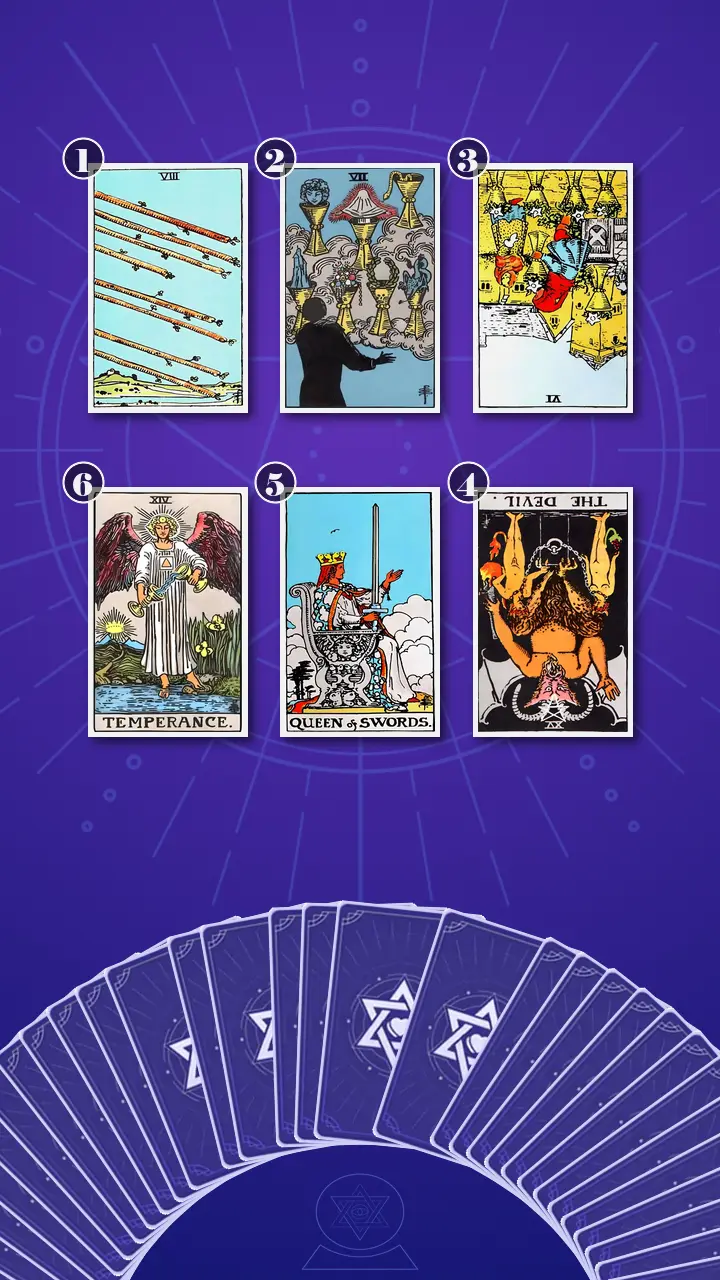
I chose the Transformation Path Grid · Context Edition, a six-card tarot spread designed for tracing a mechanism rather than predicting a relationship. For anyone trying to understand why an old flame texted and suddenly made the whole day feel urgent, this is how tarot works here: the cards provide a structured way to separate stimulus, interpretation, memory, behaviour, and choice. They do not reveal the sender’s hidden motives or guarantee a reunion.
A relationship spread might have centred the old flame and encouraged unsupported guesses about the other person’s inner life. This grid was more precise. The upper row would show the observable symptom, the active blockage, and the deeper root. Beneath the root would sit the leverage point; beneath the fantasy, the practical action; and beneath the symptom, the integrated state Jordan could build through repetition.
I laid three cards across the top, placed the fourth directly below the third, then read back through the lower row. The arrangement made a circuit: the same notification could either repeat the loop or become the entrance to a different response.
Reading the Circuit Back to Its Source
Position 1: The Notification Before the Thought
“Now I’m turning over the card for the observable symptom: the first acceleration after the message arrives,” I said.
It was the Eight of Wands, upright.
In the card, eight staffs fly across an otherwise clear sky. There is no visible sender, no receiver, and no explanation of why they are moving. That absence mattered. The image showed communication already in motion, but it did not ask us to speculate about who launched it or what they secretly intended.
For Jordan, the modern version was exact: the old flame’s name appeared on her lock screen, and within minutes she had moved from the five-line WhatsApp message to the old thread, the profile, a screenshot in a group chat, and a sixth reply draft while tomorrow’s research deck stayed open. The first energy state was excess: Wands fire moving faster than reflective judgment. The problem was not simply that a message had arrived. Her attention raced from notification to interpretation, checking, and imagined outcome before she had made a conscious decision.
“It was only one text, but within five minutes I was already reopening the thread, checking their last-seen status, and writing a reply I didn’t even want to send,” Jordan said.
She gave a short, humourless laugh and rubbed one thumb over the edge of her phone. “That’s too accurate. Almost cruel.”
“Specific can feel cruel when it catches the first automatic movement,” I said. “But this isn’t a judgement. It gives us a starting point. The notification lasted seconds; the rituals can keep it alive for hours. Which action comes first when the charge hits: reopen, search, ask, or draft?”
Her shoulders lowered by a fraction. She turned the phone farther away from herself, not as a permanent boundary, just long enough to notice that the first tap was not the same thing as a chosen response.
Position 2: Seven Tabs Open from One Warm Sign-Off
“The next position identifies the active blockage: the fantasy and projection that expand beyond the evidence,” I said as I turned the second card.
It was the Seven of Cups, upright.
A cloaked figure faces seven cups suspended in clouds, each holding a different vision. The distance between the figure and the cups is the card’s quiet warning: seeing an image is not the same as holding a fact. The energy here was an excess of emotional possibility. A small amount of information was being asked to carry the weight of several incompatible futures.
I compared the cups to seven mental browser tabs Jordan had opened from one ambiguous text: apology, reconciliation, casual catch-up, regret, sex, closure, and finally being chosen. Her internal monologue moved through them quickly: “Maybe this means they miss me; unless it’s just friendly; but the timing could mean regret; although the sign-off sounded different; perhaps they want to see me; perhaps this is my only chance.”
“A message can be real without the future attached to it being real yet,” I said. “A possibility can be emotionally vivid and still not be present relational evidence. What do the actual words say, and which part did your hope write afterward?”
Jordan counted the imagined futures on her fingers, stopped at seven, and stared at the spread. Her eyes went briefly unfocused, as if she were watching several versions of the same reunion play across the room. Then she opened her Notes app and typed one sentence: None of these futures is in the message.
Position 3: The Archive Behind the Present
“This position reveals the deeper root of the repetition compulsion: the emotional memory that makes current contact feel like a chance to repair the past and confirm your worth,” I said.
The third card was the Six of Cups, reversed.
In the Rider-Waite-Smith image, one figure offers a flower-filled cup within a protected courtyard. Reversed, that tender courtyard can become a closed emotional environment. The energy was a blockage: nostalgia had stopped being one part of Jordan’s history and had begun to set the terms for reading the present.
I asked her to picture the archived WhatsApp thread, the shared playlist from that particular summer, and the familiar Tube stop where she had once believed the connection might become stable. The present message had not arrived alone. It had arrived carrying selected photos, affectionate lines, missed opportunities, and the old promise that perhaps this time the person might finally choose her.
“I’m not only responding to what they said today,” Jordan murmured. “I’m responding to the moment when I thought this could become something. I keep calling it closure when I’m really looking for certainty.”
I let the silence stay kind. “A memory can be true and still be selective. Alongside the warmth, what instability or uncertainty also belonged to that connection?”
Jordan’s fingers tightened around the edge of her chair. First she looked down; then she closed her eyes and replayed an old conversation; finally she exhaled through her nose and gave a small nod. She did not need to disown the tenderness. She only needed to stop asking the highlight reel to testify as the whole history.
When the Loose Chain Came Into View
The room grew quieter when I reached for the card directly beneath the reversed Six of Cups. Rain tapped the window in a steady, unspectacular rhythm, and for once Jordan did not reach for her phone.
“This is the leverage point: the place where the checking-and-fantasy sequence can become visible as repeatable actions rather than an uncontrollable command,” I said.
It was The Devil, reversed.
The card can look dramatic, but I read it without fear. The two figures remain beneath the central figure, yet the chains around their necks are visibly loose. Reversed, the image brings a compelling attachment into conscious view. It does not demand that Jordan suppress attraction, block the old flame, reply immediately, or make a final relationship decision. It asks her to notice what keeps renewing the charge.
I used my Communication Dissonance Audit, a diagnostic lens I developed through ten years of studying sound, rhythm, and emotional patterning. I normally use it when two people argue past each other: I listen for the mismatch in emotional tempo rather than judging only the words spoken. Here, the text was five warm words at an ordinary conversational pace, while Jordan’s inner system had jumped into a full-volume crescendo. That dissonance made the notification feel like an instruction. It did not tell us what the sender intended. It showed us where Jordan’s attention was being recruited, and therefore where it could be reclaimed.
At 12:40 a.m., tomorrow’s research deck was still open while Jordan reread five lines, checked a profile, and rewrote a reply. The phone was warm, her jaw was tight, and the blanks already felt more convincing than the facts. The emergency was in the loop, not in the message.
The intensity is not proof that you are powerless or that the connection must resume; name the ritual, loosen one link, and remember that the Devil's chains are not locked.
Jordan’s breath stopped halfway in. First, her thumb hovered above the phone and her fingers froze, as if the next tap might still determine the entire past. Then her gaze lost focus and moved from the card to the imagined sequence: notification, profile, archive, draft, repeat. I could see the old case file rebuilding itself in her mind. Finally, her jaw loosened. Her hand lowered into her lap, and a quiet “Ah” came from somewhere below her ribs. Her shoulders dropped, followed by a small shiver of dizziness. Relief was not clean or triumphant; it carried the vulnerability of real responsibility. If the chain was not locked, she had a choice, but she also had to practise choosing. She looked at me with her eyes slightly bright, no longer needing to solve the sender’s intentions before taking back one hour of her own attention.
“The pull is evidence that an old loop has been activated, not that a relationship has been restored. Intensity can reveal a pattern without issuing an instruction,” I said. “Now, use this new perspective to remember last week: was there a moment when you could have let the message be information rather than an instruction?”
I showed her the smallest useful experiment. I asked her to set an eight-minute timer and write four lines: The text literally says...The story I added is...The next ritual I feel pulled to do is... and For the next hour, I choose... The exercise was not a demand to reply or stay silent. It was a way to separate activation from evidence long enough for self-trust to enter the room.
This was the first real crossing in the emotional transformation: not from longing into numbness, but from electrified longing, compulsive certainty-seeking, and fear of not being chosen toward grounded self-trust and tolerance of uncertainty. Jordan did not have to stop caring in order to stop obeying the loop.
Position 5: The Sword Between Facts and Fictions
“The next position translates that insight into action: separating facts from projections and choosing a response boundary based on present needs,” I said as I turned the card beneath the Seven of Cups.
The card was the Queen of Swords, upright.
Her vertical sword established a clear standard, while her open hand remained receptive to what approached. The energy was a balance of air: discernment without punishment, direct language without emotional denial. The Queen did not ask Jordan to become cold. She asked her to stop using speculation as a substitute for current evidence.
I translated the image into a research synthesis. “Open Notes and make two columns. Put the sender’s exact words in one column and everything you added in the other. Then ask: what do I know, what am I adding, and what do I need now?”
Jordan copied the message once. Her first column was short. The second filled more quickly: regret, attraction, a possible reunion, a fear of missing the right moment. When she reached for the delete key, I stopped her gently. “The added story is not shameful. It is simply not the same category as evidence.”
“You do not need to solve their intent before protecting your attention,” I told her. “A boundary can be a pace, not a punishment. You can reply, wait, ask a direct question, or decide not to engage. The choice belongs to your present needs, not to a strategy for guaranteeing their reaction.”
She nodded, then shortened the reply she had been polishing from six paragraphs to three sentences. Her hand paused over the send button. Instead of pressing it, she placed the phone beside the Queen of Swords and wrote a private line: I need directness and a slower pace before I give this more room in my life.
Position 6: The Rhythm That Can Hold Mixed Feelings
“The final position describes integration: how attraction and uncertainty can remain present without taking over sleep, work, meals, or friendships,” I said.
The card was Temperance, upright.
Water moved carefully between two cups. One foot stood on dry land and one in the stream, while a path led toward distant light. The energy was balance through gradual recalibration. Temperance did not predict whether the old flame would become a partner. It described a sustainable orientation: Jordan could stay emotionally honest while allowing present evidence to accumulate at a pace her wider life could process.
The spread began with the Eight of Wands’ instant acceleration and ended with measured flow. The Seven of Cups’ projection met the Queen of Swords’ fact-versus-inference split. The reversed Six of Cups’ preserved past met the Devil’s loosened chain. No Pentacles appeared, which told me that insight alone would not ground the change. Sleep, meals, phone-free work blocks, and ordinary plans would have to supply the earth deliberately.
Jordan rested both feet on the floor. “I can be interested and still wait,” she said. Her voice was quieter than when she had arrived, but not certain. That was fine. Temperance was not asking for certainty. It was offering a rhythm in which uncertainty could be carried without becoming the whole song.
The One-Hour Boundary
When I connected the six cards, I could see the full story. A brief message flew into a calm life and ignited the Eight of Wands. The Seven of Cups turned its limited wording into several seductive futures, while the reversed Six of Cups supplied an emotional highlight reel in which the past might finally repair itself. The reversed Devil exposed the maintenance system: every reread, profile search, friend consultation, and reply draft briefly reduced uncertainty while keeping the attachment electrically alive. The Queen of Swords supplied evidence and language; Temperance offered a pace in which feeling and judgement could share the same room.
Jordan’s blind spot was not that she cared too much. It was that she treated understanding the sender’s intent as the only route back to control, even while the search for that intent was eroding her sleep, concentration, routines, and trust in her own judgement. The key shift was practical: record the literal content, wait at least one night when possible, and choose a boundary according to present needs rather than imagined outcomes.
I gave Jordan three small next steps. None required a permanent decision about the relationship, and none depended on making the longing disappear first.
- Name the loose linkOn one evening this week, open a blank Notes page when the notification or memory activates and set an eight-minute timer. Write four lines: “The text literally says...” “The story I added is...” “The next ritual I feel pulled to do is...” and “For the next hour, I choose...” Do not send anything during the exercise.If eight minutes feels too large, write one literal fact and one choice for the next hour. Checking early is information about the loop, not proof that the experiment failed.
- Split evidence from inferenceAt the next message, make two Notes columns titled “Literal text” and “What I added.” Copy each actual statement once, place every inferred motive or future scene in the second column, then write one sentence about what contact would need to feel workable now. If drafting a reply or non-response boundary, keep it to three sentences and leave it unsent until the next day.Ask one trusted friend only whether the draft is clear and respectful, not what the old flame secretly means. Clarity is the goal; controlling the outcome is not required.
- Use the Syncopation PauseBefore reopening the thread, searching the profile, or starting another draft, place both feet on the floor and take a quiet, audible exhale across three beats. I call this the Syncopation Pause: a three-second acoustic grounding technique for lowering the emotional BPM. Then mute the conversation for one chosen work block, meal, or Tube journey, put the unmute time in the calendar, and complete one two-minute physical task.Keep the boundary narrow. It is not blocking, punishment, or a test of whether attraction is gone. It is one deliberately loosened link that protects the next part of the day.
“The point is not to win against the feeling,” I said. “It is to give the feeling a truthful volume. You remain free to respond when your body has settled and the evidence supports the choice. The cards can show the pattern, but you are the person who edits the next measure.”
The Quiet Proof of a Different Rhythm
Five days later, Jordan sent me a message while I was making tea. “I used the two columns. I waited until morning, sent three sentences, and slept a full night. My first thought at breakfast was, What if I’m wrong? I still smiled, because the question didn’t decide my next move.”
She did not tell me that the old flame had become unimportant, or that the future was settled. The small proof was more honest than that: she had finished dinner before checking, kept a morning work block intact, and let one reply arrive as information rather than an emergency. The clarity was real, and it was still becoming.
I think of that as the heart of a Journey to Clarity. Tarot did not remove Jordan’s longing or speak for the person on the other side of the screen. It gave her a visible circuit, a loose link, and enough space to hear her own judgement. The change belonged to her.
When a familiar name lights up after months of silence, I know it can feel as though a buzzing chest has to solve the whole past before the screen goes dark, as though letting the moment pass might prove you were never worth choosing. Sometimes clarity is simply the first thinning of that fog, when the message, the memory, and the self come back into separate focus.
If a five-line message were allowed to be one piece of information rather than a verdict on your worth, what small pace—the three-beat pause, the phone face down through dinner, or another rhythm that belongs to you—would feel like yours for the next hour?