The TTC Ride Home While Comparing a New Date to an Ex
When I met Jordan (name changed for privacy), a 29-year-old UX researcher in Toronto, she could describe a new date’s texting rhythm before she could name what she had enjoyed. The post-breakup comparison loop became loudest when a calm evening collided with her ex’s Instagram Story.
She brought me one scene with the precision of a research transcript. At 8:47 on a Tuesday evening, she was riding TTC Line 1 home from a date, scrolling through the new person’s Hinge profile while fluorescent lights buzzed overhead. The phone felt warm in her palm. When the train braked, her chest tightened, and she opened her ex’s old iMessage thread to compare one sentence with another.
“I can tell you exactly how her humour was different,” Jordan said. “I can’t tell you what I liked. I literally searched, ‘Why am I comparing new dates to my ex?’ on the ride home.”
I heard longing beneath the analysis. It sat behind her sternum like a subway door held half-shut: enough space to see the next platform, not enough to step onto it. “You want to meet someone new,” I reflected, “but you’re already asking whether they feel like someone who is gone. Comparison gives you a quick verdict, but it also keeps curiosity at a safe distance.”
I did not tell her to forget the relationship, lower her standards, or force herself to be ready. The past can be meaningful without becoming the entry requirement for the present. I told her our Journey to Clarity would be simpler and kinder: we would map what comparison was protecting, then find one way for her to remain inside the next conversation long enough to notice what was actually there.

Choosing a Ladder Instead of a Crystal Ball
I invited Jordan to take one slow breath and hold the question without trying to solve it. I shuffled while the rain tapped the window, using the pause as a transition from mental replay into focused observation—not as a performance of mystery.
I chose the Four-Layer Insight Ladder · Context Edition. If you are wondering how tarot works in my practice, I use card meanings in context as a structured mirror, not a prediction machine. This four-card insight spread was precise enough to separate the visible comparison habit, the hidden fear beneath it, the perspective that could interrupt it, and a grounded relational practice. A larger spread would have added future outcomes Jordan had not asked for.
The first card would show the behaviour pulling her out of the date. The second would reveal why unfamiliar connection felt less trustworthy than remembered chemistry. The third would be the transforming bridge, and the fourth would turn that insight into something she could actually do.
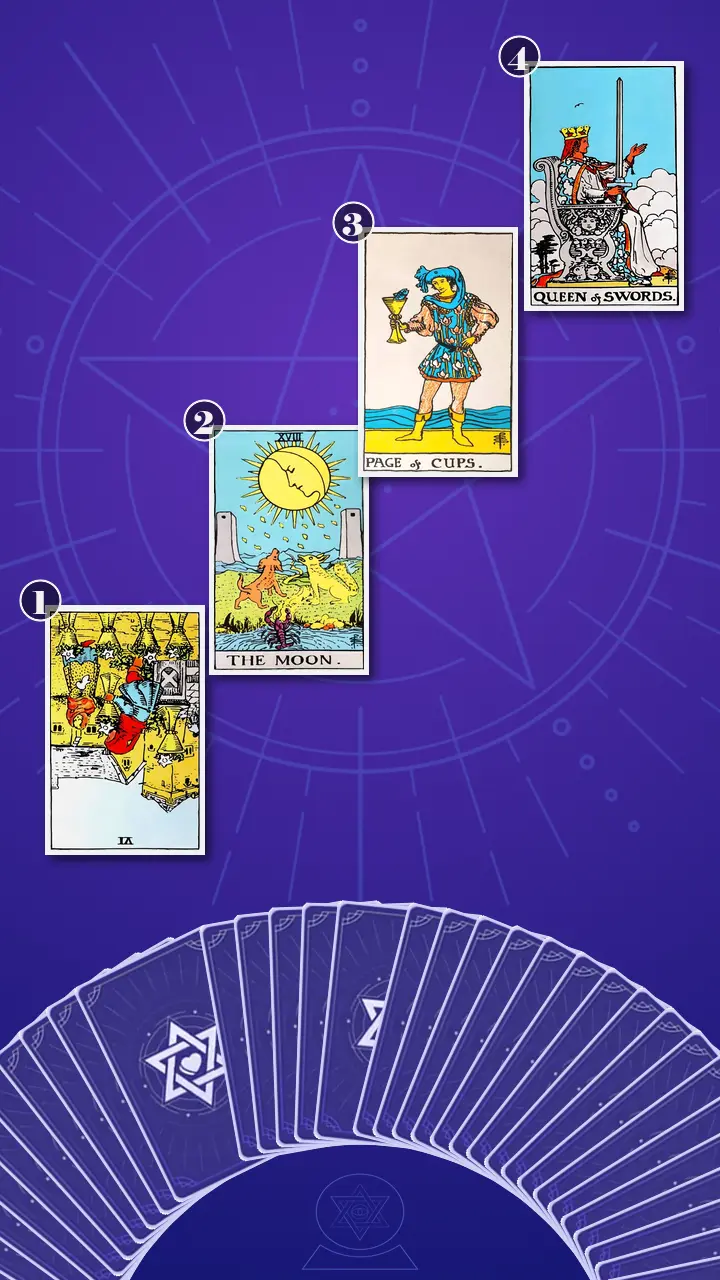
The Old Relationship in the Third Seat
Position One: The Memory That Keeps Conducting the Interview
I began with the card representing the visible pattern and current symptom: Jordan comparing each new date with her ex instead of staying engaged with the present. I turned over the Six of Cups, reversed.
In its reversed position, the card showed Water blocked and pooled in memory. I described Jordan sitting across from someone in an Ossington bar while the old relationship quietly occupied the third seat. A new laugh, a different texting style, or a calmer kind of attention was checked against saved photographs, archived messages, and remembered intensity before it could register on its own terms.
The card was not accusing her of caring about the past. It was showing how nostalgia had become an evaluation system. Like using an old Toronto map as live GPS, the route felt reassuringly familiar but could not report what was on the street now. The practical question was no longer whether the memory mattered. It was whether Jordan was meeting the person in front of her or asking that person to reproduce it.
Jordan gave a short laugh with a bitter edge. Her shoulders lifted, her mouth tightened, and then she looked away from the spread. “That’s so accurate it’s almost cruel,” she said. “My friend asked what I enjoyed, and I gave her five differences from my ex.”
“The card is being precise, not cruel,” I said. “It’s locating the moment your attention leaves. Different is information, not a verdict.”
Position Two: The Moonlit Gap Between a Text and a Story
I next turned over the card representing the hidden emotional driver—the fear that makes familiar signals feel safer than incomplete but current evidence. It was The Moon, upright.
I asked Jordan to picture the winding path between the Moon’s two towers. Then I brought her back to 10:22 that night: the brief goodnight text glowing in her dark bedroom, her jaw clenched against the weighted duvet. The observable fact was small: the new person had sent a short message. The imagined sequence was much larger: They paused, so the connection must be fading. My ex would have said something warmer. Therefore, this must mean there was no real chemistry.
The Moon’s Water was not stagnant like the Six of Cups; it was obscured by projection. Jordan had too little information, so fear and memory supplied the missing data. It was like conducting UX research in a dark room and treating the first hypothesis as the interview result.
I used my Shadow Projection Analysis carefully here. I did not assume a childhood cause or claim to know the new date’s intentions. I simply separated three layers: what the person had actually done, what Jordan’s triggered narrative predicted, and what need sat underneath that prediction. The need was not necessarily for her ex. It was for confidence that she could recognize safety and compatibility even when they arrived in an unfamiliar form.
“Comparison can give you certainty by taking you out of the conversation,” I said. “The certainty is real as a feeling of relief. That doesn’t make the verdict accurate.”
Jordan’s thumb stopped rubbing the edge of her cup. She stared at The Moon, replaying something behind her eyes, then released a breath that seemed to come from the base of her ribs. “So I’m not always spotting a red flag,” she said slowly. “Sometimes I’m filling in a blank.”
“Exactly. And we still keep your standards. We’re only refusing to let an assumption impersonate evidence.”
When the Fish Interrupted the Verdict
Position Three: The Page of Cups Opens the Loop
The room became unusually still as I reached the central card, the one representing the transforming insight. Even the radiator clicked off. I turned over the Page of Cups, upright.
The Page’s Water was moving again: receptive, curious, and gently vulnerable. A fish appeared inside the offered cup—something alive, surprising, and impossible to predict from an old script. For Jordan, this looked like feeling the familiar pressure in her chest, asking one sincere follow-up question anyway, and listening to an answer that did not sound like her ex.
I asked her to return to the TTC ride: the warm phone, the open iMessages, the instant conclusion that a quieter date meant weaker chemistry. She had been trying to eliminate uncertainty before allowing the evening to become an experience. The Page offered a smaller task: receive one unfamiliar detail before categorizing it.
I ran the pattern through my Attachment Loop Diagnosis—not to pin an anxious or avoidant label on Jordan or anyone she dated, but to trace the sequence. Unfamiliarity activated insecurity. Comparison supplied control. Mental withdrawal reduced real contact. The reduced contact then appeared to confirm that only the ex had felt meaningful. The Page interrupted that loop at its smallest movable point: attention.
Stop treating a familiar feeling as proof of compatibility; meet the present with one small, sincere question, like the Page of Cups offering a cup without knowing how it will be received.
I let the sentence settle before adding, “The old relationship can remain part of your history without becoming the test every new person has to pass. You do not need its emotional signature before you can discover what is true now. The first honest question is not whether this person feels like your ex, but what you can actually notice here.”
Jordan’s inhale stopped. Her fingers hovered above the table as if she had been about to defend the old measuring system and had forgotten the argument. Her gaze lost focus; I could almost see the recent dates replaying—not as failed auditions, but as encounters she had left early in her attention. Then her eyebrows drew together.
“Wait,” she said, sharper than before. “Doesn’t that mean I’ve been getting all these dates wrong?”
“No,” I answered. “It means comparison was protecting you from surprise. Protection can be understandable and still distort the view. You are allowed to update the method without prosecuting your past self.”
Her eyes reddened. One shoulder dropped, then the other. A small, unsteady laugh escaped her, followed by a long exhale. Relief crossed her face first; then came a brief blankness, the slight dizziness of realizing that clarity returned responsibility to her. No card could decide which person deserved another date. She would have to notice, ask, feel, and choose.
I leaned forward. “Now, with this new perspective, can you think of a moment last week when this insight might have made you feel different?”
Jordan nodded after a pause. “The person told me about a disastrous work presentation. I laughed, but then I checked whether the humour felt like my ex’s. I could have just asked what happened next.”
That was the crossing: from nostalgic scanning and guarded certainty toward curious attention, honest discernment, and grounded openness. Not instant trust. Not guaranteed chemistry. Just enough room to say, I don’t recognize this yet, but I can notice it. A small surprise did not need to become a conclusion.
The Sword That Separates Evidence from Memory
Position Four: The Queen’s Open Hand
I turned over the final card, representing the grounded relational practice: one observable way to distinguish memory, assumption, and current evidence while remaining emotionally present. It was the Queen of Swords, upright.
The Queen introduced Air in balance after three Water cards. Her sword stood upright, but her other hand remained open. I read that combination as mature discernment rather than emotional coldness: Jordan could protect her boundaries without closing the door before she knew what was on the other side.
In ordinary life, the Queen looked like Jordan leaving a date with one factual observation, one feeling in her body, and one unanswered question. She could write those down before opening old messages or outsourcing the verdict to the group chat. Her analysis would no longer be used to escape contact; it would give contact a clean structure.
“Keep the boundary; drop the audition,” I told her. “If someone is disrespectful, inconsistent, draining, or unsafe, you can leave. If you are simply unsure, you can decide only whether you want one more conversation. Uncertainty is not consent, and curiosity is not an obligation.”
The Old Toronto Map and the Live Street
I drew the four cards into one story. The Six of Cups showed an emotionally vivid past supplying the benchmark. The Moon revealed why the benchmark felt necessary: unfamiliarity opened a gap, and projection rushed in to close it. The Page of Cups offered the unused resource—curiosity that could receive a new feeling without demanding immediate proof. The Queen of Swords gave that openness language, evidence, and boundaries.
The cognitive blind spot was subtle. Jordan was treating familiar intensity as evidence of compatibility, and the relief of reaching a verdict as evidence that the verdict was true. Her analytical skill was not the enemy; it simply needed a better research question. Instead of asking, Does this feel like my ex?, she could ask, What did this person actually show me, what happened in my body, and what do I not know yet?
I reminded her that tarot had not announced whether any new date would become meaningful. It had shown why the present was hard to perceive and where she could intervene. The cards supplied a map; Jordan retained full authority over the route, her boundaries, and whether she wanted to continue at all.
Two Small Practices for Present-Tense Chemistry
I turned the insight into two actionable next steps. For the second, I adapted my Projection Detachment Exercise so Jordan could separate a date’s actual behaviour from the internal story activated by the old relationship.
- One-Cup Curiosity, during the next date. When the comparison begins, silently name the present object of attention—her story, her expression, her question, or my body right now. Then ask one genuine follow-up about something the person has just said and stay with the answer for one full beat. Tip: Make the smallest version count. Ten seconds of listening is enough. The question is not a promise to continue dating them.
- The Projection Detachment Exercise, before opening old messages. After the date, set a 20-minute comparison buffer while walking one Toronto block, waiting for the TTC, or travelling home with the phone in your bag. Then write three lines: Fact—I observed…; Feeling—In my body, I felt…; Question—I do not know yet…. Under the question, add: Is this based on their actual behaviour or my triggered narrative? Tip: Use a three-minute timer and stop after one sentence per line. If the exercise feels intrusive or overwhelming, write only the fact—or leave the note unfinished.
I asked Jordan to treat both practices as experiments in attention, not tests of whether she was healed or ready. A clear no remained a no. A neutral but respectful date could remain undecided. The aim was not to manufacture chemistry; it was to stop an old relationship from answering before Jordan had heard herself.

A Week Later: One Unanswered Question
Six days later, Jordan sent me a message from a TTC platform. On another date, she had noticed the comparison starting, named their story as the present object of attention, and asked about the person’s creative project. The answer was nothing like one her ex would have given. Jordan listened anyway.
Under the bright platform lights, she completed the fact-feeling-question debrief: Fact: she became animated when she talked about making things. Feeling: my chest loosened, then tightened again. Question: do I want to hear more, or did I simply enjoy this moment? Jordan waited through the 20-minute buffer before checking her phone. By then, the old iMessage thread no longer felt like required evidence.
She had slept through the night. Her first thought over coffee was still, “What if I’m reading this wrong?” This time, she let the question sit beside the mug and smiled at not knowing yet.
I did not see that as a solved love life. I saw a quieter and more credible proof: Jordan had moved from remembered chemistry toward current evidence. Tarot had not made the choice for her. It had helped her recover the attention with which she could choose.
When a new date feels different and your chest tightens, I hope you remember how easily the old relationship can become proof that you know what safety feels like—even while that measuring keeps the present out of focus. The past can remain meaningful without being the only container in which something real is allowed to arrive.
If you let one unfamiliar feeling stay unnamed for one more TTC stop, what might you notice—the fish in the cup, the person in front of you, or your own body’s answer—before the old relationship answers for you?
Every reading at AceTarot is a journey to connect with inner wisdom and empower the path ahead. This reading shared here is a psychological mirror, not a private record—crafted to reflect universal emotional loops and help restore personal clarity. Please note that these insights do not replace professional psychological, medical, legal, or financial advice, and should not serve as the sole basis for major life decisions.
Learn more about our Journey to Clarity.
How did this insight land for you?
🫂 This Resonates Deeply
🌀 Living This Story
✨ Now I See Clearly
🌱 Seeing New Possibilities
🧰 Useful Framework
🔮 The Confirmation I Needed
💪 Feeling Empowered
🚀 Ready for My Next Step
Author Profile
 AI
AI Giulia Canale
956 readings | 527 reviews
“Having traveled across cultures... I've learned that what we often lack isn't a simple answer, but a moment of being truly understood. I use a Jungian psychological lens to help you deconstruct your subconscious patterns—not to prove anything, but to be the gentle companion who helps you unravel your knots, free of judgment, so you can reconnect with your inner wisdom.”
In this Love Tarot Reading :
Core Expertise
- Attachment Loop Diagnosis: Logically decoding whether your relationship friction is driven by an anxious-avoidant trap or deep-seated insecurity.
- Shadow Projection Analysis: Identifying the unacknowledged fears or unmet childhood needs you are unconsciously projecting onto your partner.
Service Features
- The Projection Detachment Exercise: A structured psychological journaling prompt to separate your partner's actual behavior from your triggered internal narrative.
Also specializes in :
Explore Related Patterns:
Certainty SeekingAt 8:47 on the TTC, comparison gave you a quick verdict, and later you searched why you were comparing instead of staying with the unresolved experience. You had been trying to eliminate uncertainty before allowing the evening to become an experience. The verdict creates a brief sense of relief, which can make certainty feel like accuracy. It protects you from having to discover slowly whether a quieter connection is safe or meaningful, but mental withdrawal then leaves you with less real data and makes your ex seem like the only reliable measure. You do not have to decide whether someone is right for you in the moment; deciding only whether you want one more conversation preserves your choice without requiring certainty to create connection.
Comparison TrapOn the TTC ride home, you described the new person's texting rhythm before you could name what you enjoyed, then opened your ex's old iMessage thread to compare one sentence with another. When your friend asked what you liked, you answered with five differences, so the comparison was doing more than collecting information; it was deciding whether the new person qualified before you had met them on their own terms. That scorecard protects you from the surprise of an unfamiliar connection by turning ambiguity into a familiar reference point. It also pulls your attention out of live contact, which can make the present seem empty and the past seem uniquely meaningful. You can keep standards and still delay the verdict long enough to ask what was actually shown, what you felt, and what remains unknown.
Relational Baggage LoopAcross the dates described, unfamiliarity tightened your chest, comparison supplied control, and mental withdrawal reduced real contact. You then had less current evidence and read that absence as confirmation that only your ex had felt meaningful, while the old thread and archived messages remained available as a reference. That sequence reinforces itself rather than proving that each new person is a poor fit. The past becomes the standard, the present loses a chance to generate its own evidence, and the lack of evidence strengthens the standard. Keeping the old relationship as part of your history while asking one sincere follow-up interrupts the cycle without demanding trust or chemistry. You remain free to leave a genuinely poor fit; the work is only to stop memory from deciding before you have noticed what is here.
Romantic ProjectionAfter a short goodnight text, you moved from the observable pause to a much larger story that the connection was fading, your ex would have sounded warmer, and there was no real chemistry. The story also shows you filling the information gap with memory and fear rather than with more current evidence. That mental leap lets the absent relationship supply motives and meaning the new person has not actually communicated. It can feel like perceptive research because it produces a coherent explanation, but the explanation is still an old lens placed over an incomplete present. Separating fact, bodily response, and unanswered question gives you a way to notice what belongs to this date and what the past is adding.
IntellectualizationYou could describe a new date's texting rhythm with research-transcript precision before naming what you enjoyed, and you checked a live sentence against archived iMessages. Analysis gave you a precise task at the point where direct enjoyment, vulnerability, and not knowing were harder to tolerate. The mental review is understandable, but when it replaces contact it turns a person into a dataset and your feelings into evidence to be audited. The more efficiently you analyze, the less the current person can be encountered, and that reduced contact can then look like proof that the old relationship was deeper. Your fact-feeling-question practice keeps the intelligence while returning it to the present.
Explore Related Struggles:
Comparison EntrapmentOn the TTC ride home from a date, Jordan opened her ex's old iMessage thread and compared one sentence with the new person's before she could name what she had enjoyed. When a friend asked what she liked, she offered five differences from her ex instead, showing how the archive had become the first place her attention went. You can be caught between wanting a new connection and requiring the old relationship to certify it before the present has time to speak. Comparison supplies a quick verdict, then removes you from the live conversation, leaving less current evidence and making the ex appear even more like the only meaningful benchmark. The bind is not a lack of standards; it is that the measuring system meant to protect discernment prevents the contact needed to discover what this person is actually like.
Projection-Connection SplitAt 10:22, a short goodnight text became an imagined sequence about the connection fading, with the ex's warmer wording used as the implied proof. Jordan described the process like conducting research in a dark room and treating the first hypothesis as the interview result, while the new person's actual intention remained unknown. You can therefore move from an incomplete signal to a finished story before the next piece of evidence arrives. That story gives the blank a shape, but it also pulls your attention away from the person in front of you; reduced contact can then look like confirmation that the projection was right. The structural split is between evidence that unfolds in real time and a narrative that tries to settle compatibility before real-time contact has been allowed to accumulate.
Certainty-Safety FusionJordan says comparison gives her a quick verdict, and the session describes it as protecting her from surprise. A quieter texting rhythm, a different laugh, or an unfamiliar kind of attention is checked against saved messages before it can register on its own terms, so relief from deciding begins to stand in for proof of compatibility. You may then treat a familiar emotional signature as the condition for feeling safe enough to connect, even though the story does not establish that the new person is unsafe. The verdict reduces uncertainty for a moment while closing off the curiosity and direct evidence that could tell you whether the connection is respectful, compatible, or simply not for you. Certainty and safety become fused at the exact point where new information needs room to arrive.
Explore Related Emotions:
Ambiguity DreadAt 10:22, a brief goodnight text glows in Jordan's dark bedroom while her jaw clenches beneath the weighted duvet. The observable event is small, but the blank around it rapidly fills with a much larger prediction that the connection is fading, her ex would have been warmer, and the date therefore lacked real chemistry. When current evidence is incomplete, your body can experience the gap as something that must be closed immediately. Ambiguity Dread names the braced, suspended feeling that appears when not knowing seems more threatening than an unfavourable conclusion. The comparison is compelling because it turns an open question into a finished answer, even when the answer has outrun the available facts.
Cautious Self-TrustOn the TTC platform, Jordan writes that the person became animated, that her chest loosened and tightened again, and that she does not yet know whether she wants to hear more or simply enjoyed the moment. None of those observations gives her a total answer, but together they are enough to support a truthful pause. Cautious Self-Trust appears when you stop demanding that your first impression be perfectly correct before it deserves attention. Your standards remain active, but the old relationship no longer has exclusive authority to define compatibility. You can make a provisional choice from what you actually observed and update it when more information arrives.
Certainty HungerA new laugh, a calmer style of attention, or a short message is quickly checked against the old relationship and converted into a verdict. Jordan receives immediate closure about what the date supposedly meant, but that conclusion arrives before she can identify enjoyment, interest, or the simple wish to hear more. The speed of the verdict reveals how urgently firm ground is being sought. Certainty Hunger is the craving to replace an unfinished experience with a conclusion that feels solid enough to stand on. You do not have to abandon your standards to notice this distinction; you can keep discernment while examining whether the answer came from current evidence or from the need to stop not knowing.
Guarded LongingJordan wants to meet someone new, yet she can describe a date's texting rhythm and differences from her ex before she can say what she liked. Even while sitting across from another person, the previous relationship occupies an invisible third seat and keeps her attention divided between possible connection and remembered familiarity. The image of a subway door held half-shut captures the inner structure precisely. You can genuinely want closeness while keeping curiosity far enough away that nothing unfamiliar can fully reach you. Guarded Longing is that suspended feeling of looking toward connection without allowing yourself enough unclaimed space to enter it.
Intuitive Self-DoubtJordan says she can explain exactly how the new person's humour differed from her ex's, yet she cannot say what she liked. Later, even after recognising the comparison loop, her questions become whether she has been getting the dates wrong and whether she is still reading the situation incorrectly. When the archive consistently outranks your own developing response, your capacity to recognise compatibility can start to feel unreliable. Intuitive Self-Doubt is not proof that your judgment is broken; it is the unsettled feeling produced when your present observations have been given less authority than remembered chemistry. Separating fact, bodily response, and what remains unknown allows that authority to return without demanding infallibility.
Nostalgia Loop AnxietyAt 8:47 on the TTC, Jordan moves from the new person's Hinge profile to her ex's old iMessage thread and compares one sentence with another. The same route appears after other dates, when a laugh, texting style, or quieter form of attention is checked against saved photographs and remembered intensity before she can name what she enjoyed. When your attention repeatedly travels from present contact into a highly familiar archive, memory can begin to feel more trustworthy than the experience still unfolding. Nostalgia Loop Anxiety names the restless pressure created by that circuit—the past remains emotionally vivid, while every unfamiliar detail in the present seems to require comparison before it is safe to register on its own.
Cautious ReceptivityThe new person's answer about a creative project does not resemble anything Jordan associates with her ex, and she listens anyway. She allows the difference to arrive as its own experience rather than treating it as evidence for or against immediate compatibility. Cautious Receptivity is the feeling of opening the door without giving away control of the threshold. You can let another person affect your attention while preserving your standards, your right to decline, and your freedom to remain undecided. The openness is credible precisely because it does not require instant trust or continued dating.
Grounded CuriositySix days later, Jordan notices the comparison beginning, names the other person's story as the present object of attention, and asks about their creative project. The answer is nothing like one her ex would have given, but she listens long enough to notice the person's animation instead of converting the difference into a verdict. Grounded Curiosity grows through that small shift from evaluation to contact. You do not have to manufacture attraction or promise another date; you only remain with one real detail long enough for it to become information. Curiosity becomes emotionally stabilising because it lets the present speak before memory answers on its behalf.
Liberating UncertaintyOver coffee, Jordan still thinks that she might be reading the situation incorrectly, but she lets the question remain beside the mug and smiles at not knowing yet. On the platform, she also leaves open whether she wants to hear more or simply enjoyed one moment, without forcing either possibility into a final answer. Liberating Uncertainty is not the disappearance of doubt. It is the spacious feeling that emerges when an unanswered question no longer controls the entire encounter. You recover room to notice, revise, and choose because not knowing has stopped functioning as an emergency that memory must immediately resolve.
Cautious ReliefJordan's thumb stops rubbing the edge of her cup, a breath releases from the base of her ribs, and later both shoulders drop. Six days afterward, she waits through the comparison buffer, finds that the old iMessage thread no longer feels like required evidence, and sleeps through the night. Cautious Relief is carried by these small releases rather than by a claim that everything has been resolved. You can feel less compelled by the old reference point while still having questions about the new person and your own interpretation. The relief remains grounded because it accompanies recovered attention and choice, not a guaranteed romantic outcome.
Explore Related Contexts:
Ex Comparison LoopJordan leaves a new date on TTC Line 1, scrolls through the person's Hinge profile, and opens her ex's iMessage thread to compare one sentence with another. When her friend later asks what she enjoyed, Jordan responds with five differences from her ex, showing that the comparison is not confined to one message or one evening. Each new person consequently enters a relational structure in which an absent partner already holds the benchmark position. For you, an Ex Comparison Loop can make familiar humour, texting, or intensity look like objective compatibility criteria, while unfamiliar qualities are classified before they have enough contact to become meaningful evidence.