One More Stop Took the Errand Window; Leaving at Four Returned Choice

Finding Clarity in the 2:45 Queen West Cafe
As a hybrid product designer in Toronto, Alex (name changed for privacy) was dependable whenever a coworker, client, or deadline needed them. Their own groceries, parcel returns, laundry, and appointment booking were different. At 2:45 PM on a Saturday, a reminder appeared beside a cooling oat latte just as a friend said, ‘one more stop.’
The espresso grinder buzzed behind us. The phone felt warm under Alex’s thumb, and their restless fingers checked the time, swiped away the grocery and parcel-return alert, then returned to the group chat where another venue was already loading. Alex wanted the hangout and wanted to leave, but shared momentum made the decision before either desire was spoken.
‘Why do I keep letting hangouts replace the errands I planned?’ Alex asked. ‘I only meant to stay for an hour. The errands are flexible until suddenly they are urgent.’
I watched the immediate relief of staying settle over the deeper cost. It was like a bright cafe playlist covering a low vibration in the body: laughter on top, a heavy stomach and drained limbs waiting underneath. Alex’s guilt-tinged restlessness was not a character flaw; it was the physical feeling of letting someone else’s afternoon keep choosing the next beat.
‘I know that helpless feeling of wanting to move forward while the smallest ordinary task seems to slip out of reach,’ I said. ‘We do not have to make friendship the villain, and we do not have to turn one postponed errand into a verdict on your discipline. Let’s draw a map of the moment where the day changes hands. That is where our Journey to Clarity can begin.’

Choosing a Straight-Line Map for a Crooked Afternoon
I invited Alex to take one slow breath, name the question, and notice what happened in their hands when the reminder appeared. Then I shuffled the deck slowly. The small ritual was a transition into attention, not a supernatural test: a way to let the body stop following the group chat long enough to observe the choice.
I used the Situation-Obstacle-Advice-Outcome · Context Edition, a focused four-card tarot spread for procrastination, self-direction, and boundaries around everyday errands. For readers wondering how tarot works in this context, the spread is a reflective tool for examining a self-reinforcing social procrastination loop, not a prediction machine. The question contains a narrow routine system: an open-ended hangout displaces an errand, short-term relief rewards the postponement, and declining self-trust makes the next personal plan easier to abandon.
The first position would reveal the observable moment when socializing absorbs the errand window. The second would identify the directional blockage beneath the pattern. The third would show the exact leverage point where a boundary could interrupt the drift, and the fourth would translate that insight into repeatable practical follow-through. Four positions were enough here. A Celtic Cross would have added scope without adding useful clarity.
When the Group Chat Takes the Wheel
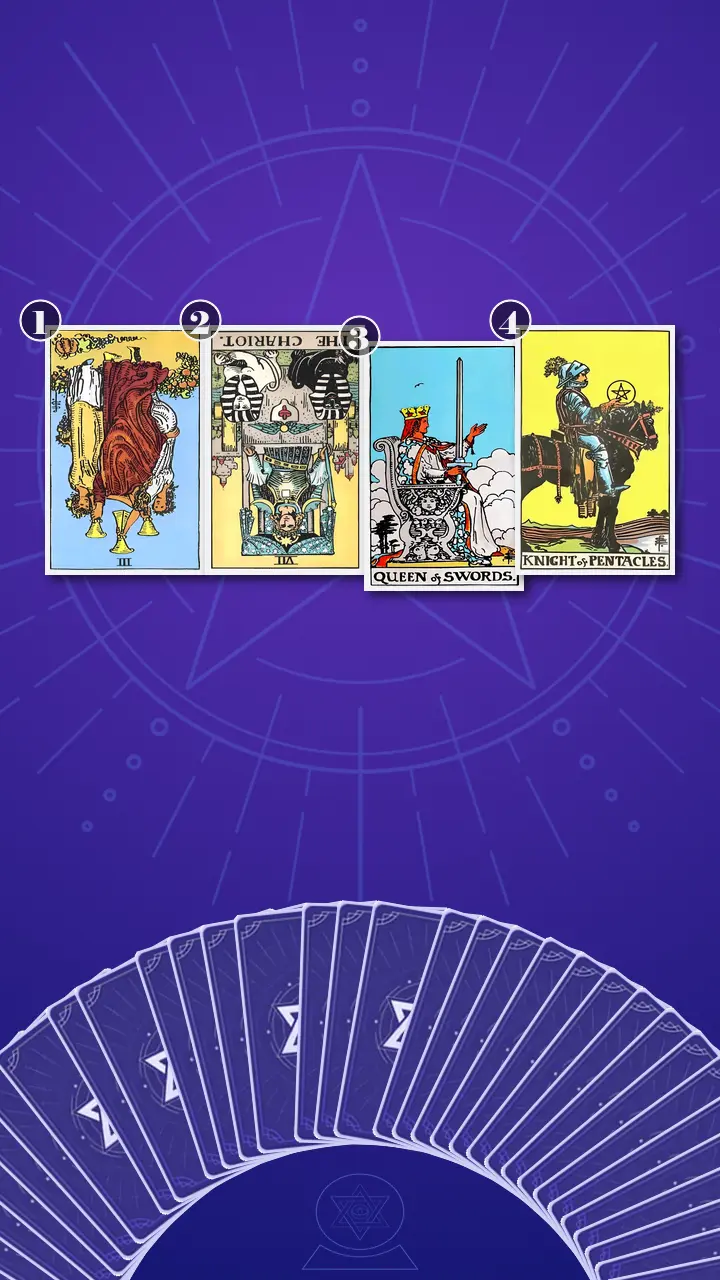
Three of Cups Reversed: The Plan with No Edge
I began with the position that reveals the observable moment when open-ended socializing displaces the errands Alex intended to complete and establishes the stagnant emotional pattern. The card was the Three of Cups, in reversed position.
The three raised cups looked like the friends’ shared momentum: coffee becoming a walk, the walk becoming another venue, and the next round appearing before anyone named a departure time. The warm phone, the laughter, and the grocery and parcel reminders treated as flexible matched Alex’s lived scene exactly. In this position, the card does not say that friendship is the enemy. It shows social enjoyment spilling beyond the container that was meant to hold it.
Reversed Water is in excess here. Connection is present, but its edges have blurred into boundary creep. The group’s energy supplies immediate relief from boredom and uncertainty, while the errand remains movable because no one else is waiting for it. The closed social circle becomes an autoplay queue: every ‘one more stop’ loads the next episode before Alex chooses whether to leave.
Alex gave a short laugh with a bitter edge. ‘That is almost rude,’ they said. ‘I can see the exact moment. I check the time, decide I can stay a little longer, and then somehow the group has already decided where we are going.’
‘That reaction is useful,’ I said. ‘We are looking at a sequence, not assigning blame. The hangout is not the problem; the plan has no edge. The first experiment is not declining every invitation. It is giving the invitation a beginning or an end before the group’s momentum has a chance to write the whole afternoon.’ Alex’s thumb rubbed the rim of the cup, and their shoulders eased by a fraction as the problem became a boundary decision instead of a judgment about how much they cared about friends.
The Chariot Reversed: Motion Without a Chosen Route
I turned to the position that identifies the mechanism beneath the procrastination: existential drift and the surrender of self-directed time when competing pulls appear. The card was The Chariot, in reversed position.
The Chariot’s black and white sphinxes seemed to face different directions, like Alex’s social plan and personal responsibilities pulling against each other without a chosen route. Alex had enough time and a clear errand list, yet no sequence had been protected before the invitation arrived. They followed the group through downtown, walked, talked, and moved plenty, but the afternoon had no self-authored destination. By the TTC ride home, the body was tired from activity and still felt as if nothing had been directed.
I asked Alex to picture the afternoon as two open browser tabs. The group chat kept loading the next plan while the grocery reminder sat unanswered in the background. The inner operating system first said, ‘I have time, so I do not have to decide yet.’ Later, it revealed the harder sentence: ‘I never actually chose where the day was going.’ Being busy was not the same as being in the driver’s seat.
This is a blockage of coordinated will, not a deficiency of care. The reversed Chariot shows motion without alignment, where an outside deadline eventually supplies the direction that personal plans were never allowed to hold. I asked, ‘What might staying protect you from feeling?’ Alex looked toward the window and said, ‘Maybe the flatness of doing something ordinary. If I leave, I might find out I do not know how to make the rest of the day feel worthwhile.’
Alex’s breath paused. Their finger stopped above the phone, and their eyes went briefly unfocused, as if replaying the last Sunday evening with its crowded list and unopened parcel. Then their jaw loosened, and they released a long breath through the nose. I said, ‘The goal is not to manufacture heroic motivation. The goal is to coordinate two real wants: connection and a day that still belongs partly to you.’
When the Queen Put an Edge on the Afternoon
Queen of Swords Upright: The Sentence Before the Extra Drink
The room seemed to quiet when I reached the center-right position, the leverage point that can interrupt boundary creep at the moment a hangout begins or extends. I turned over the Queen of Swords, in upright position.
Her open palm kept contact available. Her vertical sword gave the interaction a clean edge. This was not a command to withdraw from friends; it was a model for warm, direct communication: ‘I can stay until four, then I need to run my errands.’ The Air energy is balanced and precise. It separates a genuine choice from passive continuation without requiring a long defense.
After ten years of sound energy research, I often hear a daily schedule as a rhythm. I use Somatic Rhythm Mapping as a reflective, non-diagnostic lens: repeated physical fatigue can feel like an arrhythmia in the architecture of a day, a tempo misalignment rather than a moral failure. Alex’s restless hands during the hangout and heavy limbs on the streetcar suggested that the social rhythm had run past the errand rhythm because no transition had been named. Seeing the Queen’s open hand and sword, I had a brief flash of waveform diagrams from my research: a pattern can be loud, full, and active while still being out of sync.
At 2:45 on Saturday, the grocery-and-parcel reminder lights beside the coffee while a friend says, ‘one more stop.’ You swipe it away, keep laughing, and only feel the weight on the TTC ride home. The task is still waiting, but the deeper choice was made before you ever said what you wanted.
The day is not already lost to social momentum; use the Queen's upright sword to state your available window and keep one small promise to yourself.
For a moment, Alex froze. Their breath caught, and their thumb hovered above the card. Then their eyes lost focus as the cafe dissolved into last Saturday’s streetcar: gray storefronts, a warm phone, and an unopened parcel waiting at home. Their lips parted, but no answer came. A frown loosened, their pupils seemed to widen, and a shine gathered at their lower eyelids. One fist unclenched on their knee. When they finally spoke, their voice was low. ‘But doesn’t that mean I have been handing over the day every time?’ I let the question stand. Their shoulders dropped on a deep exhale, not like a victory, but like the slight dizziness that follows setting down a bag carried too long. I kept the silence kind. ‘Now,’ I said, ‘use this perspective to recall last week. Was there a moment when an end time could have made the choice feel different?’ Within ten minutes, I asked Alex to write one errand, give it a fifteen-minute start and end time, and say aloud, ‘I can stay connected and still leave at this time.’ If that felt too large, they could reduce it to two minutes or stop.
That was the breakthrough: not the promise that Alex would always leave at four, but the discovery that an ordinary boundary could be chosen before the moment chose it for them. ‘Every invitation does not need to take the steering wheel,’ I said. ‘You can let the hangout stay warm without donating the rest of the day to its next suggestion.’ The shift was from surrendering the day’s direction to self-authored time, warm boundaries, and steadier trust in ordinary follow-through.
Knight of Pentacles Upright: One Ordinary Promise
I turned to the integration position, which reframes outcome as a non-predictive behavioral possibility: how one clear boundary can become a repeatable errand practice and rebuild self-trust. The card was the Knight of Pentacles, in upright position.
The Knight’s still horse, carefully held pentacle, and cultivated field made ordinary maintenance visible as deliberate work rather than an interruption to a more interesting life. His Earth energy is steady and grounded. It does not ask Alex to rescue the entire weekend or create a rigid minute-by-minute schedule. It asks for one concrete task, one protected window, and completion at a deliberate pace.
I used my Execution Block Dismantling lens to find the first dissonant chord in Alex’s plan. The friction was not the grocery store or the parcel shop by itself. It was the undefined transition after coffee, the absence of a departure cue, and the temptation to turn one errand into a test of total productivity. Once the starting friction was visible, the minimalist plan became less fragile.
I slowed the scene down for Alex: leave the cafe, take the streetcar, return the parcel, then buy only the groceries already listed. The inner operating system said, ‘This is too ordinary to matter.’ The Knight answered, ‘This is one chosen act that makes my day feel more mine.’ Alex looked at the four cards again, and their fingers stopped reorganizing the imaginary Sunday list. The task had become smaller, which made it possible to imagine beginning.
The One-Errand-Before-Extension Rule
When I gathered the spread into one story, I saw a pattern that explained why social plans replaced errands so easily. The reversed Three of Cups showed the immediate relief of belonging and the way a closed social circle could keep generating another stop. The reversed Chariot revealed the deeper mechanism: the day contained movement, but no chosen route held the competing pulls together. The Queen of Swords supplied the missing sentence, and the Knight of Pentacles showed how that sentence could become behavior through one modest repetition.
The cognitive blind spot was not that Alex valued friends too much. It was treating spontaneity as automatically more meaningful than ordinary care, then mistaking a flexible schedule for a neutral schedule. Silence was not freedom when silence allowed the next invitation to decide everything. The transformation direction was specific: complete one time-boxed errand block before offering a clear start or end time for the hangout. Social connection and personal responsibilities could occupy intentional windows rather than competing until one disappeared.
The spread contained no Wands, and I pointed that out gently. Alex did not need to wait for a dramatic burst of motivation. The useful sequence was Water acknowledged, Air clarified, and Earth repeated: enjoy the connection, state the limit, complete one practical responsibility. That is actionable advice, not a demand to become rigid.
To make the transition easier, I offered my Frictionless Tempo Calibration: a three-day micro-habit sequencing experiment for adjusting task-entry rhythms without triggering burnout. On the first day, Alex would name a warm end time. On the second, they would protect one fifteen-minute errand block. On the third, they would repeat the sequence and adjust the time if necessary rather than treating adjustment as failure. The experiment changed the entry beat, not Alex’s entire personality.
I gave Alex two small next steps:
- The Warm-Edge BoundaryBefore one hangout this week, text the friend, ‘I can meet at 2:30 and stay until 4, then I need to run one errand.’ Add the departure time to Google Calendar or Apple Reminders with a ten-minute alert, and choose one specific task immediately afterward, such as returning the parcel or buying the listed groceries.Keep the wording matter-of-fact. If the boundary feels awkward, use the smallest version: one text, one alarm, one errand. You can change the plan later by choice, but do not let silence make the decision for you.
- One-Promise SteeringOn Friday, choose one non-negotiable weekend errand window with an exact fifteen-minute start and end time. At the start, complete only the smallest visible unit, such as putting the parcel by the door, walking it to the shop, or buying three groceries. Afterward, decide freely whether to continue, rest, or meet someone.Do not add five errands to prove you are serious. Use a two-minute version on a low-energy day. The rule is an experiment in self-trust, not a verdict on your discipline.
‘One ordinary promise is enough to start making the day feel like yours again,’ I said. ‘You are not choosing between a meaningful life and a responsible one. You are practicing how to let both exist in the same Saturday.’

A Week Later, One Quiet Proof
Four days later, I received a message from Alex: ‘I told Sam I could stay until four. They said, “Perfect, see you then.” I returned the parcel at 4:18 and bought only what was on the list.’ The message contained no dramatic productivity victory. It contained a chosen transition, a completed errand, and the small surprise of discovering that leaving did not erase the meaning of the afternoon.
One week later, Alex left a hangout at four, returned the parcel, and bought only the listed groceries. The kitchen was still small, and the Sunday list still existed. On waking, the first thought was, ‘What if I mess this up again?’ This time, Alex smiled.
I consider that a real first proof. The body had learned a new beat before the mind had fully trusted it. The cards did not complete the errand, and they did not decide how Alex should spend the weekend. They made the handoff visible, gave Alex language for the boundary, and returned the next choice to the person who had to live it.
If you are exploring why social plans make you procrastinate, the four-card Situation-Obstacle-Advice-Outcome tarot spread can offer a grounded way to examine the pattern: Where does the social momentum spill over? What pulls the steering wheel away? What warm sentence could restore a boundary? What one ordinary act could turn insight into self-trust? The reading is valuable because it helps connect an intuitive feeling with a specific, observable choice.
When an errand reminder makes your stomach drop, the bright noise of the group can feel safer than finding out whether an ordinary promise can actually steer the rest of your day. Noticing that handoff is already a quiet movement toward self-authored time.
If you let the Queen’s open palm and upright sword give one hangout a warm edge, what small ordinary promise would you be curious to keep, and what would you still want that friendship to have room for?