When the Group Chat Closed Her Laptop, a 25-Minute Test Reopened It

The Friday Group Chat and the FOMO-Driven Instant Gratification Loop
If you are a late-twenties city renter who can handle a full workweek but somehow loses every career-pivot block the moment the Friday group chat says one quick drink, I know the particular sound of that contradiction. I met Jordan (name changed for privacy) at 6:10 p.m. in the kitchen of her shared west-end Toronto apartment, where a half-finished career-research document glowed on her laptop and her phone rattled against the wooden table. The radiator hissed beneath the window. Cold blue light pressed against the glass. Her shoulders lifted when the message appeared: drinks in Queen West?
I watched her type, I’m down, before she had finished reading the paragraph on her screen. She told herself she would work after one round, closed the laptop, and stood up to get ready. Relief moved through her face first; regret followed so quickly that I could see them meet in the set of her mouth.
Her question was simple enough to search late at night: Why do I keep choosing going out over my goals? The pattern underneath it was a FOMO-driven instant gratification loop. A last-minute invitation promised belonging, novelty, and a clean break from the pressure of choosing a career direction. The cost arrived later as heavy limbs, lost sleep, an untouched document, and another Monday reset.
When I asked her what the night was supposed to give her, she looked at the closed laptop. I saw her fingers press into her palm before she answered, I keep calling it a social life when sometimes it is just a way to postpone myself.
Her restless dissatisfaction was not an abstract mood. It looked like a phone vibrating inside a coat pocket she could never take off: a constant small pull, impossible to ignore, followed by the dull weight of everything still waiting. I told her that enjoying friends, concerts, dinners, and late nights was not the problem. The question was whether the invitation had begun making decisions she meant to make herself. We would use the cards as an objective map, not a verdict, and begin a Journey to Clarity together.

Choosing a Map That Does Not Blame the Night
I invited Jordan to put both feet on the floor, take one slow breath, and name the question without trying to make it sound more reasonable. I shuffled slowly while she held the image of the Friday document and the group chat in her mind. The small ritual was a transition: a way to give her attention one place to land before we examined the pattern.
I chose the Four-Layer Insight Ladder · Context Edition, a custom four-card tarot spread designed for a repeating behavioral system rather than a simple either-or decision. This is one practical way to understand how tarot works: the cards do not remove choice or predict a fixed future. They organize attention so that a familiar sequence can be observed from several angles.
For you reading this, the rationale matters. Jordan was not choosing between two stable external options called nightlife and career. She was moving through a self-reinforcing loop in which immediate social reward made uncertainty feel temporarily lighter, while lost sleep and postponed career exploration made the uncertainty return stronger. A four-card path was the smallest sufficient structure: current loop, hidden influence, transformative pivot, and grounded experiment.
I told Jordan that the first position would show the concrete behavior currently steering her time. The second would reveal the emotional payoff and party-scene fatigue beneath it. The third would be the central turning point, asking how social desire and long-term intention could exist together without one automatically overriding the other. The fourth would translate the insight into one modest action she could repeat within a week.
Reading the Bright Reward
Position 1: The Notification That Became a Chain
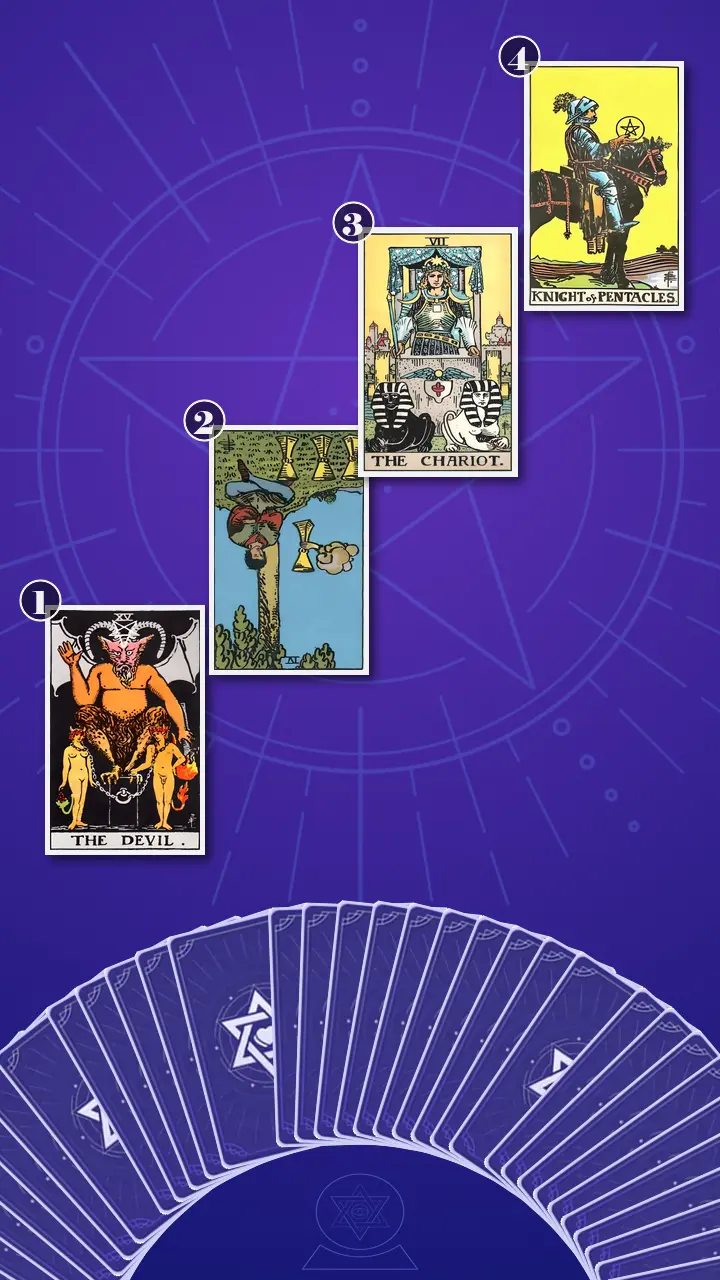
I turned the first card for the current loop: the concrete behavior in which Jordan accepted or extended nights out, received immediate social reward, and postponed a step toward the life she wanted. The card was The Devil, in upright position.
In the Rider-Waite-Smith image, the two figures wear loose chains, and the Devil holds a torch low beside them. I read the upright energy here as excess: the immediate reward was receiving more attention than the longer direction. The chain was not literal captivity, and the card was not condemning bars, friends, alcohol, or pleasure. It was showing how a familiar reward could become an automatic answer to uncertainty.
The image took me straight back to 6:10 on Friday. Jordan’s career document was open. The phone vibrated beside the trackpad. Her body lifted toward the invitation before she had asked what the night would cost in time or energy. One quick round became a later exit, then a lost Saturday morning. The group’s momentum chose the end of the night because she had not chosen one first.
I asked her to listen for the private sequence behind the action. I deserve a break. It’ll only be one. Monday-me can handle the rest. The first thought protected her from a long week. The second made the choice feel harmless. The third moved the cost into an imaginary future where she would somehow have more certainty and energy.
Jordan gave a short, bitter laugh instead of nodding. That is accurate, she said. Almost rude. I watched her reach for her water, miss the glass by an inch, and then fold both hands around it. I told her that recognition was not a character judgment. The Devil was naming an autopilot pattern, not turning her social life into a moral problem. Going out is not the problem; letting the invitation make every decision is.
When I asked what the invitation helped her avoid feeling, she looked toward the window. The answer came more quietly: If I stay home, I have to admit I still don’t know what I want. The card had made the bargain visible without asking her to shame herself for taking the relief it offered.
Position 2: When the Third Cup Stops Working
I turned the second card for the hidden influence: the emotional payoff and party-scene fatigue beneath the behavior, including the way immediate stimulation masked the discomfort of direction stagnation. The card was the Four of Cups, in reversed position.
The seated figure in the image has crossed arms beneath a tree. Three cups sit in front of the figure while a fourth is offered from a cloud. Reversed, this card carries a thaw: attention begins returning to what has been overlooked. The energy is not a demand to reject every invitation. It is a blockage loosening enough for dissatisfaction to become information instead of something that has to be covered with another event.
I placed the card beside the picture of Jordan at 11:26 on Saturday morning. I could almost hear the shared kitchen from her description: flat sparkling water against a glass, a roommate’s coffee grinder cutting through pale winter light, three postponed goals still pinned in her notes app. Before she had fully dressed, another event link arrived. Her first impulse was to tap it. Her second was to notice that the next plan might not be the thing she was actually missing.
The three visible cups became the busy weekends she had already consumed. They had given her real connection and real pleasure, but not the complete answer. The offered cup was quieter: direction, self-respect, a chance to feel engaged with her own life. In the reversed position, the card showed that she could finally see the difference between stimulation and satisfaction.
I offered Jordan a small One-Need Invitation Check. Before replying to the next plan, she could write one sentence beginning with What I am actually hoping to feel is... and then name the need without correcting it. It might be connection, novelty, relief, visibility, escape from quiet, or curiosity. Naming the need would not force a different decision. It would put the decision back in her hands.
I watched her breathe out, look away from the card, and let her thumb hover above the new event link. Then she said, I still want to go, but I also know what I’m hoping it will fix. Her shoulders did not become perfectly relaxed. Her eyes stayed tired. Still, the next event had stopped looking like a complete solution. I told her that FOMO can be real without being in charge.
When The Chariot Reclaimed the First Block
Position 3: Two Sphinxes, One Chosen Direction
The room changed when I reached for the third card. The radiator clicked once, and a streetcar bell sounded somewhere beyond the blue window. I turned the card for the transformative pivot: the self-directed shift that could interrupt the automatic reward loop without requiring Jordan to abandon social connection or decide her entire future at once. The card was The Chariot, in upright position.
The black and white sphinxes faced different directions beneath the charioteer’s starry canopy. No visible reins held them in place. I read the upright energy as balance through direction: competing drives did not need to become identical before Jordan could choose where her attention went next. Social desire, FOMO, uncertainty, ambition, and the wish for a more intentional life could all be present. The missing piece was not another burst of motivation. It was a conscious boundary around the next block of time.
I gave her a concrete Saturday split-screen. On one side was the dinner invitation and the pleasure of seeing friends. On the other was a 25-minute career experiment completed before getting ready. She could compare two creative-role course outlines, draft five portfolio bullets, or write three questions for someone in a role she was considering. The block would not prove that she had chosen the right future. It would simply let one direction receive attention before the invitation received an answer.
This is where I used my signature method, Spatial Boundary Scenting. After fifteen years as a perfumer, I have learned to notice when two atmospheres overlap until the body can no longer tell which room it is in. Jordan’s work atmosphere, social atmosphere, comparison atmosphere, and recovery atmosphere were bleeding into one another. The phone buzzed at the career document. Instagram Stories followed her into quiet time. The group’s energy set the pace of her evening, and the next morning’s exhaustion contaminated the space where she might have explored her future.
My mind went briefly to a perfume studio where too many notes have been added to a blend. The problem is not that any single note is wrong. The problem is that nothing has enough room to be recognized. I used that image carefully. I was not asking Jordan to become guarded or to build a wall around friendship. I was helping her give each atmosphere a clear edge so that social pleasure could remain social pleasure and direction could become something she could actually hear.
At 6:10 on Friday, the career document is open when the group chat starts buzzing. You promise yourself one quick round, close the laptop, and feel that familiar double hit: instant relief, then the quiet drop of regret. The question is no longer whether you love your friends; it is who gets to assign your next hour.
“You do not need a perfect route before you move. Direction starts when one small piece of your time answers to your choice, not the loudest invitation.”
I let the sentence settle, then returned to the image on the table.
“You do not need to find the perfect route before moving; let The Chariot's black and white sphinxes represent competing pulls held under conscious direction, one deliberate block at a time.”
Jordan did not nod. First, her fingers froze above the phone and her breath stopped halfway; the invitation thread remained open, blue light across her knuckles. Then her gaze lost focus, moving past me to the Friday laptop, the words Next Chapter, and the promise of one quick round. Her jaw tightened and she said, But if I can choose one block, doesn’t that mean I’ve been making excuses? There was heat in the question, not failure, and I let it stand. A few seconds later her fist loosened. Her shoulders dropped so abruptly that she looked almost unbalanced, and a long breath left her chest with a small tremor. Her eyes shone, not with a magical answer but with the shock of seeing responsibility in a size she could actually hold. For a moment she looked blank, lightly dizzy, as if the room had lost its old instructions. Then she whispered, I can want the night and still choose what gets the first block. The radiator clicked again; the silence no longer felt like punishment.
I asked her, Now, use this new perspective to think back to last week. Was there a moment when this insight could have made you feel different? She returned to the Friday notification, but this time she imagined keeping the laptop open for one small block before replying. The image did not cancel the night. It changed who entered it with a choice already made.
This was the emotional pivot from restless dissatisfaction, guilt, and FOMO-driven autopilot toward steadier self-trust and deliberate direction that could coexist with social pleasure. The Chariot did not promise certainty. It offered a first act of authorship. FOMO could sit in the passenger seat without holding the map.
The Small Furrows That Make Direction Visible
Position 4: The Quiet Work of the Knight of Pentacles
I turned the fourth card for the grounded experiment: the practical next step Jordan could try within a week to build evidence and self-trust through behavior. The card was the Knight of Pentacles, in upright position.
The dark horse stands still in a cultivated field. The Knight holds the pentacle at chest level, and parallel furrows cut into the earth. I read the upright energy as steady balance: progress that does not need to look dramatic to be real. The card answered the temptation to make an ambitious Monday reset. It asked for a repeatable action that could survive an ordinary week.
I pictured the Toronto Public Library scene Jordan described: a quiet branch at 8:30 p.m., one open browser tab, a 25-minute timer, and her phone face-down beside it. She could compare two course pages and write three questions in her career document. When the timer ended, she could record one sentence about what felt more interesting, less interesting, or still unclear. That sentence would be evidence. It would not be a final answer.
The stationary horse mattered. If Jordan demanded visible transformation every time she sat down, the first small block would feel worthless before it began. The furrows suggested a different measure: return, attention, and contact with real work. Direction is evidence you collect, not a personality trait you either have or lack.
I watched Jordan open her calendar and imagine the same library table next week. Her mouth tightened at the thought of repeating something so modest, then softened. This looks too small to count, she said, but it is small enough that I might actually return to it. I told her that was the Knight’s strength. A dramatic plan can restore control for an evening. Ordinary follow-through can teach the nervous system that a choice is safe to repeat.
A Boundary Before the Next Invitation
I gathered the cards into a single story. The Devil showed the bright bargain: uncertainty or boredom arrived, the invitation offered instant belonging and relief, and the night became the easiest available movement. The reversed Four of Cups showed what the bargain could no longer fully cover: the flat Saturday morning, the three postponed goals, and the quieter longing to feel engaged with her own life. The Chariot supplied the bridge by holding both pulls under one deliberate direction. The Knight of Pentacles gave that direction a body: one desk, one timer, one task, one return.
I told Jordan that the deeper loop resembled a stalled car circling the same bright block because movement felt better than admitting there was no destination yet. The car was not broken, and the city lights were not the enemy. But circling made it harder to discover which road she wanted to test.
The cognitive blind spot was waiting for a complete map before allowing a small experiment to count. Jordan had treated a career choice as a permanent verdict, so every uncertain task felt dangerously measurable. She had also mistaken social visibility for constant availability, as though leaving early or protecting one hour would make her disappear from the group. The shift was smaller and more useful: let one scheduled life-building action happen before deciding whether and how to socialize.
I also ran a brief Sensory Overload Audit with her. I named the phone vibration, Instagram Stories, the crowded bar, the open-ended second venue, the TTC countdown, the bright Monday office, and the LinkedIn promotion post waiting in the morning. None of these cues was a personal failure. Together, they quietly depleted the focus and psychological bandwidth she needed to make a deliberate choice. Clearer boundaries could reduce the noise without reducing her life.
The Four-Layer Insight Ladder in Real Life
I wrote the next steps in plain language. They were not promises to become a different person, cancel every plan, or turn the weekend into a productivity contest. They were small experiments designed to let Jordan observe what happened when her choice received the first block.
- The Direction-Before-Decision BlockBefore the next likely Friday invitation window, I asked Jordan to put one 20- to 25-minute event in Google Calendar titled Direction test: one next step. At the start, she would switch her phone to Do Not Disturb, open only one relevant document or browser tab, and choose one bounded task such as comparing two course outlines, drafting five portfolio bullets, or writing three questions for someone in a role she was considering. When the timer ended, she would write one sentence beginning with This made me more curious about, less curious about, or still unsure about.If the full block feels too exposed, use the Five-Minute Chariot Test. Five minutes is a valid beginning, and stopping after five minutes is not a failed attempt.
- The Physical Boundary ProtocolWithin 72 hours, I asked Jordan to use one dedicated pair of headphones only during that direction block at her chosen library table or desk. The headphones would be her sensory trigger for high-pressure output mode; the phone would stay in her bag, and the single document would remain the only open task. When the timer ended, she would remove the headphones, close the document, leave the table, and let the cue end. That created an absolute physical partition between focused output and deep recovery, so one atmosphere could stop spilling into the other.The boundary is a support, not a punishment. Keep it to one block, then go to dinner, answer the group chat, rest, or do nothing without treating recovery as something that must be earned.
- FOMO with a Finish Time and Weekly EvidenceFor one social plan this week, Jordan would choose an arrival window and a realistic leaving window before getting dressed, then send a simple message such as I’m in for dinner and heading off around 11:30. Before replying, she could complete the One-Need Invitation Check by writing What I’m actually hoping to feel is... She would arrange an independent TTC, walking, taxi, or rideshare route home and keep a four-line note titled Weekly Direction Evidence with the date, action, energy before, and what she learned.Repeat the same 20- to 25-minute experiment next week instead of expanding it into a dramatic reset. If the boundary feels awkward, shorten only one night by thirty minutes. FOMO can be present without being the person in charge.
I reminded Jordan that these actions were not a test of whether she deserved a future. They were ways to gather information. The point was not to make social pleasure compete with ambition forever. It was to stop letting an incoming notification function as her calendar administrator.
The First Furrow, Not the Finished Road
Three days later, I received a message from Jordan while I was cleaning perfume strips in my studio. I did 25 minutes before dinner, she wrote. I compared the two course outlines and realized I’m more curious about the creative strategy one. I still went out. The night was fun. I just didn’t ask it to decide my future.
At 8:42 p.m. that Wednesday, I imagined her at a Toronto Public Library branch with the ventilation humming and a printer clicking somewhere behind her. Her phone sat face-down beside the timer. Her jaw released as she wrote three questions, although restless energy still moved through her hands and the dinner invitation remained unanswered for a little while.
She had done the block and still had no final answer. She sat alone at the library before meeting friends, glad for the quiet but briefly unsure whether a direction this small could carry her. The uncertainty remained; it no longer ran the calendar.
I told Jordan that the cards had not chosen for her. They had made a sequence visible: automatic reward, honest recognition, conscious direction, and patient practice. The first evidence of her emotional transformation was not a solved career or a perfect weekend. It was a choice she could repeat, followed by enough self-trust to make another one.
That is where finding clarity often begins: not with a complete route, but with one piece of time answering to the person living the life. A small block kept on purpose can tell you more than another dramatic Monday reset.
When the group chat lights up, that lift in your shoulders and drop in your stomach can hold both truths at once: you want to feel included tonight, and you are scared that choosing your own direction might expose how little control you have over what happens next.
If one small block of time could belong to your direction before you answer the next invitation, what would you be curious to try inside it: a five-minute Chariot test, one unanswered career question, or the first small furrow in your own field?