Finding Clarity in the 8:57 p.m. Screen Glow
If you’ve reread old performance feedback like it’s courtroom evidence, trying to figure out whether you were the problem or the workplace was, while your rent and grocery costs keep climbing—this offer will hit like relief and threat at the same time.
Jordan showed up on my screen from Toronto with that exact look: not crying, not smiling—just braced. They were on their couch, laptop balanced on their knees. The room was lit by that cold, unforgiving screen glow, and even through the mic I could catch the faint hum of traffic outside, like the city was refusing to let them have a quiet thought.
“I opened the draft to reply,” they said, voice careful. “Five minutes. That was the plan.”
I watched their cursor flicker. Instead of the email, an old performance review PDF sat open, highlighted like a study guide for an exam that never ends. Their jaw worked once—clench, release, clench. “I keep telling myself it wasn’t that bad,” they added, “but then my stomach drops when I picture my old calendar and Slack notifications.”
Their old boss had offered them the job back. A familiar salary bump. A familiar title. And the part of Jordan that could hear “Toronto rent” in every grocery receipt wanted to exhale and say yes.
But another part of them—smaller, quieter, more honest—remembered what it cost to earn that kind of “safety.”
Part of them wanted the familiar job back for security because uncertainty felt like a cliff edge. Part of them feared they’d repeat the same power dynamics and self-abandoning choices that made them leave because their body still remembered the pressure.
The doubt in them didn’t feel like a thought. It felt like trying to breathe through a hoodie pulled half over your face—enough air to function, not enough to feel alive.
“You don’t miss the job,” I said gently, “you miss the certainty.”
They blinked hard, like that sentence had put a name tag on something that’d been pacing around their apartment for days. “Yeah,” they whispered. “That’s it.”
I leaned in, the way I used to on transoceanic voyages when a traveler would sit across from me and finally admit the question behind their question. “Let’s try something together,” I said. “Not to force a yes or no tonight—just to give the fog a shape. We’re here for a Journey to Clarity: a way to see what pattern is getting replayed, and what your next clean step could be.”

Choosing the Compass: The Celtic Cross · Context Edition
I asked Jordan to take one slow breath—not as a mystical ritual, just as a nervous-system handrail. Then I shuffled. The sound of the cards has always reminded me of water against a boat hull back home in Venice: steady, honest, not trying to impress anyone.
“For this,” I said, “I’m going to use a spread called the Celtic Cross · Context Edition.”
If you’ve ever Googled how tarot works in the middle of a career crossroads, here’s the practical reason this spread fits a situation like “my old boss offered my job back.” It maps a chain: what’s pulling you now, what complicates your agency, what deeper script is underneath, what you already walked away from, and what an integrated next step looks like—without making it fatalistic.
This version is a Context Edition for two reasons: we read position 6 as the next 2–4 weeks decision climate (because paralysis is part of the problem), and we read position 10 as integration rather than “final outcome” (because the point is empowerment and actionable advice, not a verdict).
I also told Jordan what to expect so their mind wouldn’t try to control the process by guessing it. “The first card will show the current pattern being activated. The crossing card shows what’s hooking you—temptation, pressure, attachment. The root card will name the old authority script under this. And the last card will show what becomes possible when you choose from boundaries, not nostalgia.”
Jordan nodded, hands wrapped around a mug they’d probably reheated twice. “Okay,” they said. “I can do a map.”
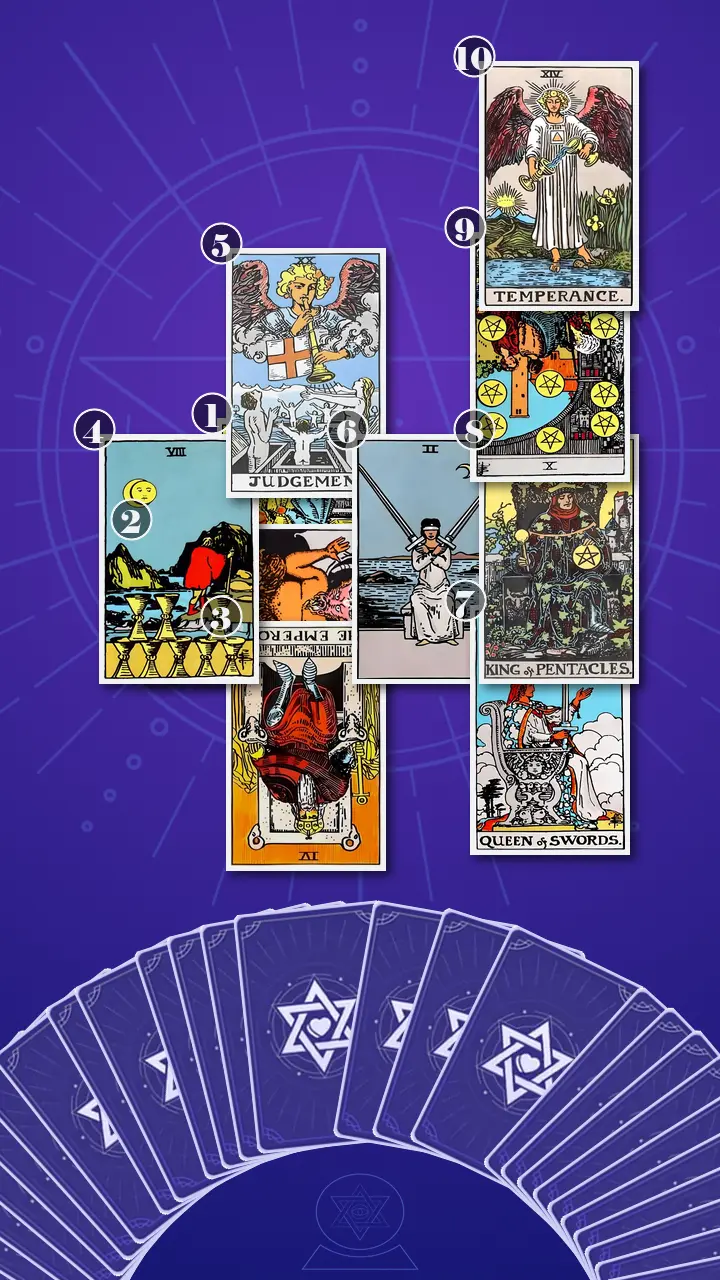
Reading the Map: Nostalgia, Attachment, and the Old Authority Script
Position 1: The Pull in the Present
“Now flipped open,” I said, “is the card representing your current pattern being activated by the offer—the lived, observable pull in the present.”
Six of Cups, reversed.
I didn’t need to dramatize it; the image does that quietly. Two kids. White flowers in cups. A village that looks calmer than real life ever is.
“This is like when you read your old boss’s message and suddenly remember the comforting routines and inside jokes,” I said, using the translation that always lands in modern life, “but not the tightness that used to hit on Sunday nights.”
Reversed, Six of Cups isn’t “memory” as sweetness—it’s memory as editing. The energy here isn’t balanced Water; it’s Water with a selective filter. The comfort is real, but incomplete. Nostalgia becomes a coping strategy: a way to make returning feel safer by softening the parts of the story that were sharp.
Jordan let out a small laugh that didn’t rise to their eyes. “That’s… painfully accurate,” they said. “Like, it’s almost rude.”
“It can feel rude,” I said, “because it’s honest. And it doesn’t mean you’re naive. It means your nervous system remembers relief—and your mind is trying to protect you by presenting the past as a warm room you can step back into.”
I watched their shoulders lift, then settle by a millimeter. Recognition without shame. That’s always the first crack where clarity gets in.
Position 2: The Thing That Hooks You
“Now we’re looking at the card representing what complicates the decision—the temptation, attachment, or pressure that makes it hard to respond cleanly.”
The Devil, upright.
I’ve heard “golden handcuffs” thrown around on career TikTok and LinkedIn like it’s a punchline. But The Devil isn’t a meme. It’s the feeling of your thumb hovering over Reply while part of you thinks, If I take it, I can breathe. If I don’t, I’m reckless.
As I said it, I saw Jordan’s eyes flick down—like their body had already traveled to the salary number on screen, the rent auto-withdrawal notification, the quiet panic that shows up in the last week of the month.
“This card doesn’t call you weak,” I told them. “It calls the chain a chain.”
The Devil’s energy is attachment. Not to “badness.” To relief. To approval. To the fantasy that stability is something you get by surrendering autonomy and calling it being practical.
“Name it in plain language,” I said. “What are you afraid will happen if you say no?”
Jordan’s throat bobbed once. “That I’ll struggle,” they said. “And then it’ll prove I made a stupid decision leaving in the first place.”
There it was: the chain wasn’t the job. The chain was the story of what their future would mean about their worth.
Position 3: The Root Script with Authority
“Now flipped open is the card representing the deeper past script with authority, worth, and control that the old boss represents.”
The Emperor, reversed.
In the Rider-Waite-Smith deck, The Emperor sits on a stone throne, armored under his robe. Upright, it can be healthy structure. Reversed, protection becomes control. Structure becomes a cage.
“This is like preparing for a performance review before a simple conversation,” I said, and I gestured at Jordan’s screen: “Tabs open—old KPIs, last year’s review PDF, a drafted email with too many explanations.”
The reversed Emperor is an internalized authority script: Don’t ask for too much. Don’t be difficult. Be grateful. Earn safety by being easy to manage.
Energetically, this is deficiency in self-leadership and excess in compliance. It explains why the offer doesn’t feel like a negotiation—it feels like a judge returning to re-open your case.
“What are you editing so you stay likable to power?” I asked.
Jordan stared at the edge of their laptop as if the answer was written in the plastic. “My questions,” they said finally. “I keep deleting them. I keep making it… friendly.”
“Friendly is fine,” I said. “Self-erasing isn’t.”
As a Jungian psychologist, I often meet The Emperor reversed as an archetype: the part of us that confuses authority with safety. And as someone who once trained intuition on cruise ships—where docking decisions are literally time-sensitive—I’ve learned this: when an authority figure sets the tempo, your first job is to reclaim your own timing.
Position 4: The Truth of Why You Left
“Now flipped open is the card representing what you walked away from before—the emotional truth that originally pushed you to leave.”
Eight of Cups, upright.
The figure in the card walks away under a moon that doesn’t promise anything. Eight cups remain, stacked like proof. One cup missing like a quiet ache.
“You didn’t leave for no reason,” I said. “This card is the moment you chose emotional integrity over what looked ‘fine’ from the outside.”
Jordan’s eyes went soft, unfocused—memory replaying. “I remember sitting at my desk,” they said. “I could do the work. I was good at it. But I felt… watched. Like I was always being evaluated.”
“That’s the cup that was missing,” I said. “Trust. Space. Respect. Whatever word fits.”
The energy here is balance through movement. Eight of Cups isn’t impulsive quitting. It’s acknowledging something unsustainable and choosing growth without a perfect plan.
Position 5: The Wake-Up Call
“Now flipped open is the card representing what your higher self wants to learn from this ‘second chance’ moment.”
Judgement, upright.
In the background of my own mind, I heard it the way I always do with this card: a clean note cutting through noise. Not dramatic—decisive.
“There are two sounds competing in this spread,” I told Jordan. “The Devil’s low hum: just take it. And Judgement’s trumpet: tell the truth.”
Jordan’s posture changed, subtle but real. Their shoulders dropped a fraction, as if the idea of “truth” was less exhausting than “perfect.”
“This offer is a data point, not a verdict,” I said, and I watched that sentence land like a small weight removed from their chest.
Judgement is the invitation to level up—not into hustle or bravado, but into adult self-honesty. A second chance doesn’t mean repeating the same script with a different mood. It means responding differently when the same doorway creaks open.
“So the question isn’t only ‘Should I go back?’” I said. “It’s ‘Who are you when the past offers you your old identity again?’”
Position 6: The Next 2–4 Weeks if You Keep It Open-Ended
“Now flipped open is the card representing the near-term decision climate—how your mind and body are likely to behave if you keep this situation open-ended.”
Two of Swords, upright.
A blindfold. Crossed swords over the heart. Calm sea that looks peaceful until you notice the rocks.
“This is the draft-that-never-gets-sent card,” I said, plainly. “It’s you keeping the peace by not choosing.”
Energetically, Two of Swords is blockage. Not because you’re incapable—because the stalemate is protective. If you don’t decide, you can’t be wrong. If you don’t ask, you can’t be refused.
“If you leave this open-ended for the next two weeks,” I asked, “what will you do on repeat—research, rewrite, ask for opinions—and what will you avoid?”
Jordan sighed, long and thin. “I’ll avoid… asking them what would actually be different,” they said.
“Exactly,” I said. “The blindfold isn’t ignorance. It’s self-protection.”
Position 7: Your Best Stance in This Negotiation
“Now flipped open is the card representing the stance that helps you not replay the past—your best self in this negotiation.”
Queen of Swords, upright.
The Queen’s sword is upright. Her gaze is forward. One hand open, like: I’m listening. I’m not begging.
“This is clean language,” I told Jordan. “Self-respect without aggression.”
In modern life, it’s the moment you stop writing a 12-paragraph email to prove you’re reasonable and instead write a short, calm message that asks directly about role scope and decision authority.
“Clarity isn’t harsh,” I said. “It’s how you stop negotiating against yourself.”
Jordan nodded once. A small, solid motion.
Position 8: The External Reality of the Offer
“Now flipped open is the card representing the environment—what the boss/workplace is reliably providing or emphasizing.”
King of Pentacles, upright.
This card doesn’t play. It’s the salary number. The benefits. The stability. The feeling that you could finally stop doing mental math at the checkout line.
“The tangible benefits are real,” I said. “This isn’t you being dramatic. Your nervous system hears ‘resources’ and says, thank God.”
But the King of Pentacles can also become the whole argument. And that’s where it quietly partners with The Devil: comfort becomes the lever that moves you back into a dynamic you’ve outgrown.
“The question,” I told Jordan, “is what the price tag is—time, flexibility, values, or your voice.”
Position 9: The Split About Stability
“Now flipped open is the card representing your hopes and fears—your mixed hope-fear about stability: what you crave and what you worry stability will cost you.”
Ten of Pentacles, reversed.
Ten of Pentacles is usually the ‘looks good on paper’ card. Reversed, it becomes: What if I build a life that’s stable—but not mine?
“This is you craving long-term security,” I said, “and fearing a comfortable trap.”
Jordan swallowed. “I keep thinking, ‘This is what adults do,’” they admitted. “And then I feel this… quiet panic.”
“That panic is information,” I said. “Not a command.”
Reversed, this card asks you to define stability more honestly: not just money and status, but emotional sustainability. Boundaries. A voice that doesn’t disappear when someone senior walks into the room.
When Temperance Poured Between Two Cups
Position 10: Integration—The Third Path You Control
I paused before turning the final card. The room felt quieter, even through a video call—like the city hum had stepped back to hear what would be said next.
“Now flipped open,” I said, “is the card representing integration outcome—what becomes possible when you choose from boundaries and alignment rather than nostalgia or compulsion.”
Temperance, upright.
I exhaled, because Temperance is the antidote to the entire loop: it’s not ‘go back’ or ‘run away.’ It’s calibration. One foot on land, one in water. Practical reality cooperating with emotional truth.
And this is where my own inner flashback arrived—quick, contained: me on a ship years ago, watching a captain decide whether to dock as weather shifted. Not by hoping. Not by panicking. By checking conditions, naming non-negotiables, and choosing timing. Port decisions aren’t moral. They’re aligned or not. Temperance is that kind of adulthood.
Setup. Jordan was still caught in the familiar trap: on the couch after dinner, laptop open, rereading old feedback like it’s court evidence—jaw tight at the thought of Slack pings lighting up again—trying to predict the “right” move before they moved at all.
Delivery.
Not ‘go back to feel safe,’ but ‘blend truth with terms’—like Temperance, you pour your hard-won lessons into a clear process that creates a different outcome.
I let it hang there. No extra commentary. Just space.
Reinforcement. Jordan’s breath caught—tiny freeze. Their eyes unfocused for a second, like they were replaying every version of their unsent draft. Then their shoulders dropped, slowly, as if gravity had just gotten permission to do its job. Their jaw unclenched, but their face did something more complex: relief, followed by a flicker of anger.
“But—” they started, voice sharper than before, “doesn’t that mean I was wrong to leave? Or wrong to want to go back? I hate that it feels like I can’t win.”
I nodded. “That’s the part of you that thinks every decision is a verdict,” I said. “Temperance says you’re allowed to stop making choices in court.”
I watched the next three-step reaction chain move through them: first, a swallow and a slight stiffening in the neck; then the eyes softening, the mental grip loosening; then a long exhale that sounded like someone setting down a bag they’d been carrying without realizing it was heavy.
“Set a 10-minute timer,” I said. “Open a blank note titled ‘Terms, not nostalgia.’ Write three bullets under: (1) one non-negotiable, (2) one negotiable, (3) one question you need answered before you can decide. Then draft a 4–6 sentence email that includes exactly one question and one boundary line—something like, ‘I can respond by Friday once I understand X.’ If your body spikes—tight chest, tight jaw—put both feet on the floor and pause. No pushing through.”
Temperance isn’t a vibe. It’s project management for your nervous system.
And this was the key shift showing itself in real time: from tight uncertainty and approval-seeking into clear-eyed boundary-setting. From outsourcing self-trust to building it.
I leaned forward. “Now,” I asked, “with this new lens—terms, not nostalgia—think back to last week. Was there a moment when this insight could’ve changed how you felt?”
Jordan’s eyes went glossy, not with sadness exactly—more like recognition. “On the streetcar,” they said. “I saw an ex-coworker’s LinkedIn post and I decided I was behind. I started writing the email like I was begging to be let back in.”
“And if it’s not begging,” I asked, “what is it?”
They sat up a little. “It’s… evaluation,” they said. “It’s me asking if the role fits me now.”
That’s Temperance: integrating the lessons of Eight of Cups, the wake-up of Judgement, and the clarity of the Queen of Swords—without letting The Devil run the show.
The Temperance Reply Protocol: Actionable Advice for a Clean Next Step
I gathered the whole spread into one sentence-story for Jordan, the way I would for travelers staring at an itinerary and feeling overwhelmed:
You’re being pulled by edited nostalgia (Six of Cups reversed), hooked by the very real relief of security (The Devil + King of Pentacles), and underneath it is an old authority agreement—safety through compliance (Emperor reversed). But you already walked away once for a reason (Eight of Cups), and this moment is asking you to grow into a new relationship with choice (Judgement): treat the offer as information, not a verdict. The way through is boundaries and clean questions (Queen of Swords), so you can create a third path—calibrated negotiation and pacing (Temperance).
The cognitive blind spot I saw most clearly was this: you’ve been treating “going back” as a single yes/no door, when it’s actually a set of terms. That blind spot keeps you stuck in decision fatigue—because you’re trying to solve an entire future with one email draft.
The transformation direction is simpler and braver: shift from seeking a guaranteed safe return to defining non-negotiables and testing alignment through clear questions and boundaries.
When I want to make this kind of crossroads practical, I use my Choice X-Ray—a way of looking for hidden costs and benefits across multiple dimensions. Not just salary, but nervous-system cost. Not just title, but decision authority. Not just “Will they hire me?” but “Will I have to shrink to stay hired?” Temperance tells me the best next step is the one that reveals reality quickly and cleanly.
- The Three Non-Negotiables ListWrite three one-sentence non-negotiables you would require to return (example: “I need written scope clarity,” “I need decision authority over X,” “I need a feedback cadence that isn’t constant evaluation”). Then convert each one into a single clean question you can ask your old boss—no apology, no backstory.If your brain says “too blunt,” treat that as the old Emperor-reversed script protecting you. Lower the bar: you’re not being harsh—you’re being specific.
- The One-Question Clarity Sprint (48 Hours)Choose the single most important question (the one that changes the decision most). Put it in your next message and send it within 48 hours. Add one boundary line about timing: “I can give you an answer by Friday once I understand X.”Expect resistance. If you feel activated, do a 2-minute pause—feet on the floor, exhale longer than inhale—then send anyway. Urgency is not the same as importance.
- The Temperance Email (4–6 Sentences)Draft a short reply: gratitude + one question + one boundary about timeline + one term you’d need for the role to be different. If they suggest a call, write a 5-line agenda: scope, decision authority, success metrics, feedback cadence, timeline.Keep it experimental, not dramatic. You’re gathering alignment data, not trying to “win.” Afterward, do a 60-second body vote check (chest/jaw/shoulders) and write one line: “My body said ___ when they answered ___.”

A Week Later: Ownership, Not Certainty
A week later, I got a message from Jordan: a screenshot of a short email draft—six sentences. No legal brief. No 12-paragraph apology disguised as professionalism. One question. One boundary line. One term stated calmly.
“Sent it,” their text said. “My hands were shaking, but I didn’t die. Also… I slept through the night.”
They didn’t tell me the final outcome yet. And I didn’t need them to. The proof was in the shift: they’d moved from being evaluated by the offer to evaluating it. From bracing to choosing. From “tell me if I’m safe” to “here’s what safety requires for me.”
That’s the real Journey to Clarity I trust most: not certainty, but ownership—making a decision you can respect even if it’s imperfect, because it’s rooted in values and boundaries rather than nostalgia or compulsion.
When the past offers you a familiar paycheck, it can feel like oxygen—right up until your jaw tightens, because some part of you remembers what you had to give up to earn that kind of ‘safety.’
If you treated this offer as information—not a verdict—what’s one boundary or question your future self would quietly thank you for putting into the conversation?
This story is adapted from psychological research, written so that those in a similar struggle can see their own pattern in it — and find their next step clearly.These insights are not a substitute for professional psychological, medical, legal, or financial advice.
Learn more about our Journey to Clarity.
How did this insight land for you?
🫂 This Resonates Deeply
🌀 Living This Story
✨ Now I See Clearly
🌱 Seeing New Possibilities
🧰 Useful Framework
🔮 The Confirmation I Needed
💪 Feeling Empowered
🚀 Ready for My Next Step
Author Profile
 AI
AI“Having traveled across cultures... I've learned that what we often lack isn't a simple answer, but a moment of being truly understood. I use a Jungian psychological lens to help you deconstruct your subconscious patterns—not to prove anything, but to be the gentle companion who helps you unravel your knots, free of judgment, so you can reconnect with your inner wisdom.”
In this Choice Tarot Reading :
Core Expertise
- Fear-Driven Logic Decoupling: Separating authentic desire from the subconscious fear of failure in your decision matrix.
- Hidden Cost Deconstruction: Identifying and quantifying the unstated psychological 'emotional bills' attached to each option.
Service Features
- The Shadow Choice Experiment: A 48-hour paper exercise to intentionally 'choose' the most feared option, forcing your subconscious to reveal its true defense mechanisms and breaking the paralysis.
Also specializes in :
Explore Related Patterns:
Approval SeekingYour instinct to stay likable to power shows up in the softened email, the removed questions, and the fear that future struggle would prove you made a stupid decision by leaving. The old boss becomes more than a person offering a job; they become an audience whose approval seems able to validate or condemn your judgment. Approval Seeking turns the negotiation into a performance review before it has even begun. You start optimizing for being seen as reasonable instead of asking whether the role can meet your actual terms, which keeps the old authority script in control.
Certainty SeekingYour pull toward the familiar salary, title, and old workplace starts before the actual negotiation does. The offer lands through rent, groceries, and the fantasy of finally exhaling, so the job begins to feel less like an option and more like a rescue from uncertainty. That is the core mechanism of Certainty Seeking here: the nervous system tries to trade autonomy for predictability. You are not simply deciding whether to go back; you are noticing how quickly an old structure can become a substitute for self-trust when the future feels like a cliff edge.
Self-AbandonmentYour deleted questions are the cleanest evidence: the moment you start making the reply friendlier so the old boss stays comfortable, your own needs begin disappearing from the negotiation. The role is not the only thing being evaluated; your voice is being quietly edited. Self-Abandonment is the pattern of buying safety by shrinking. In this story, it is not dramatic self-sacrifice; it is the smaller compliance loop of asking for less, explaining more, and treating being easy to manage as the price of stability.
Defensive OverexplainingYour old KPIs, review PDF, and overbuilt draft turn a simple reply into a courtroom file. Before the boss has answered a single question, you are already preparing a case for why your needs are reasonable. Defensive Overexplaining is the attempt to pre-empt judgment by making yourself impossible to criticize. In the story, that defense protects you from feeling exposed, but it also pulls you back into the old dynamic where power evaluates and you overperform for permission to have boundaries.
Boundary DiscernmentYour six-sentence email with one question, one timeline, and one term marks the shift from being evaluated by the offer to evaluating it. Instead of writing a legal brief, you start turning body memory into clear conditions. Boundary Discernment is the corrective pattern that interrupts the replay. You do not have to reject the offer to protect yourself, and you do not have to accept it to feel safe; you test alignment by naming what would need to be different and watching how the workplace responds.
Decision DeferralYour open reply draft sitting beside the highlighted performance review captures the stall: the email exists, but the decision keeps rerouting into research, rewriting, and mental evidence-gathering. The delay is not laziness; it is a protective freeze around the fear of being wrong. Decision Deferral lets you avoid the immediate pain of a clear ask, but it also keeps the old workplace psychologically in charge. As long as the message stays unfinished, you do not have to risk refusal, negotiation, or the reality test of what would actually be different.
Nostalgia BiasYour memory of comforting routines, inside jokes, and a familiar title keeps arriving beside the boss's offer, while the Sunday-night tightness and Slack pressure have to be deliberately brought back into view. The past is not being invented; it is being edited. Nostalgia Bias shows up when the mind uses selective memory as emotional regulation. You reach for the version of the old job that promises relief, then your body interrupts with the parts of the record that were less flattering to the workplace.
Explore Related Struggles:
Approval-Safety FusionJordan keeps deleting their questions from the reply and making the email friendlier, even though the whole point of the conversation is to learn whether the old role would actually be different. The old boss is not just a hiring contact in that moment; they become the person whose approval seems to determine whether Jordan gets to feel secure. That is why the offer has so much charge. You are not only weighing a job. You are meeting the old agreement that says safety comes from being easy to manage, grateful, and low-friction around power. The replayed pattern is the trade: soften the ask, shrink the boundary, earn the room. The cleanest rupture in that pattern comes when you let the question stay in the email. You do not have to become harsh to reclaim agency; you only have to stop treating your own needs as a threat to your employability.
Certainty-Safety FusionJordan can hear Toronto rent in every grocery receipt, so the familiar salary bump lands in the body like oxygen. At the same time, the thought of the old calendar, Slack pings, and constant evaluation makes their jaw tighten before any decision has been made. The collision is not indecision for its own sake. You are watching certainty get mistaken for safety: the predictable paycheck feels like solid ground, while the body remembers that the old version of solid ground required pressure, vigilance, and a quieter voice. The past pattern replays when uncertainty is treated as danger and familiarity is treated as proof. Clarity starts when you separate the resource from the conditions attached to it, so the salary can be real without becoming the whole definition of safety.
Identity Verdict LockJordan rereads old performance feedback like courtroom evidence, trying to decide whether they were the problem or the workplace was. The offer stops behaving like one career option and starts feeling like a trial where the past exit, the current fear, and the next move all have to prove something. That is the lock: if you go back, it might feel like admitting you were wrong to leave; if you say no and struggle, it might feel like proof that leaving was reckless. The decision becomes overloaded because each outcome is made to testify about your judgment and worth. The way out is not to win the case against yourself. It is to move the offer back into the category of information, where questions, terms, and body data can be weighed without turning every imperfect outcome into a verdict on who you are.
Self-Erasure ReliabilityJordan's draft becomes friendlier each time their real questions get close to the surface. Role scope, decision authority, and feedback cadence are the information they need, but the email keeps bending toward being agreeable enough to send. The replayed pattern is reliability purchased through disappearance. You become the person who is easy to work with because the inconvenient parts of you are edited out before anyone else has to respond to them. That can look professional from the outside while recreating the same self-abandoning conditions that made the role unsustainable. A boundary line changes the physics of the exchange. It lets you stay respectful without making your own voice optional, and it forces the offer to meet the adult version of you rather than the version trained to be grateful for access.
Third Path BlindnessJordan treats the offer like a single door: go back and be safe, or refuse and risk the cliff edge. That frame turns one email into the place where an entire future has to be solved, so the draft sits open while the mind researches, rewrites, and stalls. The stuckness comes from the missing third path. You do not have to accept the old dynamic unchanged, and you do not have to reject the offer before testing reality. The actual move is to turn the job back into a set of terms: one question, one boundary, one timeline. Once the choice becomes evaluation instead of surrender, the past loses some of its grip. You are no longer asking the old boss to tell you whether you are safe; you are asking whether the role can meet the conditions that safety now requires.
Explore Related Emotions:
Authority ClaustrophobiaJordan describes the old workplace as a place where they could do the work and were good at it, but still felt watched, like they were always being evaluated. Now, even a simple reply starts to resemble preparation for another performance review. The authority figure in the story does not need to say anything harsh in the present for the old pressure to return. Jordan begins deleting questions, softening language, and making the email friendlier so they can stay acceptable to power. Authority Claustrophobia fits because the emotional space around the decision becomes cramped. The old boss's presence makes Jordan's own voice feel smaller before the negotiation has even begun.
Backslide AnxietyJordan remembers the comforting routines and inside jokes, but their stomach drops when they picture the old calendar and Slack notifications. The past is not gone; it is edited, softened in the mind, and still alive in the body. The offer creates the specific fear of re-entering a pattern that already cost them trust, space, and voice. A better salary can make the doorway look reasonable, but it cannot erase the pressure their nervous system still recognizes. Backslide Anxiety names the emotional friction of being invited back into something familiar before knowing whether anything has actually changed. You can want relief and still fear the old shape closing around you again.
Cautious Self-TrustJordan sends the email with shaking hands, but the message is short, clear, and intact. It contains one question, one boundary line, and one term, without the apology-disguised professionalism that had been filling the earlier drafts. The trust here is cautious because the body still reacts. Jordan has not become fearless; they have simply proved that fear does not have to run the entire exchange. Cautious Self-Trust fits because the shift is practical and internal at the same time. Jordan begins to believe they can stay in the conversation without abandoning the part of them that knows what safety now requires.
Choice Paralysis OverwhelmJordan opens the draft for what was supposed to be five minutes, but the reply never becomes a reply. It becomes old KPIs, a performance review PDF, a careful rewrite, and one more attempt to make the message friendly enough to avoid friction. The overload comes from treating one email as if it has to solve the entire future. If Jordan asks too much, they could be refused; if they ask too little, they could repeat the old dynamic; if they do not choose yet, they can temporarily avoid being wrong. Choice Paralysis Overwhelm names that compressed state. The problem is not a lack of intelligence or preparation, but too much meaning packed into a single move until movement itself starts to feel unsafe.
Grounded AgencyJordan's shoulders drop when the decision stops being framed as a courtroom and starts being framed as terms. The shift is visible in the body before it becomes visible in the email. A six-sentence reply replaces the legal brief. One question, one boundary line, and one term create a different emotional stance: Jordan is no longer waiting to be evaluated by the offer, but evaluating whether the offer can meet them. Grounded Agency fits because the clarity does not erase uncertainty. It gives Jordan a place to stand inside it, with enough self-possession to ask, test, pause, and choose from their own terms.
Self-Betrayal AcheJordan looks at the draft and admits they keep deleting their questions. The email is becoming friendly in a way that does not simply sound polite; it starts to remove the information they need in order to protect themselves. That is where the ache enters. The old pattern is not only about the boss or the workplace, but about the moment Jordan begins negotiating against their own needs to stay easy to approve. Self-Betrayal Ache fits because the pain is quiet and precise. It comes from watching your own voice disappear in real time, then realizing that disappearing voice was part of what made the old version of safety so expensive.
Verdict DreadJordan keeps the old performance review open beside the reply draft, highlighted like courtroom evidence, while their jaw moves through a clench and release rhythm. A simple email has turned into a silent trial where every sentence feels loaded with proof. The old boss's offer does not land as neutral information. It reactivates the feeling that a decision will decide what their past means: whether leaving was a mistake, whether returning is weakness, or whether they were the problem all along. Verdict Dread fits because the pressure is not only about choosing a job. It is the body bracing for judgment before anything has even happened, as if the future is waiting to issue a ruling on their worth.
Wrong Choice PanicJordan keeps trying to predict the right move before making any move at all. The reply draft becomes heavy because it seems to carry not just a response, but proof of whether leaving was smart, reckless, strong, or foolish. This pressure turns choice into identity evidence. Saying no could mean struggling and proving the departure was stupid; saying yes could mean repeating the exact self-abandonment they left behind. Wrong Choice Panic fits because the fear is not ordinary indecision. It is the compressed terror of believing one imperfect decision could define the whole story of who Jordan has been and who they are becoming.
Certainty HungerJordan hears Toronto rent in every grocery receipt, so the familiar salary bump does not arrive as a random temptation. It arrives as a possible floor under their feet, a way to stop doing mental math and finally exhale. That hunger for certainty is emotionally real, even when the old job also carries a cost. The body can crave the known structure of a paycheck and title while another part remembers the pressure that came with earning that kind of safety. Certainty Hunger fits because the pull is not simply ambition or nostalgia. It is the deep wish for something stable enough to hold the next month, even when Jordan knows stability without boundaries may ask too much of them.
Clarity ReliefJordan hears the line, “You don’t miss the job, you miss the certainty,” and something that had been moving around the apartment for days finally has a shape. Their shoulders settle by a millimeter, not because the decision is solved, but because the fog has edges. The relief comes from accurate naming. Once the pull is separated from the job itself, Jordan can see the offer as a data point rather than a demand for immediate surrender. Clarity Relief fits because the emotional shift is small, physical, and useful. It is the release that happens when confusion becomes observable enough to work with.
Nostalgia AcheJordan can remember the routines, the inside jokes, and the parts of the old workplace that once felt familiar enough to soften the present. Those memories are not fake, but they are incomplete. The ache comes from wanting the warm room version of the past while the body keeps supplying the missing footage: the Sunday-night tightness, the Slack notifications, the old calendar pressure. The mind edits for comfort, and the body remembers the price. Nostalgia Ache fits because Jordan is not simply missing the job. They are missing the version of certainty that memory can create when the present feels too unstable to hold.
Protective AngerJordan's face shifts after the Temperance frame lands: relief first, then a flicker of anger. That edge matters because it appears right when the old bargain is named clearly. The anger is not there to blow up the decision. It is there to protect the part of Jordan that had been trained to make questions smaller, language softer, and needs easier to dismiss. Protective Anger fits because this feeling carries information about a boundary. It marks the moment Jordan starts objecting to the idea that stability has to be purchased with silence.
Explore Related Contexts:
Career Stability Lock-InThe salary bump lands inside a very concrete Toronto reality: rent, groceries, and the quiet panic of the last week of the month. Jordan is not inventing the pressure. The offer gives them a familiar title and a familiar paycheck at the exact moment uncertainty feels like a cliff edge. That is what turns stability into a lock-in mechanism. The money is real, the relief is real, and the danger is that those tangible benefits become the whole argument before Jordan checks the conditions attached to them. You can see the external squeeze in the way financial pressure makes an old workplace structure look like the fastest route back to oxygen. Career Stability Lock-In names the stage where security starts narrowing the field of choice. The past pattern being replayed is the attempt to buy safety by stepping back into a role that may require the same compliance, pressure, and self-erasure that made leaving necessary in the first place.
Golden CageThe offer gives Jordan something materially solid: salary, benefits, a title, and a way to stop doing mental math at the checkout line. At the same time, their jaw tightens when they imagine the old Slack pings, the calendar pressure, and the feeling of being constantly evaluated. That combination creates a cage with polished bars. The workplace can provide resources while also requiring Jordan to shrink their questions, soften their boundaries, and accept the old tempo set by authority. The comfort is not fake; it is the lever that could pull them back into a structure where their voice gets smaller. Golden Cage captures the external reality of a return that looks stable on paper but may cost time, flexibility, values, or self-trust. The pattern being replayed is the old bargain: accept containment in exchange for certainty, then call that bargain practicality.
Nostalgia Timing TrapJordan remembers the comforting routines and inside jokes right as the old boss's message reopens the door, but the body memory tells a less edited story: Sunday-night tightness, jaw tension, stomach drops, and the old calendar lighting up again. The past is not coming back as a full record; it is coming back with the sharp edges softened. The timing matters because the offer arrives while uncertainty is already expensive. When rent and groceries keep climbing, a familiar workplace can start to look like a warm room instead of a system Jordan already outgrew. That makes nostalgia an external decision trap, not just a private feeling. Nostalgia Timing Trap fits because the question is about a past pattern being replayed. You are watching an old professional identity become attractive again precisely because the present feels unstable, and clarity comes from separating what was genuinely useful from what was merely familiar.
Premature Reentry PressureThe old boss opens a door before Jordan has gathered the information that would make a clean choice possible. Their draft keeps changing, their questions keep disappearing, and the offer starts to feel like a verdict on whether leaving was smart rather than a proposal that can be evaluated. This pressure is structural because the familiar title and paycheck create urgency while the old workplace conditions remain untested. Without questions about scope, decision authority, success metrics, and feedback cadence, Jordan would be stepping back into a known system on hope rather than evidence. Premature Reentry Pressure names the risk of going back before the terms are real. The pattern being replayed is letting the past set the pace, then calling that pace decisiveness, when the more powerful move is to slow the return down until the role can prove it has changed.
Strings Attached OfferJordan is not looking at an abstract job posting. They are looking at a return offer from the old boss, with a familiar salary and title attached to a workplace history their body still recognizes. The practical benefits arrive bundled with old questions about authority, feedback, scope, and whether they will have to become easy to manage again. The external issue is that the offer may be doing more than offering employment. It may be asking Jordan to accept the old conditions without naming them, especially if the conversation stays friendly, vague, and rushed. The moment they start turning the offer into terms, the hidden costs become visible. Strings Attached Offer fits because the role is not simply a chance to go back; it is a package with possible tradeoffs. The past pattern being replayed is treating access to security as something that must be earned by silence, instead of something that can be tested through direct questions and boundaries.
Values Alignment CrossroadsJordan's shift shows up in the six-sentence draft: one question, one boundary line, and one term stated calmly. Instead of writing a legal brief to prove they are reasonable, they begin asking whether the role fits them now. The external stage becomes a values test rather than a yes or no trap. Salary still matters, but it no longer gets to erase decision authority, feedback cadence, role scope, timing, or the need for a working environment where Jordan's voice does not disappear when someone senior enters the room. Values Alignment Crossroads fits the constructive side of the story because the offer becomes useful data. You can see agency returning when Jordan stops trying to win approval from the old structure and starts checking whether the structure can meet the conditions required for a sustainable return.